They Fought Together As Brothers In Arms

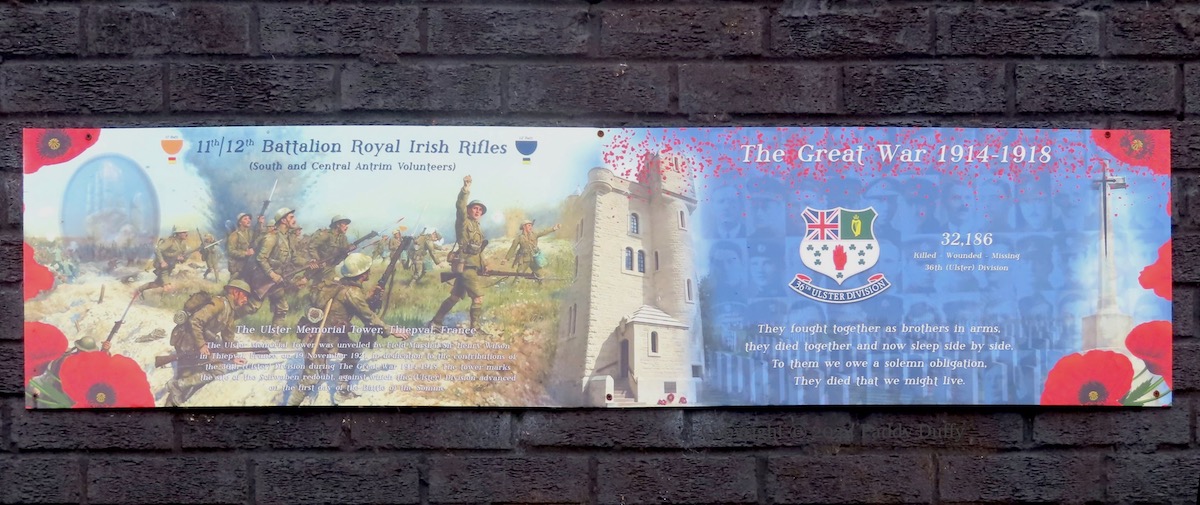
This is a smallish board in New Mossley, Newtownabbey:

On the left: “11th/12th Battalion Royal Irish Rifles (South and Central Antrim Volunteers) – The Ulster Memorial Tower, Thiepval, France. The Ulster Memorial Tower was unveiled by Field Marshall Sir Henry Wilson in Thiepval, France, on 19 November 1921, in dedication to the contributions of the 36th (Ulster) Division during The Great War 1914-1918. The tower marks the site of the Schwaben redoubt, against which the (Ulster) Division advanced on the first day of the Battle of the Somme.”

Specifically, the Central Antrim regiment (of the Ulster Volunteers) became the 12th battalion RIR, while the South Antrim regiment (of the Ulster Volunteers) became the 11th battalion RIR; both joined the 108th brigade in the 36th division.

The redoubt is also the site of the Thiepval Memorial.

JP Beadle’s painting “Battle of the Somme: Attack of the Ulster Division” hangs in Belfast City Hall (Royal Irish has a history of its purchase).

On the right: “The Great War 1914-1918. 32,186 killed, wounded, missing, 36th (Ulster) Division. They fought together as brothers in arms, they died together and now they sleep side by side. To them we owe a solemn obligation. They died that we might live.”

The sword-in-cross is a common war memorial but the one pictured is probably the Tyne Cot memorial to the Commonwealth dead of WWI (see Great War 100 Reads).

See also: The same boards (at larger size) next to the memorial garden – South And Central Antrim Volunteers. And from the historical record, True Heroes – which includes two small, painted, 36th Division boards from the street in 2009.

Ballyearl Drive, Newtownabbey.

Click image to enlarge
Copyright © 2024 Paddy Duffy
T05664

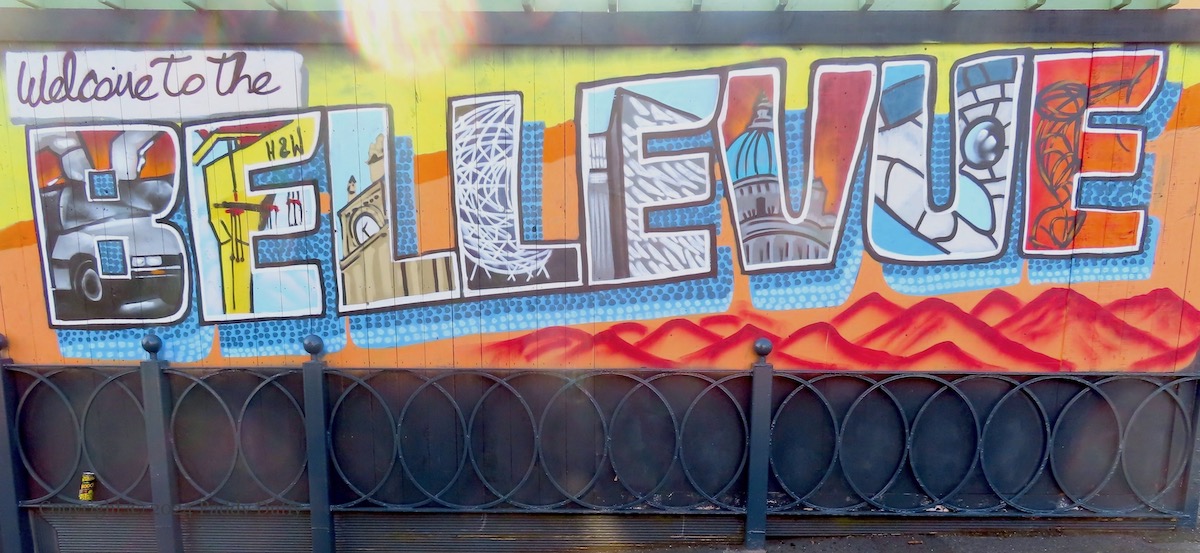
Welcome To the Bellevue

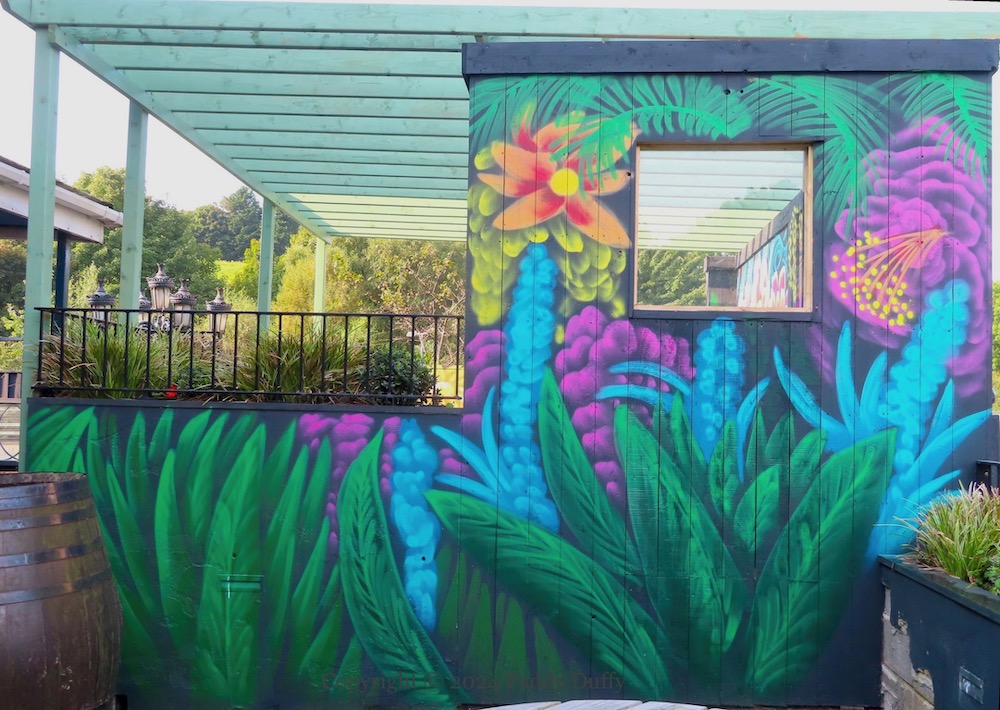
The beer garden at the Bellevue Arms got a facelift in the summer (of 2024), including new a name-sign in the style of the “Greetings from …” postcards in the US, which would feature local landmarks within the letters of the place-name. (Here is a history from Smithsonian magazine.)

Within the letters of “BELLEVUE” we can see a Delorean, one of the H&W cranes, the Albert Clock, the Rise sculpture (the Balls On The Falls), the Titanic museum, Belfast City Hall, the Big Fish, the Beacon Of Hope sculpture (Nuala With The Hula).

The seating areas have also been decorated with paintings of flowers.

Antrim Road, Glengormley. Perhaps by Visual Waste (web).

Click image to enlarge
Copyright © 2024 Paddy Duffy
T05655 T05656 T05657 T05658 T05659

Union Bears

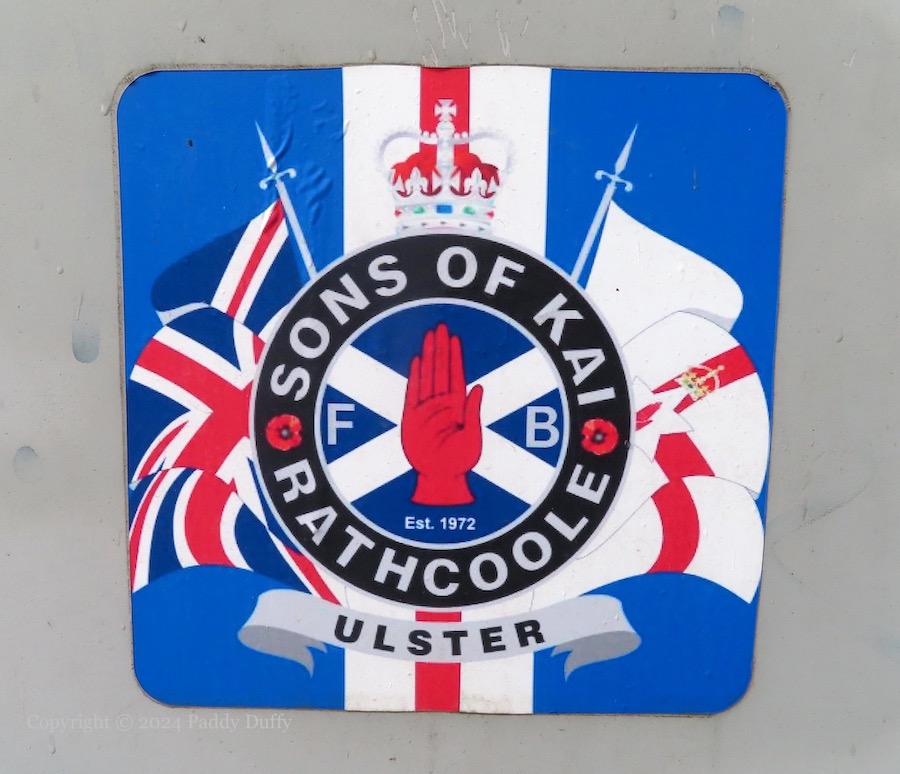
The “Union Bears” are a Rangers FC “ultras” supporters club whose web page currently features the giant tifo – “sign” or “banner” is too small a word, so the Italian word is used – unveiled at various games. This much smaller display (above) is on an electrical box on the Doagh Road next to the Iceland at the eastern edge of the Rathcoole estate.

For the Sons Of KAI flute band sticker, see Kai Johansen’s Bar | Sons Of KAI | Four Lads Had A Dream.

Click image to enlarge
Copyright © 2024 Paddy Duffy
T05661 T05662 T05663

3rd Battalion New Mossley

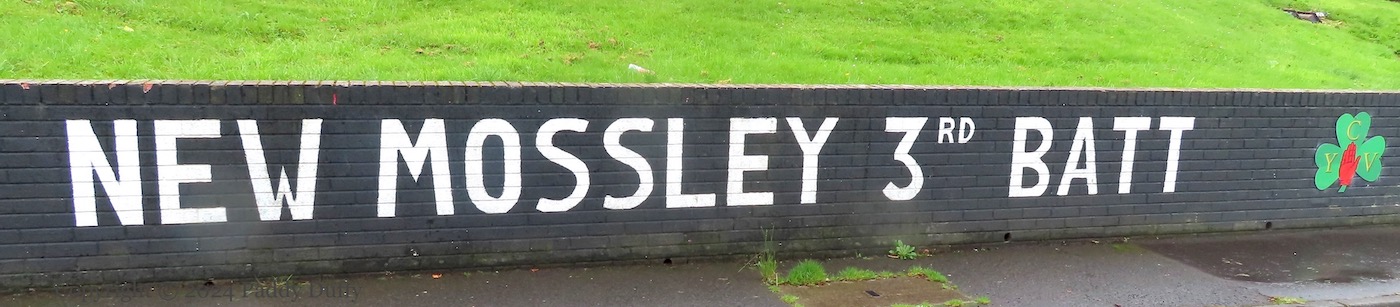
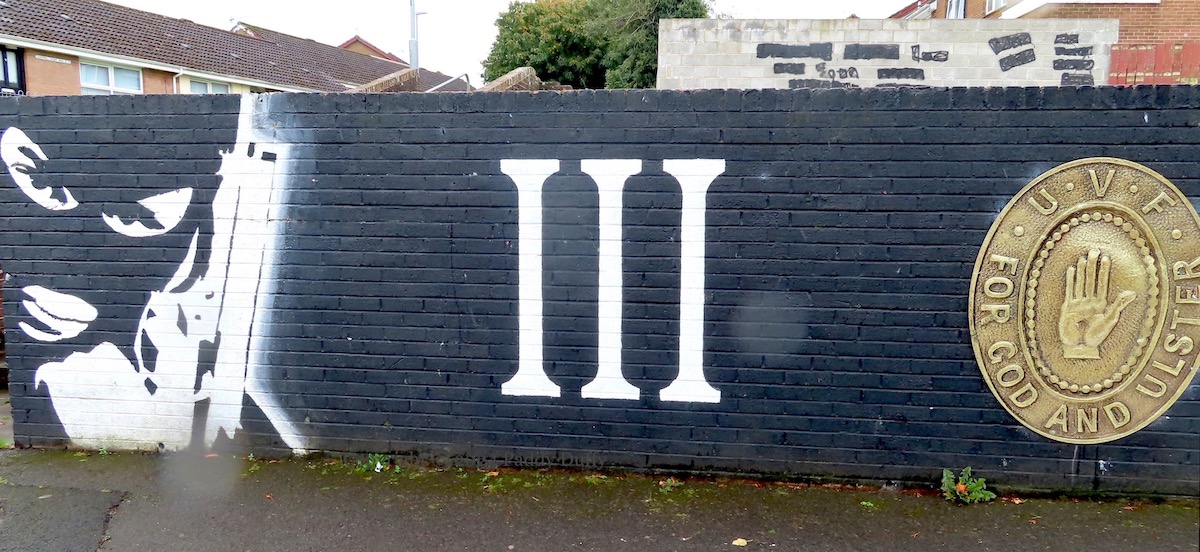
The hooded gunman at the New Mossley playground – seen previously in Welcome To New Mossley Play Area – has been upgraded with a golden UVF emblem (shown last, below), and has been joined by two new pieces: the printed board above and the low wall below. The 3rd battalion also includes Rathcoole, Mount Vernon, and Tiger’s Bay.

Click image to enlarge
Copyright © 2024 Paddy Duffy
T05665 T05667 T05666

One Big Clean Up

“Stop the illegal migrants – we need to protect our children – we stand together”. Rathcoole signs reading “Anyone facilitating the settlement of Muslims or illegals in our areas will be held responsible” (in the same style as the Shankill signs seen in Not A Dumping Ground) were removed by police after complaints from community members (Belfast Media). The style of placard referring only to “illegal immigrants” (shown above) remains.

“Protecting children” might be a reference to the knife attack on a dance studio in Southport, England, in late July, in which three children died and eight more were injured; misinformation on social media (falsely) identified the attack as Muslim and an asylum-seeker (Independent); he is a Cardiff-born teenager of Rwandan parentage (WP). Several days of rioting followed the attack, including in Belfast.

See also: Stop The Boats in north Belfast, in connection with the UK’s plan to send migrants to Rwanda | Protect Our Children sticker in east Belfast from February.

(“One big clean up” is the name of a previous campaign against dog fouling; A&N’s current campaign is called “Dog Watch“.)

Green End, Rathcoole, Newtownabbey

Click image to enlarge
Copyright © 2024 Paddy Duffy
T05660

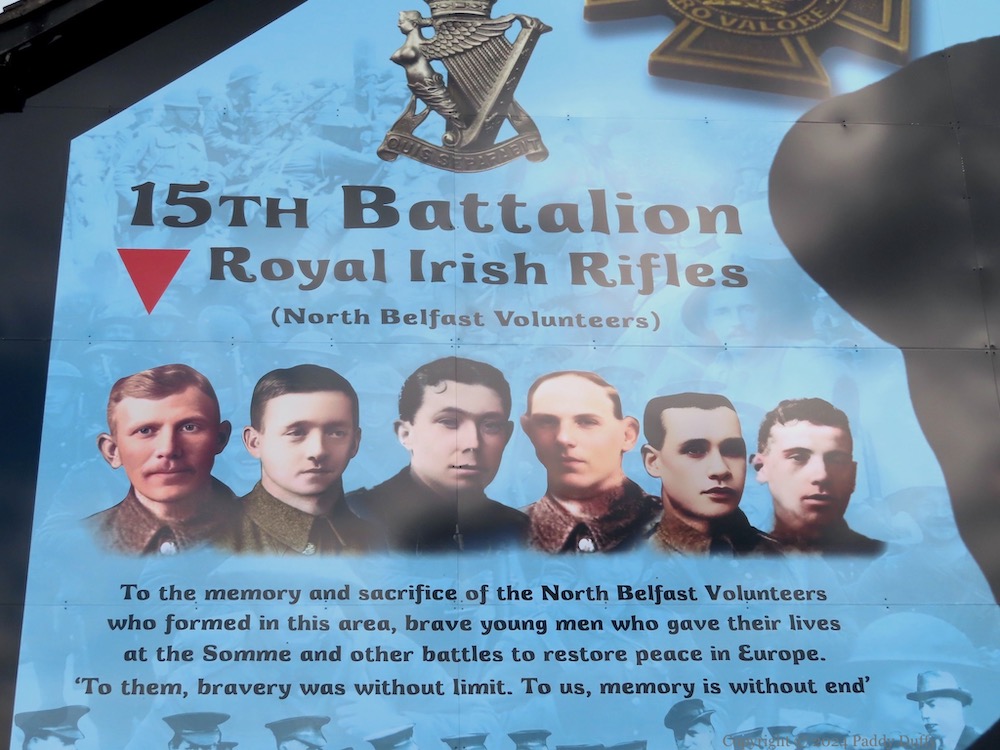
Bravery Without Limit, Memory Without End

“15th battalion Royal Irish Rifles (North Belfast Volunteers). To the memory and sacrifice of the North Belfast Volunteers who formed in this area, brave young men who gave their lives at the Somme and other battles to restore peace in Europe. ‘To them, bravery was without limit. To us, memory is without end.'” Five of the six portraits were included in the previous mural (see Many Did Not Return): (1) Rifleman Forrester, (2) Rifleman Baird, (4) Sergeant Major Magookin, (5) Rifleman Templeton, (6) 2nd Lt De La Harpur.

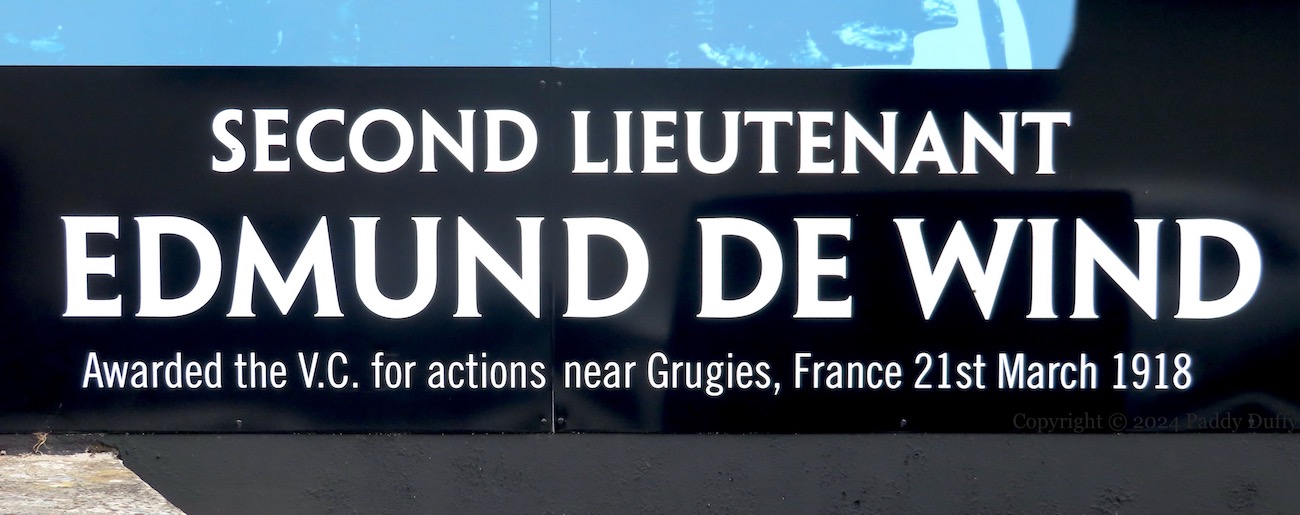
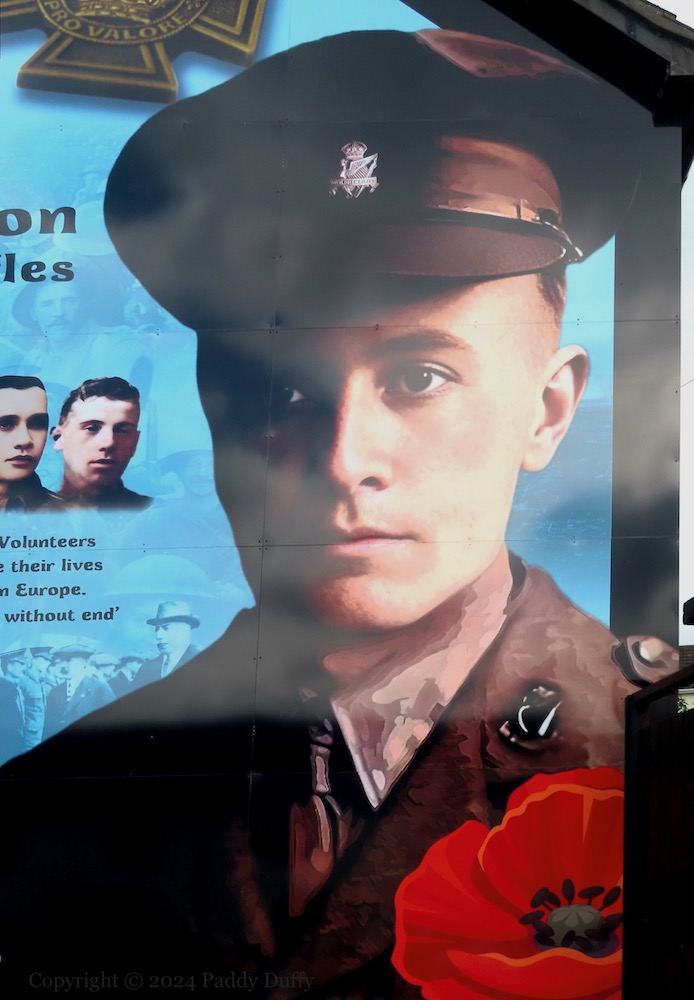
“Second Lieutenant Edmund De Lind. Awarded the VC for actions near Grugies, France 21st March 1918.”

De Wind was born in Comber but went to Canada in 1911. When the Great War began he joined the Canadian Army in Edmonton and fought at the Somme and Vimy Ridge. He joined the British Army and joined the RIR, the 15th battalion of which was originally drawn from the North Belfast Volunteers (War Time Memories). He died on March 18th, 1918, at St Quentin, near Grugies, in the Aisne. For his actions he was awarded the Victoria Cross; it is held in the Canadian War Museum, Ottawa. (CEF | Royal Irish | Legion | Ulster History | WP)

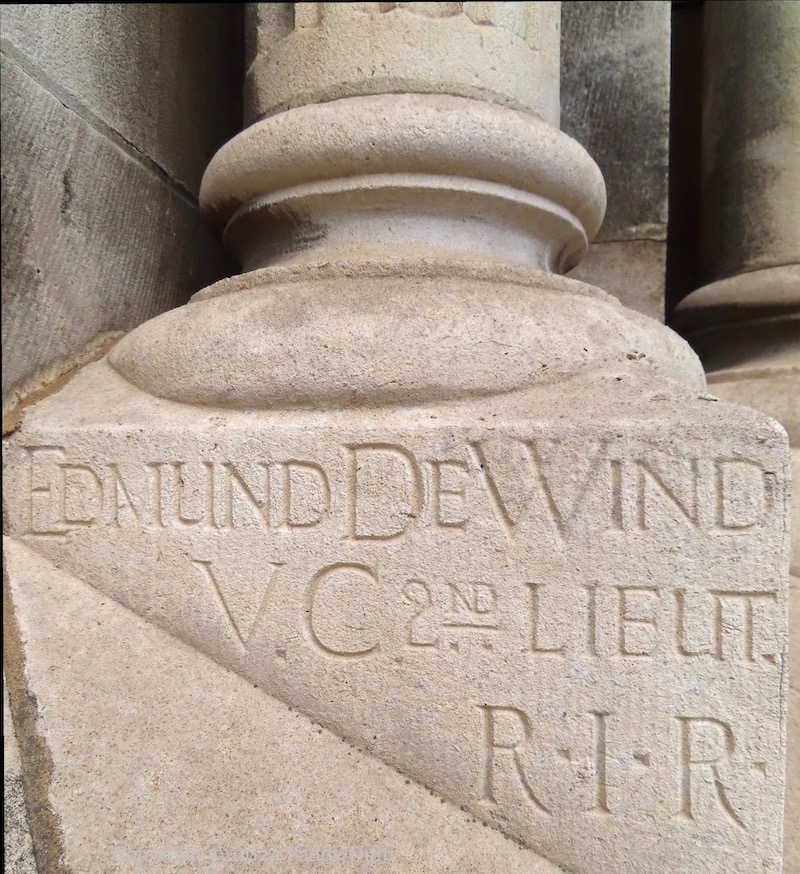
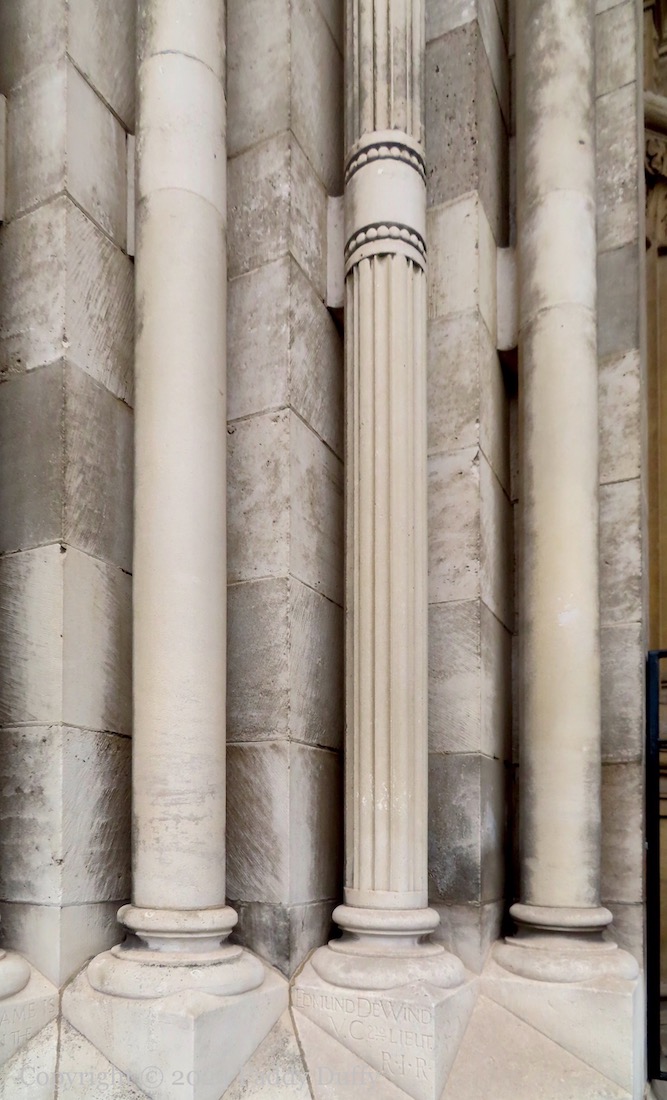
As is seen in the final two images, De Wind is remembered on one of the pillars outside St Anne’s in Belfast city centre.

The stone in front pre-dates this mural, though more names have been added since it was seen in Ghosts Of The Somme. “Rathcoole Friends Of The Somme roll of honour. Past member – lest we forget.”

Inniscarn Drive, Newtownabbey. Launched July 22nd, 2024.

Click image to enlarge
Copyright © 2024 Paddy Duffy
T05587 T05588 T05589 T05590 T05591
T05592 T05593

Row On Row

This images in this entry depict, above and below the information board about the park, the World Wars installation inside the park and the banners on the fence along Derrycoole Way.

There is an annual commemoration of the fallen in the World Wars in Rathcoole each year. The monument consisting of mourning soldiers and sandbags) was created in 2020 (Fb group | News Letter) and the bench was perhaps added in 2022. Images from the 2023 ‘row on row’ commemoration can be seen at NI World. The Row On Row group (web) hope to create a permanent memorial on the spot.

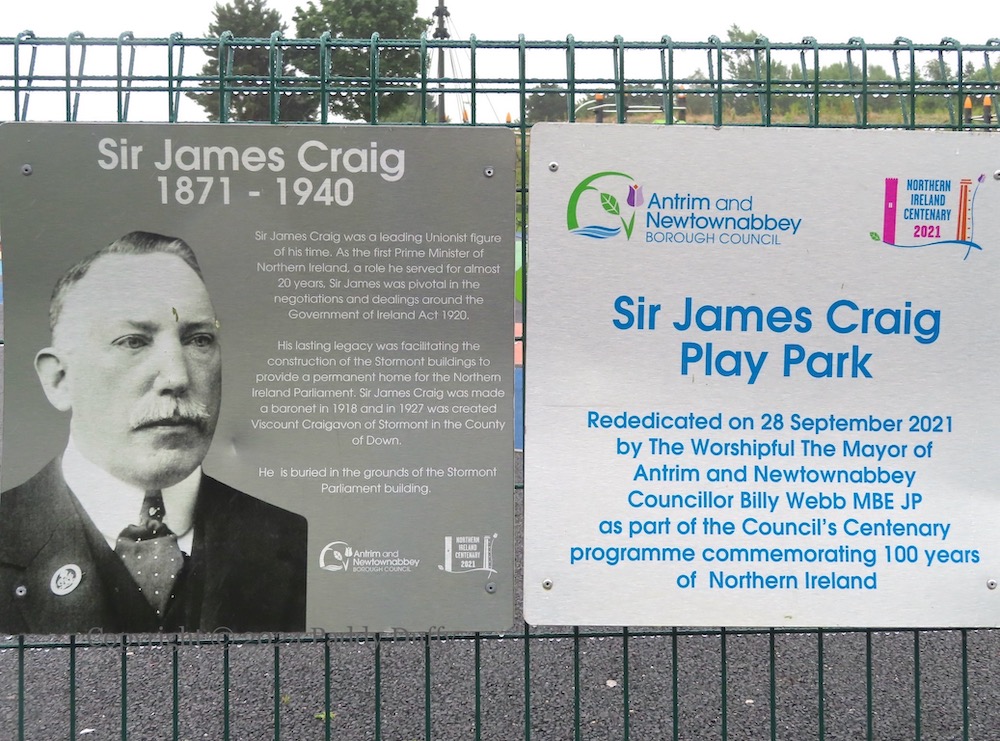
Rathcoole People’s Park was renamed the Sir James Craig Play Park by Antrim & Newtownabbey council in September, 2021, as part of the council’s celebrations of the centenary of Northern Ireland (NI World).

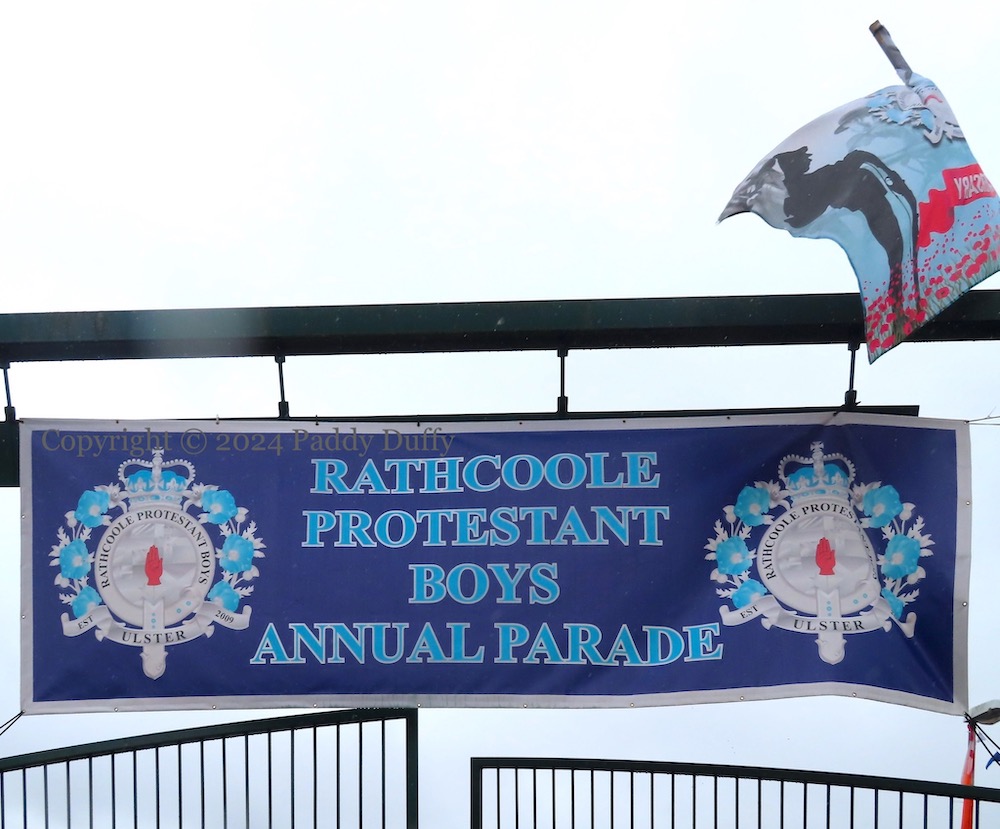
The banners on the side are from the Rathcoole Protestant Boys flute band (Fb) whose annual parade was at the end of June, and the Whitehouse Williamite Historical Society (Fb) whose fun-day on June 15th included a historical re-enactment of William’s army landing at Whitehouse. (For more on William’s connection to Whitehouse, see June 14th, 1690.)

Click image to enlarge
Copyright © 2024 Paddy Duffy
T05013 T05014 T05016 T05012 T05017
T05043 T05018 T05019 T05021 T05042 [T05022] T05020
T05023 [T05041]

His Majesty King Charles III By The Grace Of God

September 8th, 2022, is the date of the accession of Charles – then Prince Of Wales – the UK crown, upon the death of his mother Elizabeth at ten past three in the afternoon (as shown on the clock in the bottom left of the wide shot, below). At Balmoral Castle, the Royal Standard (in the top left of the wide shot, below) was lowered and immediately raised again, as the monarchy immediately moved to Charles and he was present in the building (WP).

The unnamed figure on the left is William, the son of Charles and his first wife, Diana, and the current Prince Of Wales. William’s son, George, on the right, is known as “Prince George Of Wales” (and his siblings similarly) rather than (as here) “George, Prince Of Wales.” The title “Prince Of Wales” is reserved for the heir to the UK throne, currently William.

“His Majesty King Charles III by the Grace of God of the United Kingdom of Great Britain and Northern Ireland and of His other Realms and Territories, King, Head of the Commonwealth, Defender of the Faith.”

Devenish Drive, Monkstown, Newtownabbey, with funding from the Housing Executive (NI World) to replace the UDA hooded gunman seen in Open & Shut.

Click image to enlarge
Copyright © 2024 Paddy Duffy
T04766c T04765 [T04767]

June 14th, 1690

On this day 334 years ago (in the Julian calendar, which would be June 24th in the Gregorian), King William III landed at Carrickfergus and began his journey, via Belfast and Lisburn, to the Boyne river (outside Drogheda) where he successfully led his forces against those of James II.

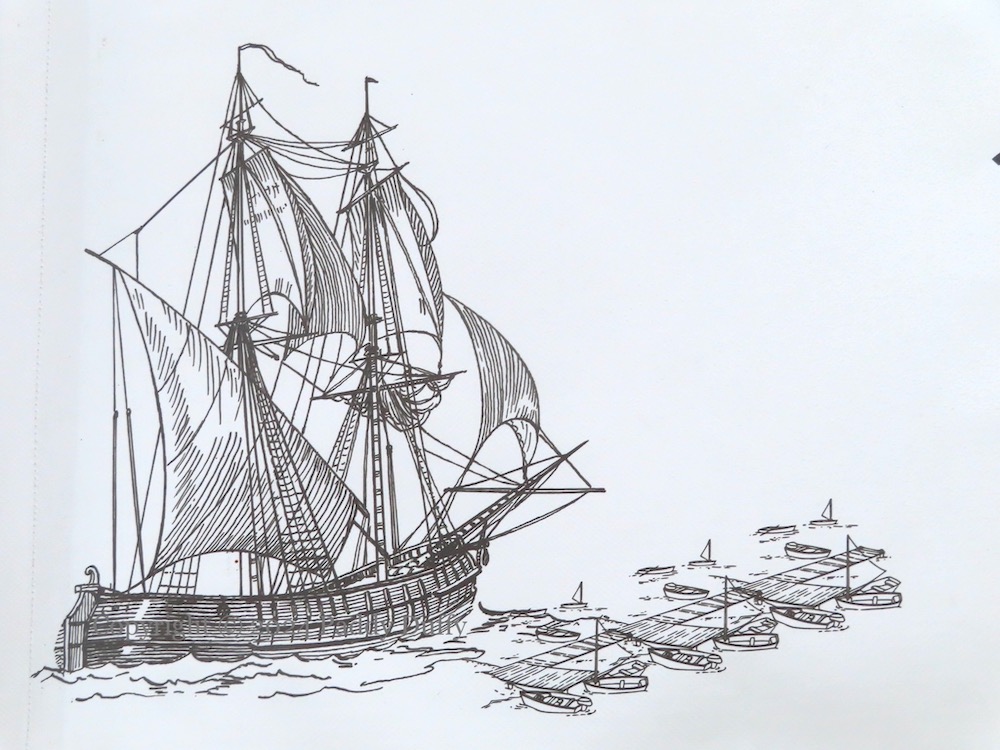
After landing in Carrick, William rode by horse to Whitehouse, half-way to Belfast, where he met his commander-in-chief, the Duke Of Schomberg, who had been in Ireland since the previous August and laid siege to, and taken, the Jacobite garrison in Carrickfergus, making William’s landing there possible (WP).

This new large board at Monkstown Old Boys (Fb) celebrates William’s landing and journey to Whitehouse, which is the point closest to Monkstown.

The image reproduced in the centre of the board (see below; a crisper version can be found at Orange Heritage) shows William meeting Schomberg at the eponymous White House, where Glas Na mBradán (the Salmons’ Stream) made a small port. Dalaradia has a 3-D flyover of what the White House and surrounding area might have looked like at the time. The remains of the White House have been restored and now house an interpretive centre (Bangor Historical Society | Causeway Coastal Route).

(For more on William’s journey from Carrick to Belfast see George Benn’s (1877) A History Of The Town Of Belfast p. 180 ff and Millin’s Sidelights (1938) – a contemporary map of the area appears at the bottom of the page. “Lord Belmont” also has a two-part history of William’s journey from Carrick to Belfast and on to Lisburn.)

Other images of William’s landing at Carrickfergus can be found in an old Bobby Jackson mural in the Fountain, Londonderry, (see the Peter Moloney collection) and in the Glenfield estate in Carrickfergus (see The Liberties Of England). There is also a statue of William in Carrickfergus harbour – see The Landing Of SARS-CoV-2 At Carrickfergus, March 2020.


The text on the board and the other images are as follows:

[The portrait of William is by Godfrey Kneller and part of the collection in the National Gallery Of Scotland.]

[The following text appears to be an excerpted and slightly modified version of a page at Orange Heritage.]

“King William was in Ulster from Saturday, June 14th, 1690 until Thursday, June 26th, only 12 days, yet he left behind a legend full of proud memories. For his part he liked what he saw. “This country is worth fighting for,” he said.

“His departure from London had been held up by parliamentary business till the end of May, when he announced that he could wait no longer and adjourned Parliament.

“Early in the morning of June 4 he set out, but on June 11th he embarked on board the yacht “Mary” with a fleet escorted by Sir Cloudesley Shovell’s squadron. On June 14th the hills of Ireland came in sight and in the afternoon the fleet cast anchor off Carrickfergus. He was rowed ashore in the Rear Admiral’s barge and at about 3.30 p.m. landed at the Old Quay under the shadow of the great Norman Castle.

[The 1973 painting of the Quaker greeting William is by Thomas Everard Spence and held by Carrickfergus Council – see Art UK. The Union Flag on the right lacks the St Patrick’s Cross – this would not be added until after the 1801 Act Of Union.]

The Garrison of the Castle had drawn up a Guard of Honour and the townspeople added their applause. The chosen spokesman was a Quaker, whose principles forebade [sic] him to doff his hat, or use such titles as Sir and Majesty. He got over the difficulty by taking off his hat and laying it on a stone and then stepping forward and saying “William, thou art welcome to thy Kingdom” which pleased the King so much that he replied: “you are the best bred gentleman I have met since I came to England.”

“With these words he mounted his horse and set off for Belfast. Half-way along the shore was the little port of Whitehouse, where most of the army disembarked. The Commander-in-Chief, the Duke of Schomberg, and his senior commanders were waiting here to welcome the King. To cover the disembarkation, earthworks has [sic] been thrown up by the engineers at Fort William and garrisoned by troops ready for action.”


[The following text perhaps draws upon the BBC page on the Battle Of The Boyne.]

“Battle of the Boyne: Although the battle has been commemorated on 12th July for more than 200 years, it actually took place on 1st July according to the old Julian calendar, and on 11th July according to the Gregorian (which replaced the Julian calendar in 1752). It was the last time that two crowned Kings of England, Scotland and Ireland faced each other on the battle field.”
[By the time of Britain’s adoption of the Gregorian calendar in 1752 the calendars had moved (in 1700) another day apart, making them eleven days apart at that time. However, eleven days rather than ten were added to all prior dates, even those before 1700 and further back, to yield July 12th as the date of the Battle in 1690.]

[The two paintings of the Battle Of The Boyne are by Jan Wyck. The painting of William on horseback is part of the (UK) Government Art Collection; the 1693 painting of the battle-field can be found in the National Gallery Of Ireland.]


[This statue of William is in the grounds of Kensington Palace (WP).]

[The painting of William and Mary is actually two portraits blurred together. See e.g. History Extra.]

[The following text appears to come from the royal.uk page on William and Mary.]

“In 1689 Parliament declared that James had abdicated by deserting his kingdom. William (reigned 1689-1702) and Mary (reigned 1689-94) were offered the throne as joint monarchs.

They accepted a Declaration of Rights (later a Bill), drawn up by a Convention of Parliament, which limited the Sovereign’s power, reaffirmed Parliament’s claim to control taxation and legislation, and provided guarantees against the abuses of power which James II and the Stuart Kings had committed.

The exclusion of James II and his heirs was extended to exclude all Roman Catholics from the throne, since ‘it hath been found by experience that it is inconsistent with the safety and welfare of this protestant kingdom to be governed by a papist prince’. The Sovereign was required in his coronation oath to swear to maintain the Protestant religion.”


Click image to enlarge
Copyright © 2024 Paddy Duffy
T04770 T04771 T04772 T04769
T04768 T04773 T04775 [T04774]

Four Lads Had A Dream

‘Four Lads Had A Dream’ is the name of Rangers song (youtube) but here the dream is not “to start a team” in Glasgow but to start a flute band in Monkstown, Newtownabbey. The result of the efforts of the four men – John Black, Freddie Maltman, Brian Crothers, Trevor Wilson – was Monkstown YCV flute band (Fb), formed in 1974 and so celebrating its fiftieth anniversary this year, 2024. To mark the occasion, the band has installed the series of boards shown here along a low wall in Cloyne Crescent; it will also visit the Somme and play at the Last Post ceremony which takes place at eight every evening at the Menin Gate (web).

The information board is transcribed (verbatim) at the bottom of this entry. A Bo Kerr from Rathcoole is also mentioned in the creation of also mentioned in the creation of the KAI tartans in Rathcoole – see the IWM link in The Famous.

The board showing words from a soldier’s diary, along with an image of soldiers marching, also appeared in the Village, south Belfast – see May I Never Hear Such Cries Again.

In the Royal Irish Rifles of WWI, Central Antrim became the 12th battalion (War Time Memories Project). For the Central Antrim Volunteers see The Central Antrim Regiment | South And Central Antrim Volunteers and 1916 Battle Of The Somme. Robert Quigg (of the 12th Rifles) was awarded the VC – see VCs Of The 36th.

Click image to enlarge
Copyright © 2024 Paddy Duffy
T04776 T04777 T04778 T04779 T04780 T04781 T04782 T04783 [T04784]

“Four lads had a Dream. Back in 1974, a group of lads were having a card school in the old rent office in Abbeytown Square. One of the lads, John Black, asked they group if they would go with him to meet Billy Greer about asking for help to start up a band. Freddie Maltman, Brian Crothers and Trevor Wilson all agreed to accompany him. So off they went to see Billy Greer, who gave them a look of disbelief and replied “son, do you realise what it would take to do this?” John replied “no.” After a while, Billy Greer said “leave it with me, I will go and get back to you.” A couple of weeks later, the lads once again met with Billy Greer, and he introduced them to a man named Robert ‘Bo’ Kerr.

The following week, Robert had brought a book with him and the amount of names in it was amazing. A lot of the people in the book were from Rathcoole. At this stage, Robert also brought down his brother, Brian ‘Bo’ Kerr, to help. The band managed to get a lend of some old side drums, some flutes and a bass drum. Roberts father also repaired some flutes for them. A lot of fundraising followed, such as street collections in the Monkstown area, and the community was very generous to the cause of the band. Robert ‘Bo’ Kerr was due to get married that year and he gave up his wedding fund money towards the purchase of four new side drums from Matchetts in Belfast and a bass drum from Willy Hewitts over in Sandy Row.

The bands first parade was an invite to Glenarm where Hughy Brown was the first band captain. The band numbers were rising, but it didn’t take too long to see who was going to make it and who wasn’t, and therefore the numbers fell slightly. John Black for one learnt his lessons very quickly to never lie to the band captain. Hughy Brown gave all the fluters a tune to learn at home, the next week they all arrived at practice and Hughy went along and asked, one by one, “well lads, did you learn The Ducks for me this week?” And they all replied “yes.” He picked out John Black to stand on the chair and play it. That was him in the bad books straight away as he had told lies and hadn’t learnt it! Hughy went mad and told him “Blackie, never in your life waste my time again if you want to stay in this band, don’t come back next week if you haven’t learnt what I give you!” After that, the flute corps was second to none.

Throughout the years the band has had its ups and downs like every other band we lost quite a few members due to being incarcerated during the troubles or by passing away. However, over the past few years we have went from strength to strength! The hard work and dedication from our members is second to none, with some of our members travelling from various locations in Newtownabbey, Carrickfergus, Shankill, East Belfast, Scotland and Liverpool.

This year 2024 we will be celebrating our 50th Anniversary with the purchase of a new uniform and a pilgrimage to the Battlefields of the Somme, culminating in playing at the Last Post ceremony at the Menin Gate, this will be one of the milestones that Monkstown will proudly mark.”

“The Battle Of Messines June 1917. Men from the Royal Inniskilling Fusiliers and Royal Irish Rifles celebrating their victory at Wytschaete.”

“We surge forward. Bayonets sparkle and glint. Cries and curses rent the air. Chums fall, some without a word … and others … Oh, my God! May I never hear such cries again! There goes the YCV flag tied to the muzzle of a rifle. That man had nerve! Through the road just ahead of us we had crossed the sunken road. We could see khaki figures rushing the German front line. The Inniskillings had got at them.”