Henly Gate

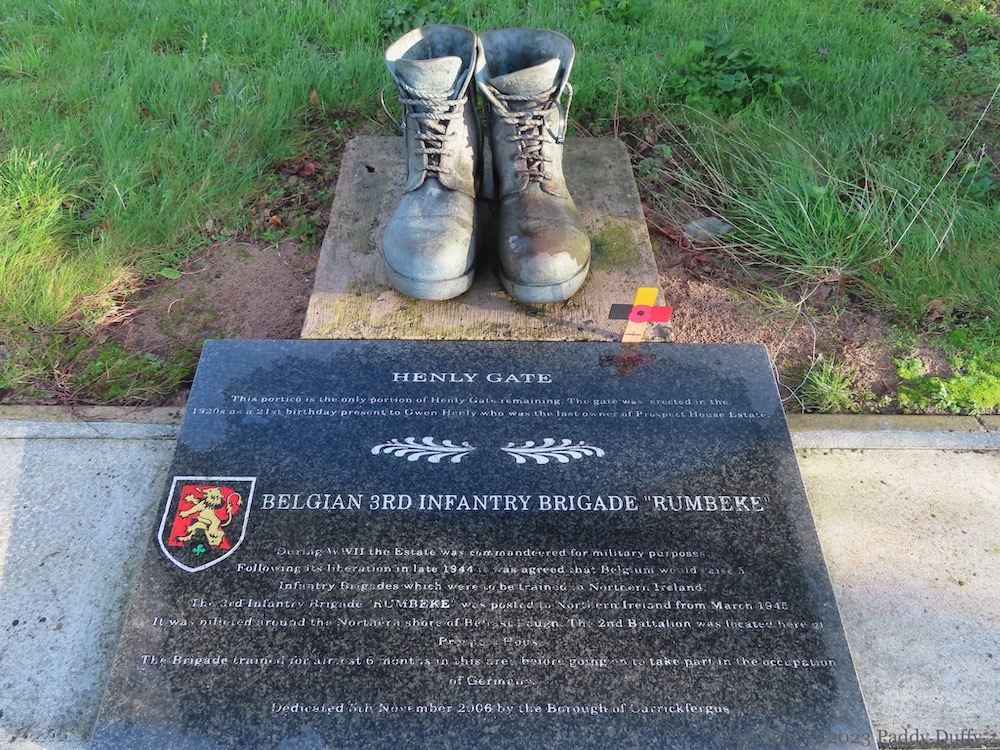
Five Belgian brigades trained in Northern Ireland towards the end of WWII, as the Belgian Army rebuilt itself after the liberation of Belgium in 1944 (WarTimeNI). The 3rd or ‘Rumbeke’ brigade was raised in March 1945 and trained in six south-east Antrim towns, including Carrickfergus, where they were stationed at Henly House. After training, it took part in the occupation of Germany for about six months (BE Brigades). The boots and plaque are beneath the arch of what was once Prospect House.

The text on the plaque reads in full: “Henly Gate. This portico is the only portion of the Henly Gate remaining. The gate was erected in the 1920s as a 21st birthday present to Gwen Henly who was the last owner of Prospect House Estate. Belgian 3rd Infantry Brigade “Rumbeke”. During WWII the Estate was commandeered for military purposes. Following the liberation in late 1944 it was agreed that Belgium would raise 5 Infantry Brigades which were to be trained in Northern Ireland. The 3rd Infantry Brigade “Rumbeke” was posted to Northern Ireland from March 1945. It was billeted around the Northern shore of Belfast Lough. The 2nd Battalion was located here at Prospect House. The Brigade trained for almost 6 months in this area before going on to take part in the occupation of Germany. Dedicated 5th November 2006 by the Borough of Carrickfergus.”

At the junction of Woodburn Rd and Prospect Rd, Carrickfergus.

Click image to enlarge
Copyright © 2023 Paddy Duffy
T01827 [T01828]

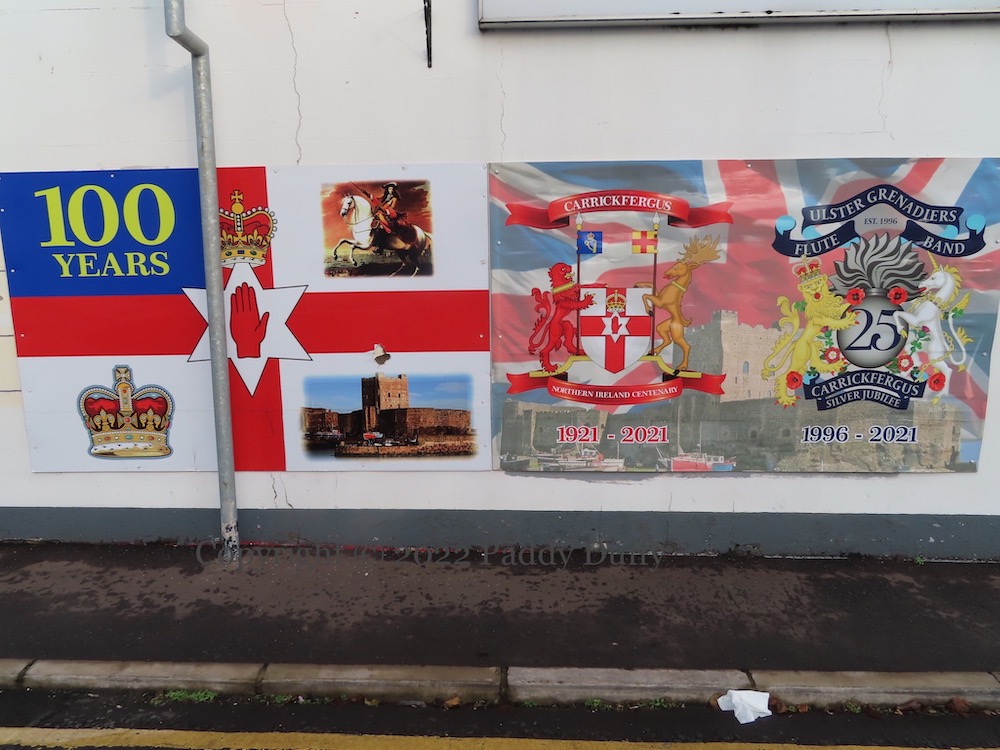
100 Years

On the left of this memorial board in Carrickfergus are five portraits from the later life of the child who began life in Greece as Prince Philip of Greece and Denmark. The family was exiled during the Greco-Turkish War. He ended up in Britain where he later joined the navy and stopped using his titles when he became the British subject, Philip Mountbatten. When he married Elizabeth he became Prince Philip, Duke of Edinburgh. His life-time matches that of the Northern Irish state (see in the second image): he was born a month after its creation and died in 2021 at the age of 99, a month shy of its centenary.

These boards and banners are in Albert Road and Thomas Street, Carrickfergus, near the Orange lodge, (for which see On Foreign Fields). They are perhaps all sponsored by the Ulster Grenadiers flute band. “Carrickfergus says “No” to Irish Sea border”

Click image to enlarge
Copyright © 2022 Paddy Duffy
T01583 [T01584] T01585 T01582 [T01581]

Wortley

“Sgt. Thomas George Wortley , “D Coy” 14th Btn. Royal Irish Rifles, Service No. 14/17063, Died Messines 07-06-1917, Spanbroekmolen British Cemetary Grave C10″. Wortley was born in Carrickfergus, lived in Belfast, died on the first day of the battle at Messines (findagrave), buried in a small cemetery of British soldiers, many from the 36th (Ulster) Division, in Spanbroekmolen on the Ypres Salient in Flanders (WP) – shown in the mural – and is remembered in Carrickfergus with a parade each year on the date of his death (carrickfergusrollofhonour).

Maple Gardens, Carrickfergus

Click image to enlarge
Copyright © 2022 Paddy Duffy
T01580

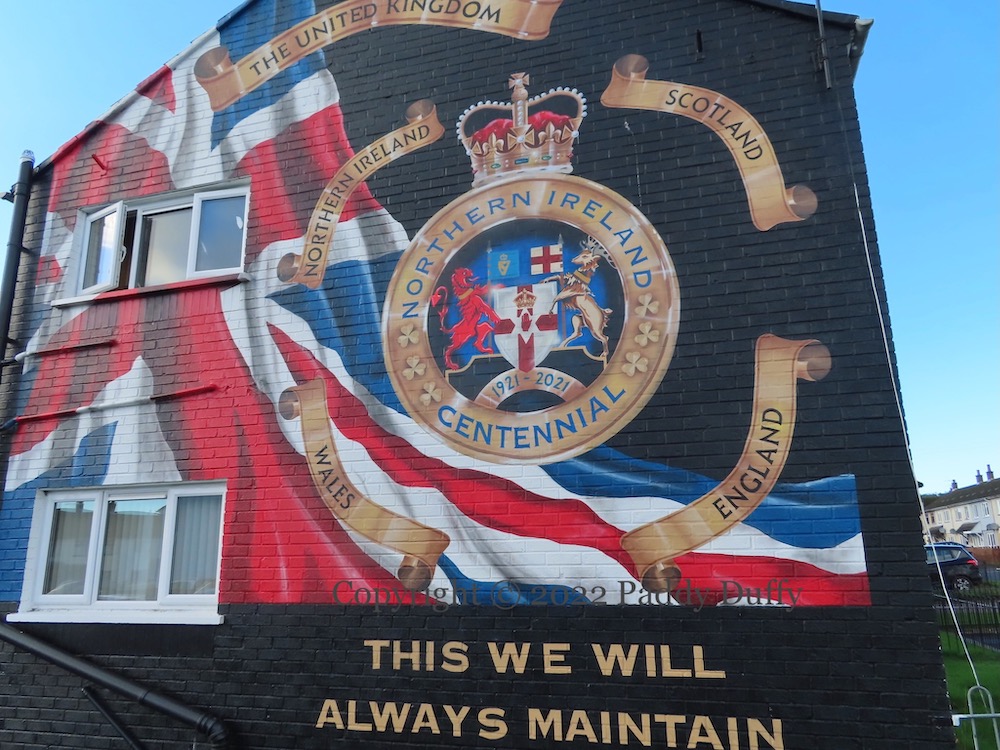
The Lion And The Elk

“This we will always maintain.” The Northern Ireland government’s coat of arms was approved for use in 1924, three years after the government was established. Its “supporters” – the red lion of Scotland and an Irish elk, carrying (respectively) Irish harp and De Burgh flags, and standing on a grassy mound with flax plants – were added later.

This mural celebrating the centenary of Northern Ireland’s creation, in the Woodburn estate, Carrickfergus, accurately shows the Tudor crown on the arms, as was used at the time of creation and prior to the Edwardian crown (WP).

Click image to enlarge
Copyright © 2022 Paddy Duffy
T01578 [T01579]

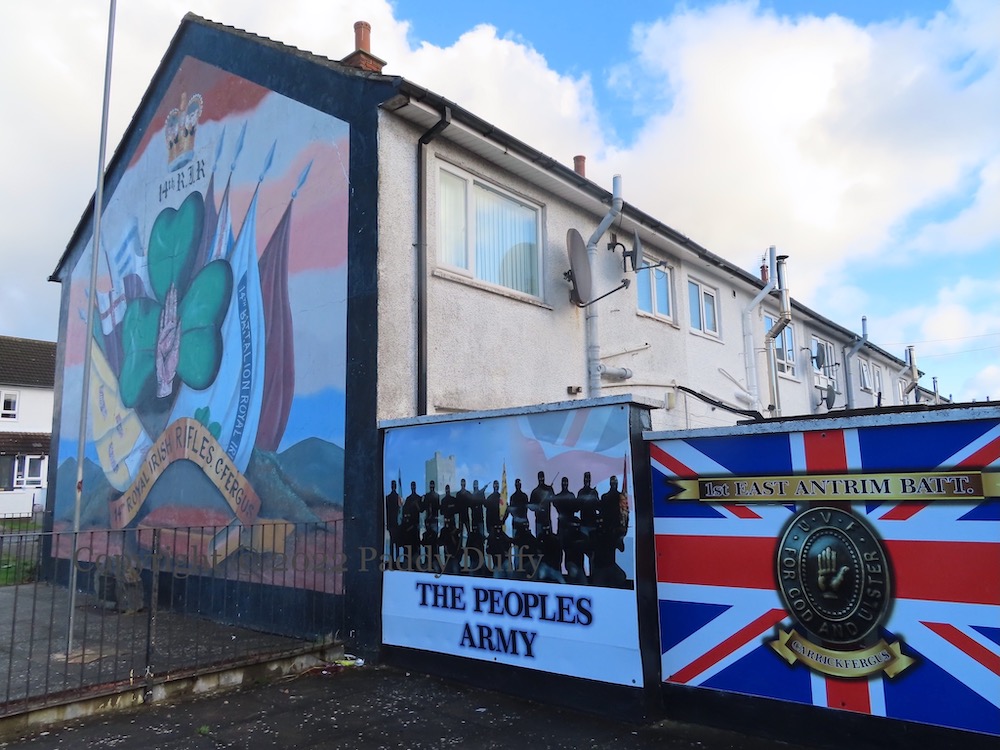
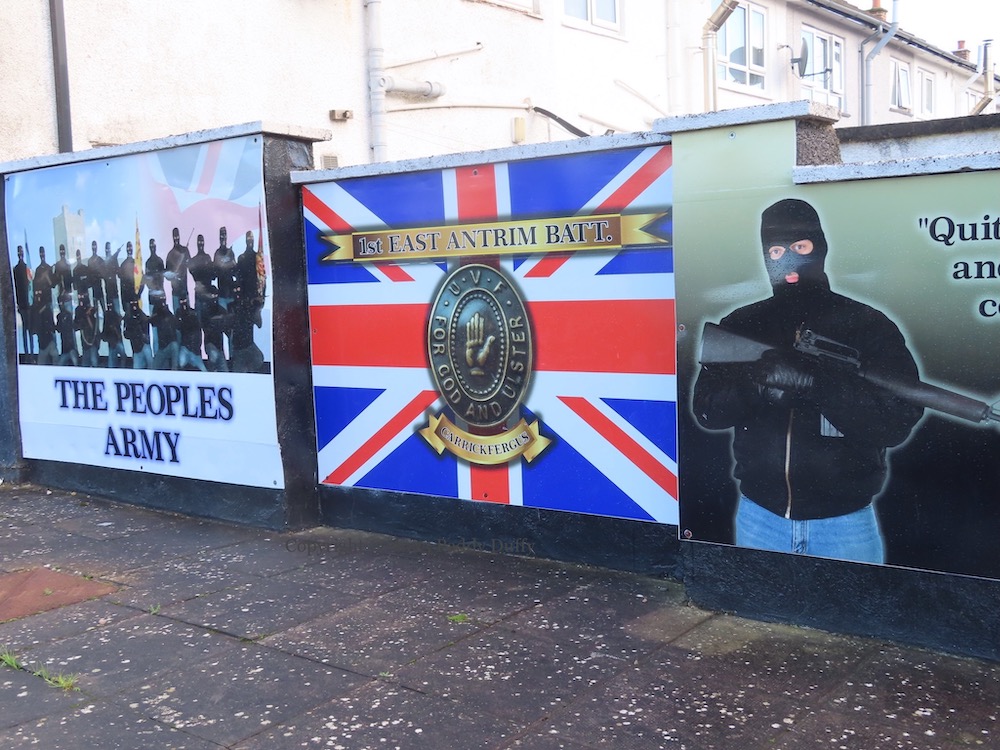
Comply With Your Country’s Demand

The new panels shown here re-re-image the side-wall of the mural on the left (see For Valour), which was dedicated to the Royal Irish Rifles of the Great War. We now see hooded UVF gunmen from the 1st East Antrim battalion, and an interesting quote from Edward Carson.

In September, 1914, six weeks after the Great War had begun, Edward Carson wrote to the Ulster Volunteers entreating “those who have not already responded” to “my call for Defenders of the Empire” to “enlist at once for the Ulster Division in Lord Kitchener’s Army”, fighting alongside “our fellow Britishers”: “Quit yourselves like men and comply with your country’s demand”. The impulse for the display of force shown here is the other, original, motivation for the paramilitary force, which Carson describes as “to defend our citizenship in the United Kingdom” (Strachan & Nally).

The Larches, Carrickfergus

Click image to enlarge
Copyright © 2022 Paddy Duffy
T01577 [T01574] T01575 T01576

The Present Conflict

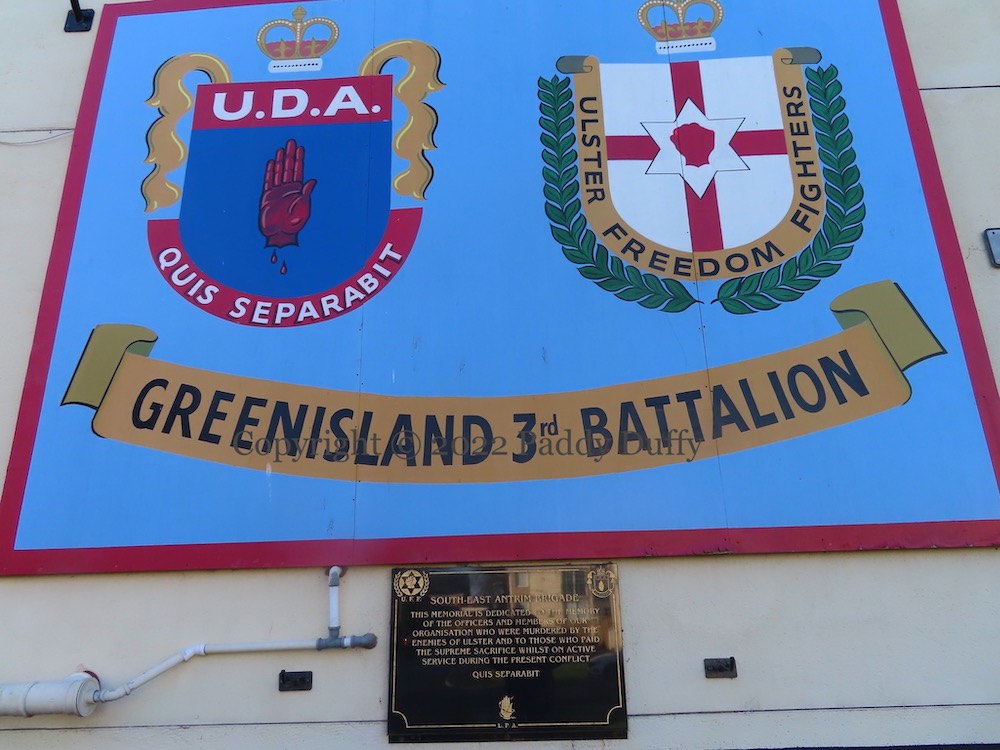
“Greenisland 3rd Battalion, South-East Antrim Brigade [UDA]. This memorial is dedicated to the memory of the officers and members of our organisation who were murdered by the enemies of Ulster and to those who paid the extreme sacrifice whilst on active service during the present conflict. Quis separabit. UFF. UDA, LPA”

At the shops in Glassillan Court, Greenisland.

Click image to enlarge
Copyright © 2022 Paddy Duffy
T01586 [T01587]

Maintain The Union

“Loyalist Woodburn celebrates 100th anniversary Northern Ireland”. Maintain the union of (left to right) England (St George’s Cross), Wales (The Red Dragon), Northern Ireland (Ulster Banner), Scotland (St Andrew’s Saltire). Along the fence we have the NI coat of arms and Captain Sir Tom Moore.

Sandes Ct, Carrickfergus

Click image to enlarge
Copyright © 2022 Paddy Duffy
T01573

Progression Requires Inclusion

The UVF 1st East Antrim Battalion is “Still ready & willing to defend the people of Ulster against all foes” including the British government that – even as Northern Ireland marks its centenary – has “deserted” it over the NI Protocol that involves checks on goods moving between Britain and Ireland (whether north or south) but no (new) checks on goods moving between north and south (gov.uk). The “still” goes all the way back to 1912, when the British government of the day proposed (for a third time) “Home Rule” for Ireland and the Ulster Volunteers were formed – though the original “deserted” postcard and previous murals show the date as 1914.

The PSNI board was seen previously: In The Pocket Of Sinn Féin.

Below: “Progression Requires Inclusion” – a UVF hooded gunman painted in 2013 is still visible in 2022.

Davy’s Street, Carrickfergus

Click image to enlarge
Copyright © 2022 Paddy Duffy
T01278 T01279 [T01280]

Show No Mercy

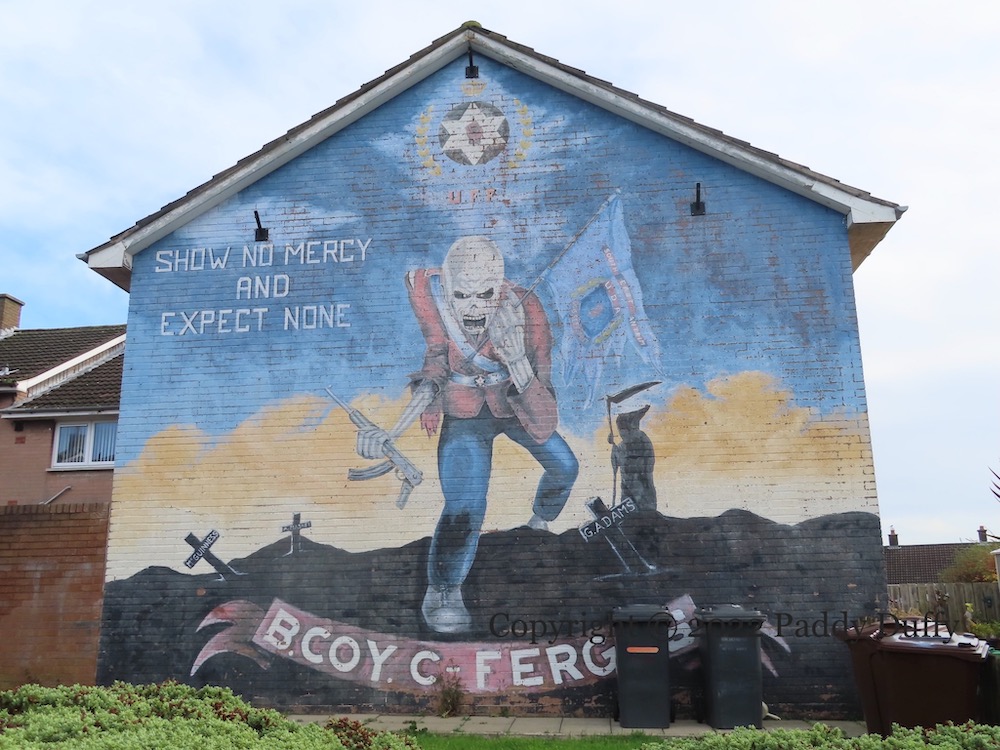
“Show no mercy and expect none”. Iron Maiden’s Eddie the trooper, armed with an assault rifle and carrying a UDA flag, leads the grim reaper over the graves of “G. Adams”, “McGuinness” and “A. Maskey”. UDA/UFF mural in Castlemara, Carrickfergus.

For more on Eddie, see his Visual History page.

Click image to enlarge
Copyright © 2022 Paddy Duffy
T01277

Young Citizen Volunteers

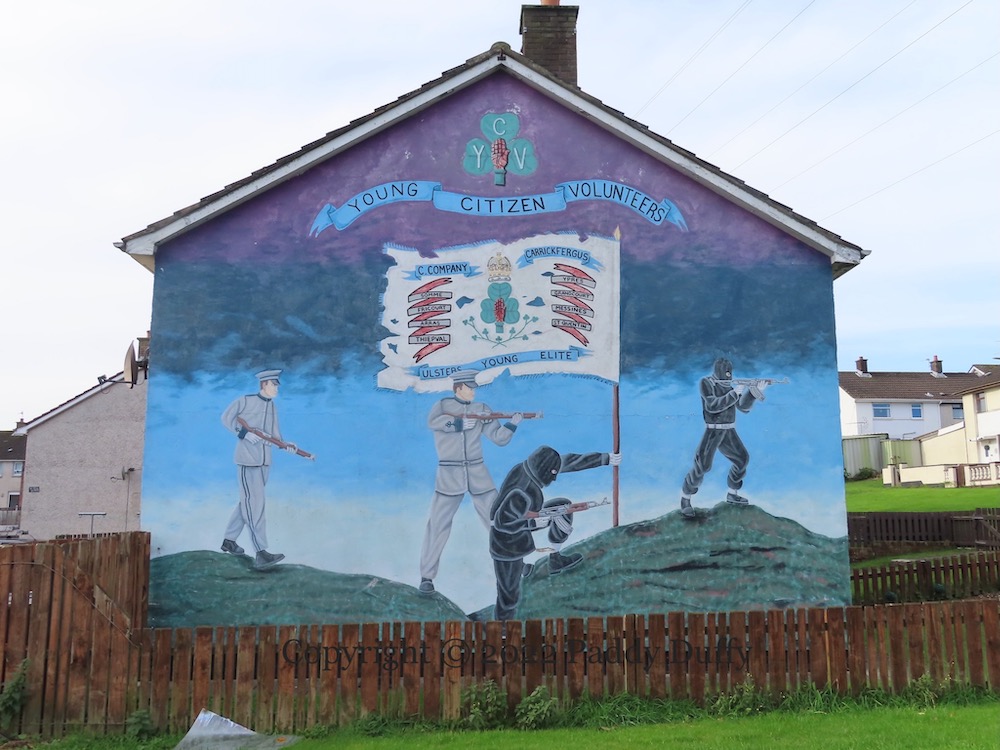
The Young Citizen Volunteers of 1912 eventually joined the Ulster Volunteers (in 1914) as the 14th battalion of the Royal Irish Rifles and part of the 36th (Ulster) Division (WP). In 1972 the name was resurrected for use as the youth wing of the UVF (WP). In the wide shot, below, this history is presented as a continuous movement from left to right; a modern-day hooded gunman climbs out of a WWI trench with one hand on a YCV flag.

Click image to enlarge
Copyright © 2022 Paddy Duffy
T01276