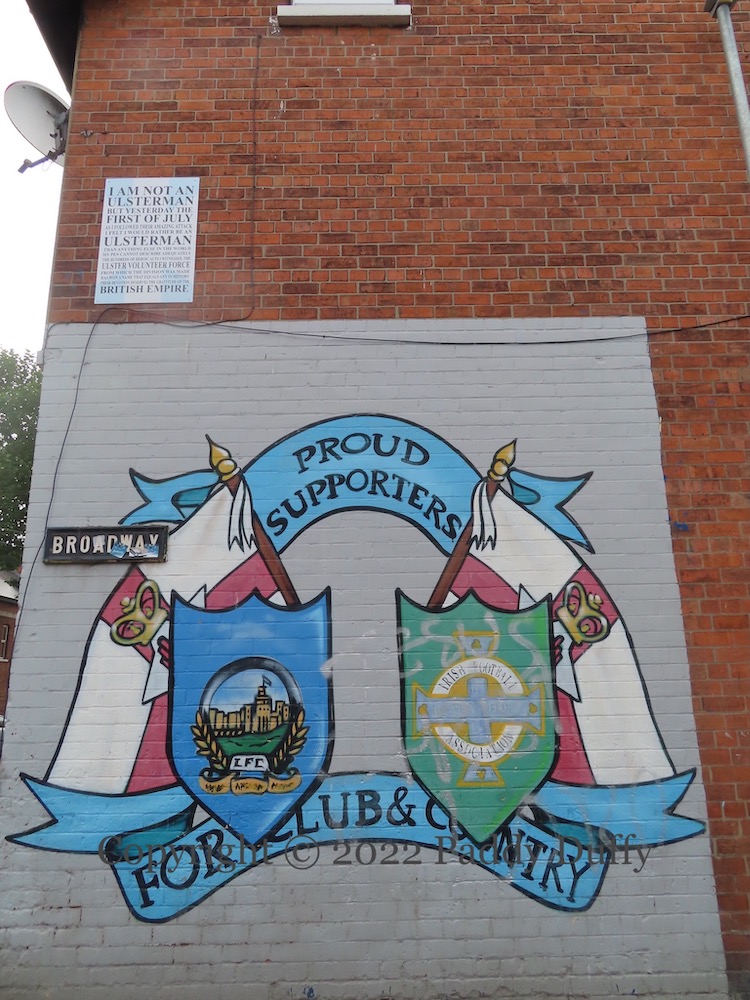
Sport and politics intersect in this mural at the junction of Broadway and Donegall Avenue in south Belfast. Northern Irish flags provide a backdrop for the shields of Linfield football club and the Northern Ireland football association.
“From Warsaw to Berlin” — Polish airmen in England, in the 300 Mazovian bomber squadron, write a “dedication” on a bomb headed for Germany in August 1941. The plane added as a background is perhaps an Avro Lancaster, while the one in the middle ground (in the wide shot, below) is a Vickers Wellington. According to the information board (shown last, below) “many Polish servicemen remained in Great Britain and Ireland after the [Second World] war, laying the foundations for a large Polish community that now (in Northern Ireland) numbers over 30,000.”
On the side-wall: The Ulster Tower at Thiepval “is dedicated to the glory of God in grateful memory of the officers, non-commissioned officers, and men of the 36th (Ulster) Division and of the sons of Ulster in other forces who laid down their lives in the Great War, and of all their comrades-in-arms who, by divine grace, were spared to testify to their glorious deeds.”
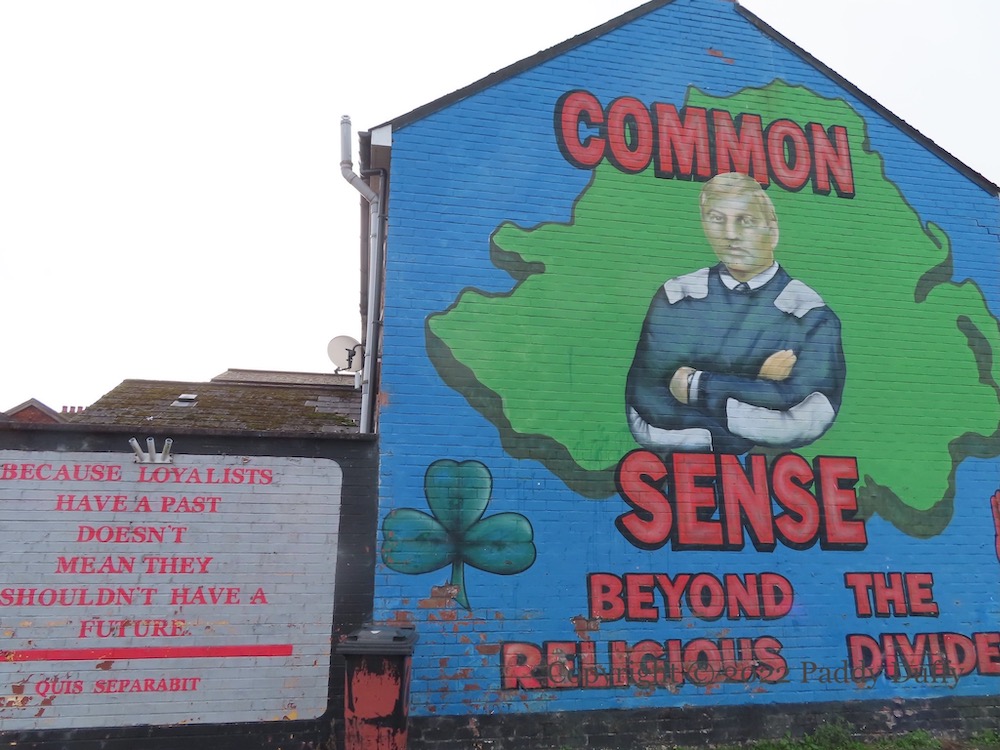
UDA commander John McMichael was also secretary of the New Ulster Political Research Group (NUPRG), a think tank of the UDA/UFF. The group argued for an independent Northern Ireland (based in part on beliefs about a separate Ulster ethnic identity – see the Visual History page on Cú Chulaınn) in two documents, 1979’s Beyond the Religious Divide and 1987’s Common Sense (available at CAIN), promoting the philosophy of ‘Ulster nationalism’, depicted here by the free-floating Northern Ireland. McMichael ran unsuccessfully for the Belfast South seat after the murder of Robert Bradford (see To Bathe The Sharp Sword Of My Word In Heaven).
The side wall reads “Because loyalists have a past doesn’t mean they shouldn’t have a future. Quis separabit.” It previously had a McMichael quote – see We Must Share The Responsibility.
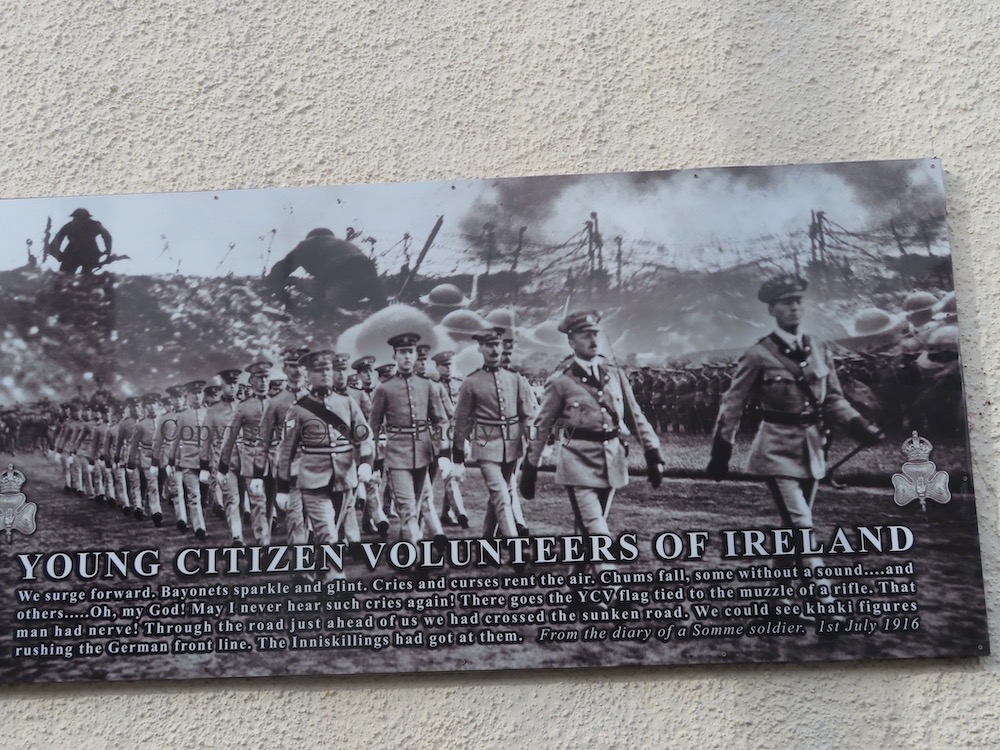
These Kitchener Street boards commemorate the “Young Citizen Volunteers Of Ireland” and the battle of the Somme. The text in the side-wall board (shown below) is from the diary of a Somme soldier: “We surge forward. Bayonets sparkle and glint. Cries and curses rent the air. Chums fall, some without a word … and others … Oh, my God! May I never hear such cries again! There goes the YCV flag tied to the muzzle of a rifle. That man had nerve! Through the road just ahead of us we had crossed the sunken road. We could see khaki figures rushing the German front line. The Inniskillings had got at them.”
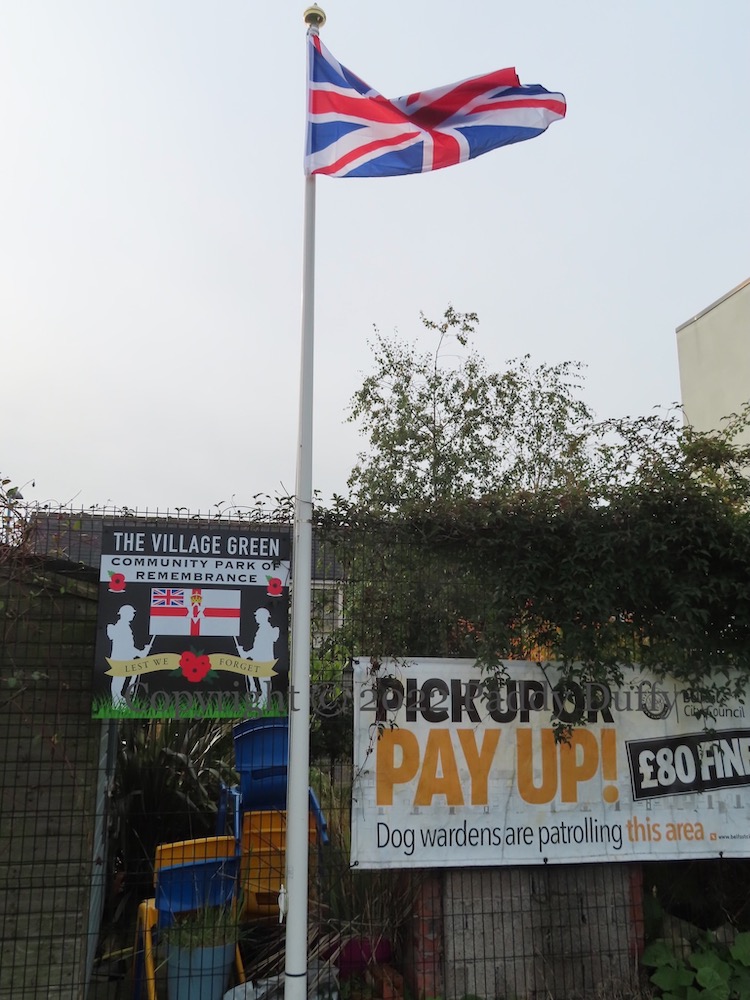
Part of the most recent development of the upper streets in the Village was not to rebuild the two rows of houses on Ebor and Nubia/Moltke streets and in their place construct a park – the Village Green – and playground. This new board on the outside railings make the park a “community park of remembrance” for WWI, showing an Ulster Banner with a Union Flag in the canton.
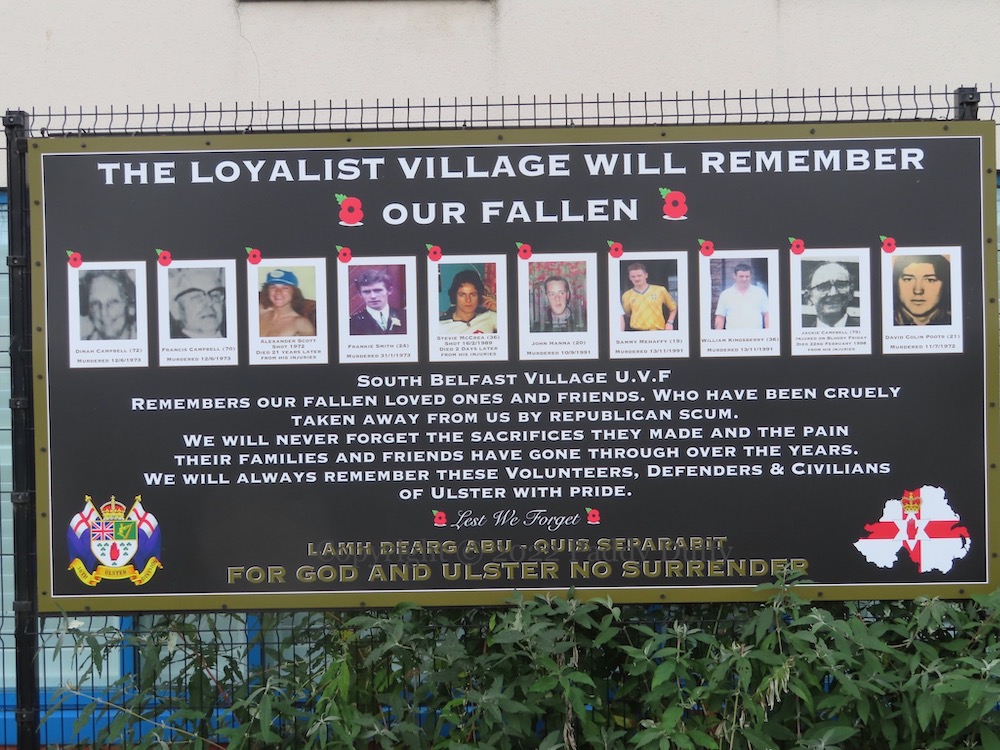
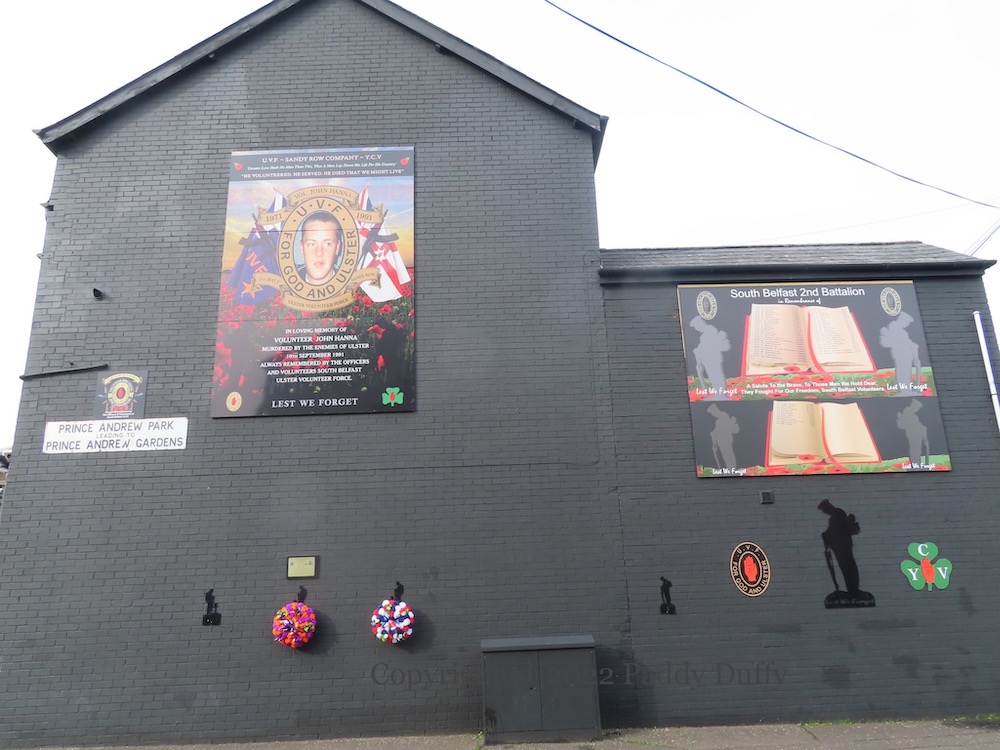
There is also a memorial to “loved ones and friends”, “volunteers, defenders & civilians” of the South Belfast UVF (though there is 36th (Ulster) Division emblem in the corner) who were “cruely taken away from us by republican scum”: Dinah Campbell, Francis Campbell, Alexander Scott, Frankie Smith, Stevie McCrea, John Hanna, Sammy Mehaffy, William Kingsberry, Jackie Campbell, David Poots.
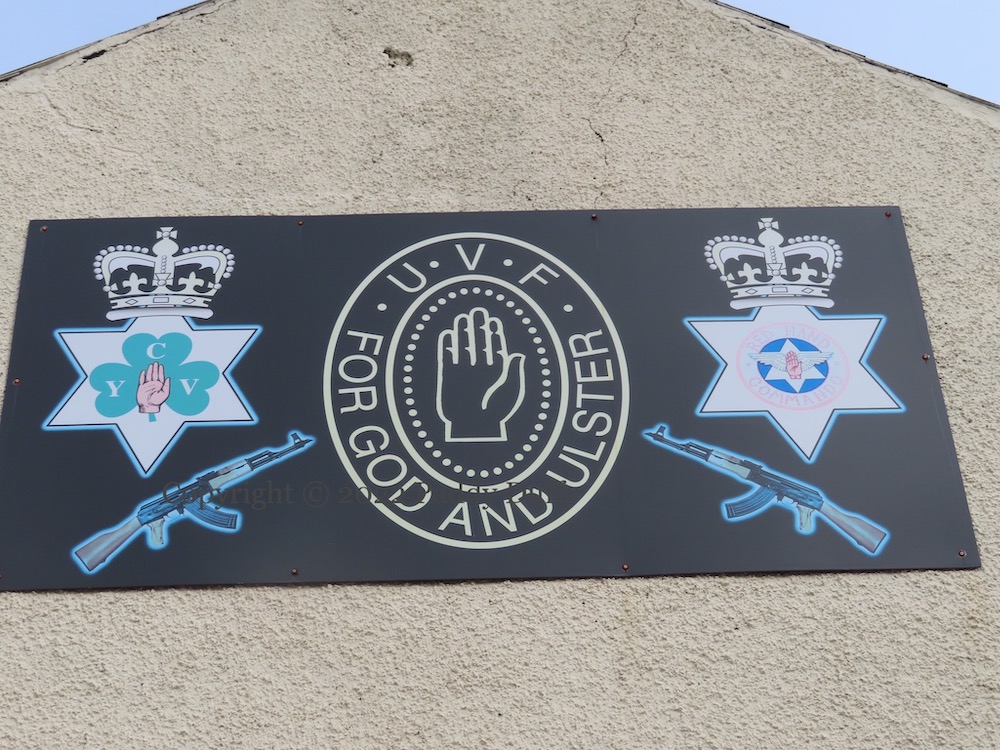
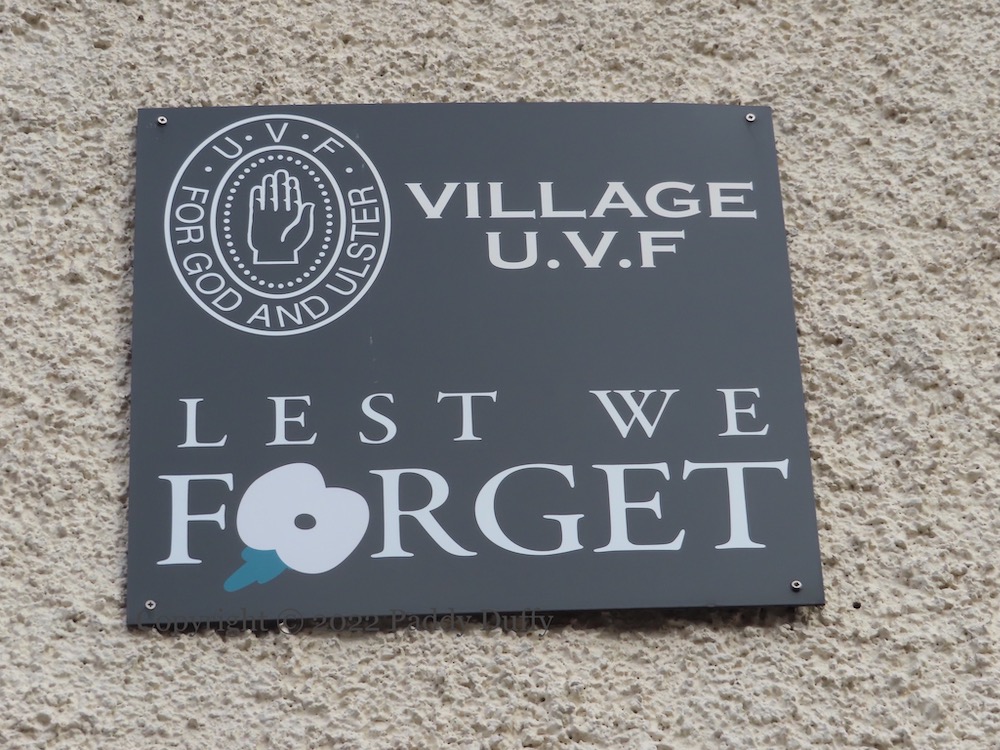
Territorial markings of the UVF are posted on the new development on the east side of the Village. These images are all from the Kitchener Drive, which has new houses in Kitchener St and Soudan St.
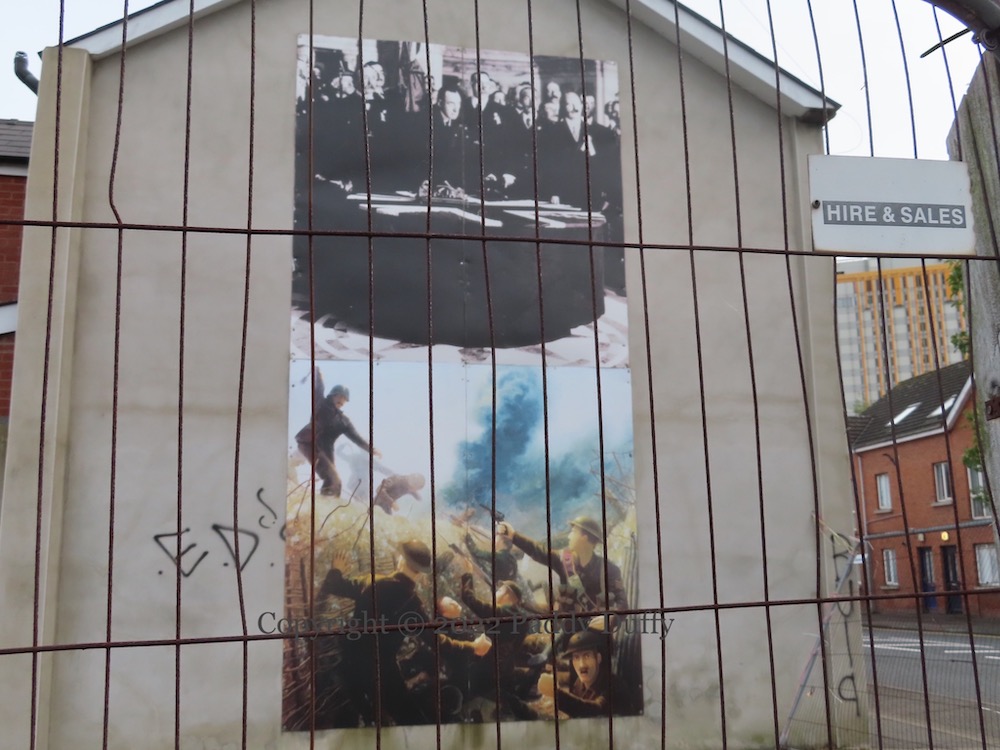
Here are a pair of boards in Barrington Gardens, Belfast: above, the signing of the Ulster Covenant, on September 28th, 1912; below, an attack on British trenches, perhaps intended to represent a scene from the first day of the Battle Of The Somme, July 1st, 1916.
Footballer Billy Simpson moved from Linfield to Rangers in 1950 and over the course of nine years and 239 appearances scored 163 goals. He also scored the winner for Northern Ireland against England in 1957. Simpson died in January of year 2017 and is remembered by this board outside the Supporters’ Club in Barrington Street, south Belfast.
UVF volunteer John Hanna was 19 years old when he was killed by “the enemies of Ulster” (the IRA) at his home on Donegall Road in the Village. This new board is in Prince Andrew Park, just off Donegall Road. “Always remembered by the officers and volunteers South Belfast [2nd Batt Sandy Row] UVF”.
On the side-wall, the poppies and the downcast soldiers come from the first World War but the names are all of modern UVF and RHC volunteers, from 1976 to the present day.
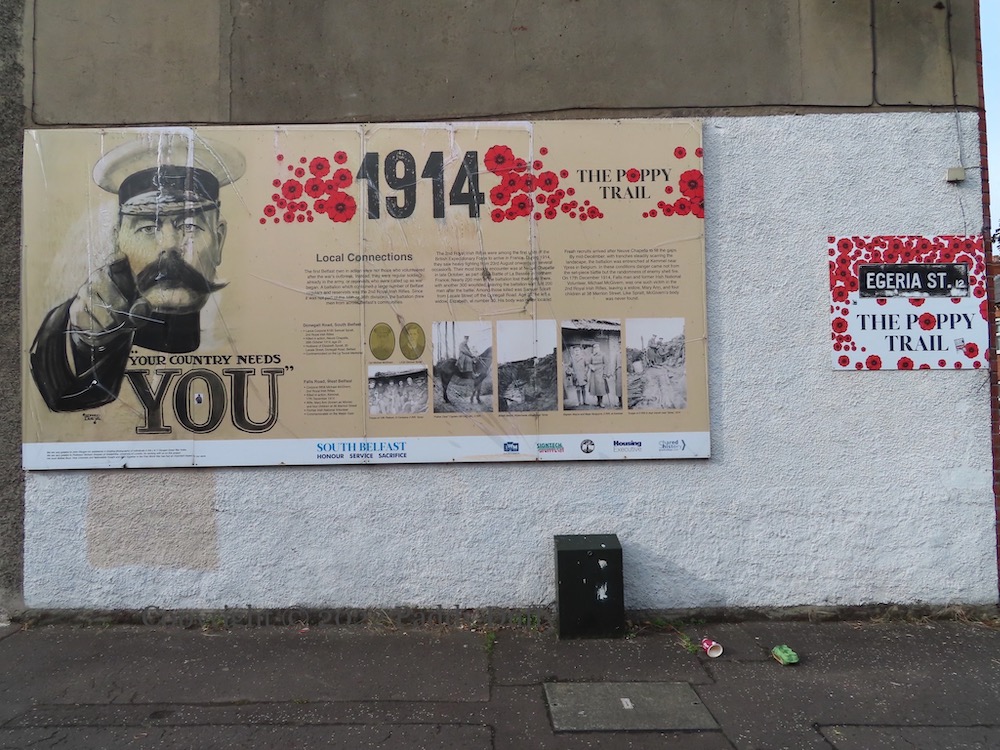
“The first Belfast men in action were not those who volunteered after the war’s outbreak. Instead, they were the regular soldiers already in the army, or reservists who were called up as war began. A battalion which contained a large number of Belfast regulars and reservists was the 2nd Royal Irish Rifles. Since it was not part of the 16th or 36th divisions, the battalion drew men from across Belfast’s communities.”
Thus begins the 1914 board on south Belfast’s “Poppy Trail” launched on February 29th, 2016. The 1914 board features the stories of Lance Corporal Samuel Spratt (from Lecale Street, off the Donegall Road) who died at Neuve Chappelle in August 1914 and Corporal Michael McGivern (from Merrion Street, off the Falls Road) who died at Kemmel in December.
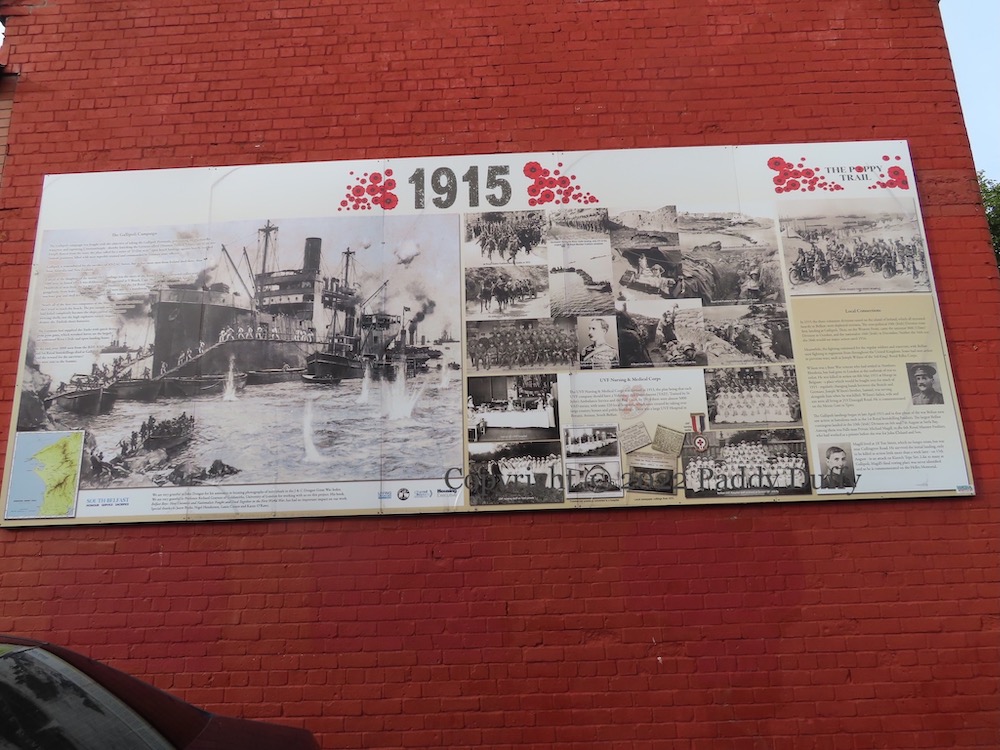
The 1915 board focuses on the Gallipoli campaign, claiming that “more men from Ireland died there than from Australia and New Zealand.” The ship on the left-hand side is the River Clyde, a converted collier, carrying men from the 1st Royal Dublin and 1st Royal Munster Fusiliers, who were decimated as they tried to reach shore — “only 372 of the original 900 1st Royal Munster Fusiliers remained”.
As with the 1914 board, the 1915 board includes the stories of men from both south and west Belfast, in this case, Joseph Wilson, who hailed from Donegall Road and died in Belgium, and Michael Magill, from the Divis area, who died at Gallipoli.
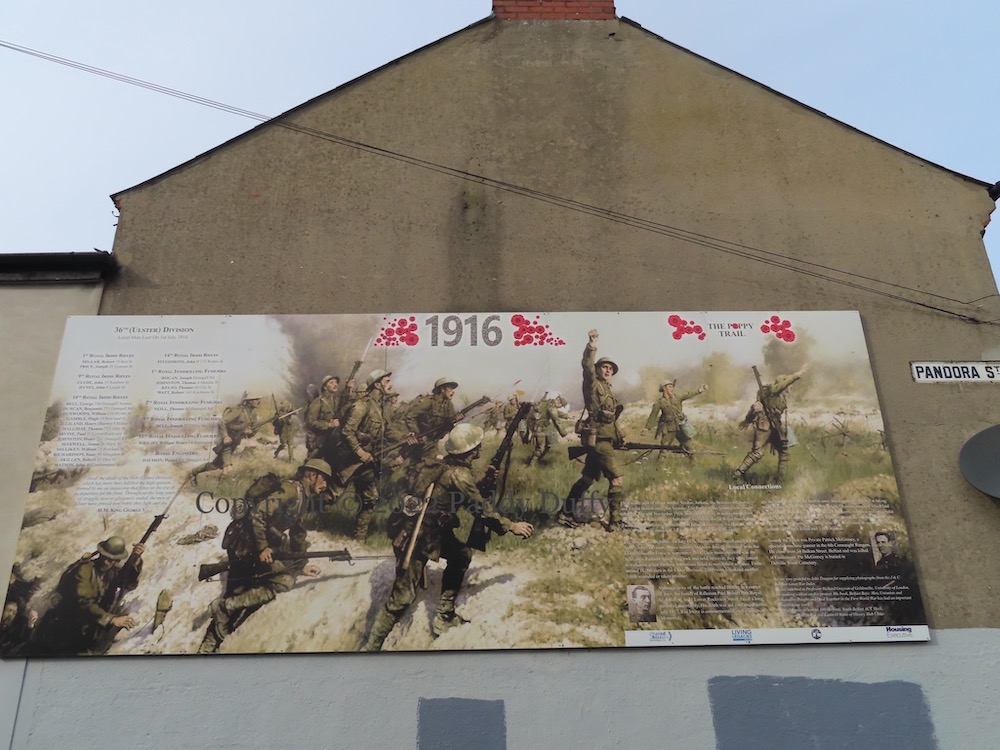
In the 1916 board, JP Beadle’s Battle Of The Somme, Attack Of The Ulster Division is reproduced in the 1916 installment of the Poppy Trail in south Belfast. (For more on the painting, see belfastsomme.com.) In addition to listing local men lost in on July 1st – from places such as Roden, Matilda, Kitchener, Barrington, Blythe, Ebor, Rowland, Abingdon, and Combermere Street – it also features an individual from each community who served and died, in this case, Rifleman Paul Irvine from Lower Rockview Street and Private Patrick McGinney from Balkan Street (in the Divis area).
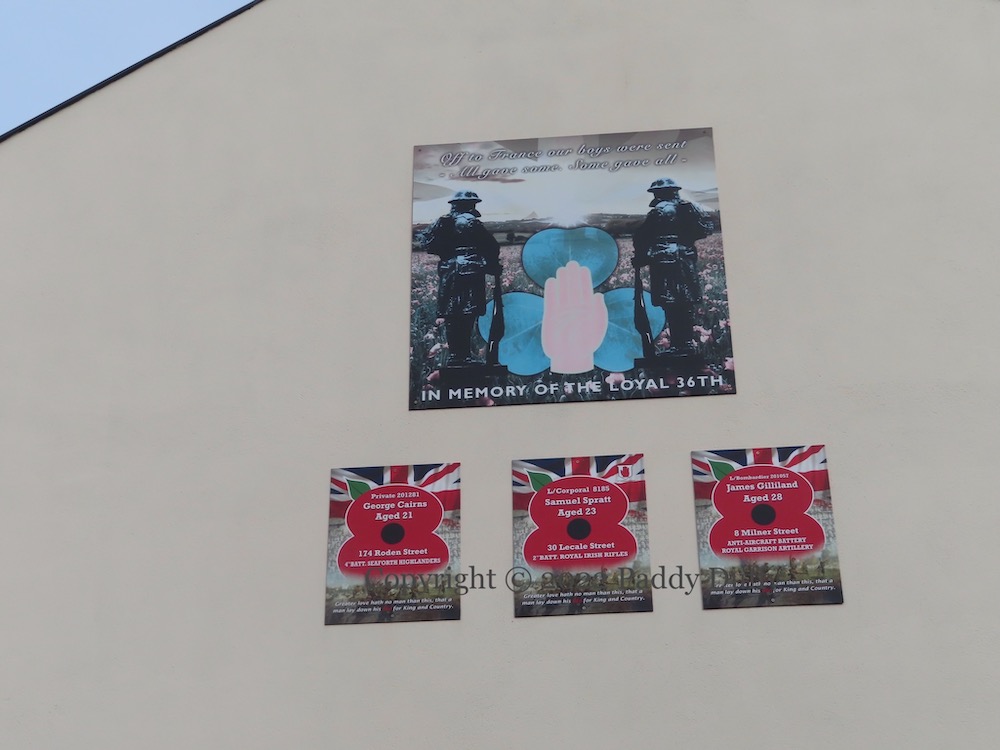
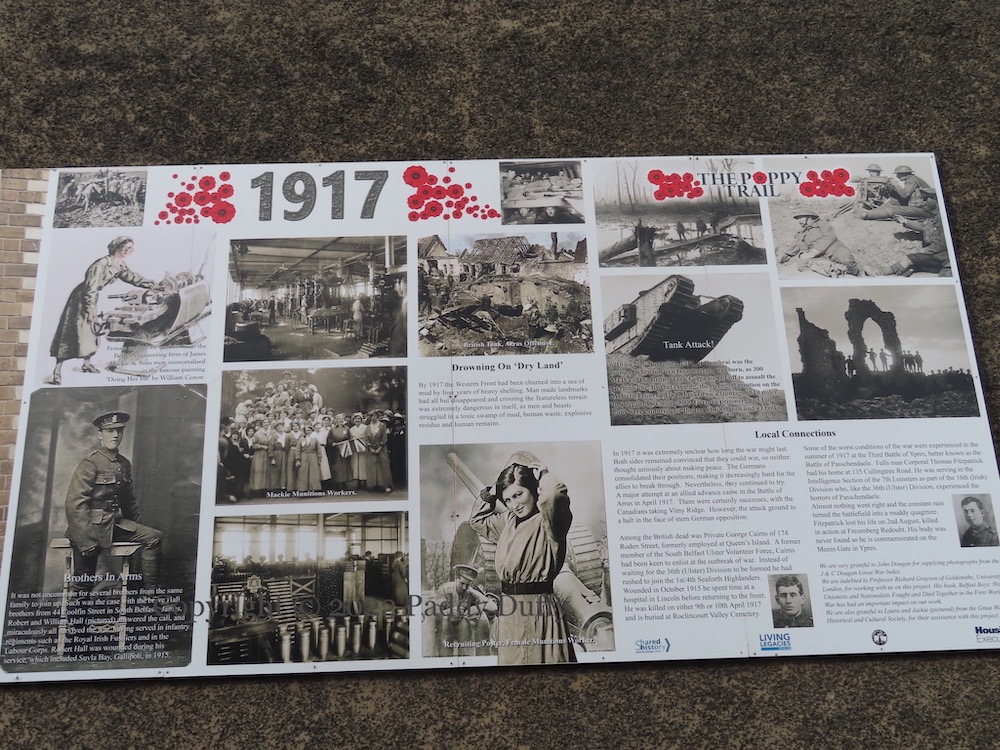
The 1917 board in the Poppy Trail series celebrates female munitions workers as well as making local connections to the battles of 1917: George Cairns of Roden Street and Thomas Fitzpatrick of Cullingtree Road.
Egeria Daphne, Pandora, Euterpe streets, south Belfast. The HMS Hawke board is on the other side of Donegall Road, in Barrington Gardens.
HMS Hawke was a Royal navy WWI cruiser sunk by German U-boat on October 1st, 1914. It was a training ship, which meant that among the 542 sailors who lost their lives on the Hawke, 75 of them were 16 year-old boys. Five of the deceased were from the Donegall Road area.






 Paddy Duffy Collection