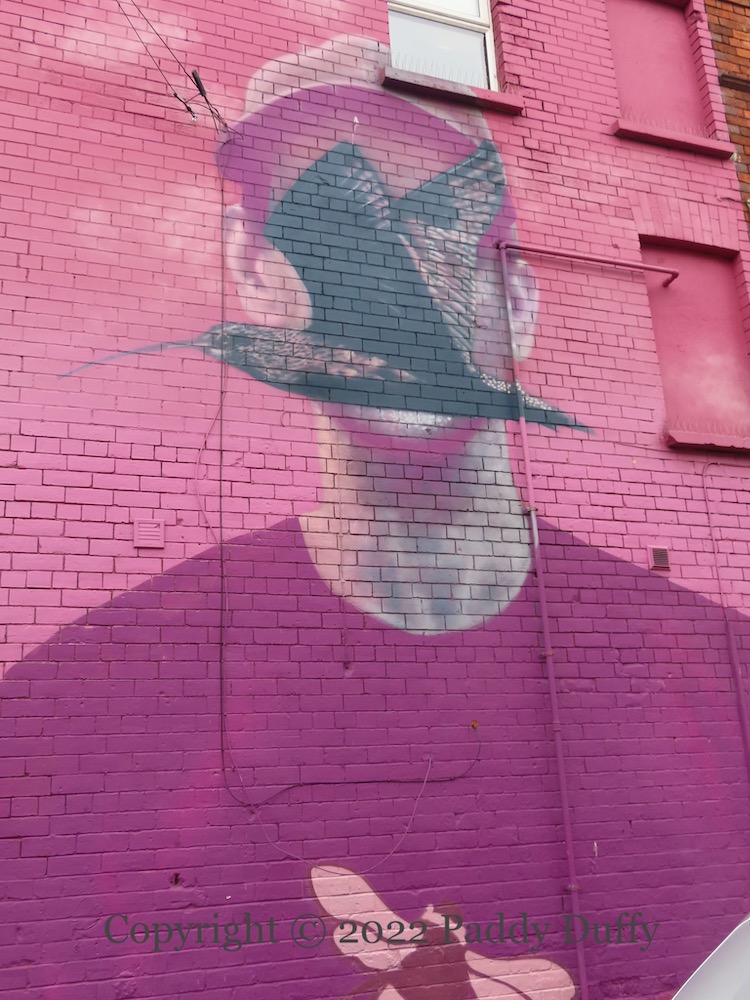
The Lower Ormeau Cafe & Guesthouse (Fb | web), which opened in October 2017, added a mural in 2019 of the nearby Belfast Gasworks in Victorian times – the building still stands today, although it ceased to function as a gasworks in 1988.
This is and old (2009) repaint of the mural in the Markets to IRA volunteers: They are: Tony Nolan, Joseph Downey, Frank Fitzsimons, Joey Surgenor, Paul Marlowe, Jim Templeton, and Brendan Davison.
One of the first casualties of the Easter Rising, on the evening of Good Friday, was Belfast-born Charles Monahan (Charlie Monahan, Cathal Ó Monacháın/Ó Muıneacháın), who died along with Con Keating and Daniel Sheehan in a motor accident in Kerry, when their car – which only had one headlamp – was driven off a pier. His body was not found until October 30th. The driver, Tommy McInerney – shown here studying a map – survived. This mural is in the Markets; Monahan is also claimed by east Belfast and a 2006 mural to him was painted on Mountpottinger Road (Visual History).
“Born in Riley[‘s] Place in the Market area of Belfast, Charles was one of many people who left Belfast to take part in the events leading up to the Easter Rising. Charles[‘s] role was to meet up with 3 other vols and help guide Roger Casement (top left) land a ship full of weapons. On the 21st April, 1916, the driver took the wrong road and drove off the pier into the Laune at Ballykissane. Charles, 37, drowned along with two of his comrades.”
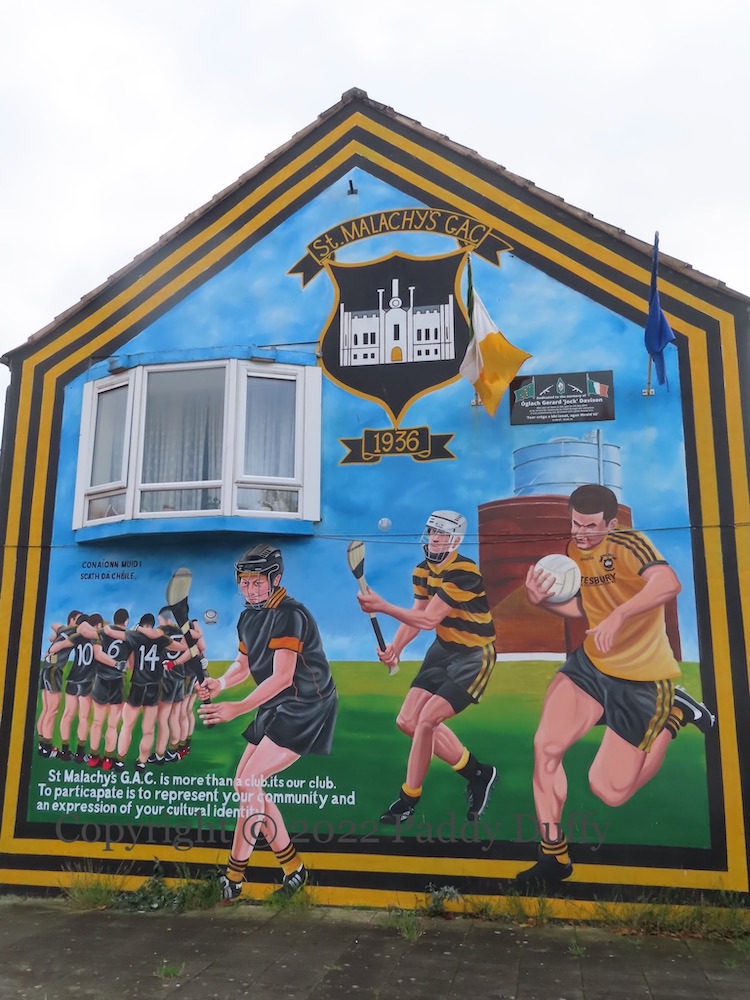
“Saint Malachy’s G.A.C. is more than a club. It’s our club. To participate is to represent your community and an expression of your cultural identity.”
This is the 2021 repaint of the mural celebrating Gaelic games in the parish of St. Malachy/Naomh Maolmhaodhóg, in the Markets area of Belfast. The parish church – featured in the top centre – has a celebrated fan-vaulted ceiling (WP). This mural, on the other hand, features a bay window.
“Conaíonn [Cónaíonn] muid ı scath dá chéıle” is a straightforward rendering of the epigrammatic “Ar scáth a cheıle a mhaıreann na daoıne”, which was included in the previous version – see Cultural Identity.
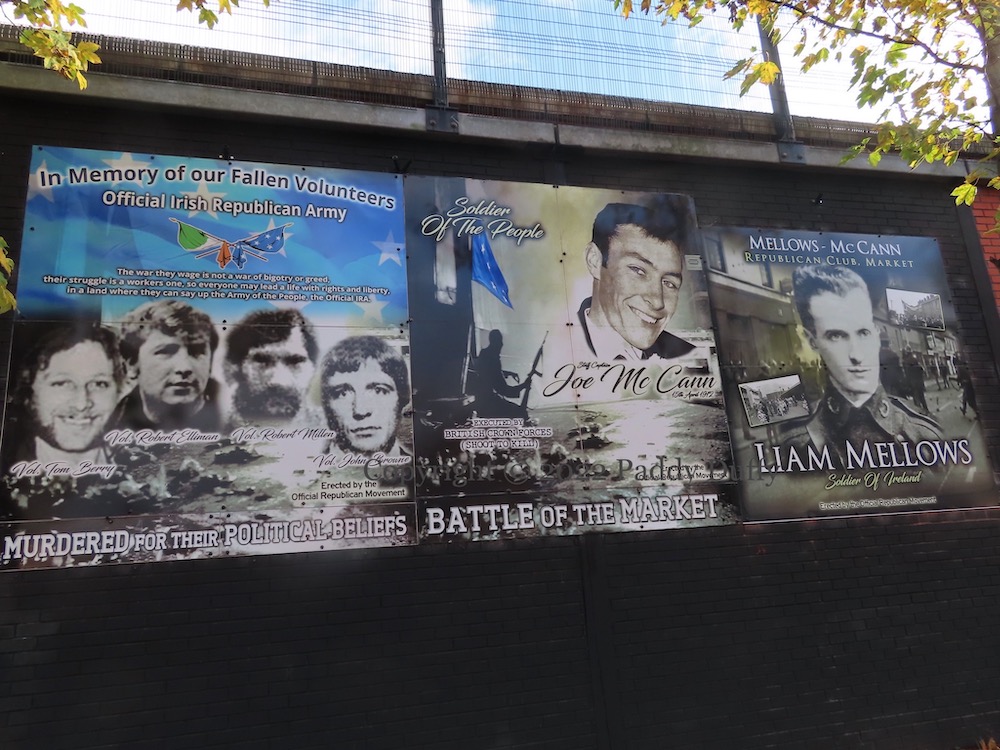
Left: “Murdered for their political beliefs: Tom Berry, Robert Elliman, Robert Millen, John Browne”. All four had a connection Markets or Ormeau area of south Belfast. Millen, from the Ormeau area, was shot in 1973 by the UVF; he played on the same soccer team (Bankmore Star) as Thomas Berry, who was shot in a Short Strand GAA club; Elliman was shot in a Markets pub; John Brown (without the “e”) was shot in his Cooke Street home in front of his family. The first three were all Protestants; the latter three were among 11 people who died in the 1975 feud between the Officials and the Provisionals. (Lost Lives)
“The war they wage is not a war of bigotry or greed, their struggle is a workers one, so everyone may lead a life with rights and liberty, in a land where they can say “Up the Army of the people, the Official IRA”.” “Erected by the Official Republican Movement.”
Centre: Internment (imprisonment without trial) was introduced on August 9th, 1971 by NI Prime Minister Brian Faulkner, with 342 people arrested on the first day. The Bogside was “hysterical with hated”, according to Eamonn McCann (History Ireland) and of Belfast Kevin Myers wrote “Insanity seized the city.” Two dozen people would die in the rioting and gun-battles that followed, leading to the suspension of Stormont rule (WP). In the Markets area, OC Joe McCann and other (Official) IRA volunteers took over the Inglis bakery and reportedly prevented 600 British troops from entering the area – the image to the left of the board above is a Ciaran Donnelly photograph showing McCann during the battle, kneeling beneath a Starry Plough and holding an M1.
Right: After serving in the IRA in the War Of Independence, Liam Mellows was elected to the First Dáil and as a member of the second Dáil voted against the Treaty in January 1922 (his speech is recorded in Oireachtas.ie under the name “Liam Mellowes”). In the Civil War that followed, he served as IRA quartermaster in the force in the Four Courts that surrendered to Free State forces on June 30th, 1922. He was imprisoned in Mountjoy and executed in December, in reprisal for the killing of Seán Hayes (see Executed). (WP | An Phoblacht) His proposals for government were published posthumously as ‘Mellows Testament’ (NLI) and include state ownership of heavy industry, large estates, the transport system, and the banks. The sticker below quotes from that document: “Ireland, if her industries and banks were controlled by foreign capital, would be at the mercy of every breeze that ruffled the surface of the world’s money-markets.”
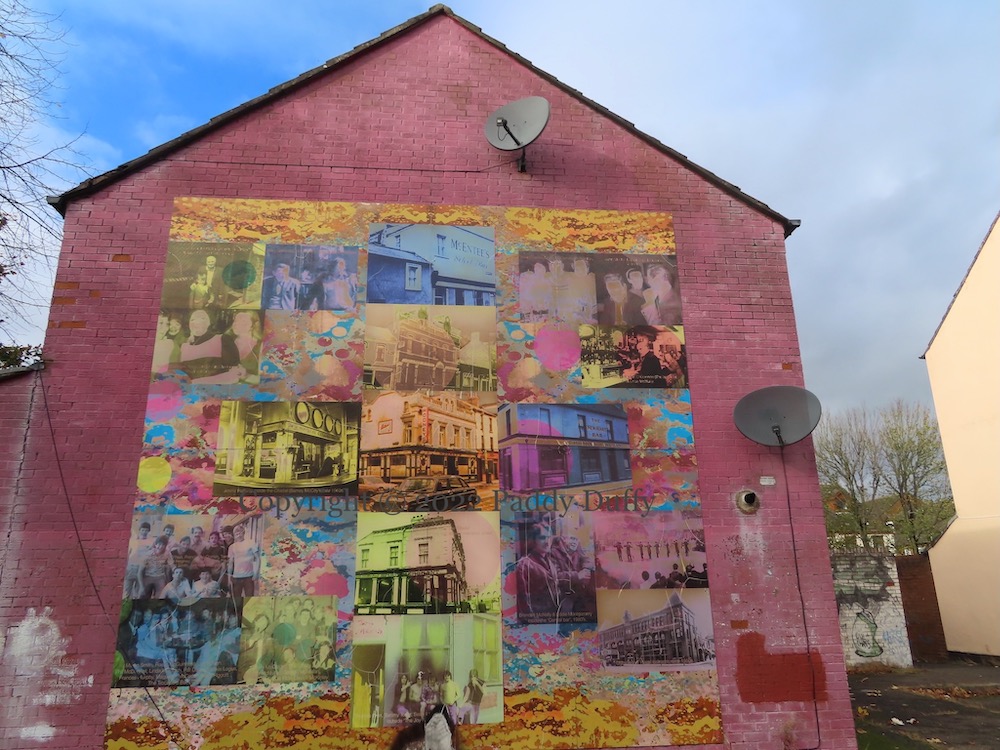
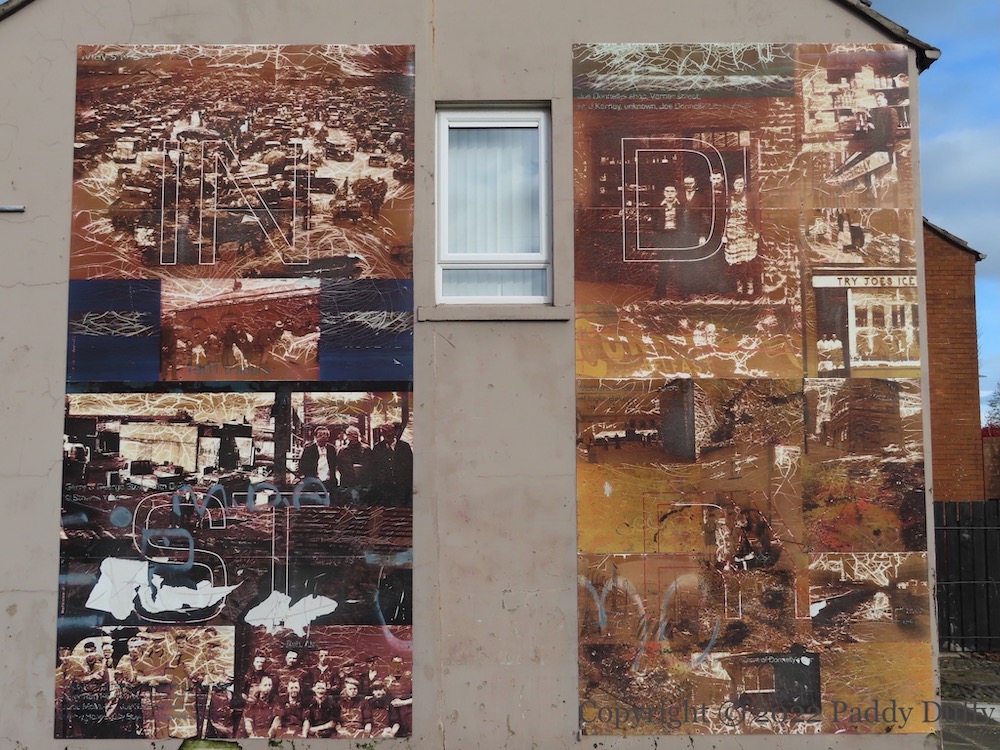
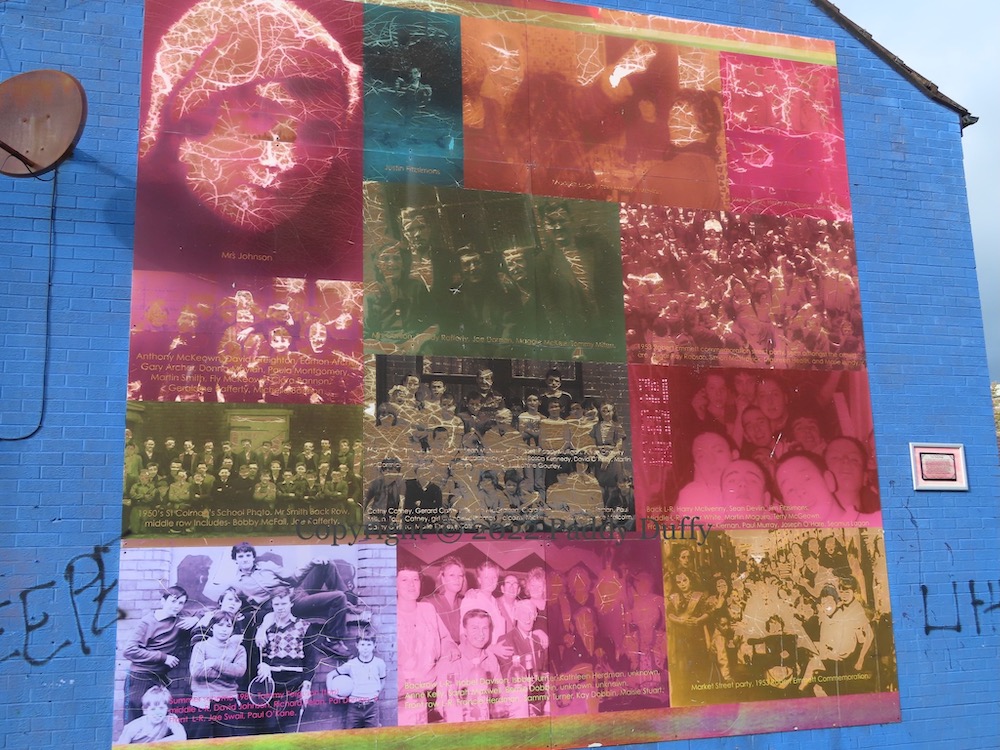
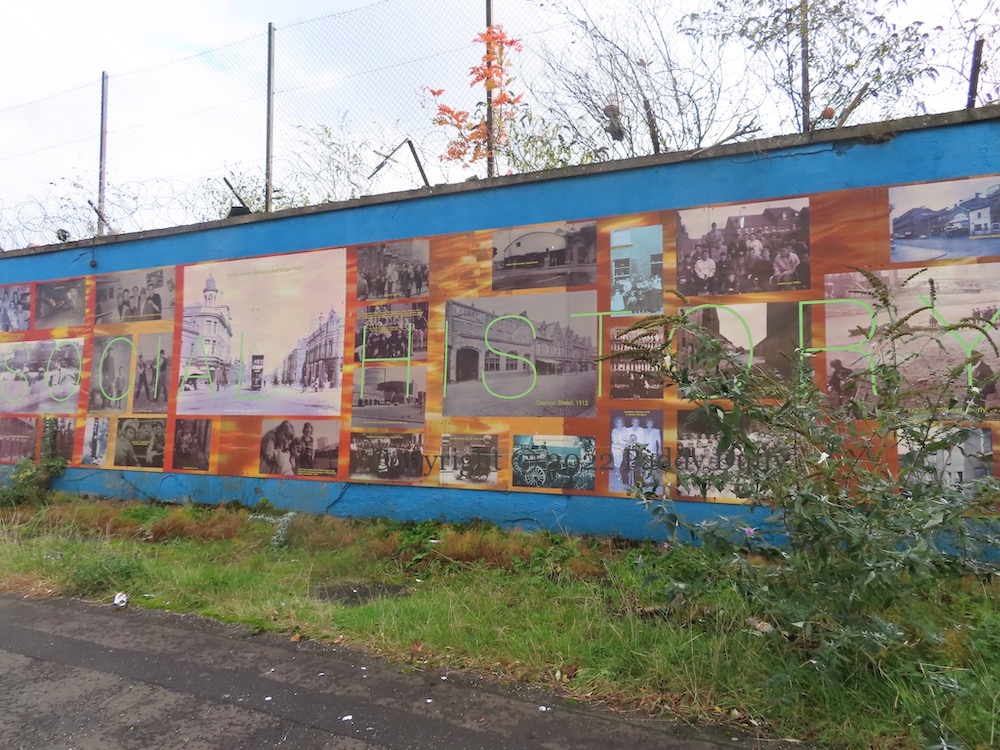
Artist Raymond Henshaw produced a series of boards in 2008 and 2009, with support from the Arts Council, depicting the Markets area in the good old (i.e. pre-Troubles) days. Above are the bars of the Markets and below ‘industry’, ‘social’ and ‘social history.
“Remember the fallen, care for the living”. Five boards arranged into a single piece in Ebor Street, south Belfast. The large bottom panel features a silhouette of a (staged) photograph taken in Basra (DailyMail) of a soldier on a stretcher giving the ‘thumbs up’ sign.
“May Ulster flourish” as the newly created Northern Ireland under “Sir James Craig, 1st Viscount Craigavon, Prime Minister of Northern Ireland”. The Northern Ireland parliament was opened in 1921 and the coat of arms adopted in 1924 (WP); the Special Constabulary (including the B-Specials) had been formed prior to and in preparation for partition – the quote from Carson (also seen in an east Belfast mural) is from July 12th, 1920.
The text on the board is the same as at WP: “The Ulster Special Constabulary (USC; commonly called the “B-Specials” or “B Men”) was a quasi-military reserve special constable police force in what would later become Northern Ireland. It was set up in October 1920, shortly before the partition of Ireland. It was an armed corps, organised partially on military lines and called out in times of emergency, such as war or insurgency. It performed this role most notably in the early 1920s during the Irish War of Independence and the 1956-1962 IRA Border Campaign. During its existence, 95 USC members were killed in the line of duty. Most of these (72) were killed in conflict with the IRA in 1921 and 1922. Another 8 died during the Second World War, in air raids or IRA attacks. Of the remainder, most died in accidents but two former officers were killed during the Troubles in the 1980s. The Special Constabulary was disbanded in May 1970, after the Hunt Report, which advised re-shaping Northern Ireland’s security forces and demilitarizing the police. Its functions and membership were largely taken over by the Ulster Defence Regiment and the Royal Ulster Constabulary.”
This Belfast Live article (which has images from the launch) leads with the headline that this new board replaces a UVF mural, but there hasn’t been anything on this wall since a large “UDA” lettering in 1999. The adjacent wall, which has now been painted over, previously (in 2010) had a UVF flag which had been vandalised with “Jesus Christ Is Lord Of All’ graffiti by 2017.





 Paddy Duffy Collection