“Stop the war on Gaza! Pray for peace!” There are doves in the upper corners but the central imagery is of a clenched fist and the background shows a republican volunteer (perhaps from the INLA) comforting a Palestinian.
For the mural that this framed image has been added to, see Clós Ard An Lao.
Clós Ard An Lao/Ardilea Close, in the Bone, north Belfast
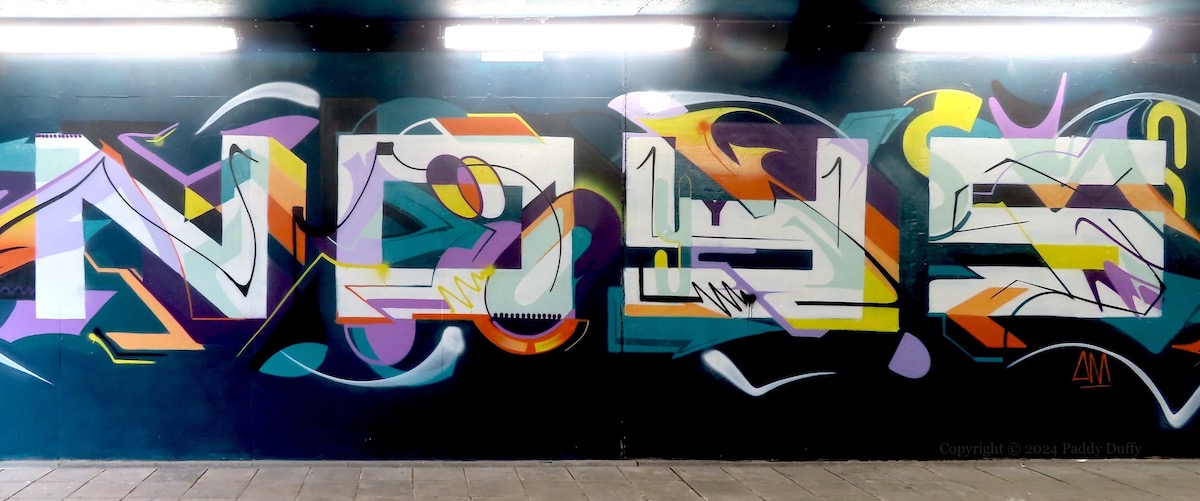
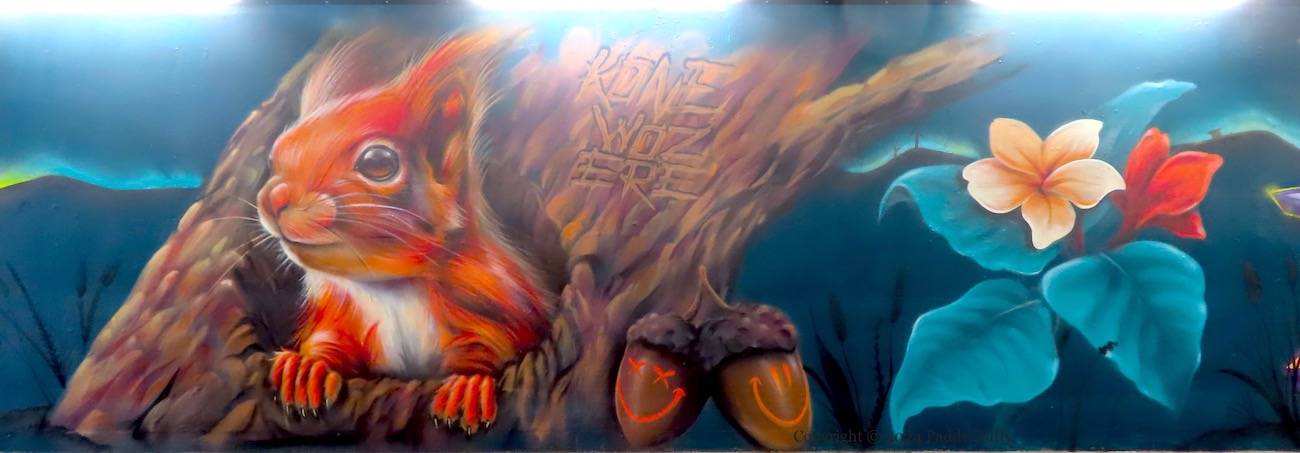
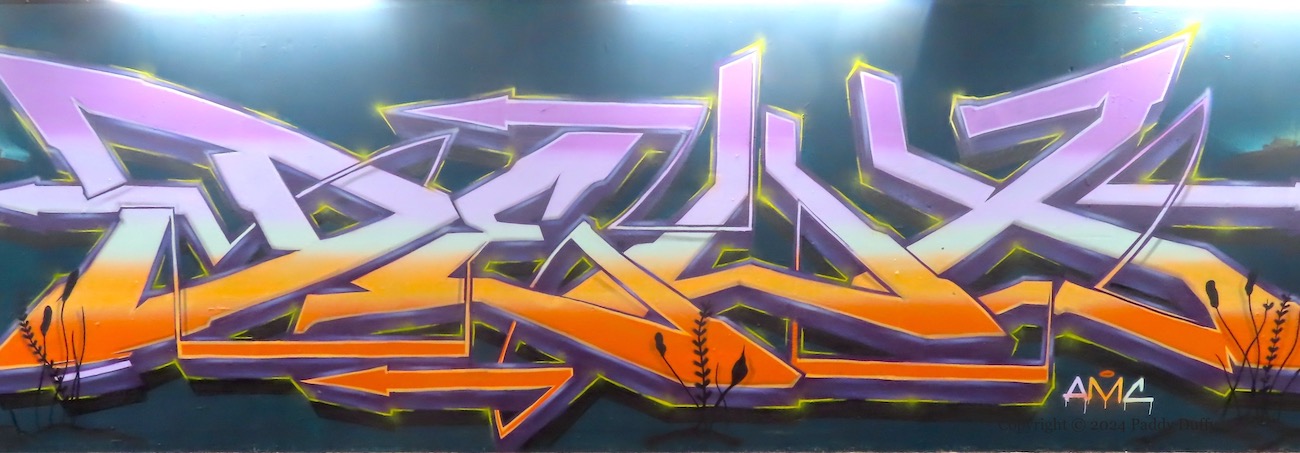
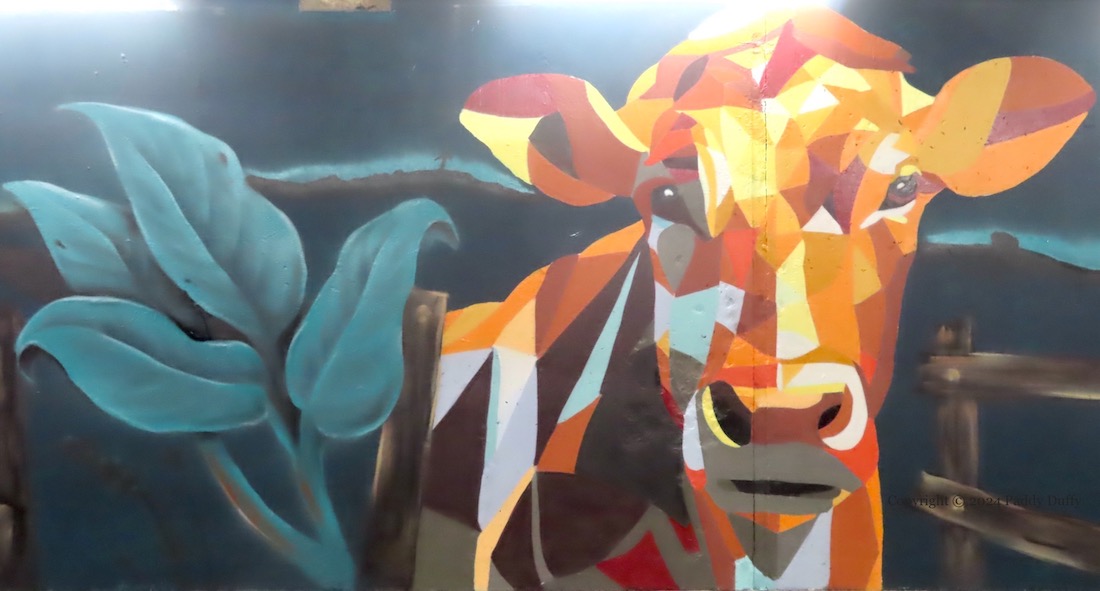
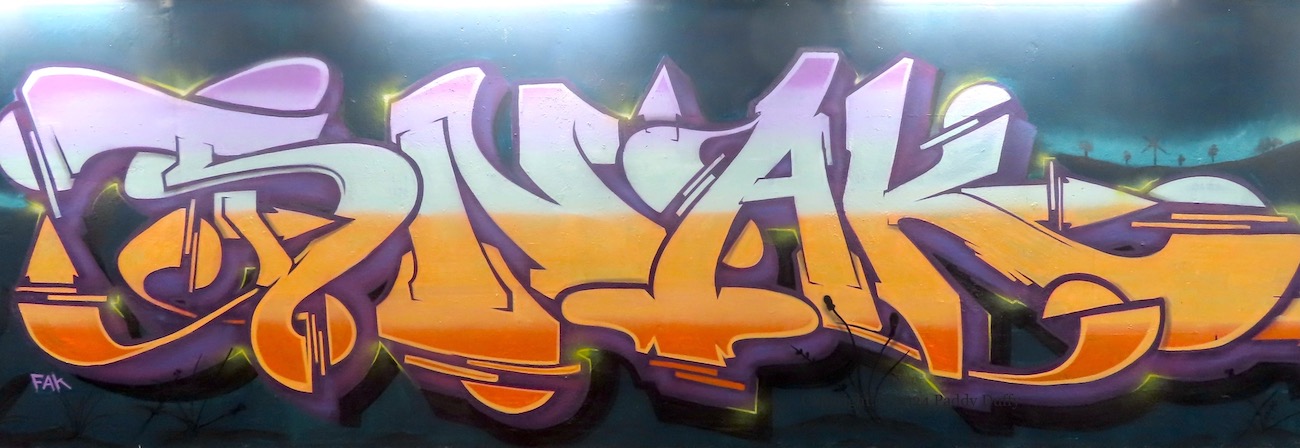
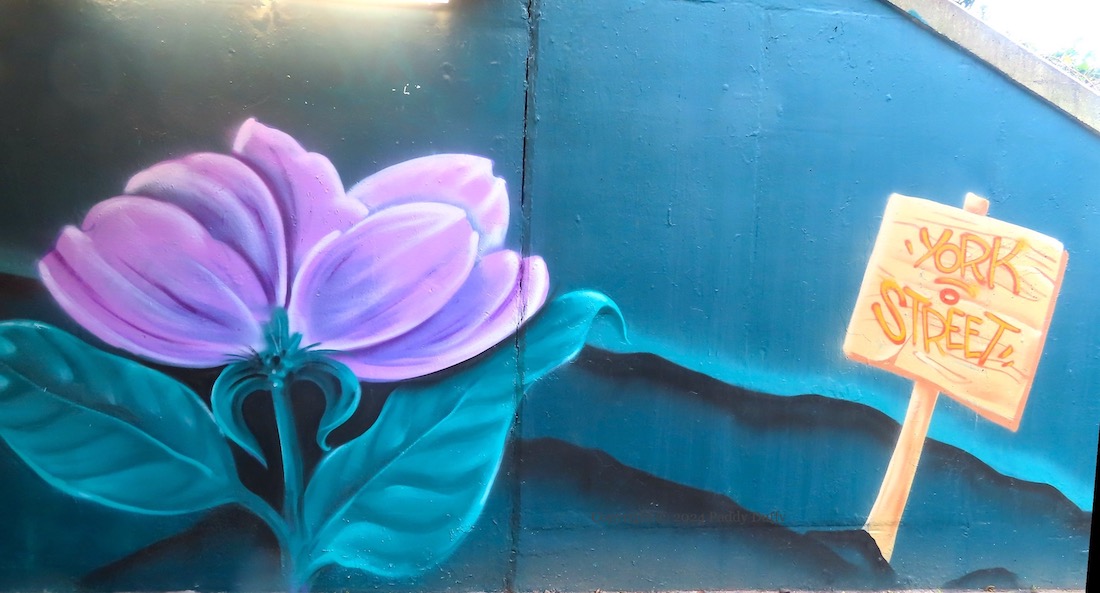
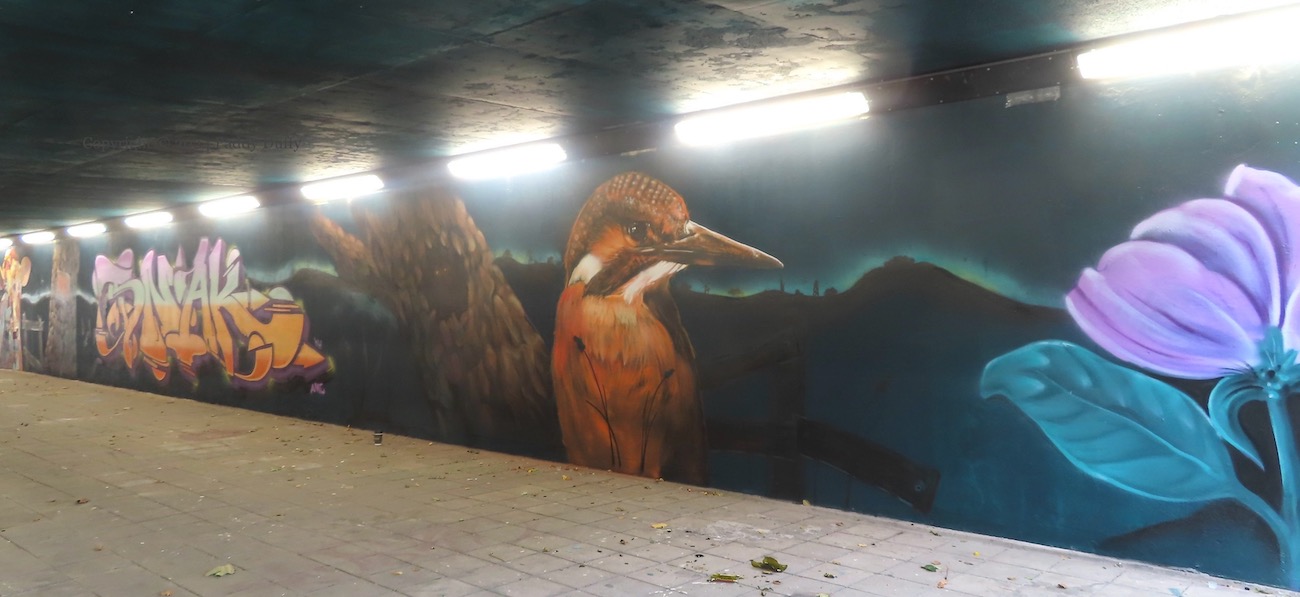
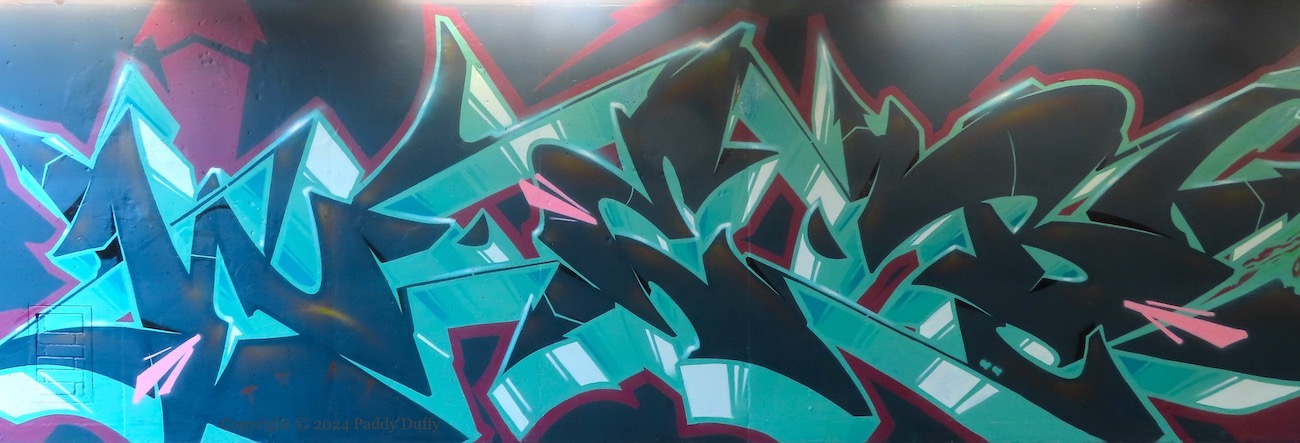
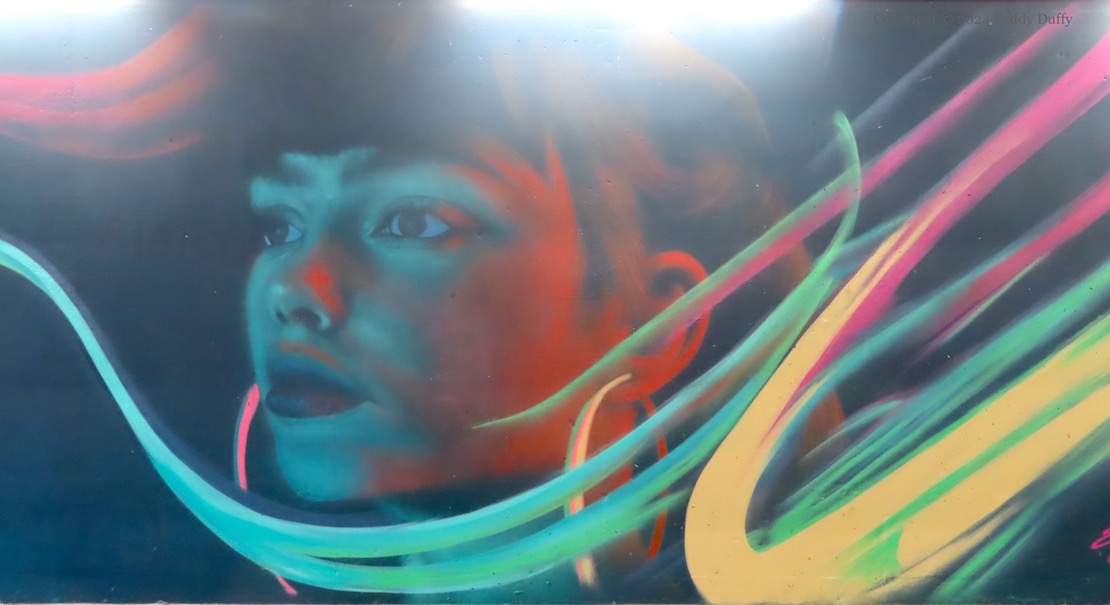
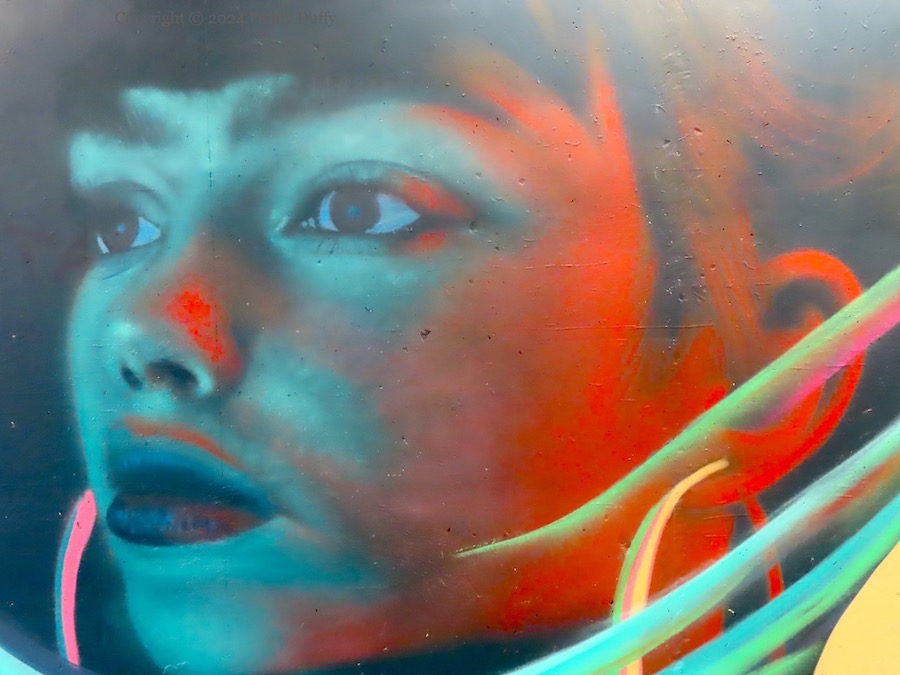
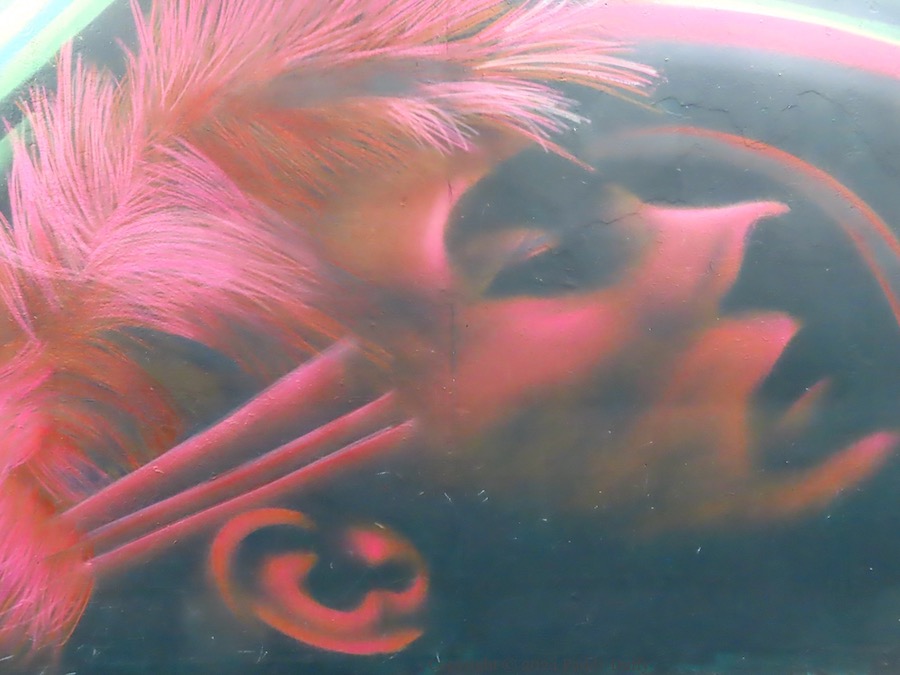
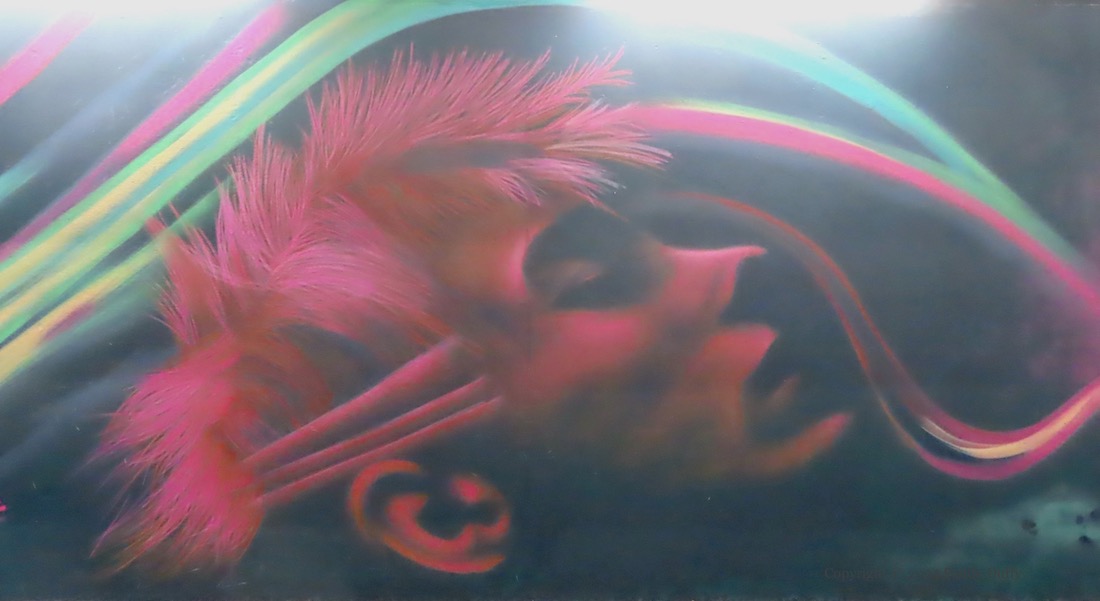
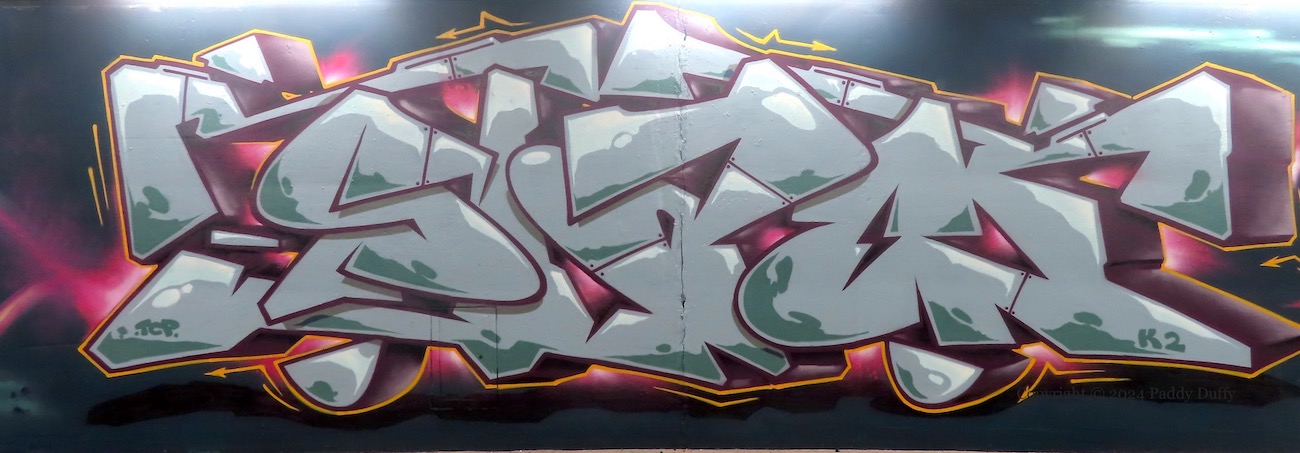
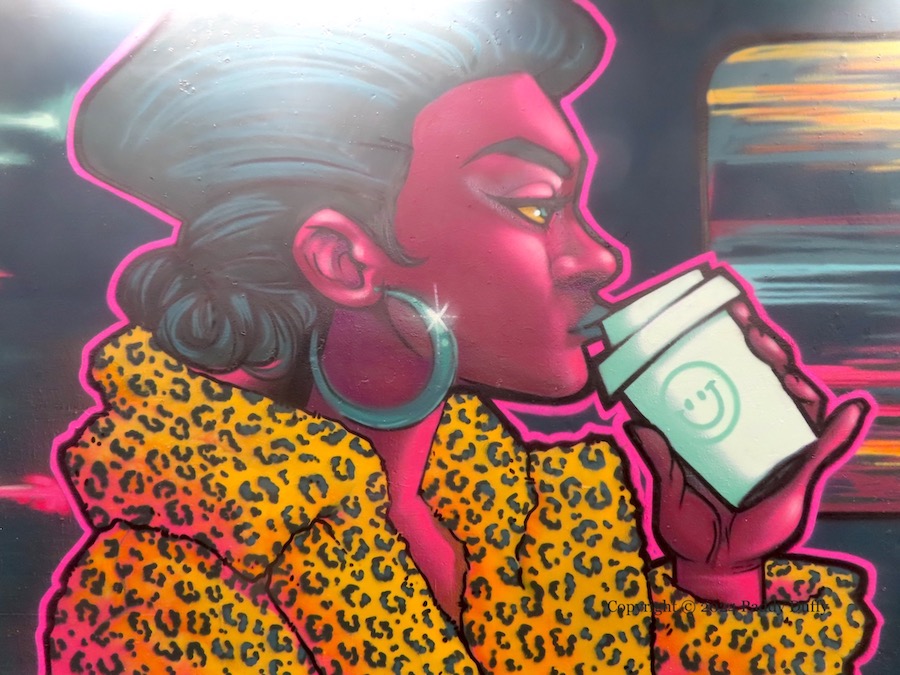
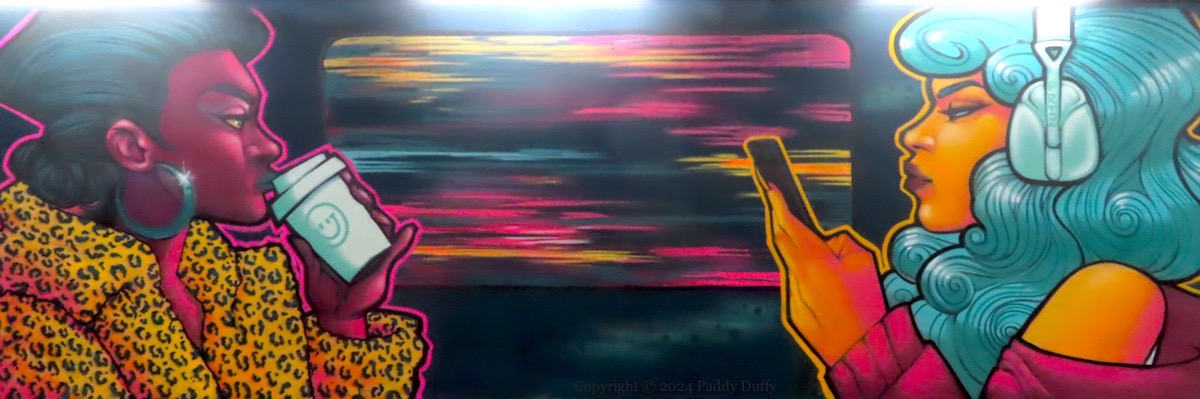
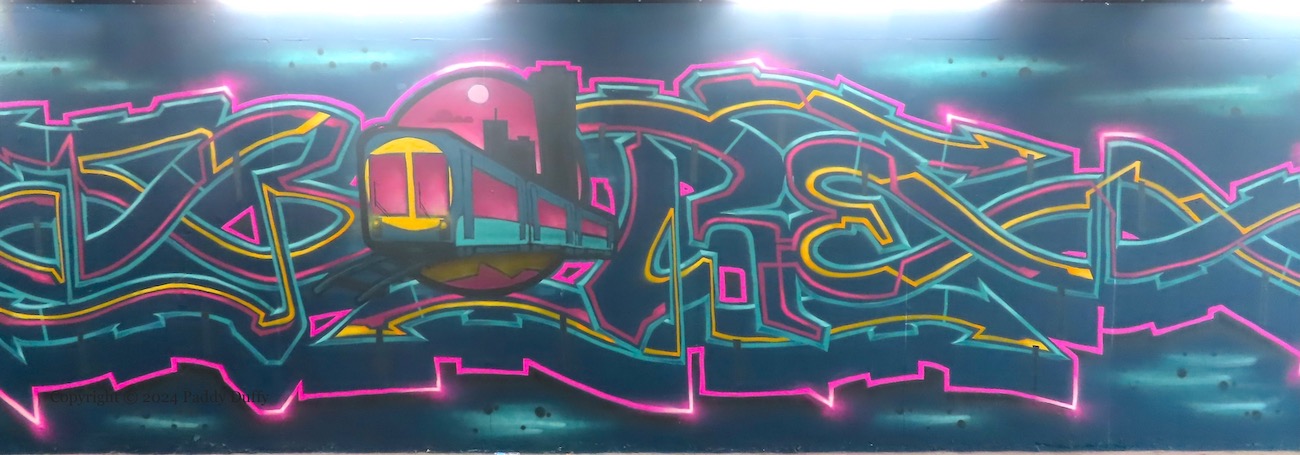
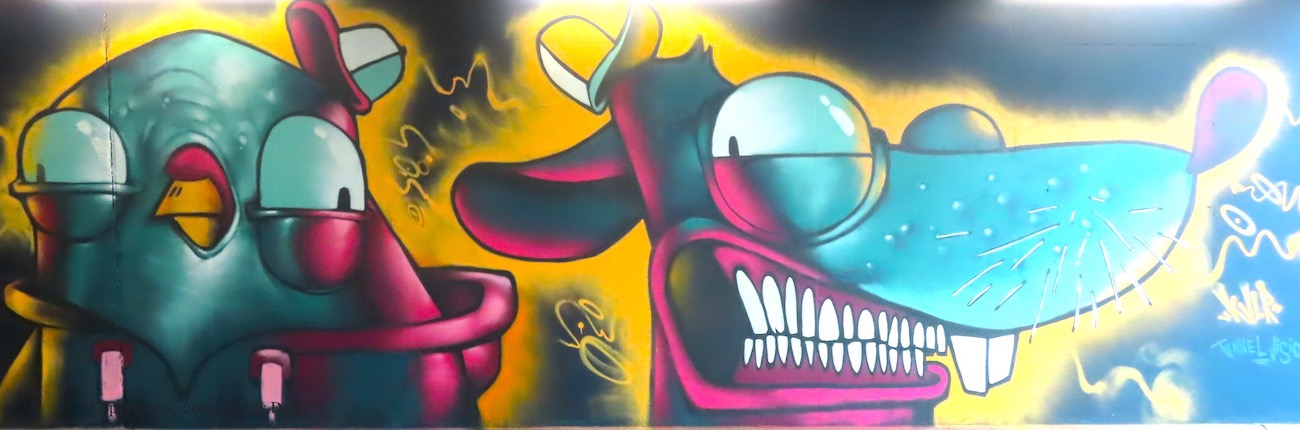
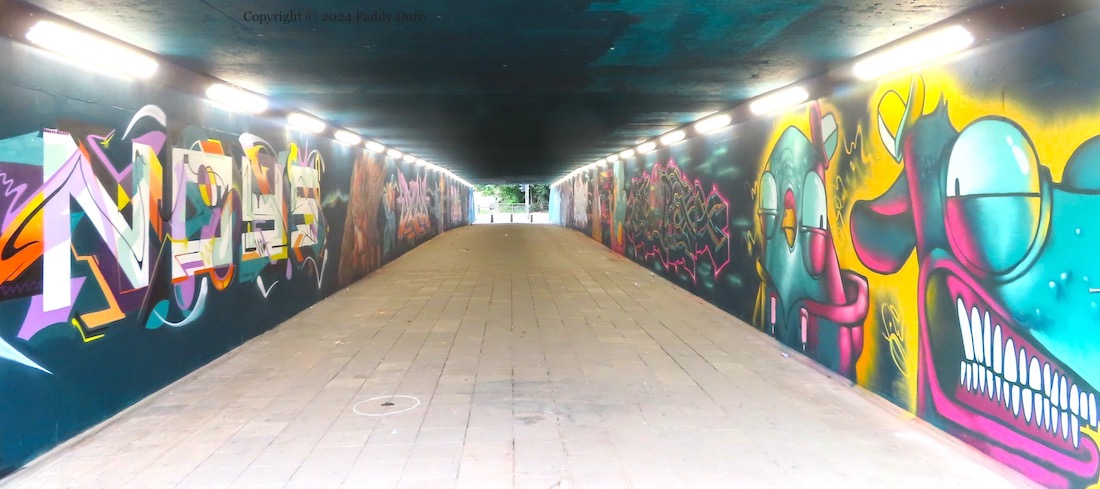
Here is a gallery of the street art and wild-style writing painted in the tunnel at the redeveloped York Street Station (BBC), formerly Yorkgate Halt. Get in touch if you can supply any of the missing artists in the list below …
NOYS (ig) KONE (ig) JAM2 (ig) Karl Fenz (ig) SNAK (ig) Kyle McGinley (ig)
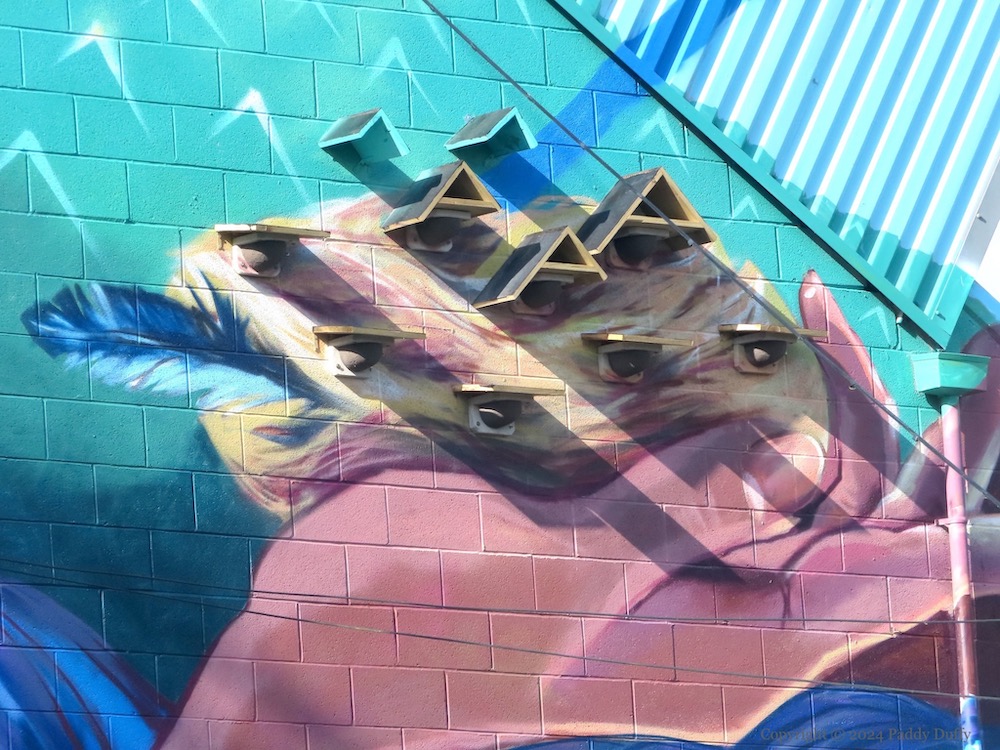
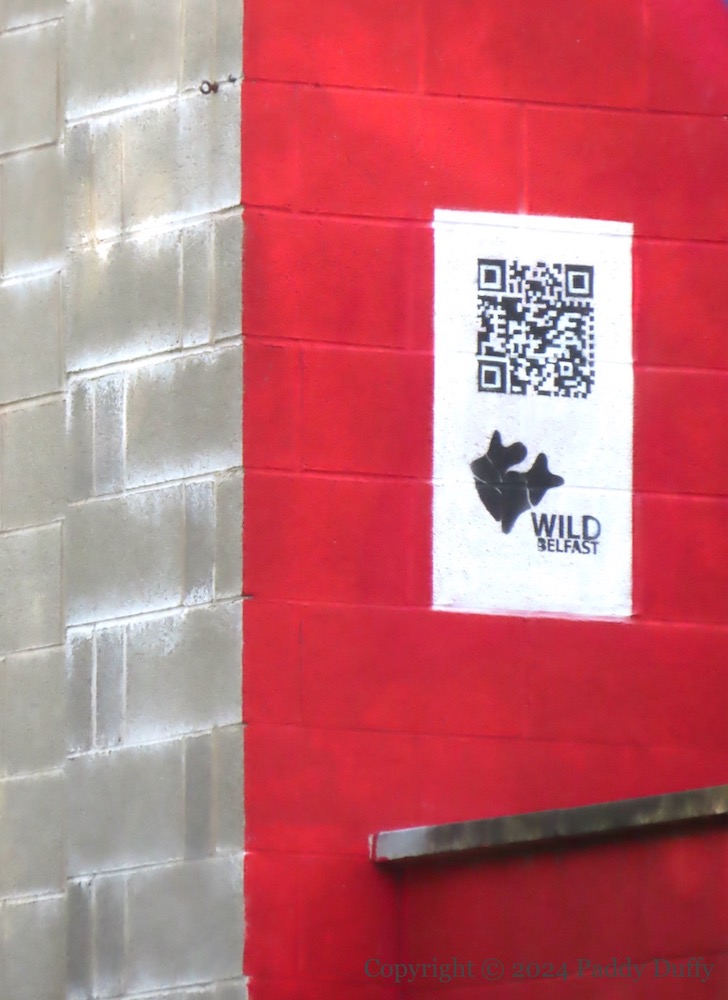
These bird-boxes and platforms were installed by Wild Belfast (web) – a group aimed at enhancing natural habitats – in order to attract house-martins, who visit Ireland in the summer in order to breed, but whose numbers are in decline because of a loss of nesting sites (under the eaves of houses) and building materials (mud).
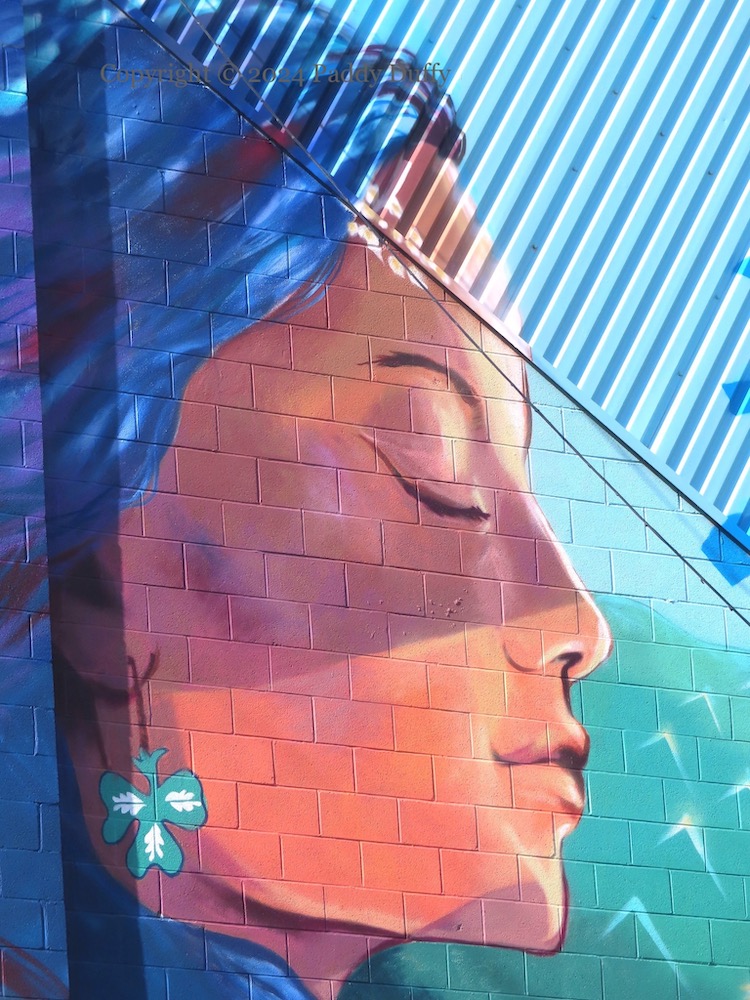
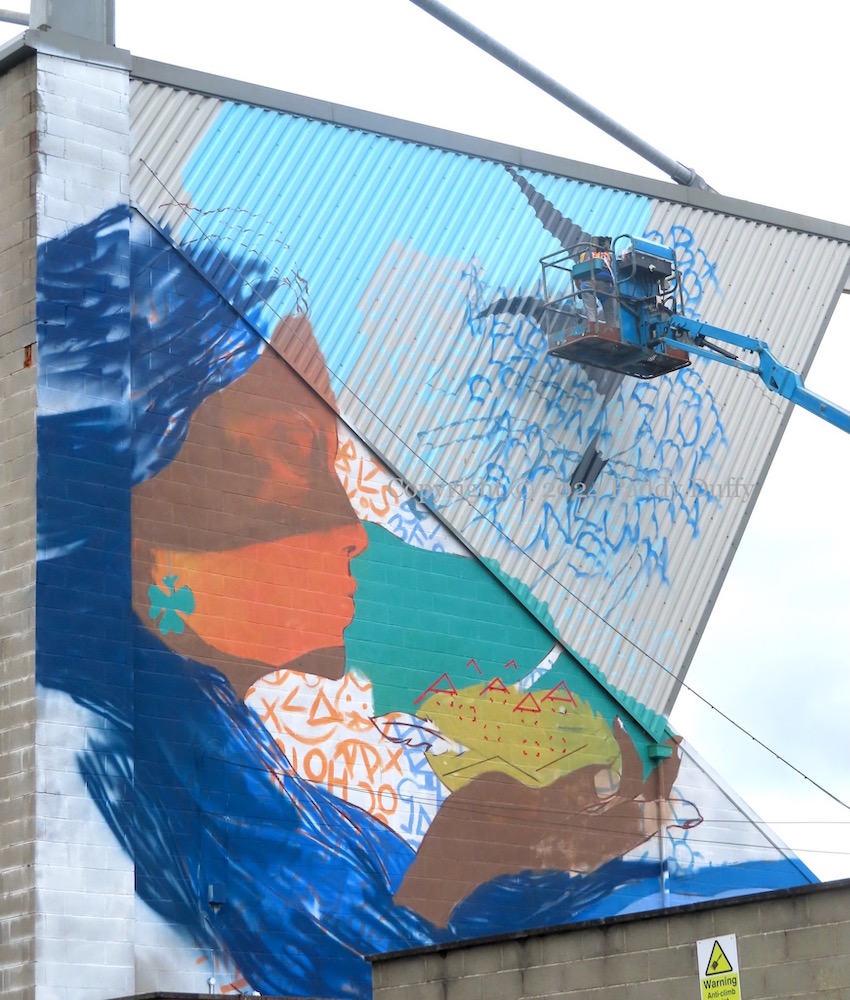
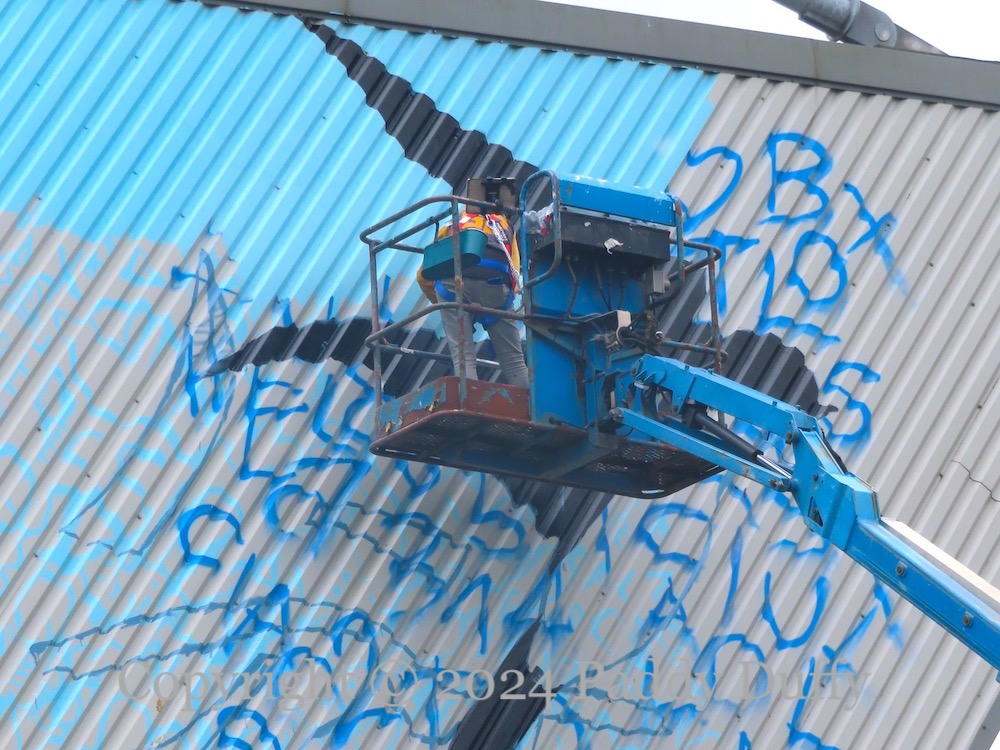
The boxes are in front of street art by artist Daniela Balmaverde (web) on the end of one of the stands at Cliftonville FC (BBC) – the shamrock earrings are the club’s emblem.
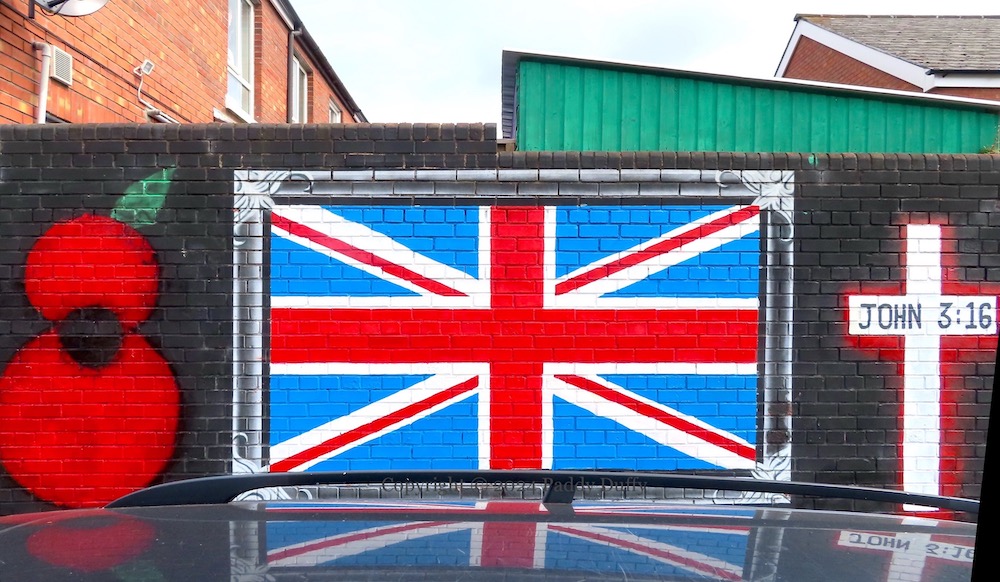
God so loved the world that he gave his only begotten son (John 3:16). And greater love hath no man but to lay down his life for his friends (John 15:13, often used in the context of military sacrifice). But local homes are for local people. (The use of a stencil is a step up in sophistication.)
The Union Flag fills the empty frame where there used to be a list of locals who died in The Belfast Blitz.
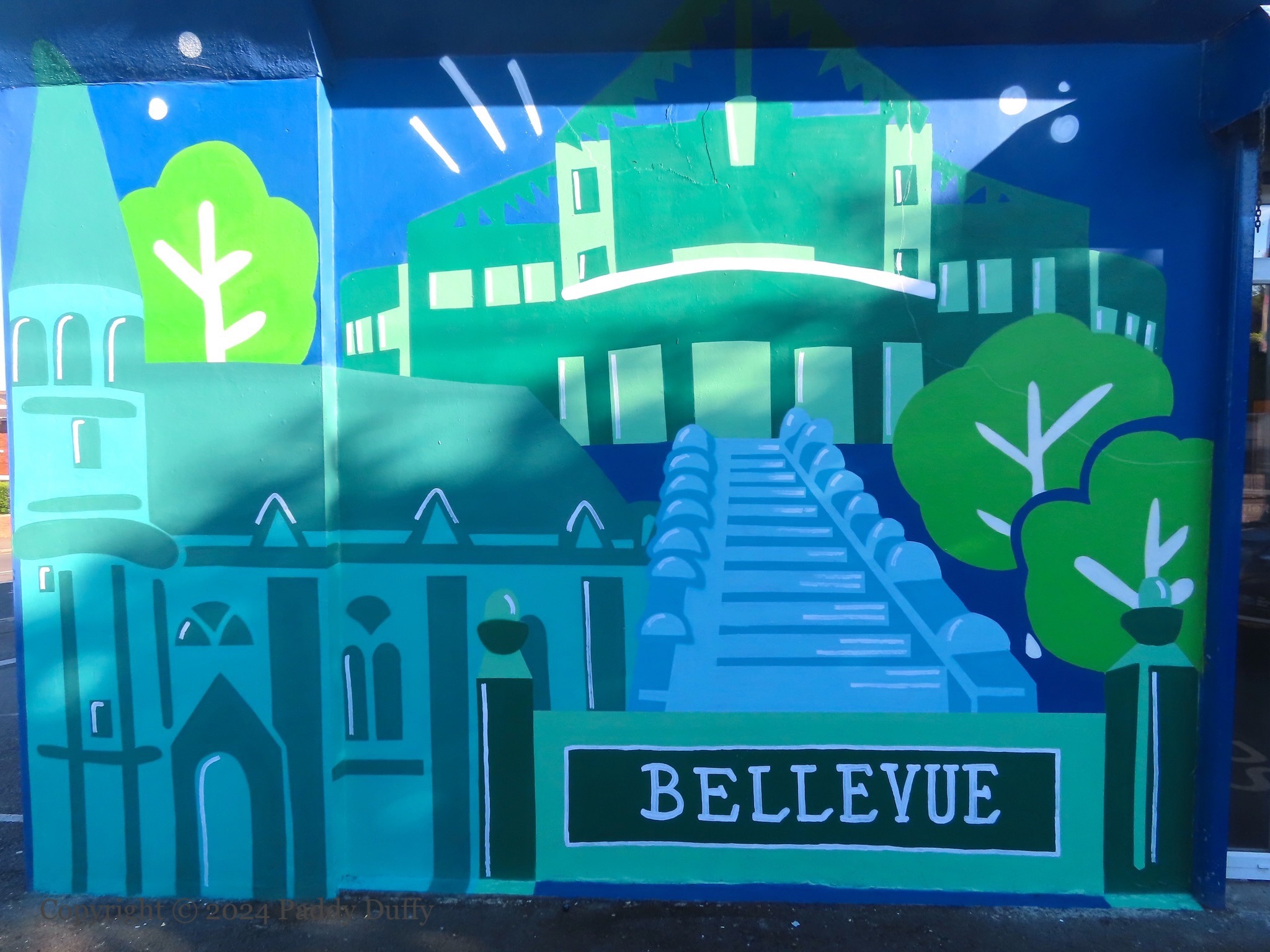
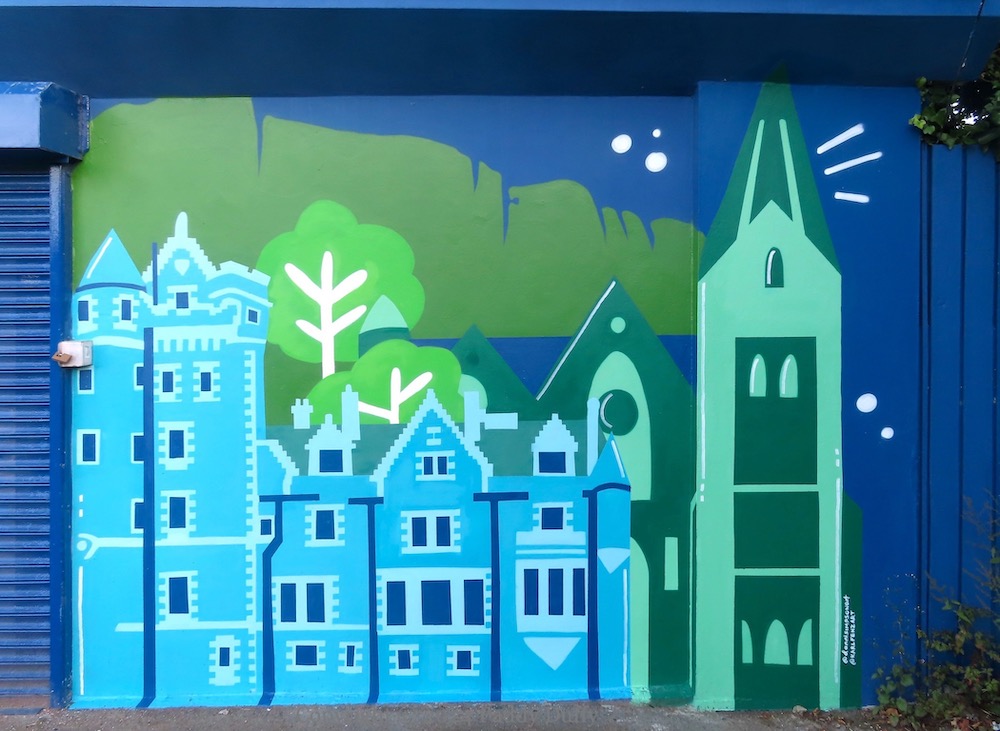
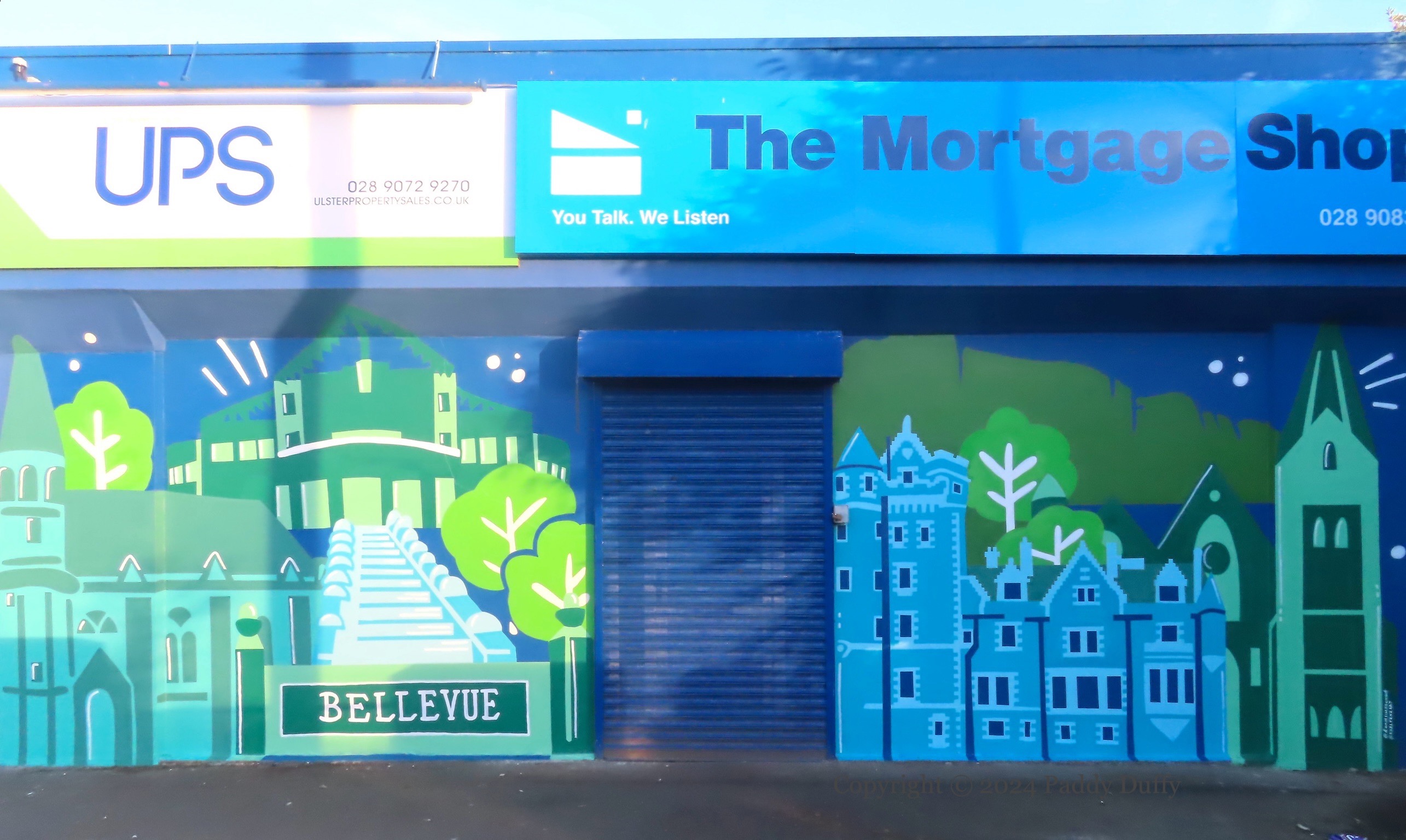
Here are four north Belfast landmarks that are still standing in the shadow of Cavehill, though not all of them are in great shape. From left to right:
Chapel Of The Resurrection (as seen from Innisfayle Park – Street View), originally built in the 1860s as part of the Belfast Castle estate and from 1938 until 1972 a (public) Church Of Ireland chapel (WP), after which it was left derelict until recently being turned into luxury apartments (Property News) as part of “Donegall Park Gardens”;
the Bellevue steps (official title, the “Grand Floral Staircase”) – the currently overgrown steps and a vintage photograph of the steps in happier times can be seen in Everyone Wants To Eat – leading to Floral Hall, which now provides storage space for the zoo – full history at ‘Lord Belmont’ | BelTel;
Belfast Castle;
(perhaps) the former Fortwilliam Park Presbyterian on the Antrim Road (News Letter | BelTel) – once Belfast’s tallest spire (BelTel) – which in 2019 became Immaculate Heart Of Mary/Eaglaıs An Ċroí Ṁuıre Gan Smál (web) saying only the (Catholic) Latin mass.
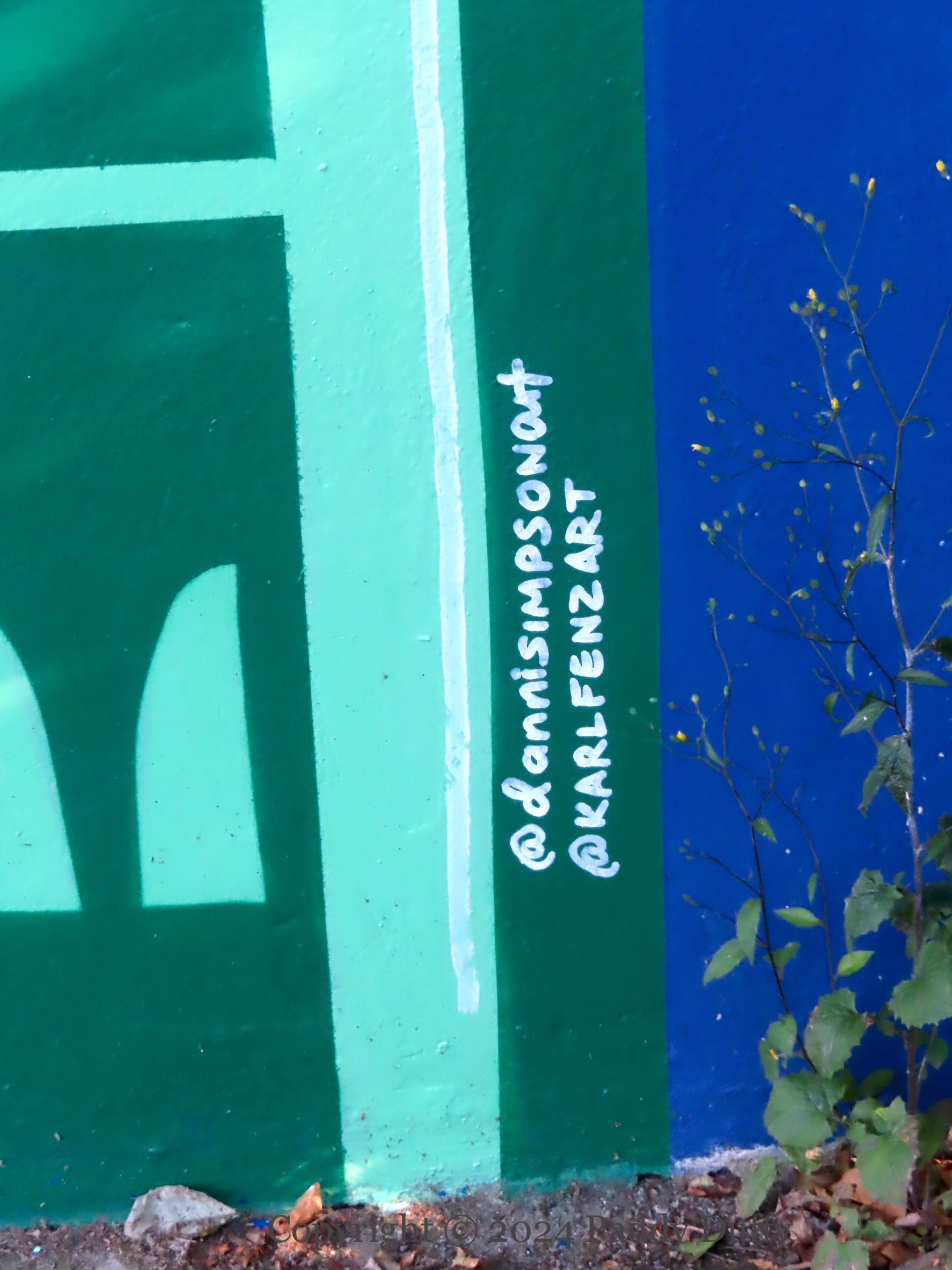
The art is on the walls of UPS estate agents’ at the top of Cavehill Road, north Belfast, by Danni Simpson (web) and Karl Fenz (web), who also did the swan, the fox, and the squirrel on other local establishments.
The two passages cited here have been cited before on the side wall at the junction of the Limestone Road and N Queen St, with images of Orange symbols and Union Flags, in order to promise that Your Kingdom Will Endure Forever. That theme has now been invoked in upper Tiger’s Bay, to celebrate the latest king (Charles III) of the everlasting kingdom demarcated by the shields of the “four nations” in the corners of the main gable, Northern Ireland included.
The people in question in the second book of Samuel are the people of Israel but as with previous scriptural references on the lower wall (Lamentations | Chronicles | Revelations | Psalms | Genesis), the Protestant people in Ireland and Britain are under discussion (though they might also refer to contemporary Israel).
In the King James version, 2 Samuel 7:10-16 the prophet Nathan is speaking to David: “Moreover I will appoint a place for my people Israel, and will plant them, that they may dwell in a place of their own, and move no more; neither shall the children of wickedness afflict them any more, as beforetime, and as since the time that I commanded judges to be over my people Israel, and have caused thee to rest from all thine enemies. Also the Lord telleth thee that he will make thee an house. And when thy days be fulfilled, and thou shalt sleep with thy fathers, I will set up thy seed after thee, which shall proceed out of thy bowels, and I will establish his kingdom. He shall build an house for my name, and I will stablish the throne of his kingdom for ever. I will be his father, and he shall be my son. If he commit iniquity, I will chasten him with the rod of men, and with the stripes of the children of men: But my mercy shall not depart away from him, as I took it from Saul, whom I put away before thee. And thine house and thy kingdom shall be established for ever before thee: thy throne shall be established for ever.”
In Luke 1:31-33, an angel is speaking to Mary: “And, behold, thou shalt conceive in thy womb, and bring forth a son, and shalt call his name Jesus. He shall be great, and shall be called the Son of the Highest: and the Lord God shall give unto him the throne of his father David and he shall reign over the house of Jacob for ever; and of his kingdom there shall be no end.”
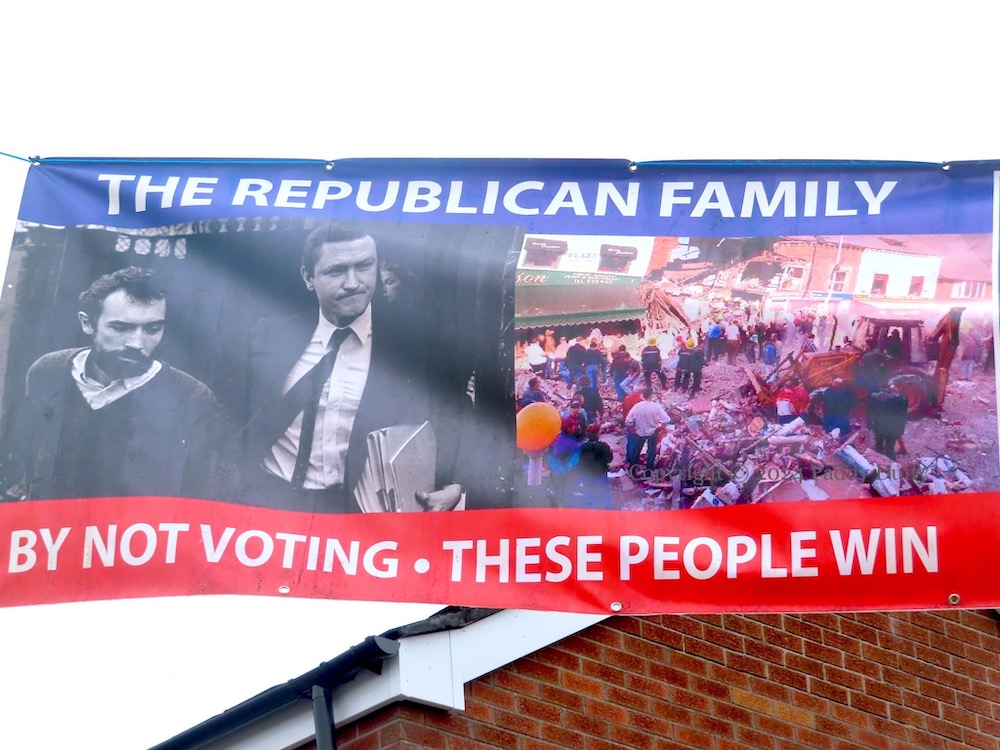
“By not voting, these people win. Fight back, vote unionist.” “These people” are: lawyer Pat Finucane, who was assassinated by the UDA in 1989 (far left panel); Shankill bomber Seán Kelly (WP) (second and third panels, with a 2017 BelTel quote about Kelly canvassing for Finucane); John Finucane, the incumbent Sınn Féın MP for Belfast North (fourth panel, with Gerry Kelly, MLA and previously unsuccessful candidate in Belfast North), and Gerry Adams (fifth panel, with Kelly and Finucane).
In the 2019 election, both the UUP and SDLP did not field candidates in Belfast North, and Sınn Féın’s John Finucane won over the DUP’s Nigel Dodds. In this election, the SDLP is fielding a candidate while the UUP is not; however, recent changes in the constituency boundary are predicted to favour nationalists (Bangor Dub | Slugger) and Finucane is generally odds-on favourite to win (OddsChecker).
A very similar tarp was mounted on the Shankill (part of which is in the Belfast North constituency) in 2019 (see Steeped In Blood). See also: Sinn Fein-IRA’s Golden Boy.
The large gable at the junction of the Limestone Road and North Queen Street in north Belfast – most recently the site of a celebration of Rangers’ 55th title – see We Are The People – is being repainted, beginning with the low wall in front, as shown above. The side wall on the right of the wide shot below dates back to 2017 (see Your Kingdom Will Endure Forever) and the scriptural references on it also appear in the new installation in Mervue Street – see I Will Plant Them, That They May Dwell In A Place Of Their Own. It’s possible that a King Charles installation is in progress here, too.
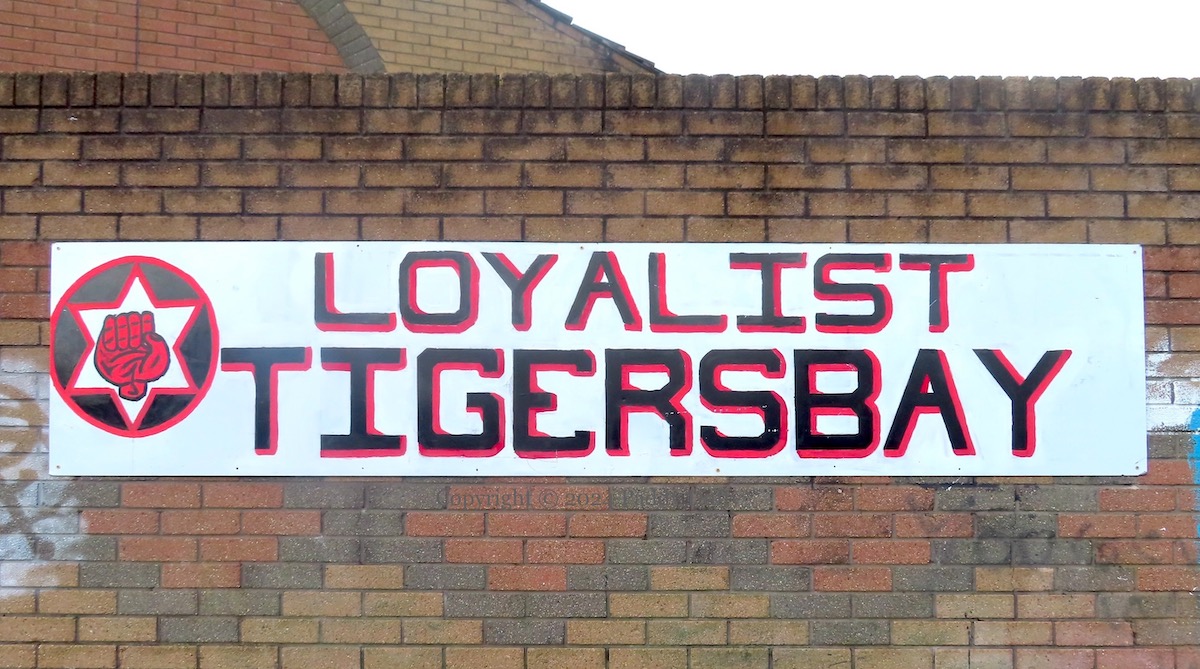
The final image is of another Tiger’s Bay territorial marker in Upper Canning Street.
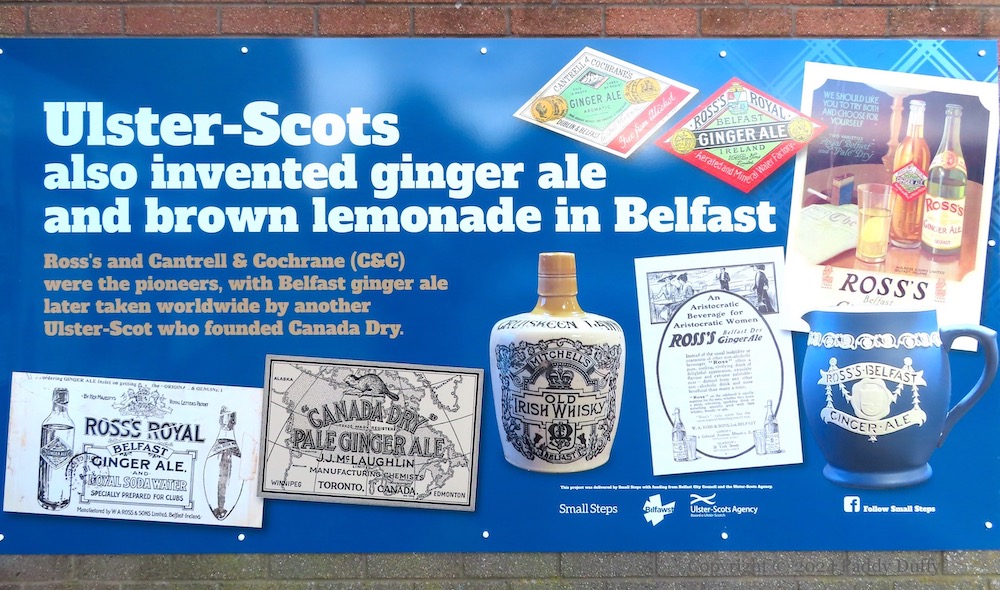
Discover Ulster-Scots (web) has added some more boards in north Belfast, joining the recent gallery of famous figures at Mountcollyer Avenue (see The Scots In Ulster).
Above, Alexandra Park Ave: “The Ulster Fry – Ulster-Scots put the Ulster into the Ulster Fry with our famous soda and potato farls. Farl is an Ulster-Scots word describing the quarter round shape of the breads.” Breakfast fries as we now think of them date back only to the Victorian period and became popular particularly after WWII (WP). Soda farls (and soda bread) go back further, to the 1830s and 1870s when baking soda began to be commercially manufactured and cheaply available (ACS). Recipes can be found at the Discover Ulster-Scots ‘Food Traditions’ page.
Below, from Upper Canning St: “Ulster-Scots distilleries made Belfast a global centre of whisky production. Historic Ulster-Scots brands like, Dunville’s, Mitchell’s and McConnell’s are making a comeback in the 21st century.” “Ulster-Scots also invented ginger ale and brown lemonade in Belfast. Ross’s and Cantrell & Coughran (C&C) were the pioneers, with Belfast ginger ale later taken worldwide by another Ulster-Scot who founded Canada Dry.” The labels shown use the “-y” spelling, perhaps in order to emphasise the Scottish association rather than the Irish. Cowan’s appear to have used both spellings (“whisky” and “whiskey”) in their labelling – see the gallery at Bloggin’ Fae The Burn. Dunville’s now appear to use the “-ey” spelling exclusively (web).
Finally, in North Queen St: “Ulster-Scots have been making Belfast a better place for over 400 years. Many of Belfast’s leading charitable, religious and educational institutions were founded by Ulster-Scots.” with images of BRA (James Crombie), Clifton House (possibly William Tennant is intended), the Linen Hall Library (a list of founders can be found on page 11 of this History), the Assembly buildings (of the Presbyterian church), and Queen’s (John Mowat).
The Belfast marathon (web) took place on May 5th (the same day as Hit The North) and as the runners completed their twentieth mile at the Waterworks on the Antrim Road they might have seen the mile marker shown above, which hopefully inspired them to power through ‘the wall’ they typically hit around 18-20 miles/3.5 hours of running (Marathon Handbook).
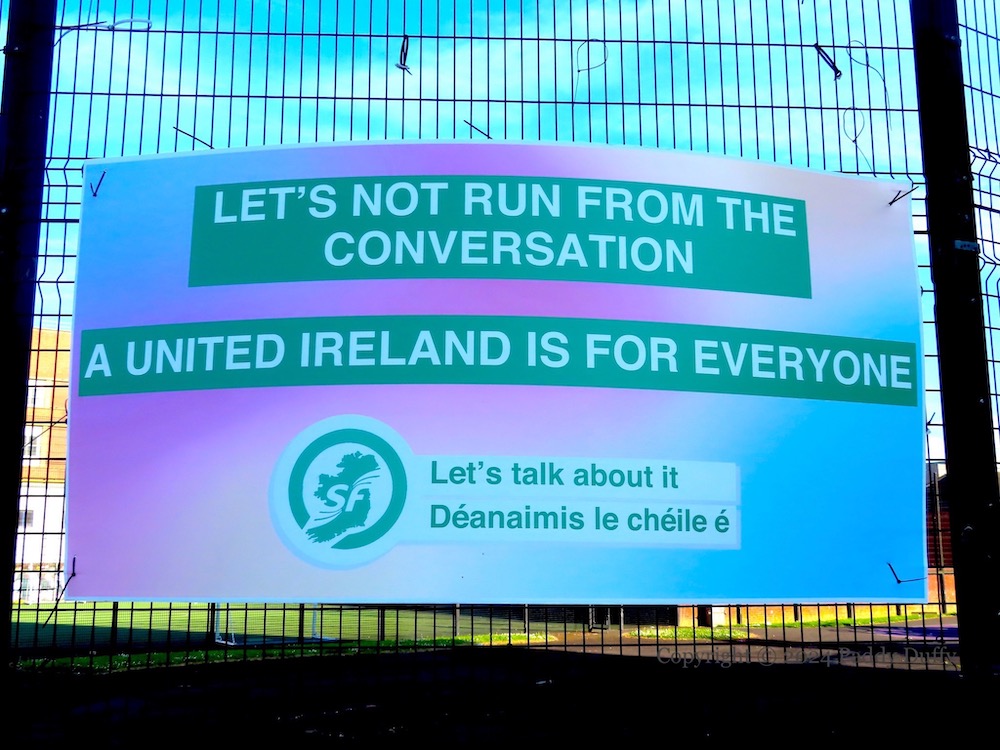
Also along the route, in North Queen St, and with a suitable theme, is the Sınn Féın placard shown below: “Let’s not run from the conversation” about a united. Ireland.












 Paddy Duffy Collection