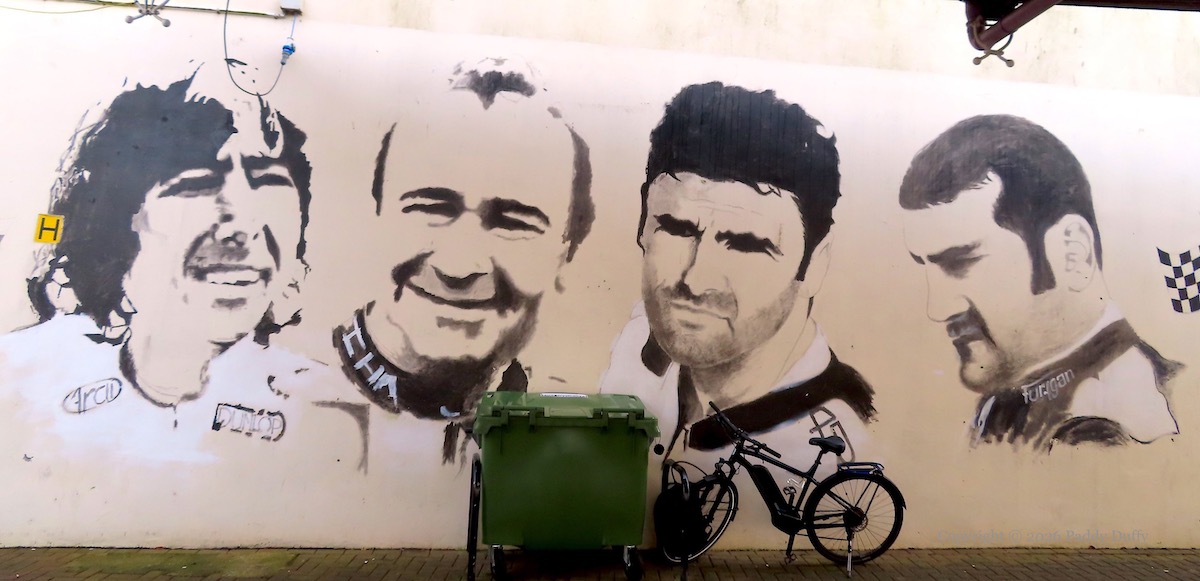
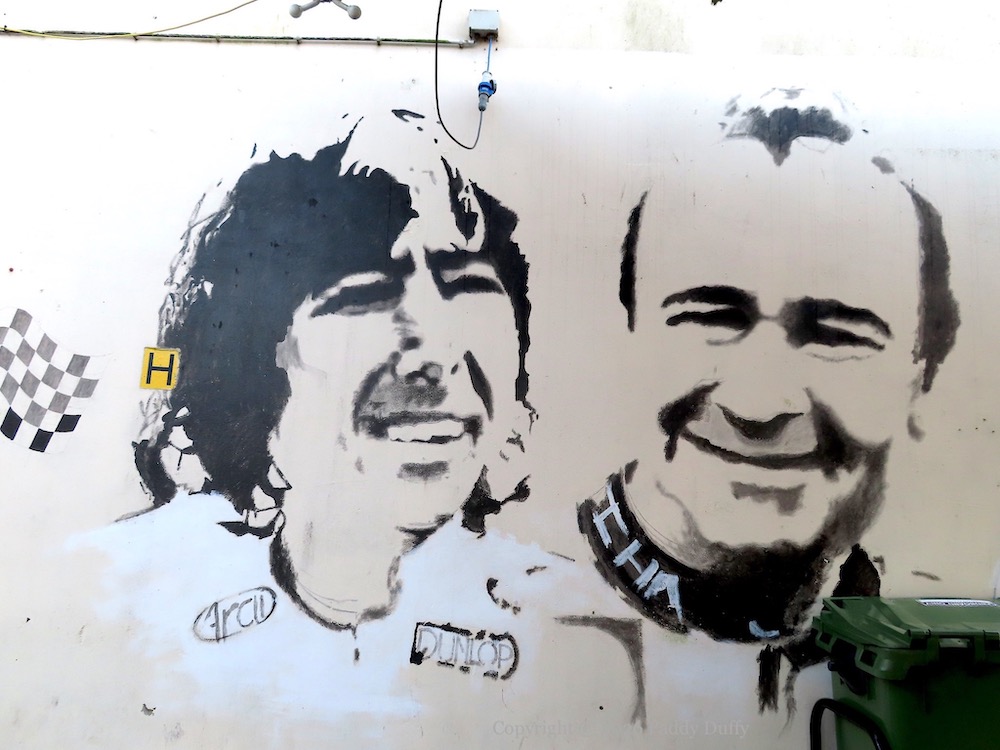
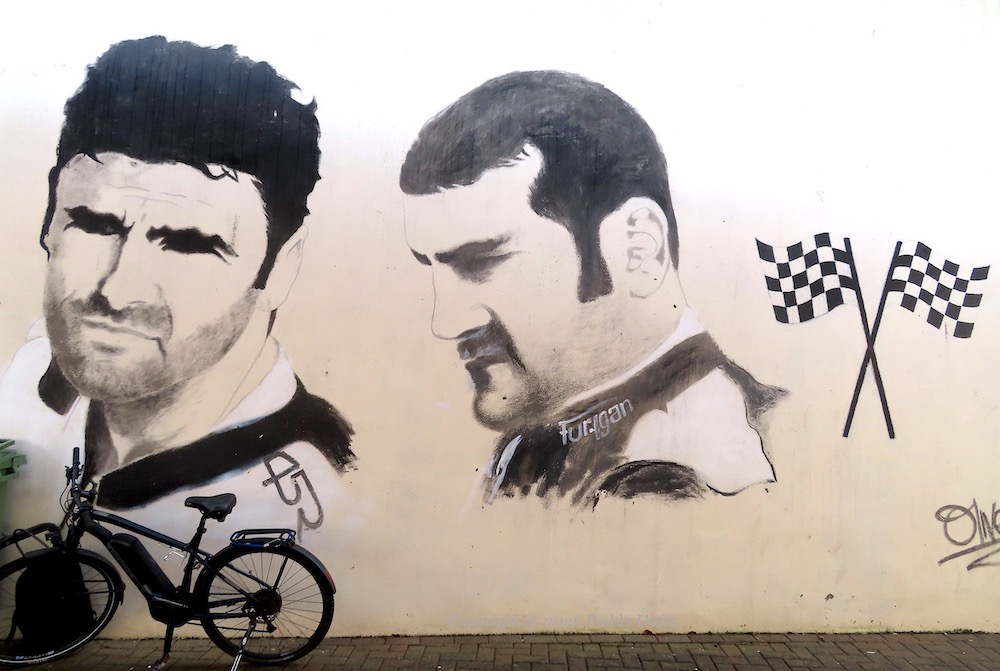
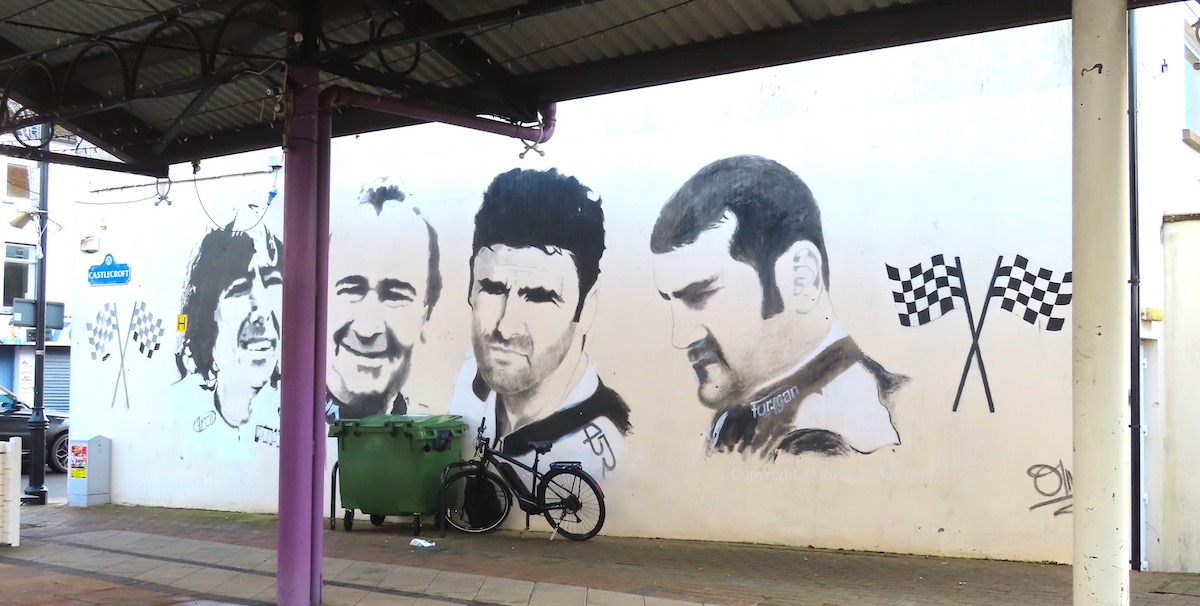
This Ballymoney mural celebrates and commemorates members of the Dunlop family of motorcycle racers. From left to right we see brothers Joey and Robert and then Robert’s sons William and Michael. Joey died in a race in Estonia in 2000; Robert died in 2008 of injuries sustained in a practice session for the North West 200; William died in 2018 in a crash during practice for the Skerries 100. Michael is still alive and currently aged 36; he was Irish Motorcyclist Of The Year in 2025 (BelTel).
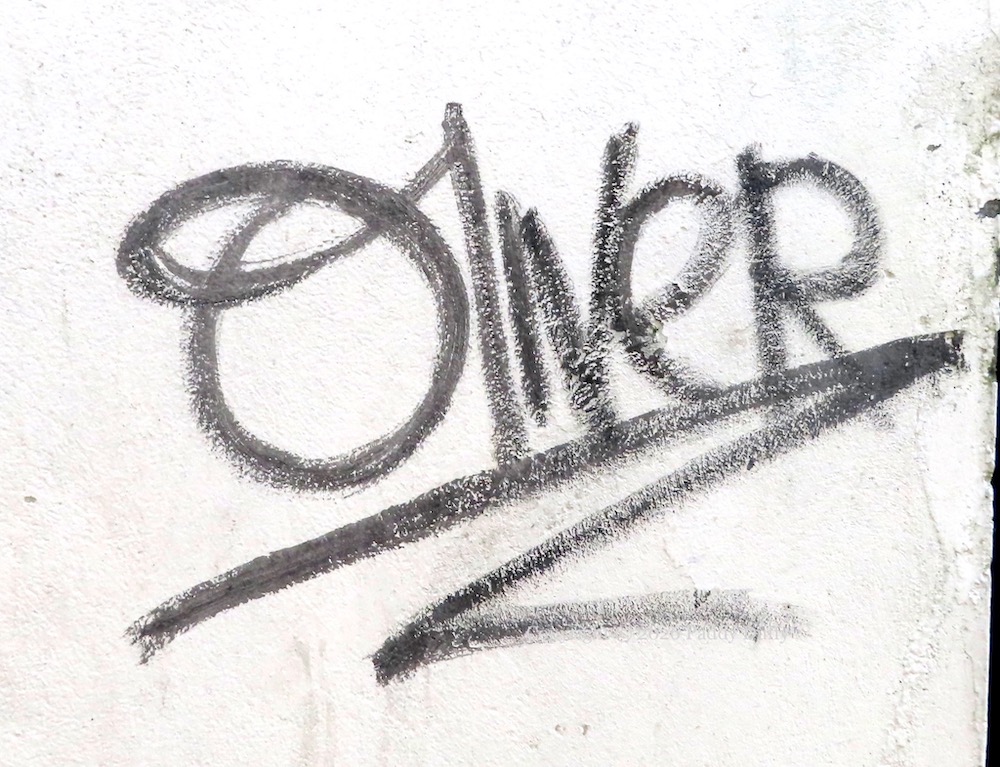
This mural was painted by Oliver McParland (web) in Castlecroft Square, Ballymoney.
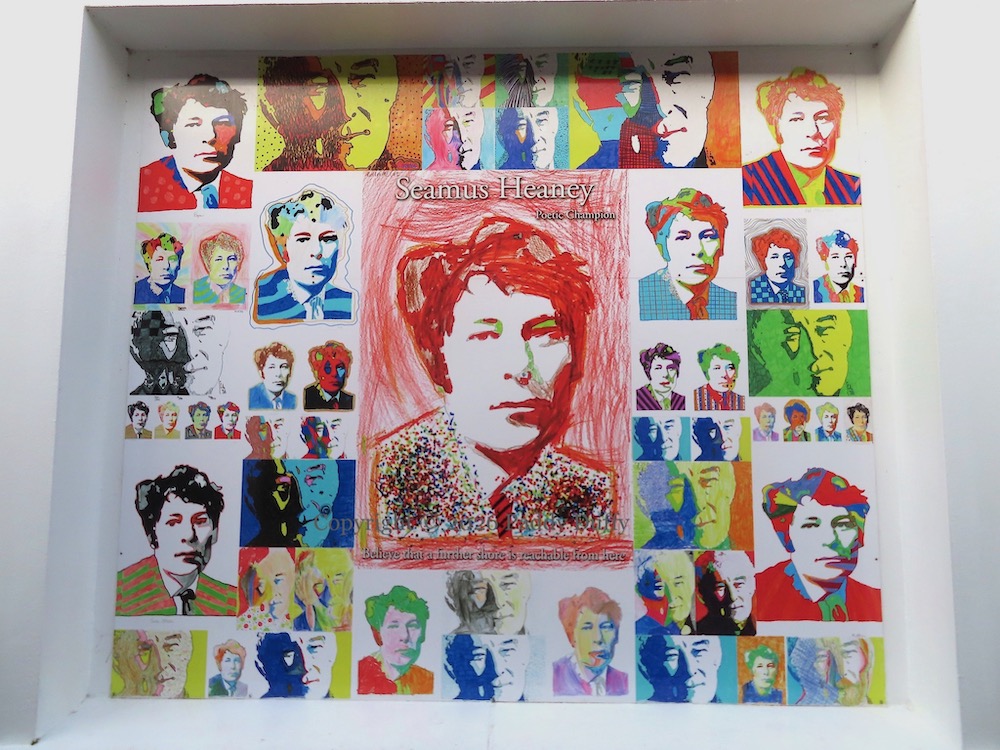
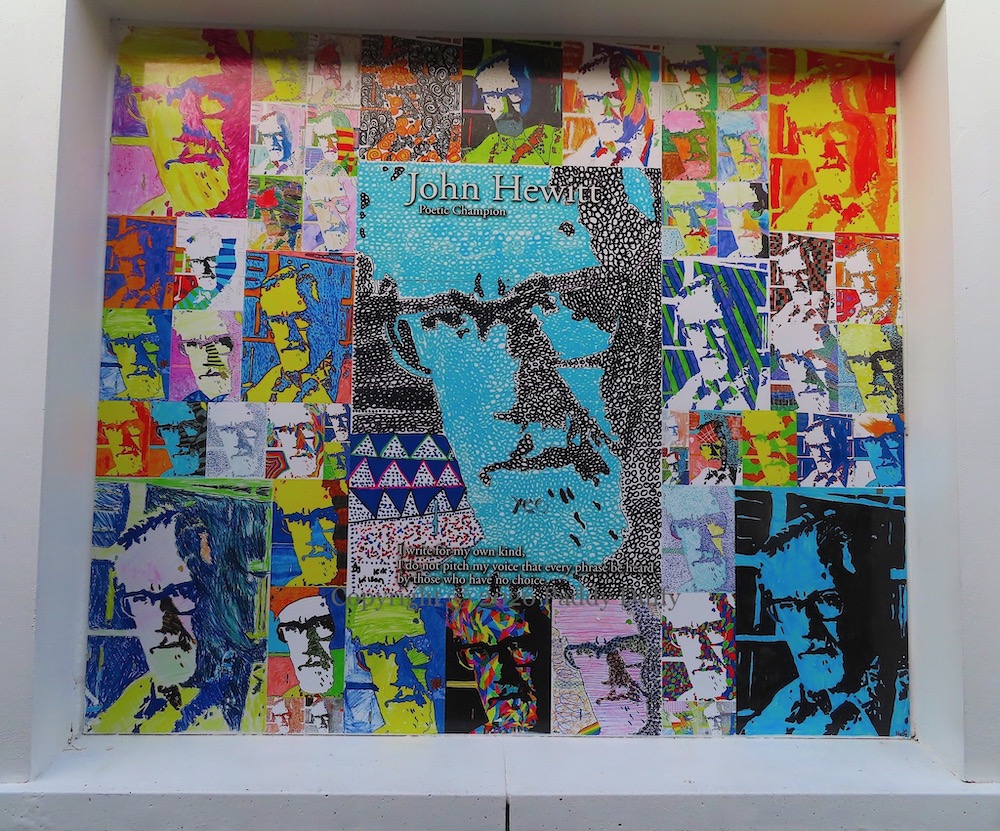
These two panels were created by Ross Wilson (web) along with children from four local Ballymoney schools (BBC | NI World). They portray two famous poets from Northern Ireland, Seamus Heaney and John Hewitt and include a line from a work of each:
Seamus Heaney’s “Believe that a further shore is reachable from here”, comes from The Cure At Troy (youtube).
The quotation from John Hewitt is the first line of the poem I Write For: “I write for my own kind, I do not pitch my voice that every phrase be heard by those who have no choice.”
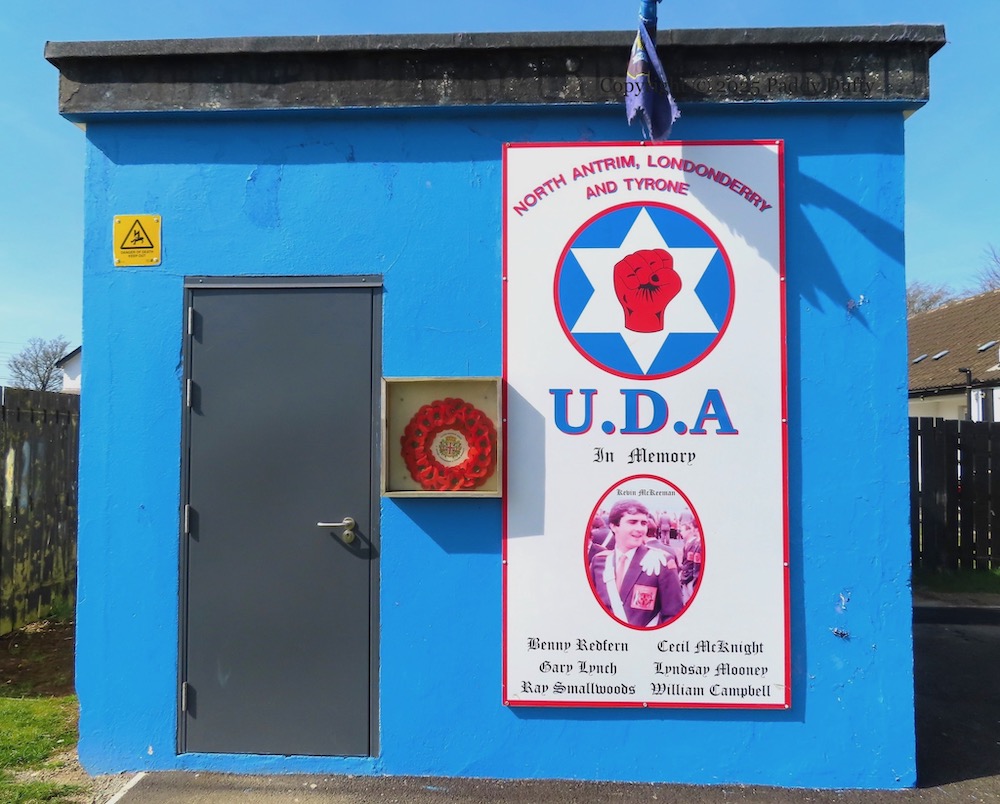
As can be seen from the photography, Kevin McKeeman was a flute band member, perhaps part of the local Dervock Young Defenders (Fb) though the patch shown is not the current one.
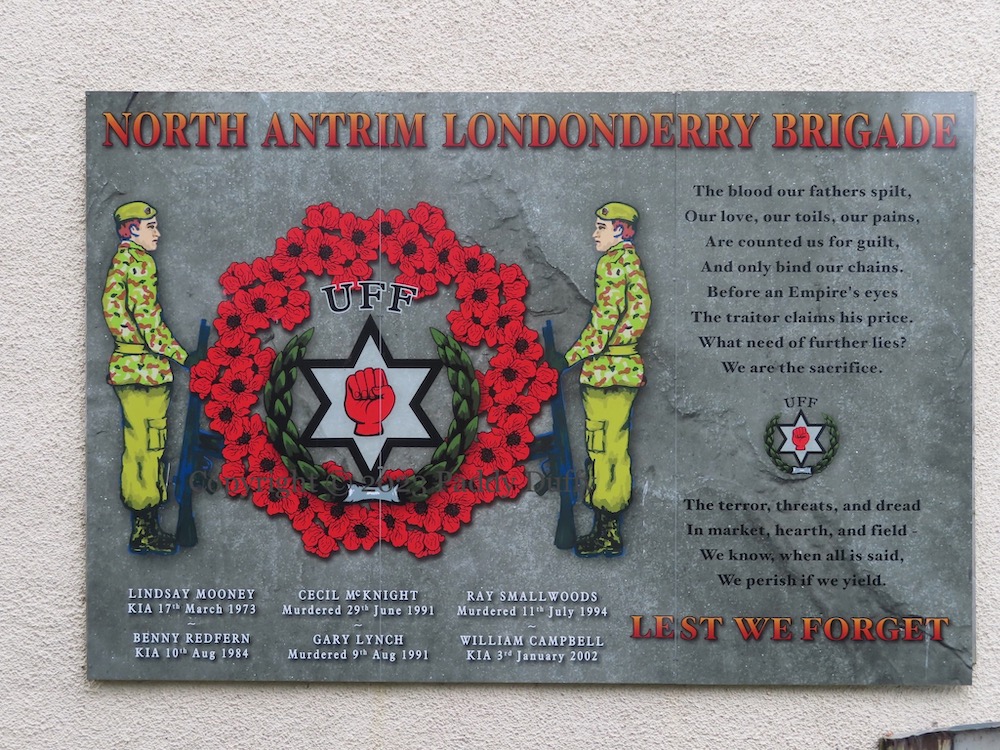
He is named here alongside six “North Antrim, Londonderry, And Tyrone” UDA members – “Benny Redfern, Gary Lynch, Ray Smallwoods, Cecil McKnight, Lyndsay Mooney, William Campbell” – who are named (together) on a number of murals in Londonderry and along the north coast – for background on them, see UDA Memorial.
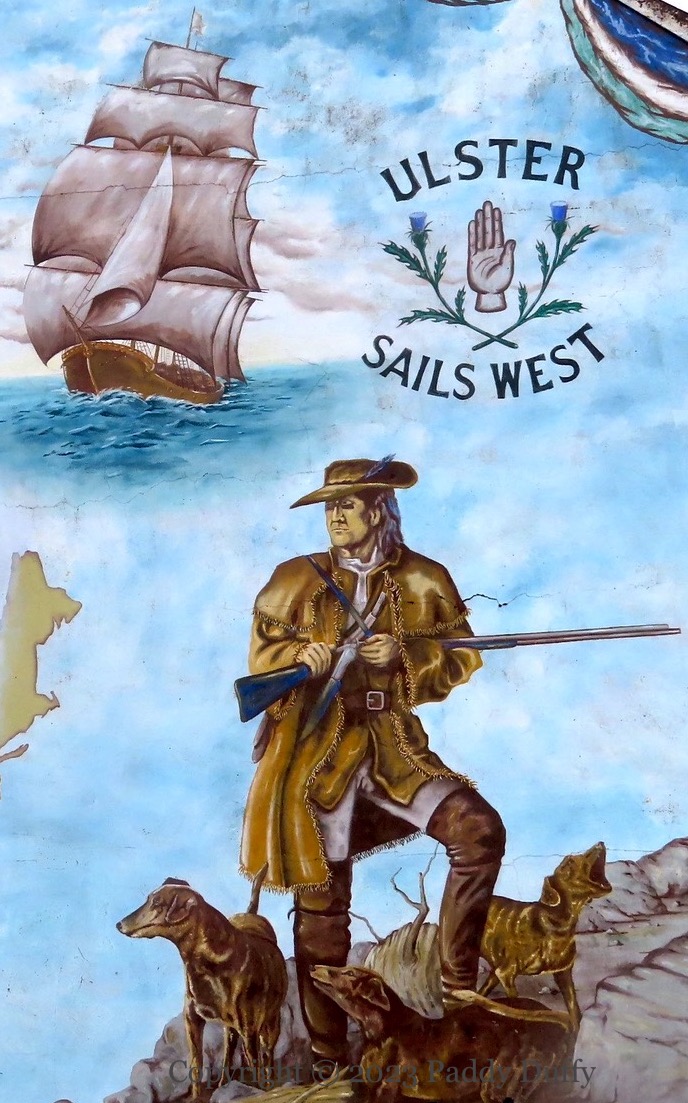
This Ballymoney mural goes all the way back to at least 2004 and to the wave of Ulster-Scots – or as here, “Scotch-Irish” – murals painted in PUL areas after the promotion of Ulstèr-Scotch as a parallel language to Irish by the Good Friday/Belfast Agreement.
As the Visual History page on Ulster-Scots Murals shows, most of these murals made a connection to (what would-become) the United States, to where about a quarter million people emigrated (WP). The mural is intended to tell a story of emigration (signified by the sailing ship), American independence (the McKinley quote), and American expansion (the frontiersman).
The Scotch-Irish were Presbyterians and supporters of breaking the ties to Great Britain. In 1893, Governor Of Ohio (and later US President) (Ulster Nation) William McKinley said, “They were the first to proclaim for freedom in these United States. Even before Lexington [i.e. the outbreak of the Revolutionary War, on April 19, 1775] the Scotch-Irish blood had been shed for American Freedom.” (According to William Marshall’s book Ulster Sails West, the battle McKinley is referring to took place on the Alamace river in North Carolina in 1771 (p. 29).)
The frontiersman on the right is generally taken to be David “Davy” Crockett, from the 1830s (Rolston in Al Jazeera | McCormick J2024); it is in fact a 1991 sketch of a generic frontiersman by David Wright (web), called “The Long Knife”, and the figure is referred to generically as “a trapper” by the artist (BBC).
None of the conquests of European-American colonists provides a good parallel to unionism, due to the complicated nature of political conflicts both there and here. The Americans, of course, threw off British rule in their revolution; Irish unionists want to remain part of the UK. And Crockett died in the Battle Of The Alamo in the Texas Revolution; that is, he died fighting for Texan independence from the Mexican government, which again doesn’t line up well with the desire of Irish unionists to remain part of the United Kingdom. (For another strained analogy involving the Scotch-Irish and US political history, see The War Of Northern Aggression and its discussion in the Ulster-Scots Murals page.)
The reason for its inclusion is the simpler idea that the Scotch-Irish are a rugged and feisty people who are not to be trifled with, whether in North America or Ireland.
Painted by Kenny Blair (Fb) in Hillview Avenue, Ballymoney; sponsored by the North Antrim Cultural And Musical Society and funded by the Heritage Commission. “Ulster Sails West” is the title of a 1943 book by WF Marshall (Isles Abroad).
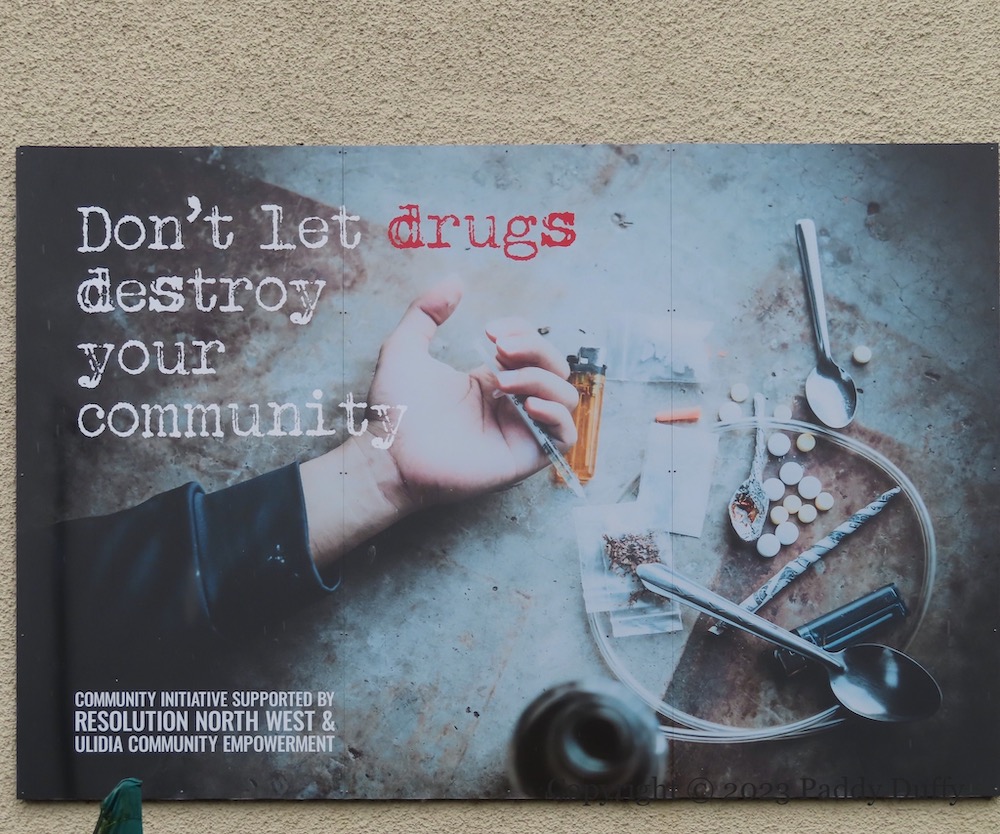
Here is a survey of the UDA boards in Carnany estate, Ballymoney. Many of these have been seen before (in Ulster’s Past Defenders, Ulster’s Present Defenders, The Terror, Threats, And Dread, and Ballymoney UDA). The anti-drugs board in the final image is new (see previously the one in Londonderry: Peace Impact Programme) and the one shown above and immediately below is an updated version of the board shown in Past, Present, For All Time. The dates given in the earlier version were 1972 and 2016; in this one, for “50 years of service”, they are 1971 and 2021. 1971 is the typical date given for the formation (in Belfast) of the the UDA; the 1972 date might have been a specific reference to the North Antrim And Londonderry brigade or the beginning of the Londonderry UDA’s actions, with bomb attacks on a factory and a pub in Donegal in October and November, 1972 (WP).
This street art, unfortunately by both a hedge and parked cars, is by Shane O’Driscoll (web) in Church Street, Ballymoney, inspired by the town’s history as a market.
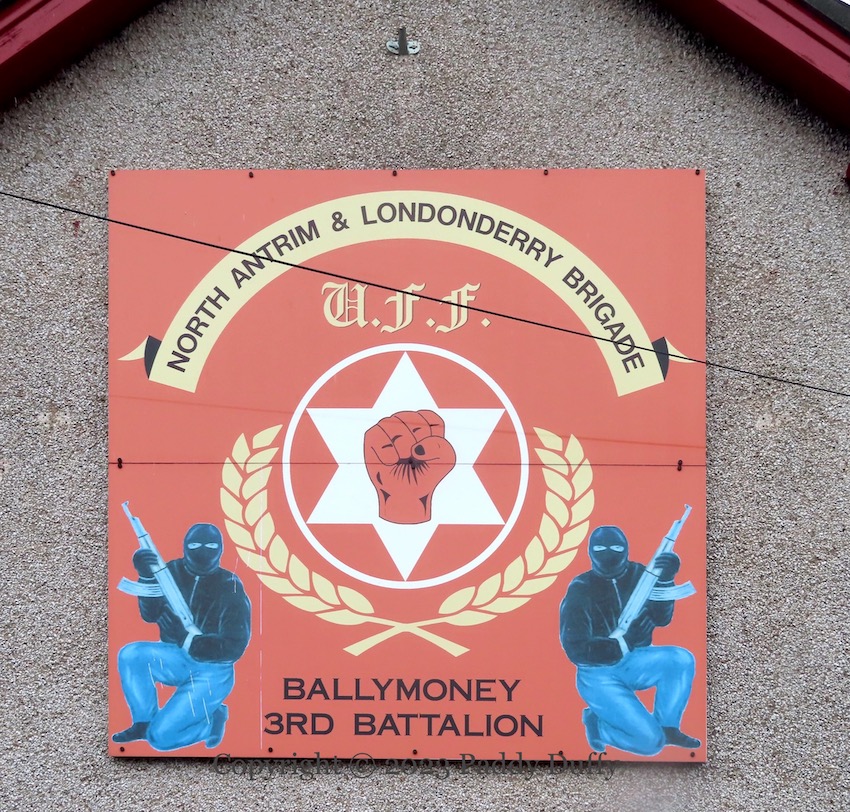
“North Antrim & Londonderry brigade, UFF, Ballymoney 3rd battalion” – hooded men with assault rifles remain on the walls in Alexandra Avenue/The Crescent, Ballymoney.





 Paddy Duffy Collection