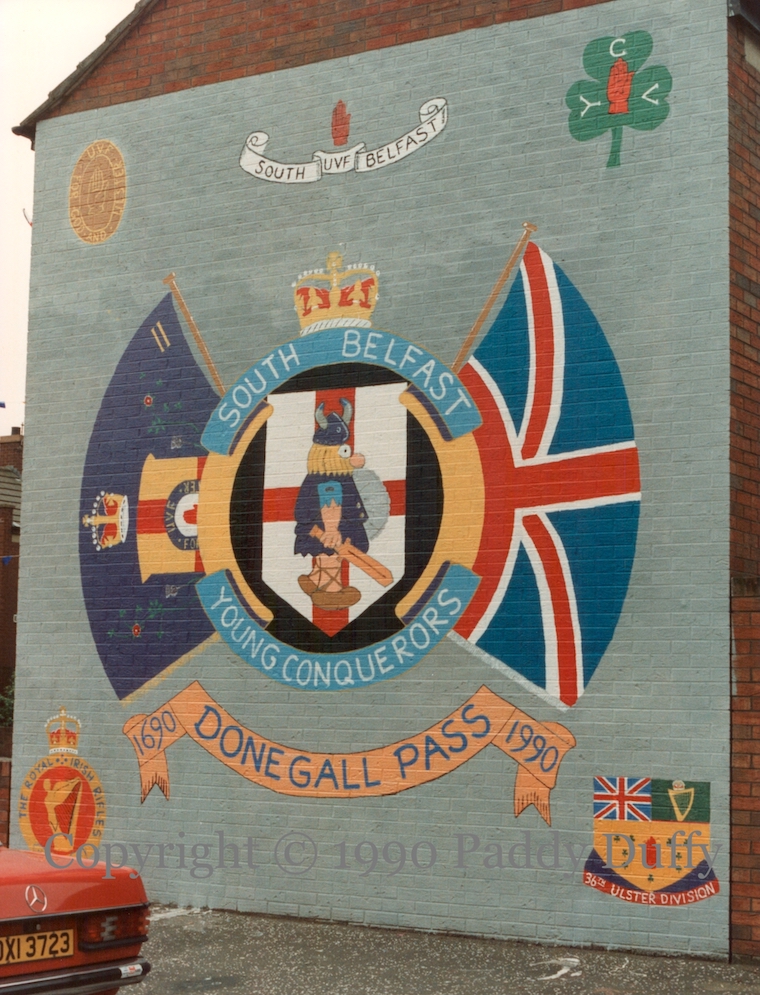
The Young Conquerors flute band (Fb) and the South Belfast UVF celebrate the 300th anniversary of the battle of the Boyne, with a new mural in Pine Street, Donegall Pass, south Belfast. The emblems of the RIR and 36th Division are in the bottom corners, and the flag on the left is a regimental flag of the Ulster Volunteers.
South Belfast MP Robert Bradford was assassinated by the Provisional IRA in Finaghy at a meeting with constituents; the caretaker of the community centre, Ken Campbell, was also killed by the fleeing attackers. In late 1981, with the hunger strikes having ended only a month before, the killing was noted around the world and raised fears of broad civil unrest (BBC | NYTimes).
“Vita, veritas, Victoria” [life, truth, victory] is the motto of Londonderry. Here we have “vita, veritas, victa” [life, truth, conquered; perhaps the intended meaning was “conquering” rather than the passive]. The crest is also not quite the crest of the Apprentice Boys, with a ship in the bottom right rather than a skeleton. Get in touch if you can resolve either discrepancy.
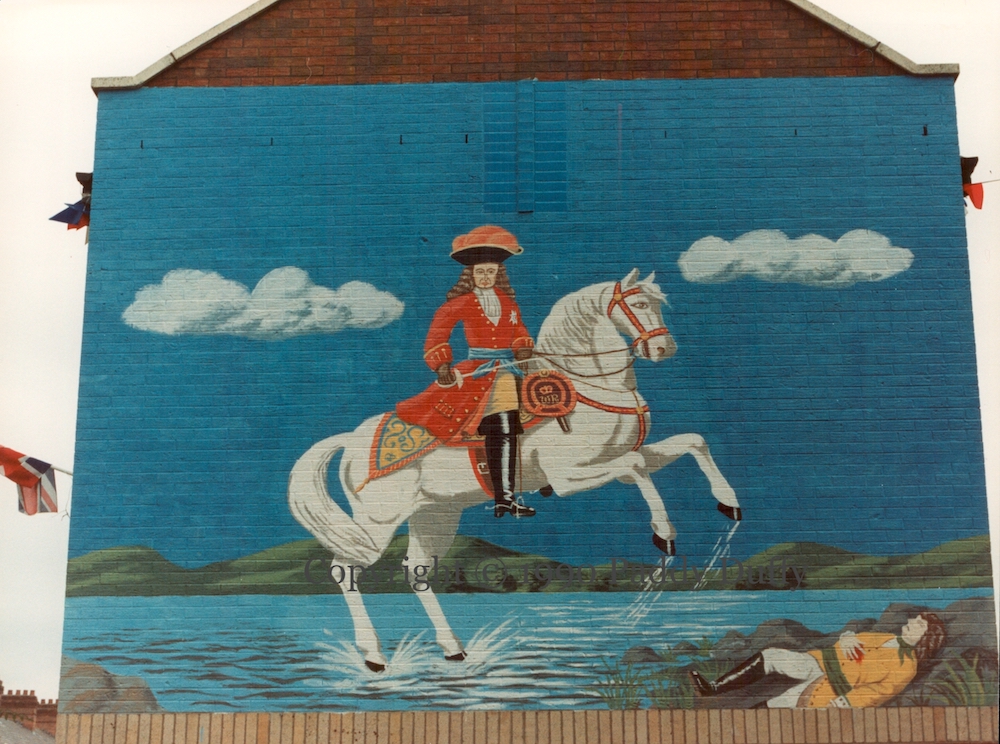
King Billy, in red, white, and blue, crossing the Boyne and trampling on a Jacobite soldier in green, white, and orange. This mural was painted in 1989 by a “H. Gibson” (according to the 2015 repainting). The original version of this mural was on the other side of the Pass, at the junction of Apsley Street and Howard Street South, next to a mural of the Lindsay Street arch dedicated to Robert Bradford. (See Cemented With Love for both of these.) 1989 was the 25th anniversary of the erection of the arch in nearby Lindsay Street, but the arch was not painted into this mural until 2002.
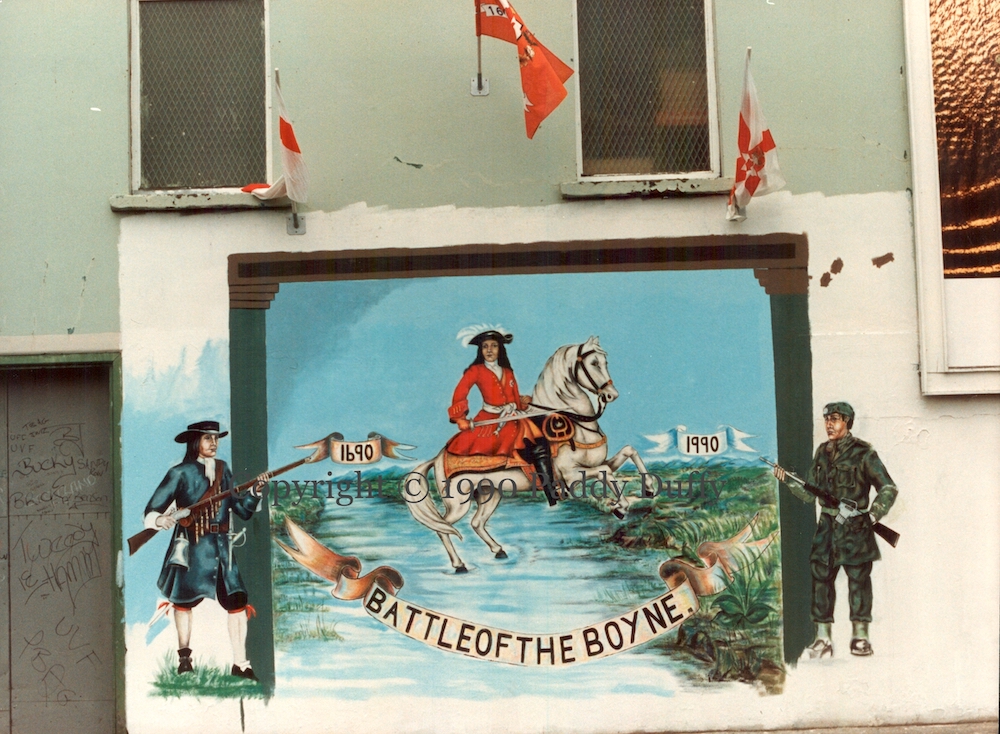
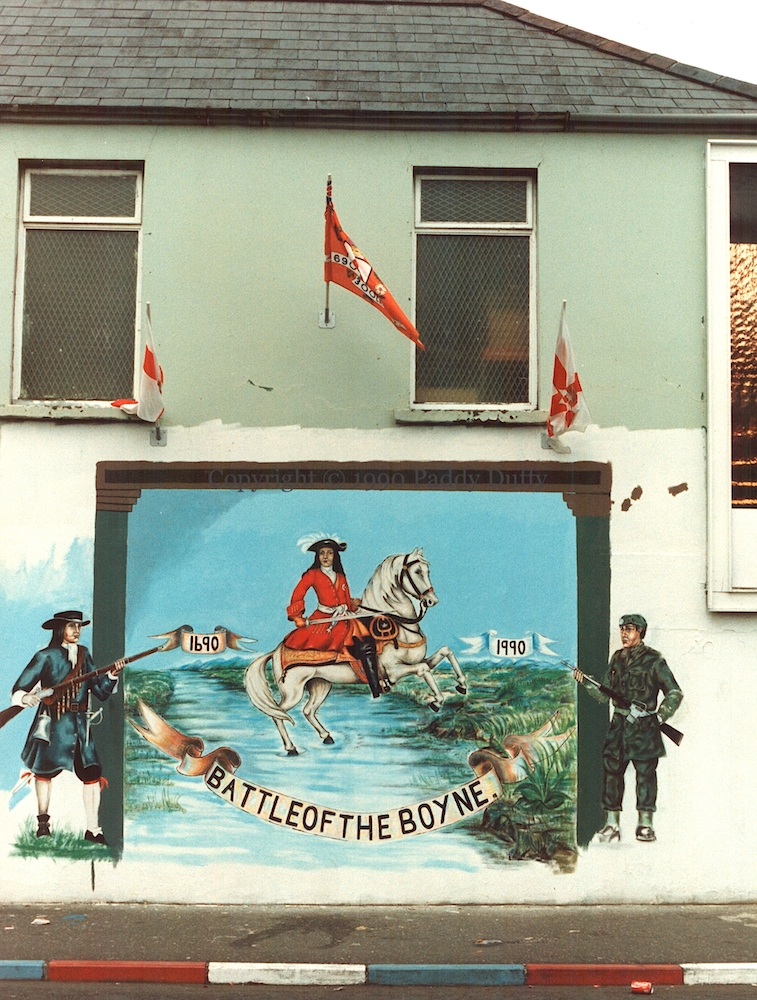
King William III is flanked by foot soldiers from 1690 and 1990. A small painted sign to the right reads, “We the people of Sandy Row remember with pride the 300th anniversary of the Battle of the Boyne. No surrender. Signed, UFF.”
The modern-day gunman on the right would later be replaced by another period soldier – see the Peter Moloney Collection.
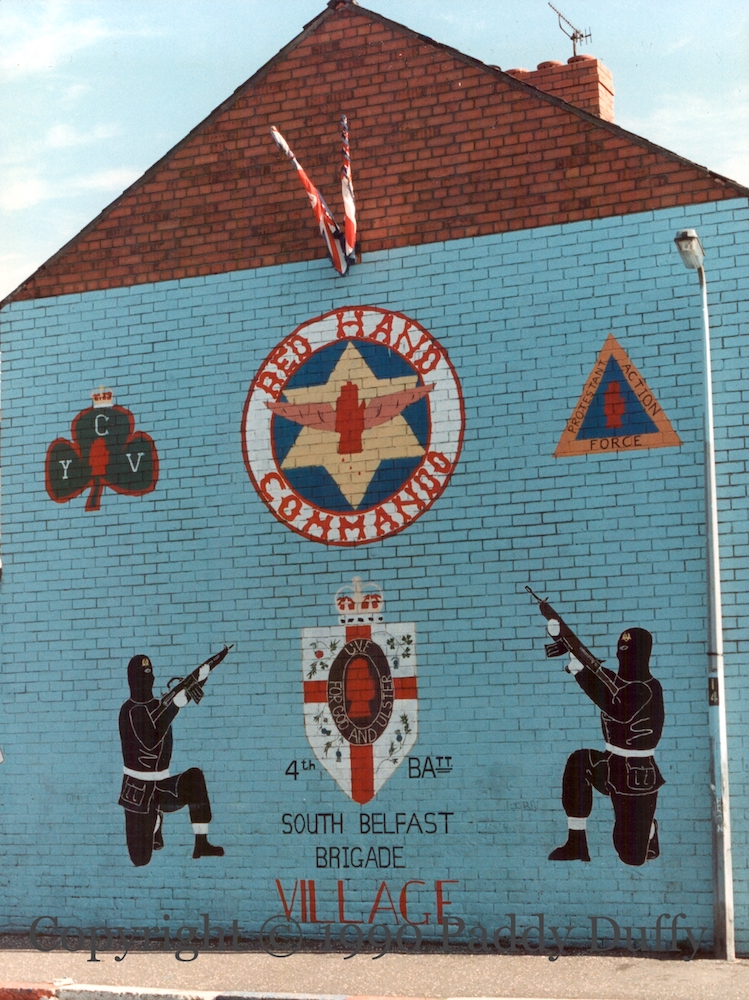
“YCV/Red Hand Commando/PAF – 4th battalion, south Belfast brigade, Village”
Hooded gunmen fire over a modified UVF emblem, with four quadrants of flowers, which appear to be (top left) a poppy (or rose?) with one shamrock leaf and some thistle leaves, (top right) three shamrock leaves and a thistle, (bottom right and left) thistles.
Broadway, in the Village. There was also a side-wall, to the left, dedicated to Stevie McCrea – see the Peter Moloney Collection.
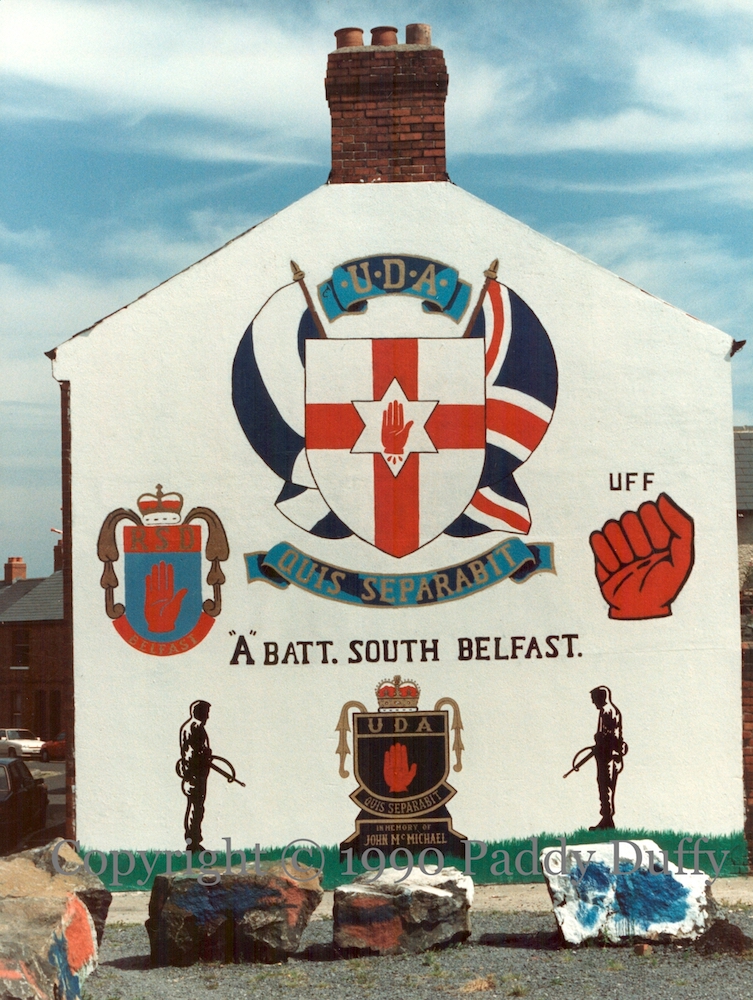
The mural at the corner of Roden Street and Donegall Road was repainted annually in 1989, 1990, and 1991. The first (see the image from 1988) lacked the McMichael memorial seen here and the white background only went half-way up the wall; the second completed the background, added LPA and UDF emblems and “In memory of John McMichael” in text (see C00525). This third iteration places the McMichael memorial and the attendant graveside mourners on a bed of grass.
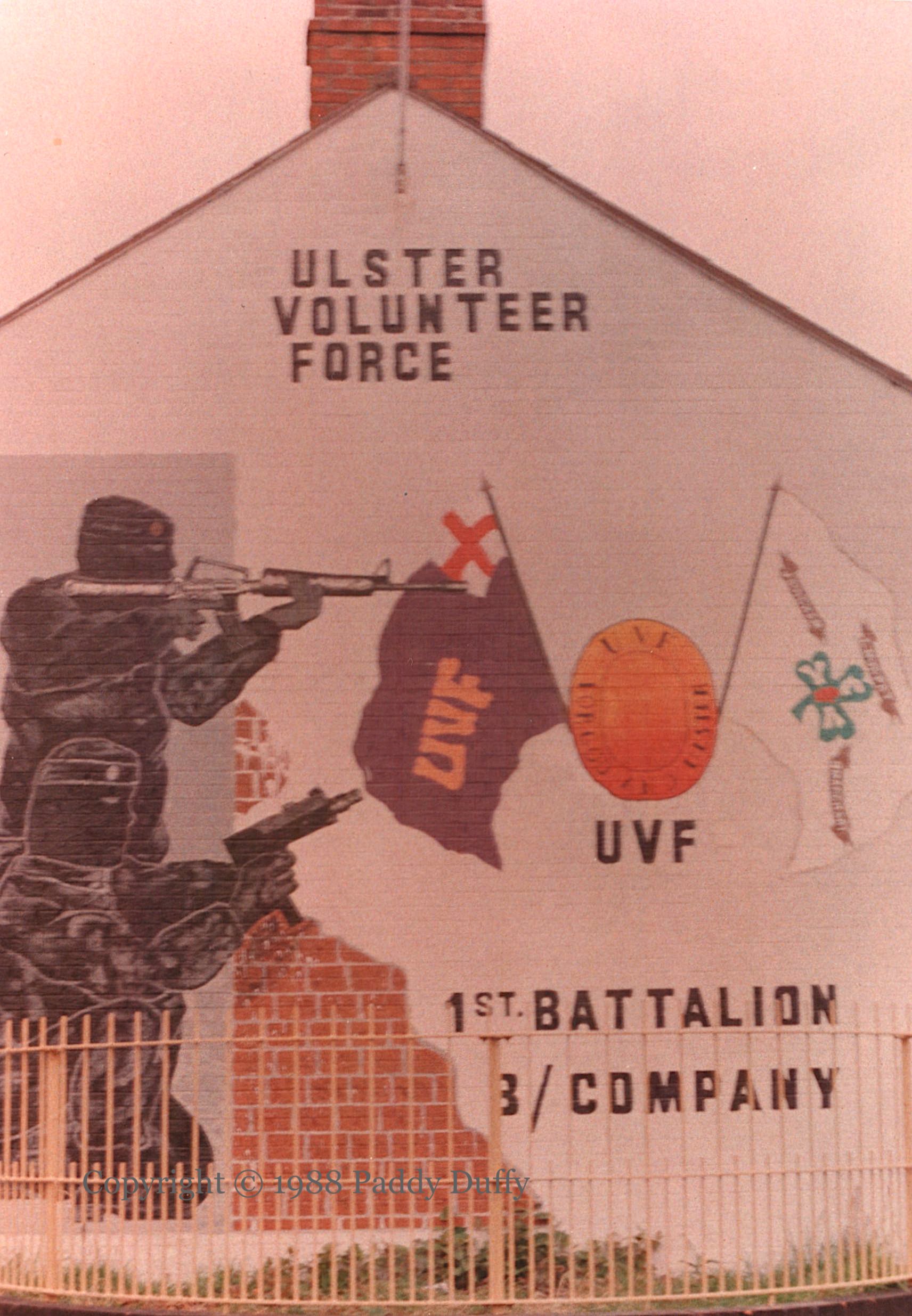
Hooded UVF volunteers from “1st battalion, B company” armed with an assault rifle and an Uzi take aim at unspecified targets.
On the side-wall to the left it reads, “The UVF reserve the right to strike at republican targets where and when the opportunity arises” – see also the Peter Moloney Collection.
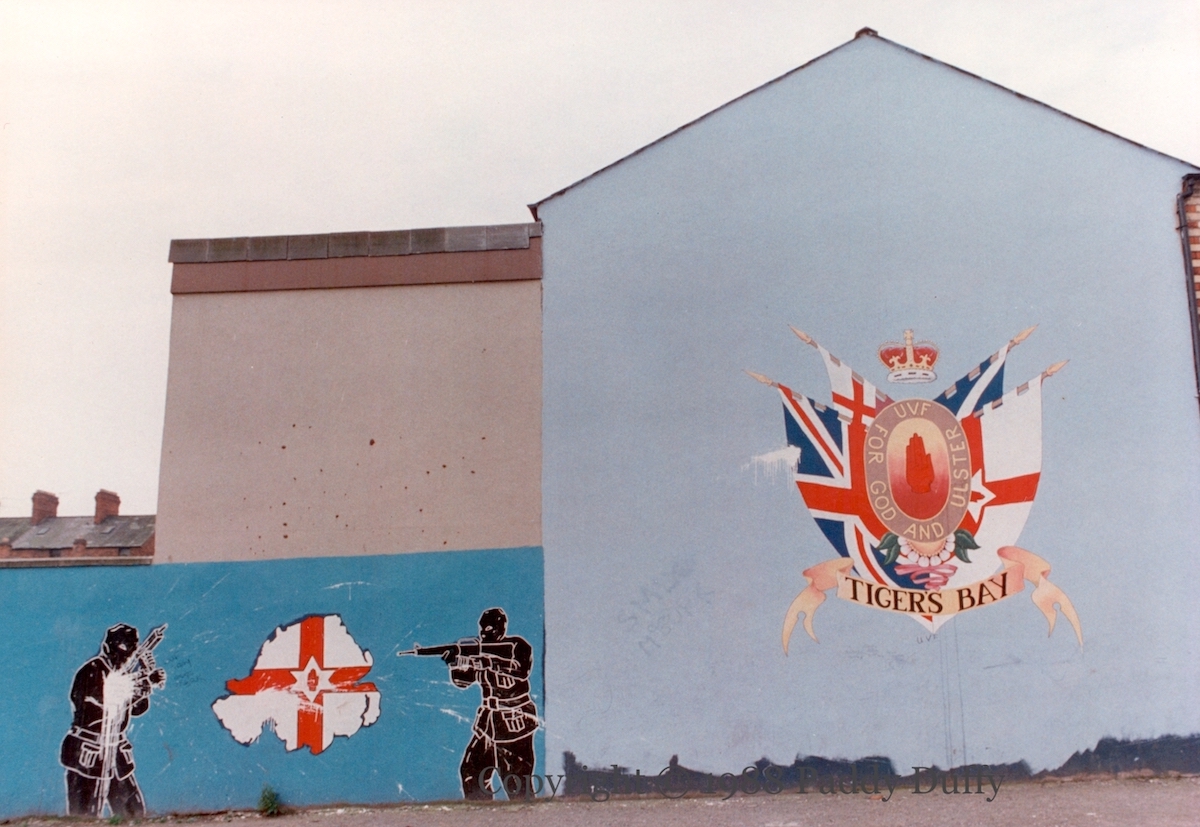
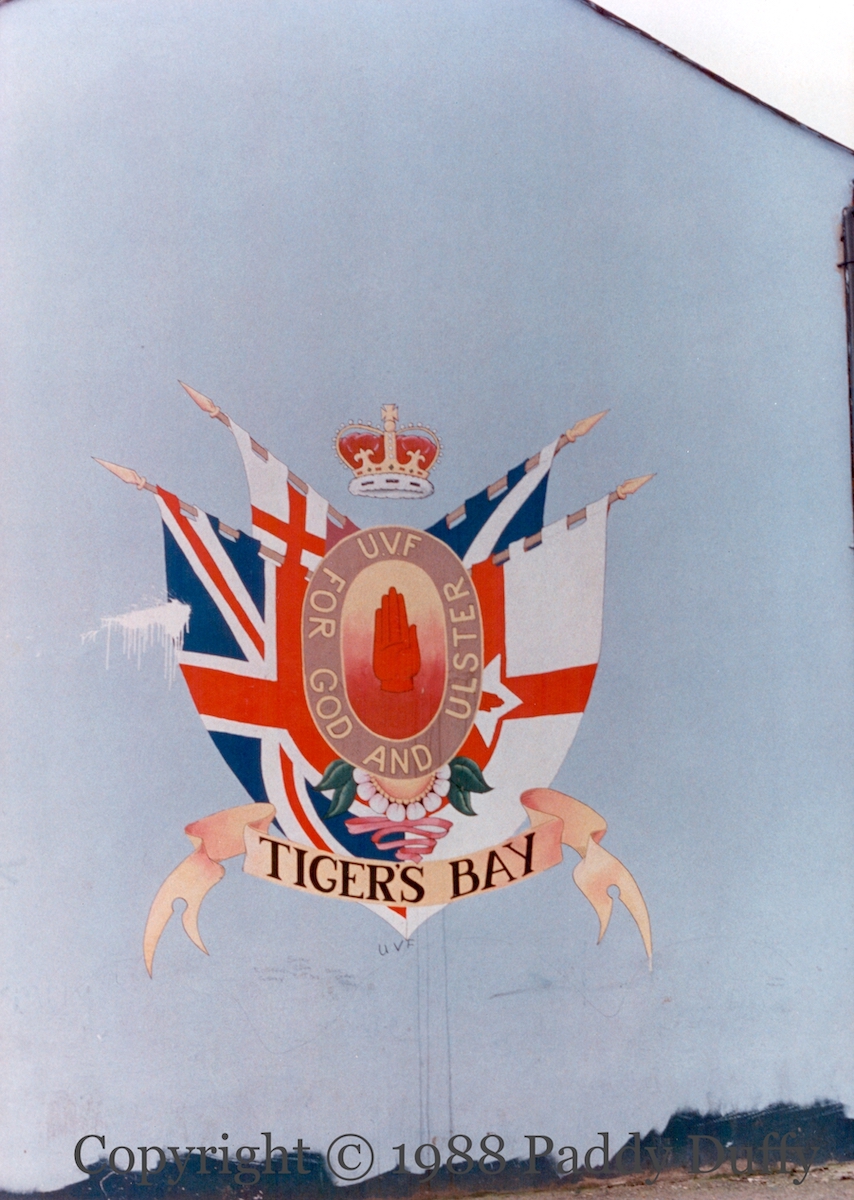
For some speculation as to the origins of the name “Tiger’s Bay” see Connolly Cove; a more realistic origin-story is given on the Belfast Forum, that a “tiger bay” or “tiger’s bay” is sailor slang for a rough area. The name was originally applied only to the warren of streets immediately below Newington (again Belfast Forum), but later extended to include everything down to North Queen Street.
Hogarth Street, north Belfast, though the precise location is uncertain
UVF volunteers in balaclavas take aim other across a free-floating Northern Ireland with an Uzi and an assault rifle. The emblem supported by flags on the right is unusual for its inclusion of a ?large daisy? and pink ribbon.
The location of this wall is unknown, which suggests the site of the Community Centre – please get in touch if you know where it was.
“West Belfast Brigade UDA C Company”. UDA/UDF/LPA/UFF mural on the Shankill. (For a similar quartet of names and explanation of “UDF”, see Sans Peur.)
The title “First Ulster Defence Assoc.” is an attempt to tie together the defenders of Derry in 1688 (300th anniversary) with the modern Ulster Defence Association. This is an early attempt to give the UDA historical roots, beyond the Shankill and Woodvale Defence Associations. To this end, the group would adopt Cú Chulaınn (beginning in 1992 – see the Visual History page) and (beginning in 2007 – see UDU-UFF-UDA) the 1893 Ulster Defence Union as ancestors.