No Consent, No Parade

Parading This mural demands that Orange Order marches have the consent of local residents in Derry, Garvaghy [Portadown], and lower Ormeau [south Belfast].

Parading was the central on-the-ground issue of the post-Agreement years (BBC). Resistance to Orange Order parades marching through CNR areas was led by local groups: in Derry, by the Bogside Residents’ Group, in Portadown, by the Garvaghy Road Residents’ Coalition, and in lower Ormeau by Lower Ormeau Residents Action Group. In each case, residents were appealing directly to the local lodges and to the police. (The Parades Commission would be established in 1998.)

In 1995, there was a three-day stand-off on the Gavraghy Road that resulted in a silent march without bands (CAIN). The police initially re-routed the 1996 march but reversed the decision at the last minute, citing the threat of loyalist violence, and forced residents off the street in order to accommodate the parade.

Rossville Street, Bogside, Derry

Click image to enlarge
Copyright © 1996 Paddy Duffy
T00190

Upper Springfield Development Trust

This is an in-progress image of a mural sponsored by and for the Upper Springfield Development Trust (web | until 1993 the Upper Springfield Development Forum) focusing on young people: “Mol an óıge agus tıocfaıdh sí.” (Praise youth/the young and it will flourish.”/”Youth responds to praise.”)

For a finished version, see the Peter Moloney Collection.

Signed by “Mo Chara” (Gerard “Mo Chara” Kelly) and “Spud” in the bottom right corner.

Whiterock Road, west Belfast

Click image to enlarge
Copyright © 1996 Paddy Duffy
T00188

The Battle Of Moy Tura

“Nuadha, rí Tuatha Dé Danann, buaıteor chath Magh Tuıreadh Conga, Éıre/King Nuadha of the Tuatha De Dannan, victorious at the battle of Moy Tura [at Cong, the first battle], Ireland.”

“Mo Chara” Kelly’s mural reproduces the cover of Jim Fitzpatrick’s The Book Of Conquests in the middle and adds various other elements (Visual History).

Upper Whiterock Road, west Belfast

Click image to enlarge
Copyright © 1996 Paddy Duffy
T00187

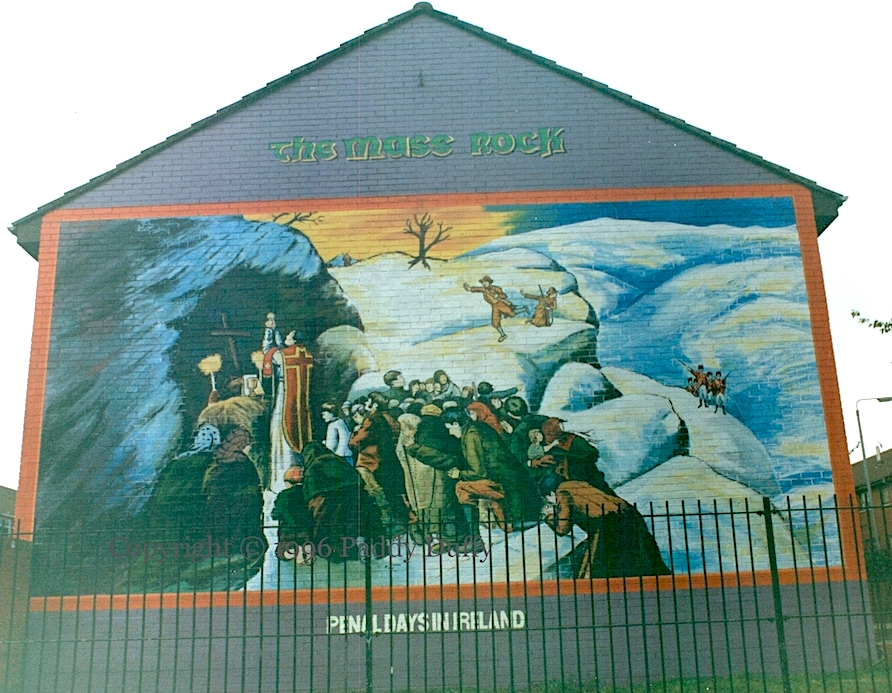
The Mass Rock

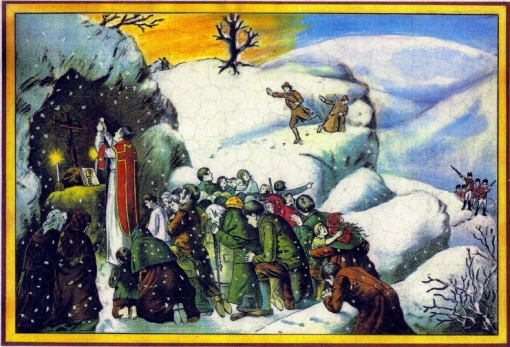
“Penal days in Ireland” – this mural commemorates the repression of Catholicism and use of mass rocks as secret locations in the days of Cromwellian conquest and the penal laws, c. 1650-1800. The 1652 Act Of Settlement (WP) banished Catholic priests from the island and services had to be held at short notice and in remote locations, with sentries posted to keep watch against soldiers from the New Model Army. Laws against the practice of Catholicism in Ireland were not lifted until the 1782 Roman Catholic Relief Act (PCUG).

See also: The Hedge Row School.

Click image to enlarge
Copyright © 1996 Paddy Duffy
T00186

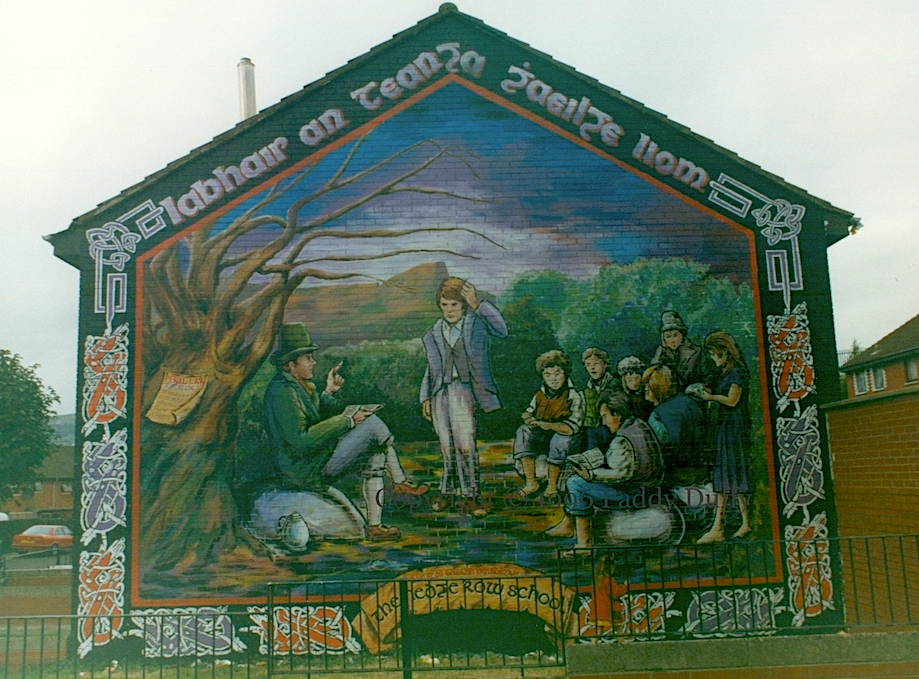
Labhaır An Teanga Ghaeılge Lıom

Catholic (and Presbyterian) education was prohibited by the penal laws (WP) and particularly the Education Act of 1695 (WP) – this is probably what’s on the notice on the left-hand tree. Schooling by Catholics (in Irish) nonetheless took place, in covert houses and outhouses, as well as in fields and hedge-rows. The Act was repealed in 1782, provided the teacher took an oath of allegiance to the Crown.

See also: The Mass Rock.

Ardoyne Avenue, north Belfast

Click image to enlarge
Copyright © 1996 Paddy Duffy
T00185

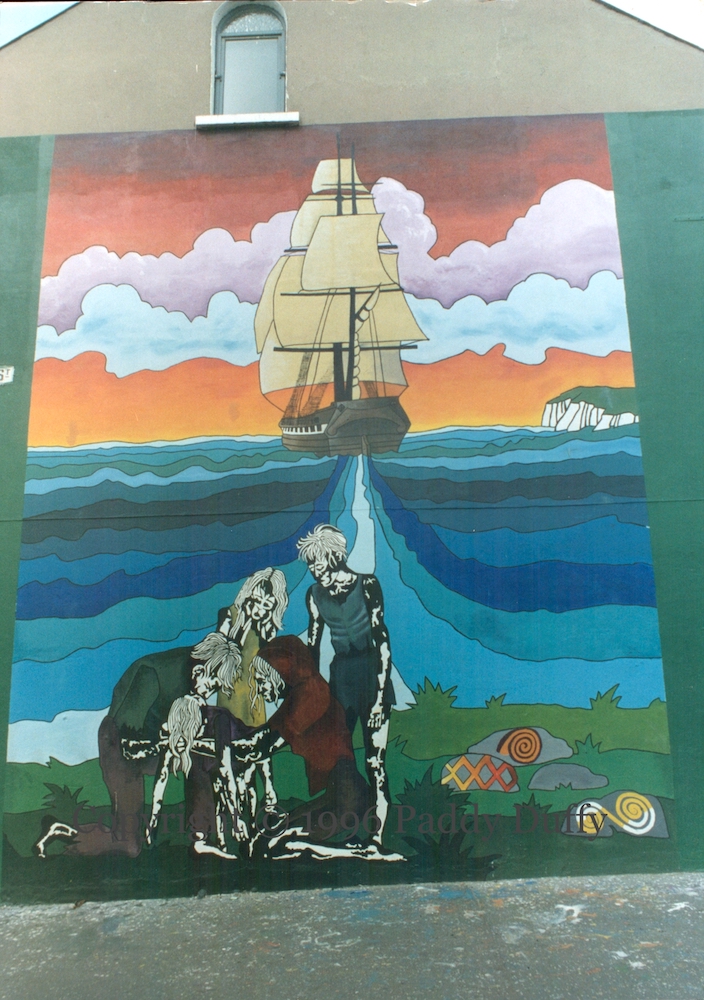
Coffin Ship

A million, and perhaps as many as 2 million – one in four Irish people – left Ireland between 1845 and 1855, many sailing on so-called “coffin ships” which had mortality rates of 30%. Another million died in the Great Hunger itself (Visual History), in most cases the proximate causes were fever and dysentery (WP | Irish Central).

Crocus Street, west Belfast. Perhaps by the same hand(s) that painted the Gorta Mór mural in Rossnareen.

Click image to enlarge
Copyright © 1996 Paddy Duffy
T00113

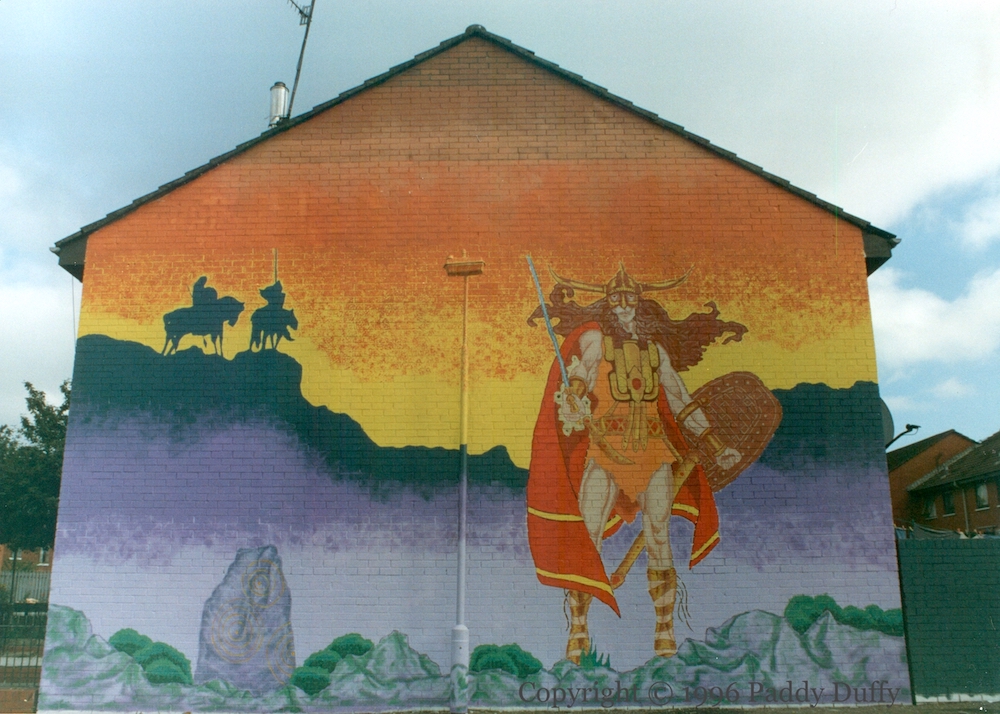
The Coming Of Lugh

The main figure is from Jim Fitzpatrick’s The Coming Of Lugh and the two horsemen on the left are from Lugh The Il-Danna.

For more Jim Fitzpatrick drawings reproduced in murals, see the Visual History page.

The mural was perhaps painted for the Ardoyne Fleadh, and perhaps by Sean Doran, who worked on the Blind Piper in 1994 and produced posters for the Fleadh in 1996, 1997, and 1998.

Ardoyne Avenue, north Belfast

Click image to enlarge
Copyright © 1996 Paddy Duffy
T00184

Bloody Sunday

The third mural by the Bogside Artists (after The Petrol Bomber and BernadetteVisual History) is “Bloody Sunday” (painted with Sean Loughrey), painted for the 25th anniversary of Bloody Sunday. It reproduces a Fulvio Grimaldi photograph of local priest Edward Daly waving a blood-stained handkerchief in advance of four men carrying the body of Jackie Duddy. The left-most figure has been changed into a British paratrooper, and he is trampling on a “civil rights” banner similar to the one later used to cover a body. In the background is an image from earlier in the day, of the civil rights march from Creggan to the Bogside.

Lecky Road/Rossville Street, Bogside, Derry

Click image to enlarge
Copyright © 1996 Paddy Duffy
T00192 [T00202]

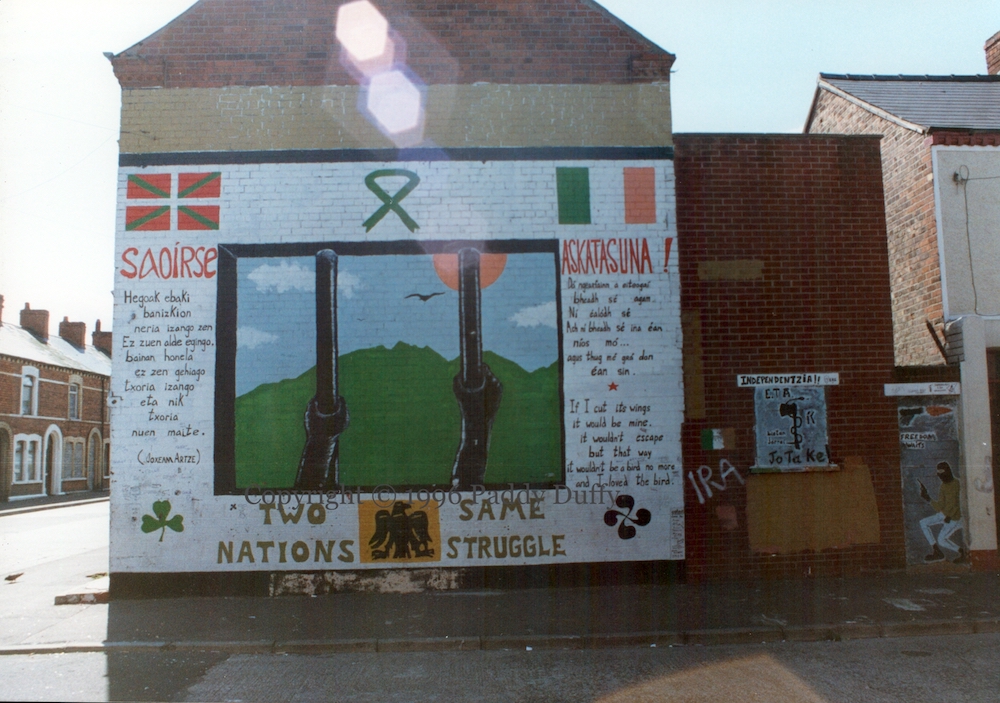
Two Nations, Same Struggle

“Saoırse – Askatasuna!” Lines from Joxean Artze’s poem Txoria Txori appear in three languages – Basque, Irish, and English – in this Clonard mural:

“Hegoak ebaki banizkion neria izango zen. Ez zuen alde egingo bainan, honela. Ez zen gehiago txoria izango … eta nik txoria nuen maite.”

“Dá ngearfaınn a eıteogaí, bheadh sé agam. Ní éalódh sé, ach ní bheadh sé ına éan níos mó … agus thug mé grá don éan sın.”

“If I cut its wings it would be mine, it wouldn’t escape, but that way it wouldn’t be a bird no more … and I loved the bird.”

The bird for Irish prisoners is the lark, which can be seen through the prison bars. The green ribbon above the central image is a symbol of the campaign to release political prisoners as part of any agreement that might come out of the peace process.

For Basque prisoners the bird is the “arrano beltza” [black eagle] which appears at the bottom of the mural.

The symbols on the left and right are the Irish shamrock and the Basque “lauburu” (four heads).

Painted by the Askapena Basque Internationalist Brigade in Cawnpore Street, Clonard, west Belfast, August 1995. To the right are two small murals in support of the ETA (“Independentzia!!”, “ETA” with the snake-and-axe (politics and armed struggle) and “bietan jarrai“, “Jo ta ke!” [push on!] and the IRA (a blazing pistol above a balaclava’d volunteer with pistol, “Freedom awaits”).

Click image to enlarge
Copyright © 1996 Paddy Duffy
T00169

History Is Written By The Winner

The mask of “revisionism” covers the face of “truth” reading the book of “Irish history”. Originally painted in 1996 by Ciaran McKeirnan, Brian O’Loan, and Donal Daly, son of IRSP leader Miriam Daly, who was killed by the UDA in 1980, and to whom the title quote is attributed.  

Click image to enlarge
Copyright © 1996 Paddy Duffy
T00189 T00179 [T00203]