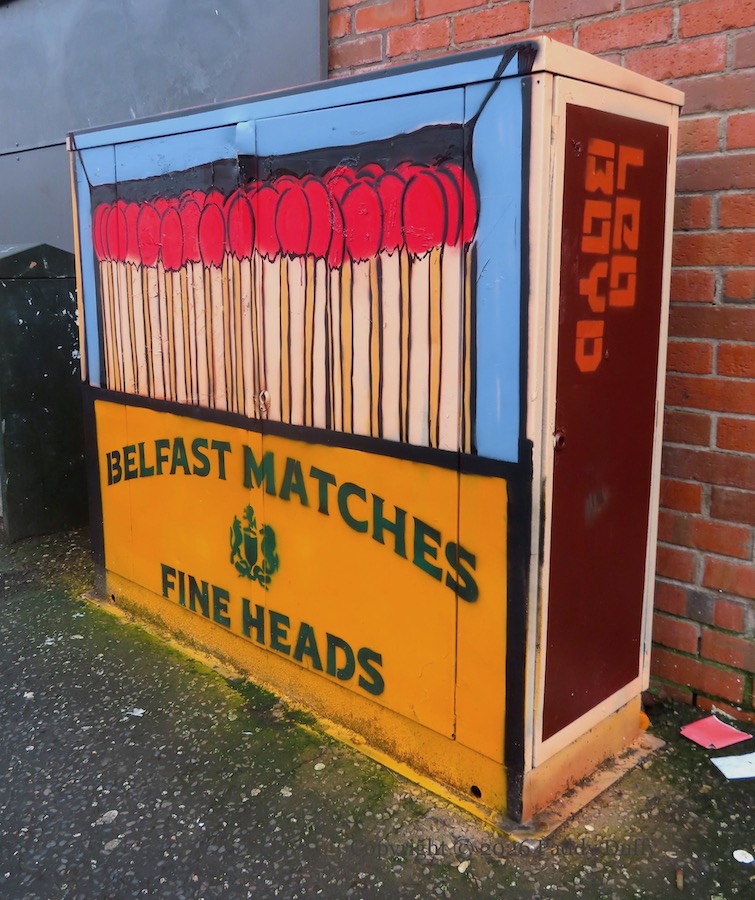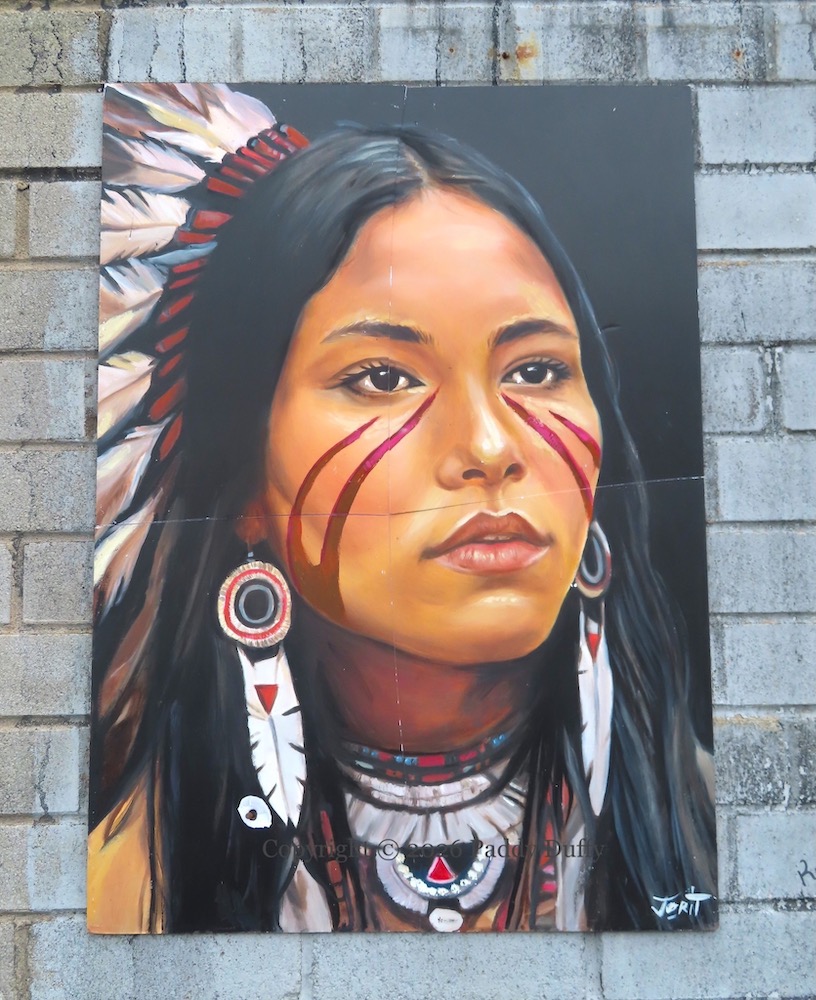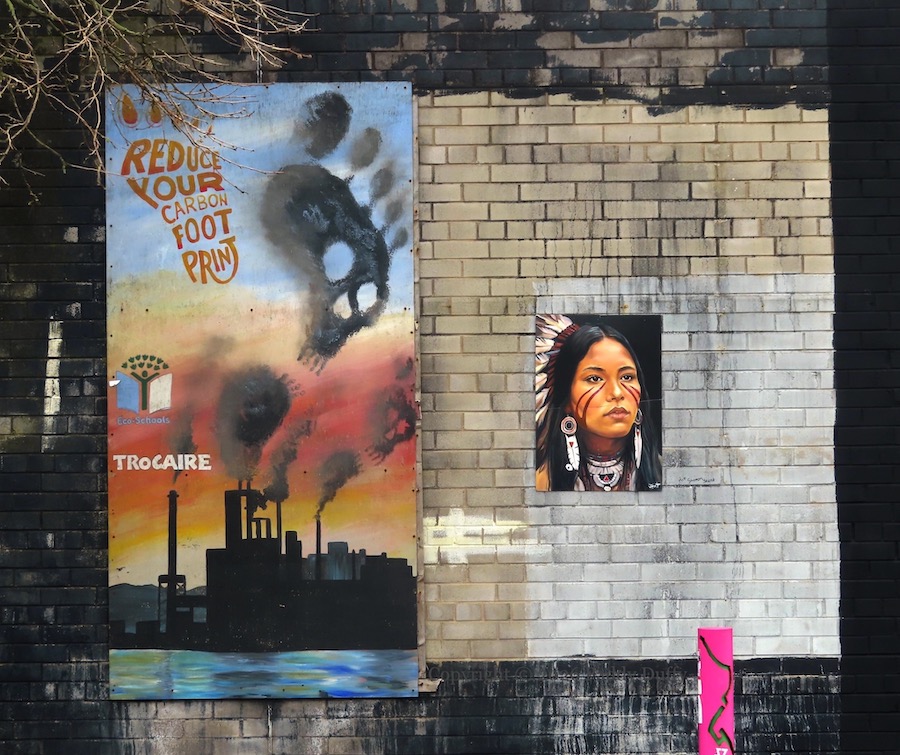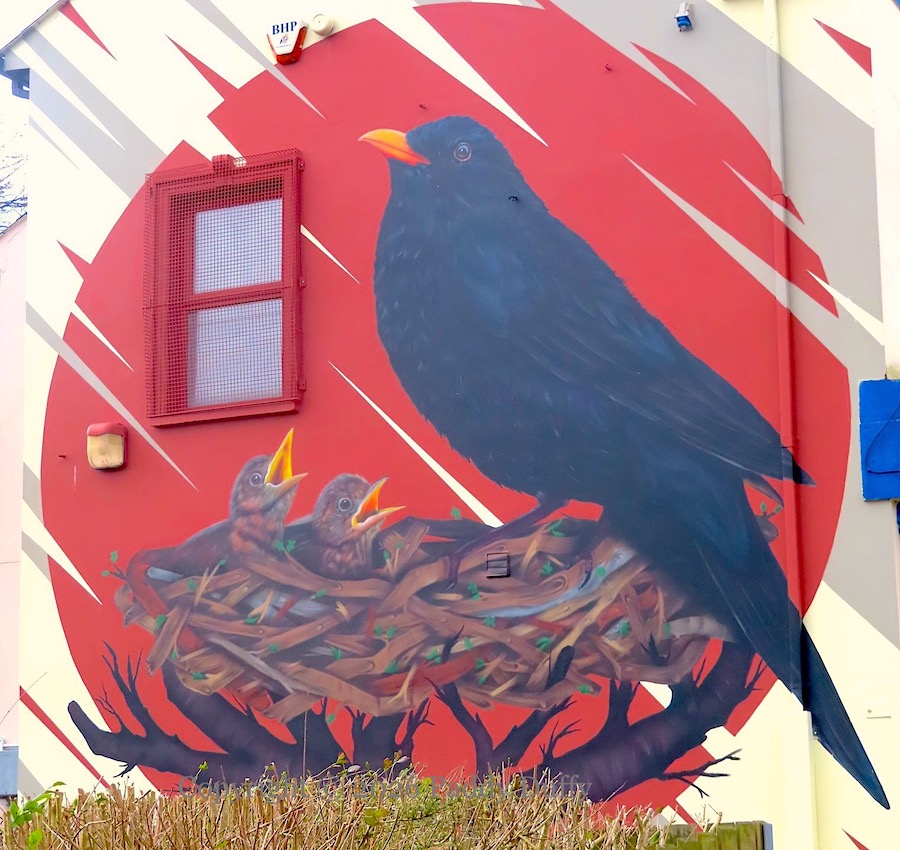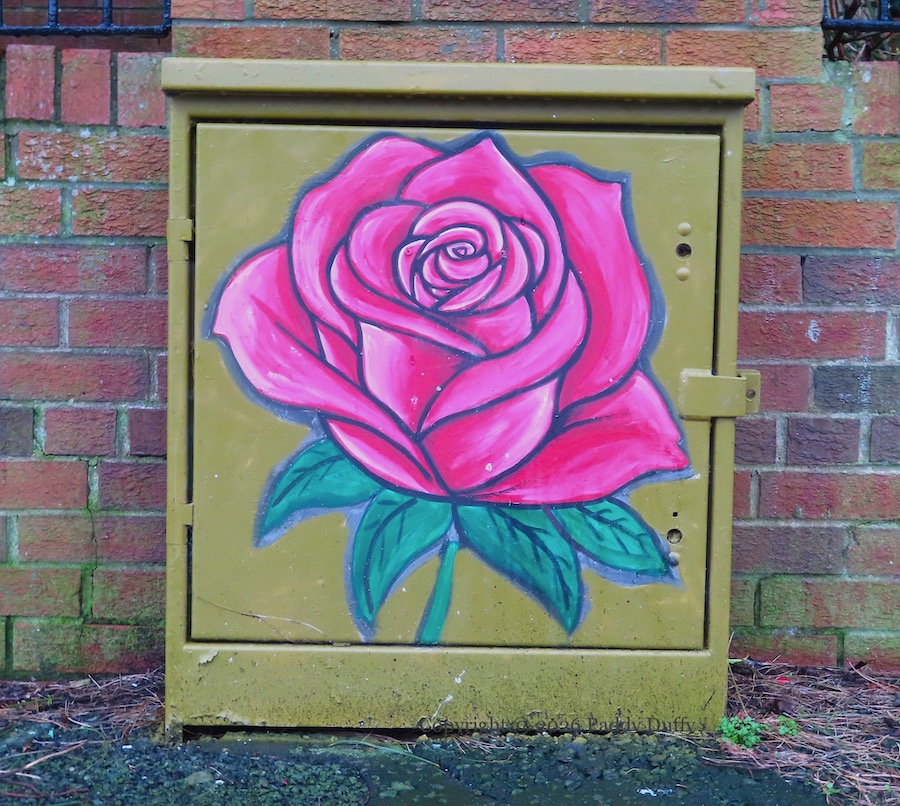
These Easter lilies are on a junction box on the Springfield Road at New Barnsley Park, west Belfast, and across the street from the boxes seen in Bóthar Chluanaí and Gaırdín Na hÉıreann.
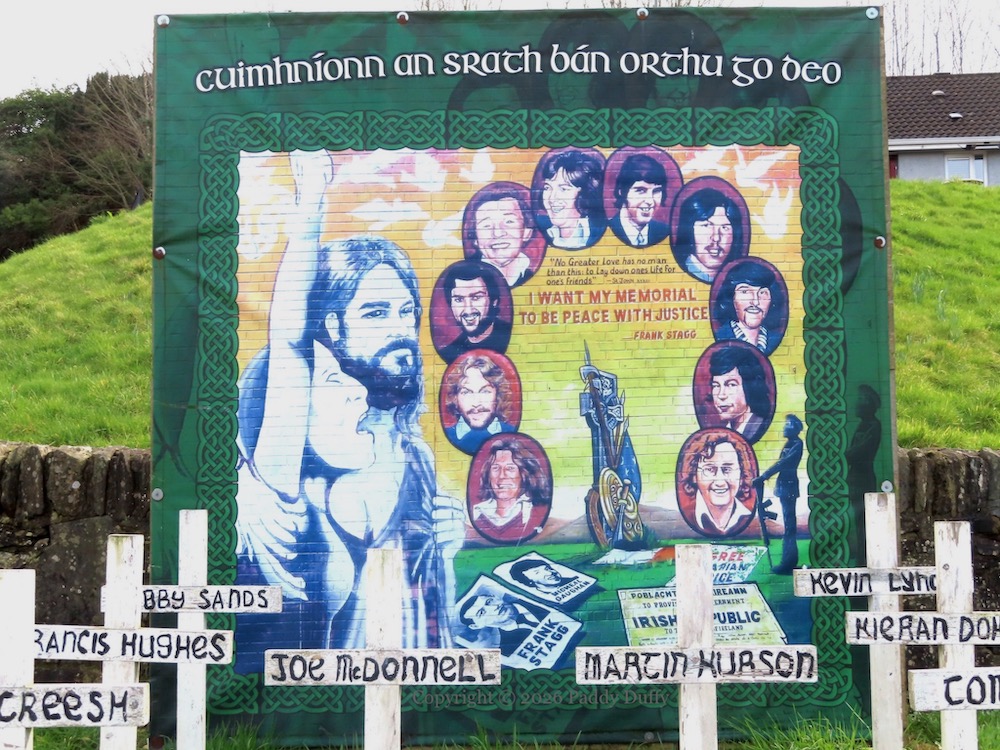
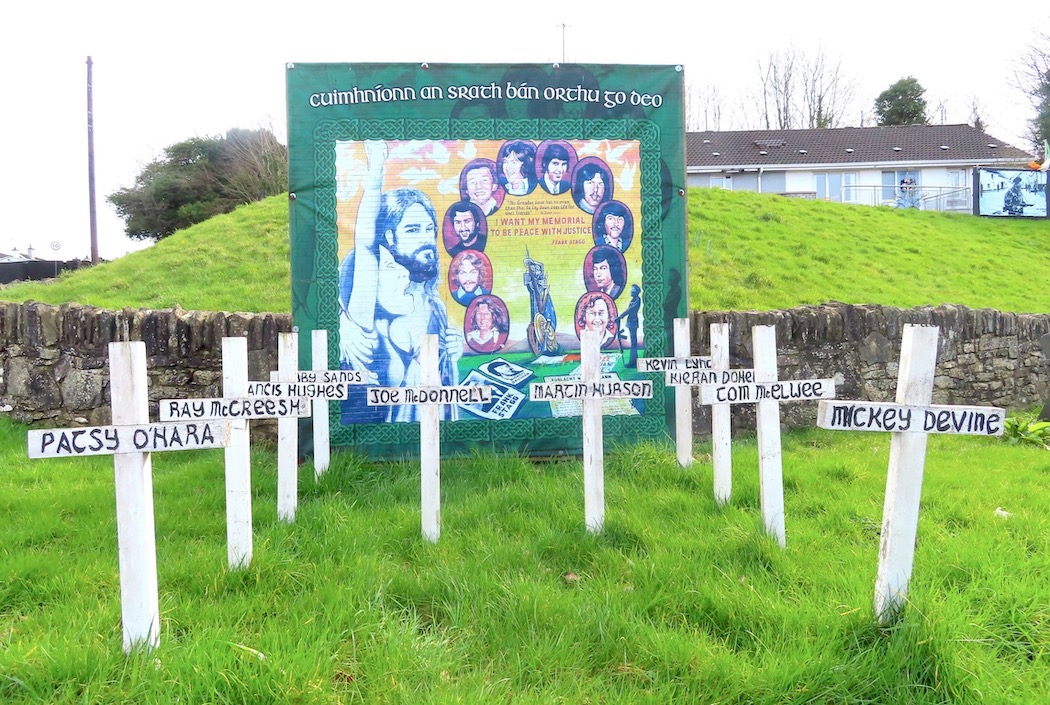
Michael Gaughan and Frank Stagg are presented along with the ten deceased 1981 hunger strikers on the cross-beam of a large wooden “H” at the top of Turf Lodge.
IRA volunteer Michael Gaughan died in Parkhurst prison in 1974 after 64 days on hunger strike. Gaughan’s coffin was draped with the Tricolour used to bury Terence McSwiney in 1920. He was force-fed seventeen times during the strike and his family alleged that he died from food stuck in a punctured lung. The practice was ended after Gaughan’s death.
Frank Stagg was on the Parkhurst hunger strike with Gaughan, and another in Long Lartin prison, and a third in Wakefield in December 1975. He died after 62 days on February 12th, 1976.
“NFC – representing our community with pride”. Newington Football Club [Fb], also known as “the swans”, is an NIFL team from north Belfast. The club was “est[ablished] 1979” as Jubilee Olympic FC, and was later Newington Youth Club, before becoming Newington FC c. 2018. A full list of its honours can be found on the club’s WP page.
The seven “houses” (tower blocks) in the New Lodge are named after figures from Irish mythology: Méabh, Eıthne, Cú Chulaınn, Fınn, Na Fıanna, Gráınne, and Oısín. In the foyer of each house there is a painting of the eponymous hero, painted by Danny D and Marty L in imitation of Jim Fitzpatrick (as is explicitly acknowledged in the Gráınne painting, below): Eıthne is represented by Fitzpatrick’s Palu The Cat Goddess; Na Fıanna are represented by Lugh; Gráınne is represented by Fann. The bulls are by Finbarr O’Connor; Cú Chulaınn is inspired by the Oliver Sheppard statue in the GPO.
For the old names of the buildings, and the pairs of hunger-strikers painted on the tops of six of the seven towers, see New Lodge Flats.
“Fıonn Mac Cumhaıll gained fable knowledge after sucking his thumb which he burned while cooking the magical Salmon of Knowledge. He followed in his father Cumhall’s footsteps becoming captain of the Fıanna. His death at the Battle of Gabhra marked the beginning of the decline in the might of the Fıanna.”
“The Fıanna was the name given to the band of warriors drawn from all over Ireland, under the control of the High King who travelled the country ready to protect it from invaders. The motto of the Fıanna was – Truth in our Hearts, Strength in our Hands, and Consistency in our Tongues.”
“Gráınne, daughter of Cormac Mac Art, High King of Ireland, betrothed to a grey-haired Fıonn Mac Cumhaıll but ran away with the handsome young Dıarmuıd before the marriage took place. She returned to marry Fıonn after Dıarmuıd’s death.”
“Oısín, son of Fıonn Mac Cumhaıll, fought many brave battles with the Fianna. He fell in love with Nıamh and went to live with her in Tír Na nÓg for 3 years. He became homesick and when he returned he discovered that 300 years had passed. He instantly turned in a withered old man and died.”
“RNU [Fb] stands with Palestine” – the board has been augmented by some knotwork corner-borders in the colours of the Palestinian and Irish flags, along with “freedom” in Irish (saoırse) and Arabic (الحرية).
For the board as originally presented in April 2024, see X14944.
Anti-Agreement armed group Óglaıgh Na hÉıreann split in 2024 (BelTel) with the larger faction following Tony McDonnell (BelTel). Death threats against seven members from the smaller faction (under Sean O’Reilly) were issued and attacks were made in February (BBC), March (Irish News/reddit), and July (Irish News).
The signage seen here is in the New Lodge in north Belfast. On the left are the names of the ten deceased 1981 hunger-strikers, on the right, armed and masked volunteers pose against a background of a vintage picture of the flats (from Getty Images – BBC).
Winifred Carney was a qualified secretary and typist, and became secretary of the Irish Textile Workers’ Union in 1912, in which position she met James Connolly, who was secretary of the Belfast branch of the ITGWU. She was a member of Cumann Na mBan and participated in the Easter Rising of 1916. Carney was in the GPO when it was taken over and was among those who surrendered at the end; during the occupation she typed up dispatches from the Moore Street headquarters – this is how she was portrayed in the the 1916 Centenary mural.
These are images of the sub-station at the green in the middle of Drumbeg. Above are children bearing messages of “happiness” and peace (a second trio of children on the right-hand side of the image above has been blotted out by a large pink splotch). The plaque in the top right reads, “A Shared Space & Services Re-Imaging Project supported by the European Union’s Peace IV Programme”.
On the other walls are a goal with points for hitting different spots, the “Drumbeg Omniplex” with “movie coming soon”, and two pairs of Irish dancers on either side of a reflective panel that has now disappeared.
These paintings are in the Meadowbrook estate in Tullygally, Lurgan, painted by local children with support from Drumgor Detached Youth Work Project (DDYWP) (ig) (Community Facebook page).