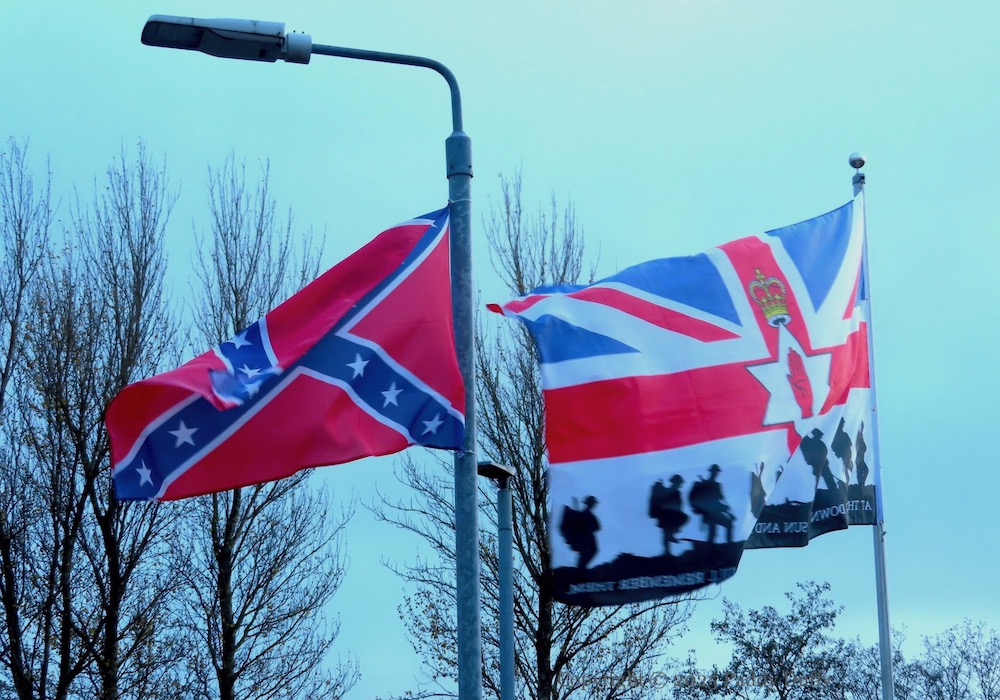
The Confederate battle flag flies alongside a flag combining the Union Flag, Ulster Banner, and image of WWI soldiers, at the corner of Northwood Crescent and Skegoneill Avenue, north Belfast. (Compare with the flags flying in August.)
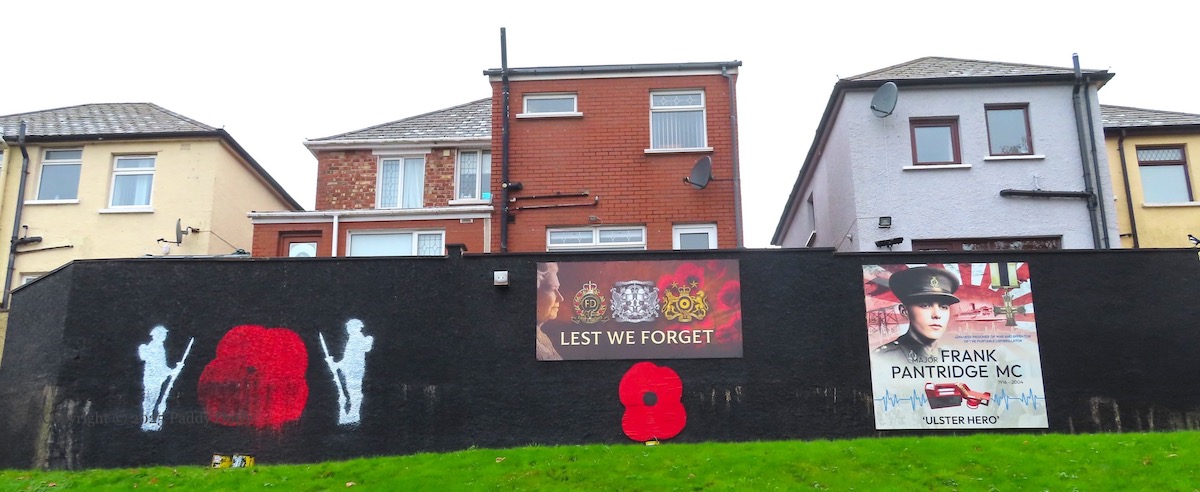
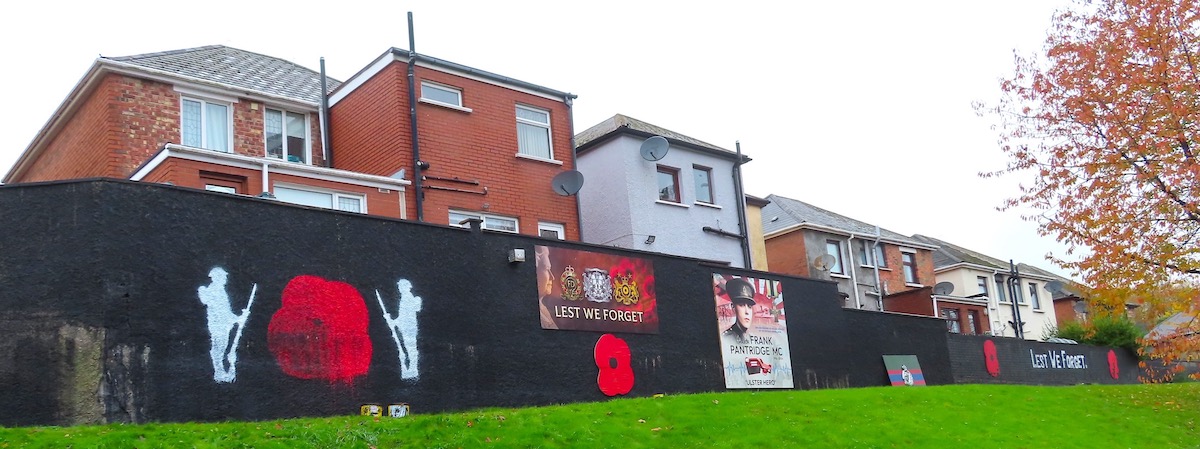
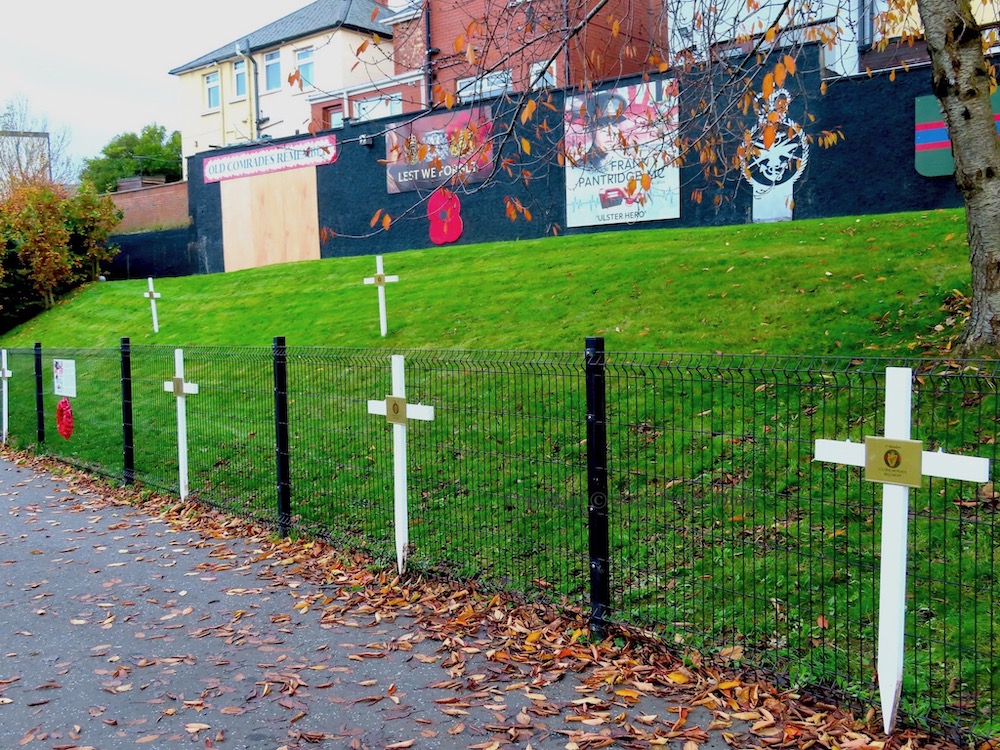
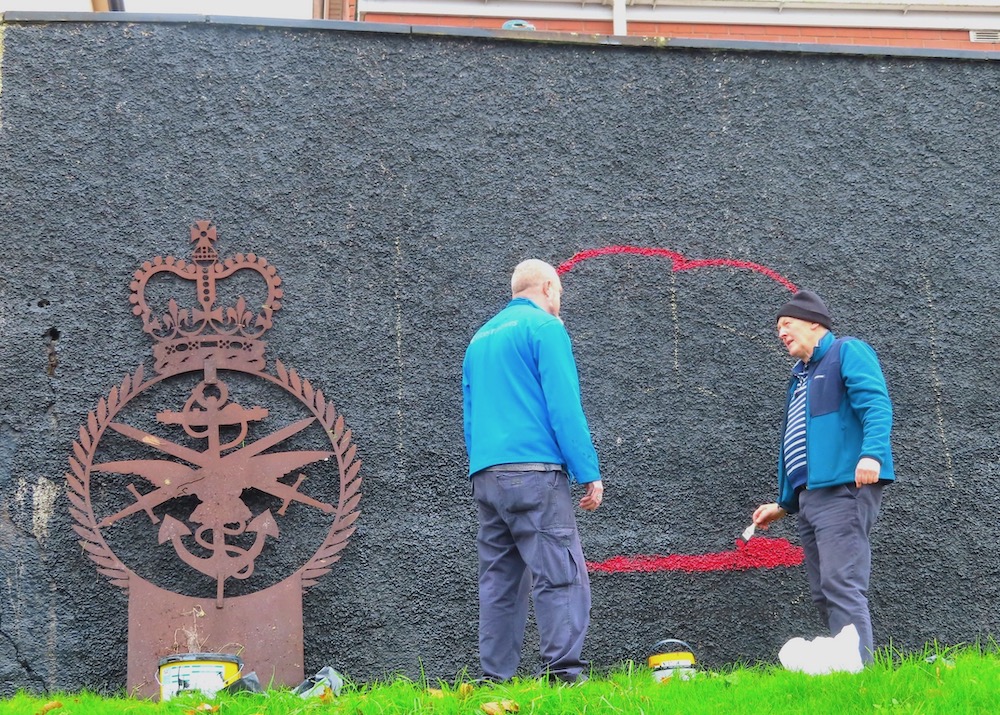
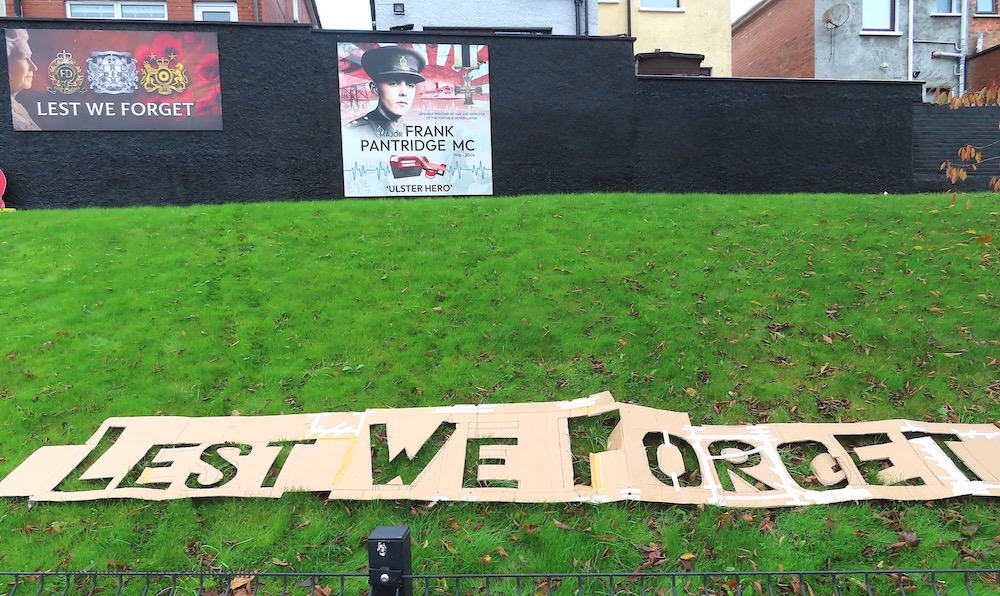
Here is a gallery of images from the wall behind the Shore Road ‘World Wars’ memorial (see Remembrance Sunday) which has a few new additions and re-ordered boards for this year’s commemorations. The main additions are the “Lest we forget” stencil shown above, and a large number of white crosses in the grass and along the fence bearing the emblem of the UDR. The UDR board has been moved from the slanted wall at the far left to what is now the central position on the wall.
For images from Sunday’s ceremonies at City Hall, see BBC.
The 1st Ranger Battalion was formed in 1942 as the United States Army’s equivalent to the British Army’s Commandos and – after training at a camp in Carrickfergus – it saw action in France (at Dieppe (SOF History), resulting in the first US casualties of the war – WP), Algeria, Tunisia, and Italy. (There are four information panels at the Sunnylands shops about the formation and training of the unit.)
The insignia shown – which is here placed on top of the beret patch – is the insignia of the modern (75th Regiment) Rangers, with the lightning-bolt indicating the unit’s quick-strike abilities (SOF History); these are also alluded to by the motto “sua sponte”, meaning “of its/their own accord”.
This new art is by Dan Kitchener (web) in Victoria Parade, Carrickfergus, just outside the train station, produced in co-operation with Wonder Arts, the Communities In Transition programme from the Executive Office (web) and Carrickfergus Alternatives’ Peace Impact Programme (Fb).
It has been criticized by street-artist Wee Nuls (web) as glorifying conflict (ig), a charge the artist rejects, saying that it was produced in co-operation with locals and has been well received by them (MSN). (See also the reactions on the Let’s Talk Loyalism Fb page.)
The tank might be the M4 Sherman “Fury”. The tank appeared in the 2014 film of the same name (Bovington Tank Museum) used by the 66th Armor Regiment under the command of Brad Pitt; the film is perhaps the inspiration for the image (e.g. the scene in which the town of Kirchohsen is captured – youtube).
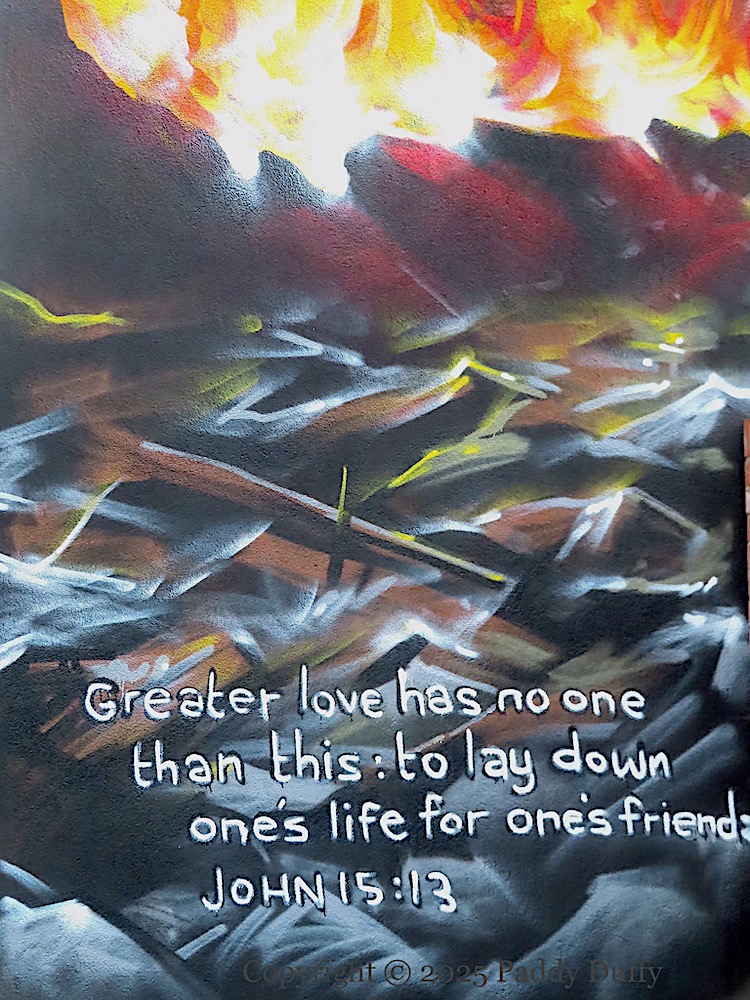
“Great love hath no man than this: to lay down his life for his friends – John 15:13”
“In loving memory of volunteer John Hanna, murdered by the enemies of Ulster 10th September 1991. Always remembered by the officers and volunteers South Belfast Ulster Volunteer Force. Lest we forget.”
UVF volunteer John Hanna was 19 years old when he was killed by the IRA as he tried to escape over his back-garden wall at his home on Donegall Road in the Village (UPI).
The small board to the left reads, “Volunteer John Hanna, 30th anniversary. Always remembered by the officers and volunteers South Belfast UVF. Sandy Row C Company.” On the side-wall, the poppies and the downcast soldiers come from the first World War but the names are all of modern UVF and RHC volunteers, from 1976 to the present day.
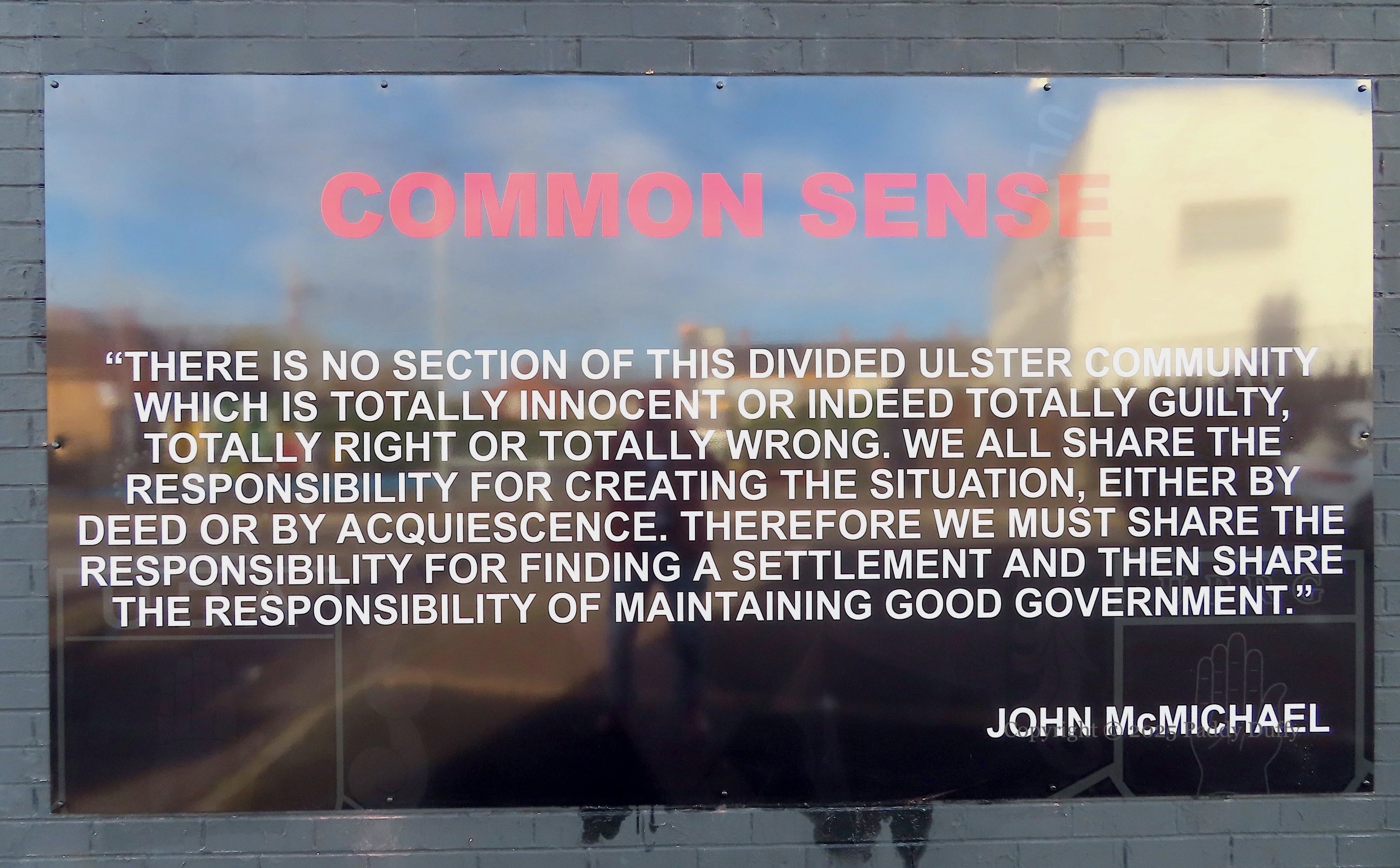
Prince Andrew Park, just off Donegall Road, south Belfast, replacing the printed board seen in He Died That We Might Live.
“Common Sense: “There is no section of this divided Ulster community which is totally innocent or indeed totally guilty, totally right or totally wrong. We all share the responsibility for creating the situation, either by deed or by acquiescence. Therefore we must share the responsibility for finding a settlement and then share the responsibility of maintaining good government.” – John McMichael”
John McMichael, the South Belfast UDA/UFF commander, was killed by an IRA car bomb in 1987. In addition to organising a team of assassins in the 70s and 80s, he founded a Political Research Group and wrote two documents proposing an independent Northern Ireland. The words above come from the end of the introduction to the second of these, Common Sense (available at CAIN).
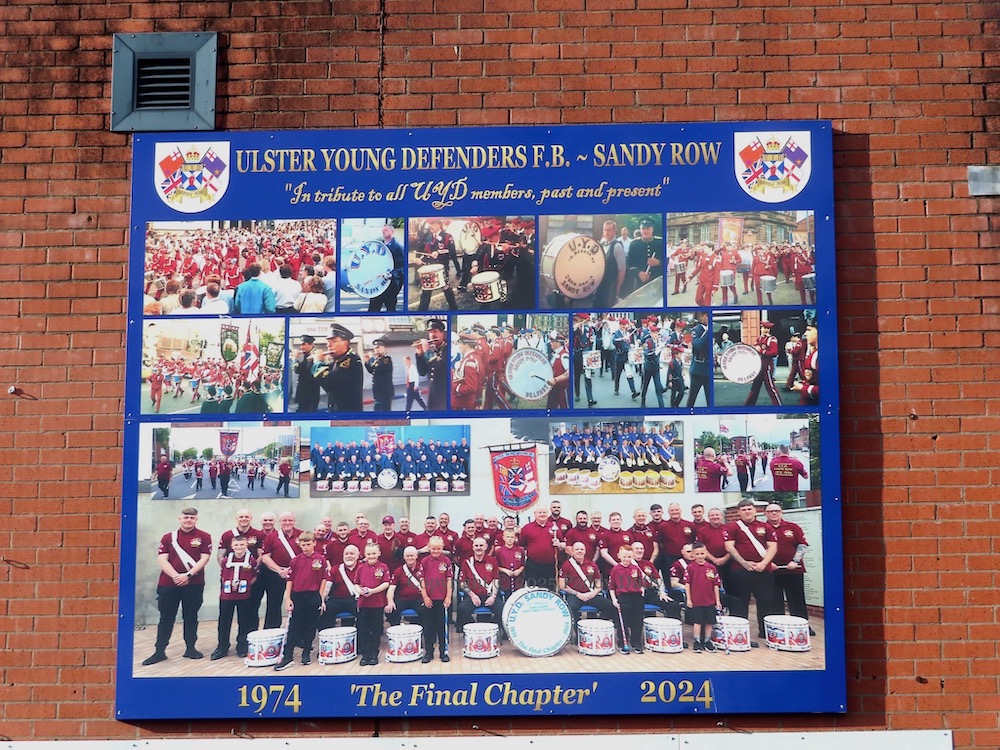
This is a fiftieth anniversary (1974-2024) board celebrating the “Ulster Young Defenders F[lute] B[and], Sandy Row.” It is on the side of the Sandy Row Rangers Supporters’ Club, above a composite board of six old Sandy Row bars including the Shaftesbury Arms, the Albion, the Royal, the Sandhurst, and the Klondyke.
“In tribute to all UYD members, past and present.” ‘The Final Chapter'”
“25 years from home. In proud and loving memory of Inky & Candy. Gone but not forgotten.”
October 2000 was a violent month in Tiger’s Bay, north Belfast, as the UDA and UVF feuded. David “Candy” Annesley (commonly known as David Greer – BelTel) was shot in Mountcollyer Street on October 28th by the UVF. On the 31st, Bertie Rice, veteran UVF member and canvasser for the PUP, was killed by the UDA at his Canning Street house. Later the same day, Tommy “Inky” English – UDA commander in north Belfast who had previously lived in Tiger’s Bay – was shot death by the UVF at his Ballyduff home. Mark Quail of the UVF was shot in Rathcoole on November 1st. (BBC | BBC | WP) There were fears that the feud would end (An Phoblacht) but it was formally ended on December 15th, with a joint statement by both groups (RTÉ).
This twenty-fifth anniversary tarp is on the multi-use pitch on North Queen Street at Upper Canning Street.
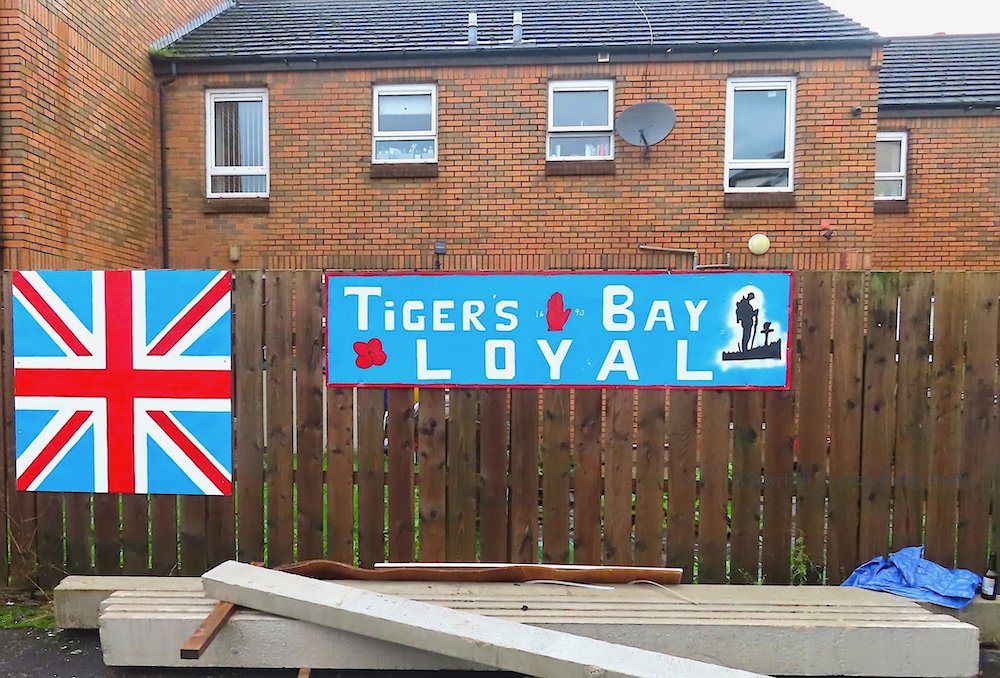
This pair of hand-painted (and stencilled) boards is next to the Mount Inn on North Queen Street. Tiger’s Bay is loyal to the memory of “1690” and the service of the 36th Division in WWI in 1916.
Greenmount Street, Tiger’s Bay, north Belfast
On the other side of the Mount, at the bottom of the old Lewis Street, are two more hand-painted boards from 2024 – see Friends Of The Somme.











 Paddy Duffy Collection