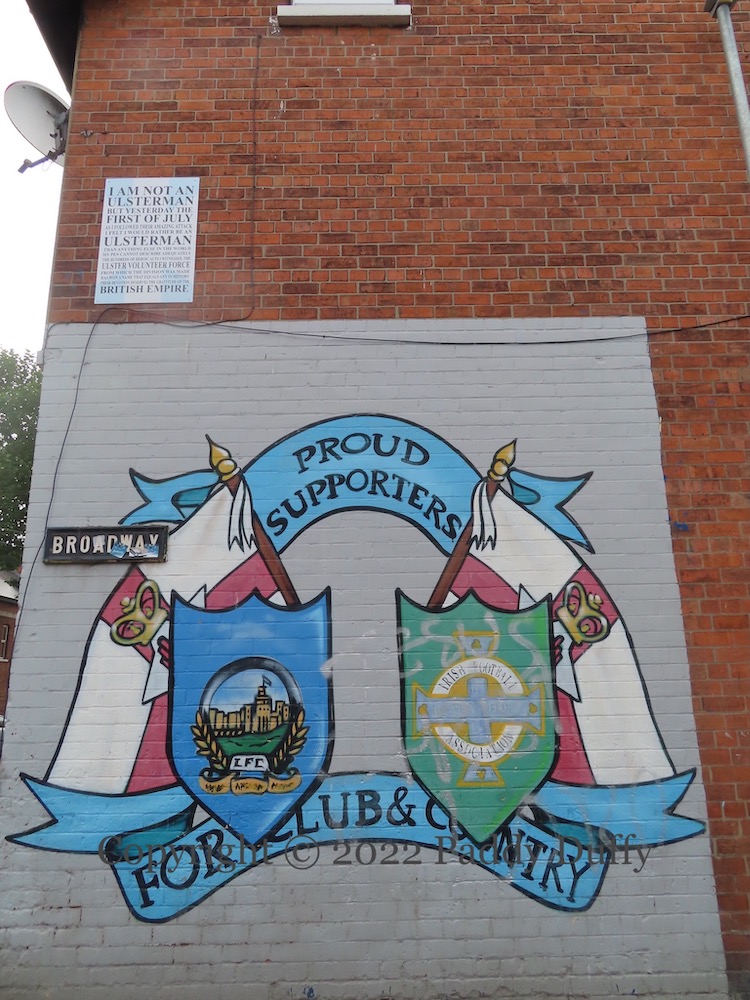
Sport and politics intersect in this mural at the junction of Broadway and Donegall Avenue in south Belfast. Northern Irish flags provide a backdrop for the shields of Linfield football club and the Northern Ireland football association.
The board on the left explains the composition of the Union flag as a combination of the saltire of Saint Andrew of Scotland, the cross of Saint George of England, and the saltire of Saint Patrick of Ireland. As the text notes, the saltire is much later than the saint: “The association with Saint Patrick dates from the 1780s, when the Order of Saint Patrick adopted it as an emblem. This was a chivalric order established in 1783 by George III. It is often suggested that it derives from the arms of the powerful FitzGerald dynasty [which dates to the 12th century].”
The text ends oddly: “The saltire has occasionally served unofficially to represent Northern Ireland and [has] been considered less contentious than other flags flown there.” Similar language is used on the symbols.com page for the Saltire.
The central board, shown above, shows a young Patrick (without the clerical garb in which he is often portrayed) against the backdrop of Slemish mountain, where Patrick is thought to have tended sheep as a young slave to a local chieftain, c. 401 AD and developed his Christian faith.
The board on the right shows a ship racing towards shore, superimposed over a 1659 map of Ulster by Blaeu. “The Red Hand Of Ulster: According to legend Ulster had at one time no rightful heir. It was agree that a boat race should take place and that whoever’s hand first touched the shore would become king. One contended, upon seeing that he was losing the race, cut off his hand and threw it ashore to win. O’Neill is said to have been the chieftain who cut his hand off to become the King of Ulster. The Red Hand is a key emblem of Ulster’s identity, an ancient and powerful symbol that is traditionally shown as a blood red hand.”
The colourings of the Saint Patrick profile are by children from the nearby Donegall Road Primary School.
The boards were unveiled on March 10th, 2016 by first minister Arlene Foster who remarked that the saint had become “very Gaelicised” and this — and the presence of Irish tricolours at parades — deterred unionists from celebrating “the patron saint of everybody in Northern Ireland” (Belfast Telegraph; also contains video of the launch). Anglicanism venerates saints but Presbyterianism does not, generally taking the “communion of saints” to refer to all members of the church.
“From Warsaw to Berlin” — Polish airmen in England, in the 300 Mazovian bomber squadron, write a “dedication” on a bomb headed for Germany in August 1941. The plane added as a background is perhaps an Avro Lancaster, while the one in the middle ground (in the wide shot, below) is a Vickers Wellington. According to the information board (shown last, below) “many Polish servicemen remained in Great Britain and Ireland after the [Second World] war, laying the foundations for a large Polish community that now (in Northern Ireland) numbers over 30,000.”
On the side-wall: The Ulster Tower at Thiepval “is dedicated to the glory of God in grateful memory of the officers, non-commissioned officers, and men of the 36th (Ulster) Division and of the sons of Ulster in other forces who laid down their lives in the Great War, and of all their comrades-in-arms who, by divine grace, were spared to testify to their glorious deeds.”
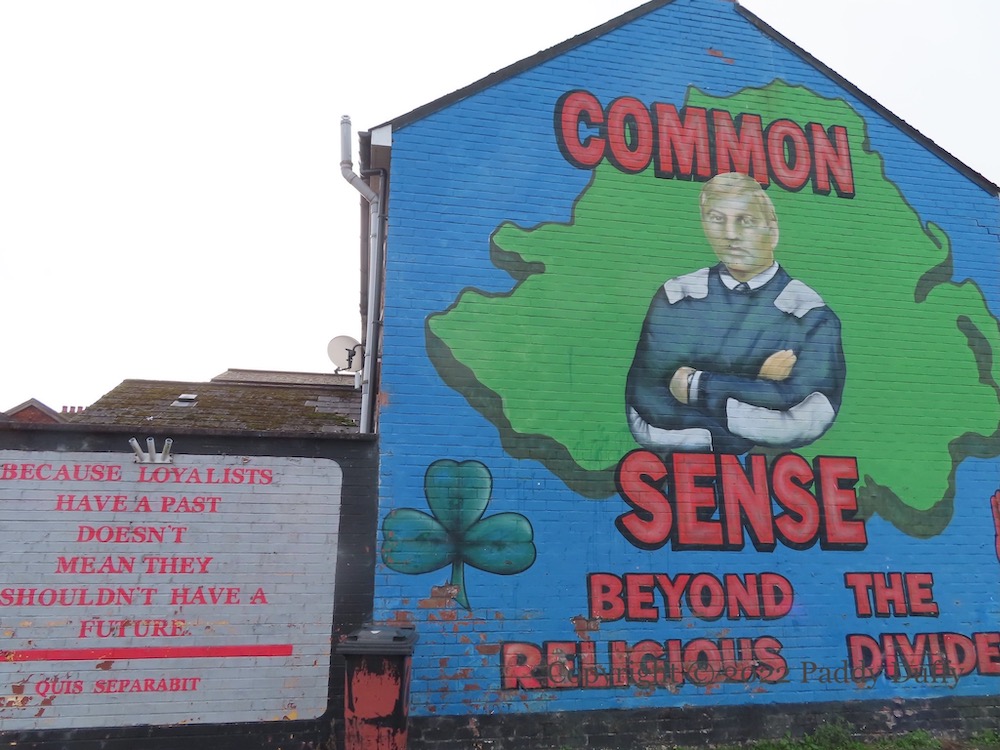
UDA commander John McMichael was also secretary of the New Ulster Political Research Group (NUPRG), a think tank of the UDA/UFF. The group argued for an independent Northern Ireland (based in part on beliefs about a separate Ulster ethnic identity – see the Visual History page on Cú Chulaınn) in two documents, 1979’s Beyond the Religious Divide and 1987’s Common Sense (available at CAIN), promoting the philosophy of ‘Ulster nationalism’, depicted here by the free-floating Northern Ireland. McMichael ran unsuccessfully for the Belfast South seat after the murder of Robert Bradford (see To Bathe The Sharp Sword Of My Word In Heaven).
The side wall reads “Because loyalists have a past doesn’t mean they shouldn’t have a future. Quis separabit.” It previously had a McMichael quote – see We Must Share The Responsibility.
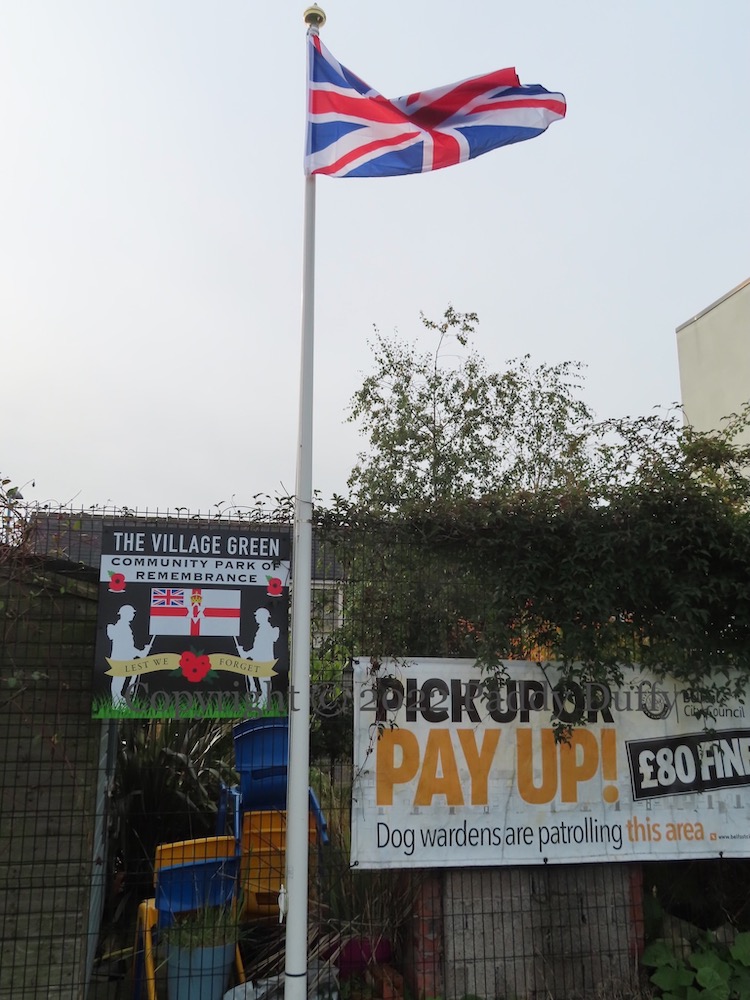
Part of the most recent development of the upper streets in the Village was not to rebuild the two rows of houses on Ebor and Nubia/Moltke streets and in their place construct a park – the Village Green – and playground. This new board on the outside railings make the park a “community park of remembrance” for WWI, showing an Ulster Banner with a Union Flag in the canton.
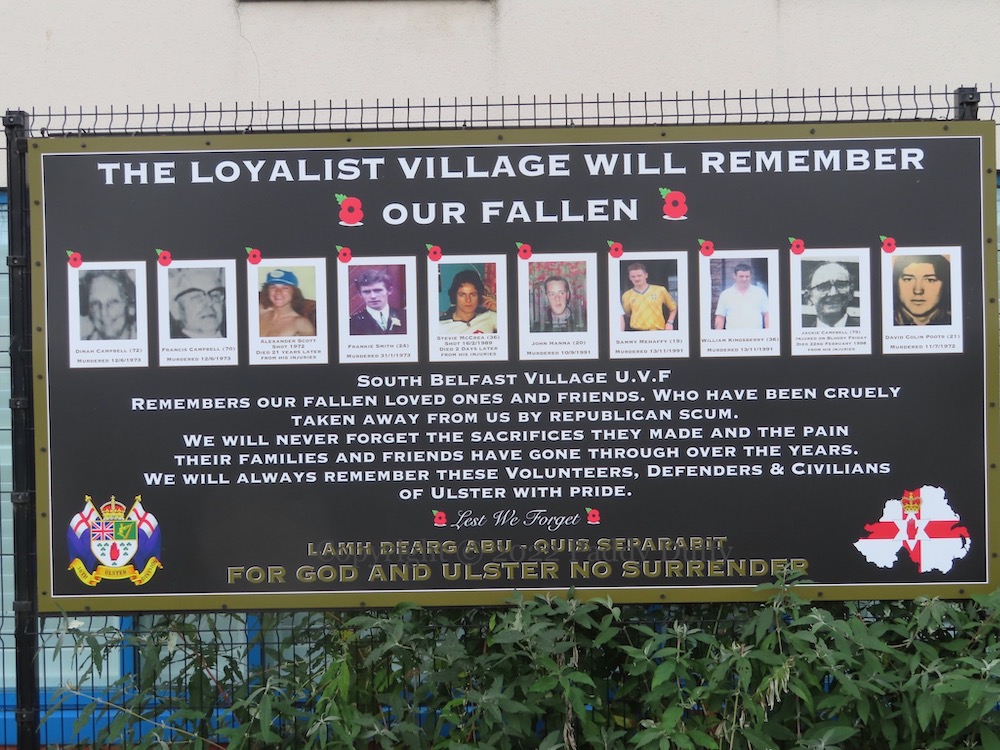
There is also a memorial to “loved ones and friends”, “volunteers, defenders & civilians” of the South Belfast UVF (though there is 36th (Ulster) Division emblem in the corner) who were “cruely taken away from us by republican scum”: Dinah Campbell, Francis Campbell, Alexander Scott, Frankie Smith, Stevie McCrea, John Hanna, Sammy Mehaffy, William Kingsberry, Jackie Campbell, David Poots.
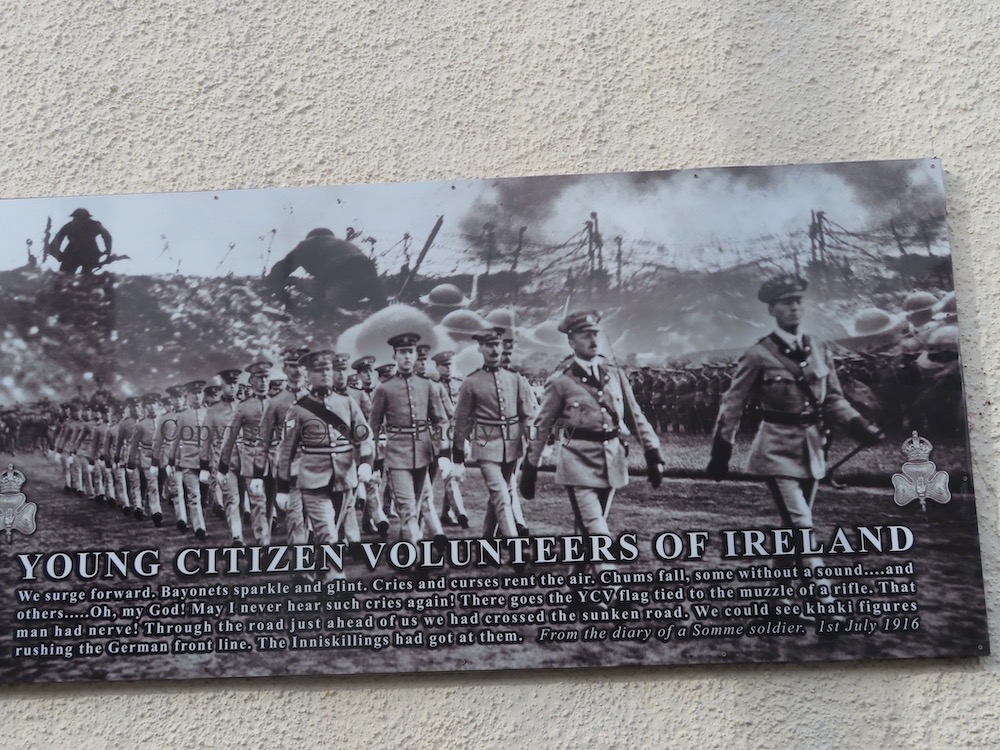
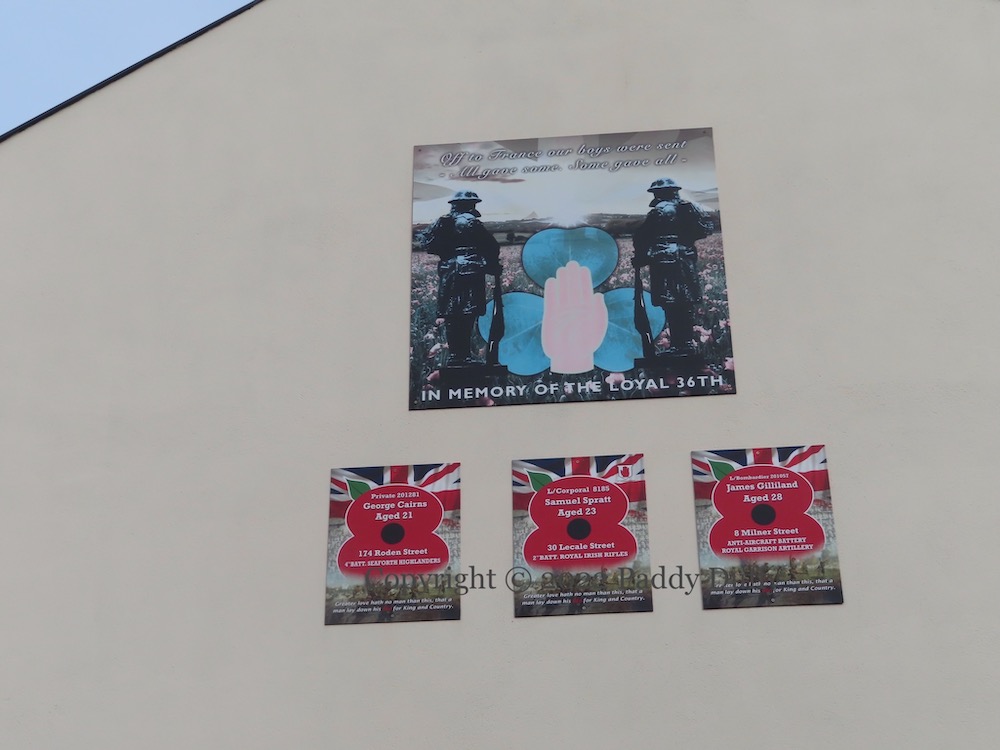
These Kitchener Street boards commemorate the “Young Citizen Volunteers Of Ireland” and the battle of the Somme. The text in the side-wall board (shown below) is from the diary of a Somme soldier: “We surge forward. Bayonets sparkle and glint. Cries and curses rent the air. Chums fall, some without a word … and others … Oh, my God! May I never hear such cries again! There goes the YCV flag tied to the muzzle of a rifle. That man had nerve! Through the road just ahead of us we had crossed the sunken road. We could see khaki figures rushing the German front line. The Inniskillings had got at them.”
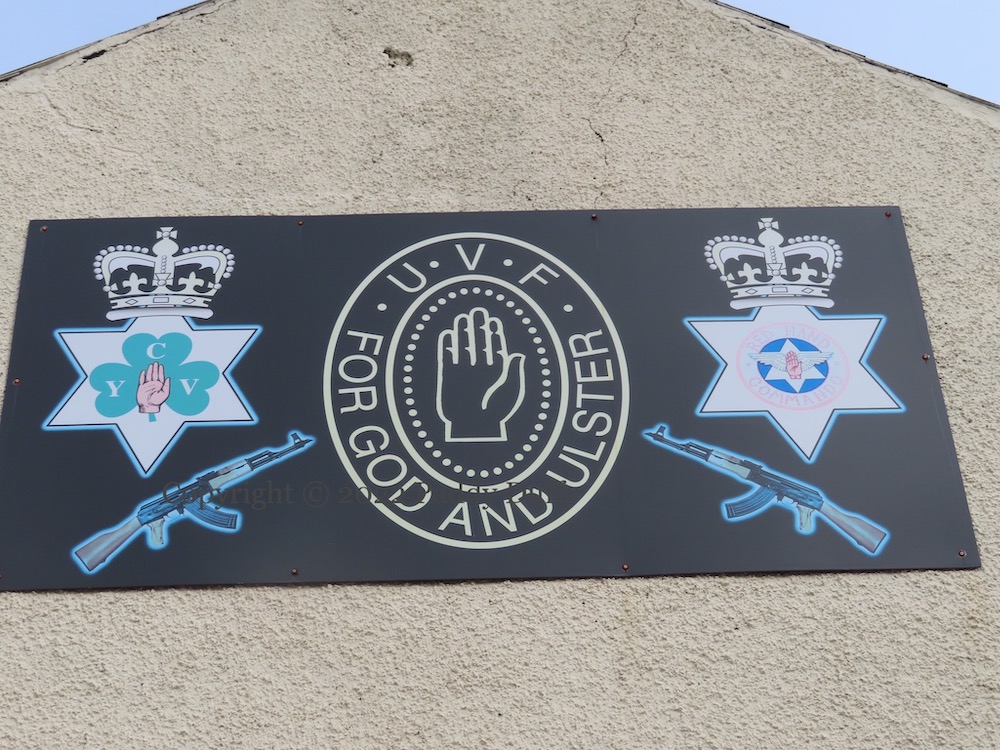
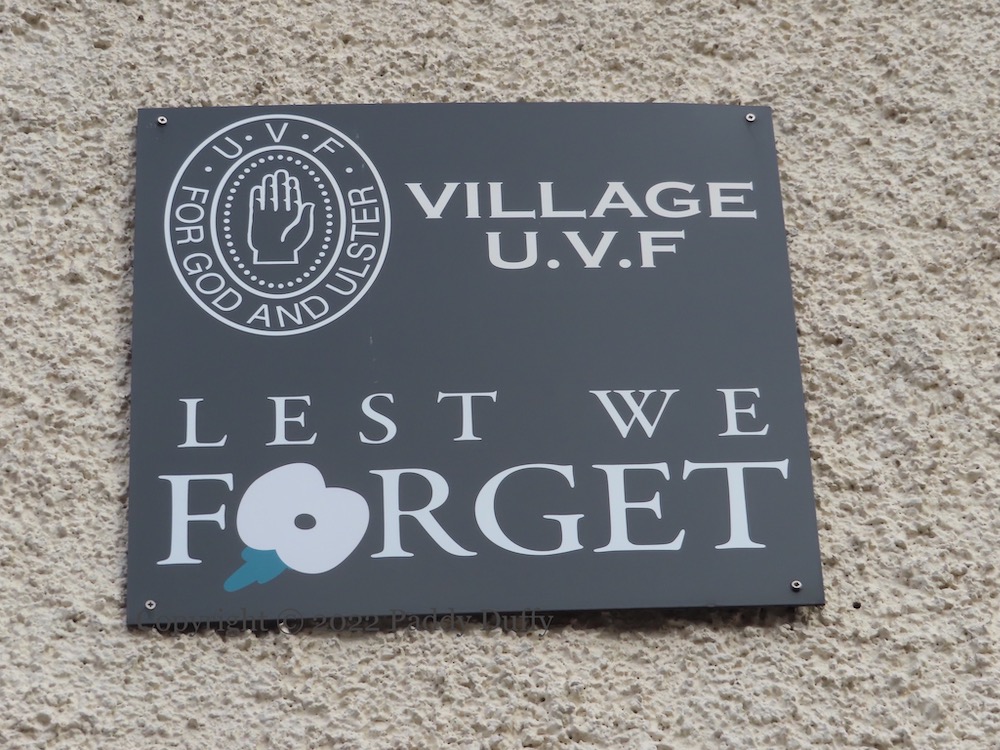
Territorial markings of the UVF are posted on the new development on the east side of the Village. These images are all from the Kitchener Drive, which has new houses in Kitchener St and Soudan St.
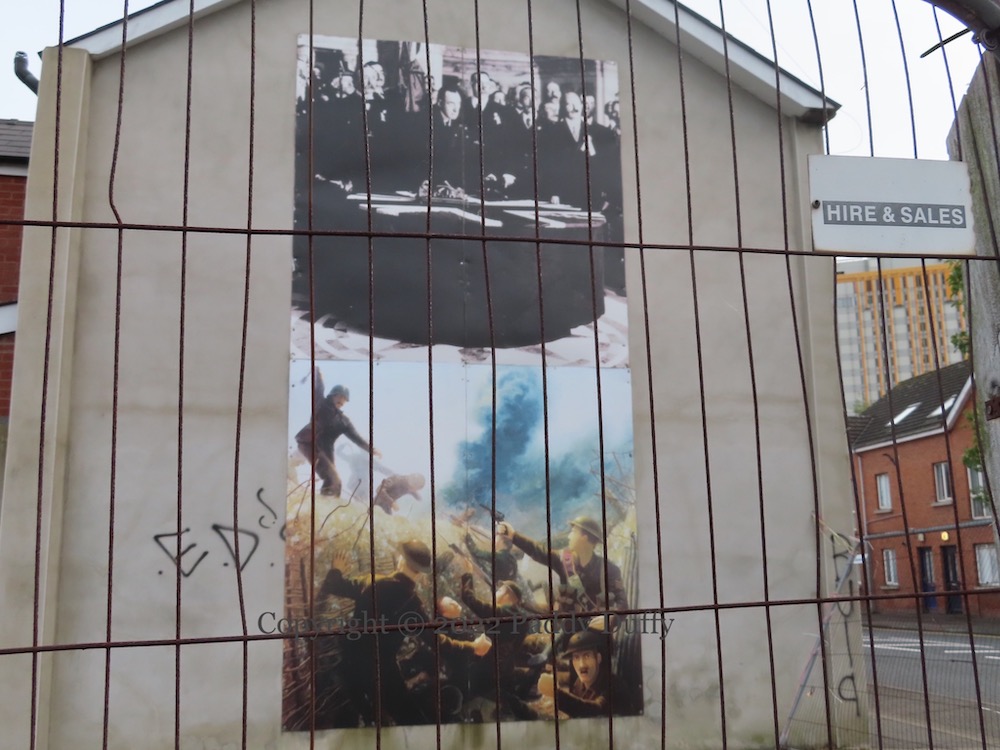
Here are a pair of boards in Barrington Gardens, Belfast: above, the signing of the Ulster Covenant, on September 28th, 1912; below, an attack on British trenches, perhaps intended to represent a scene from the first day of the Battle Of The Somme, July 1st, 1916.
Footballer Billy Simpson moved from Linfield to Rangers in 1950 and over the course of nine years and 239 appearances scored 163 goals. He also scored the winner for Northern Ireland against England in 1957. Simpson died in January of year 2017 and is remembered by this board outside the Supporters’ Club in Barrington Street, south Belfast.
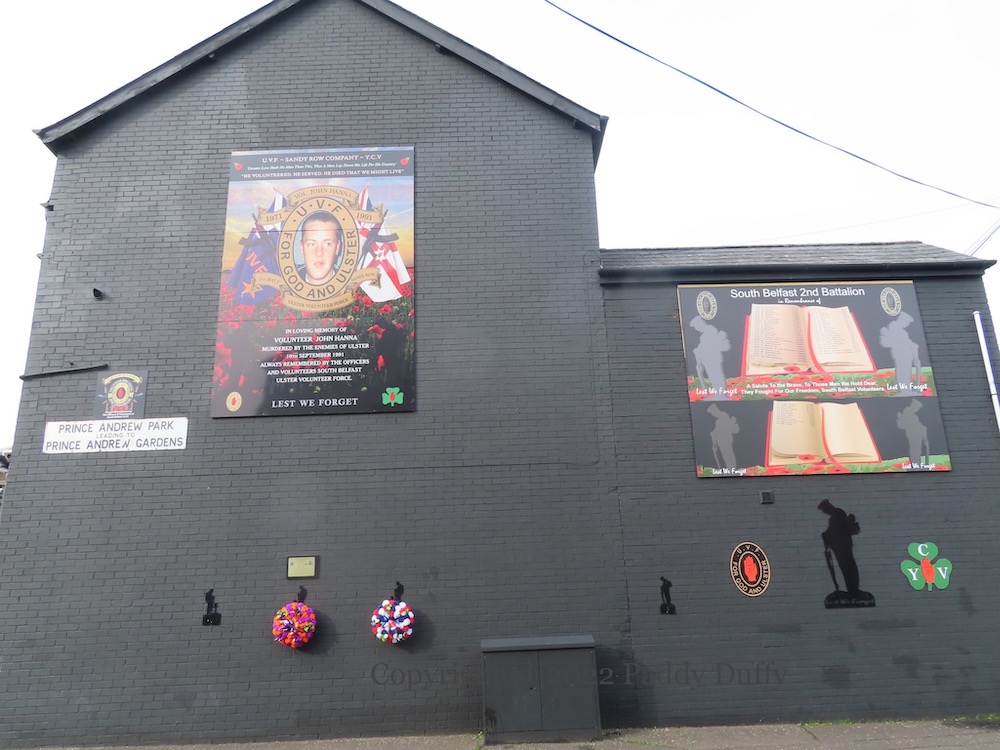
UVF volunteer John Hanna was 19 years old when he was killed by “the enemies of Ulster” (the IRA) at his home on Donegall Road in the Village. This new board is in Prince Andrew Park, just off Donegall Road. “Always remembered by the officers and volunteers South Belfast [2nd Batt Sandy Row] UVF”.
On the side-wall, the poppies and the downcast soldiers come from the first World War but the names are all of modern UVF and RHC volunteers, from 1976 to the present day.





 Paddy Duffy Collection