Lesbians Are Everywhere

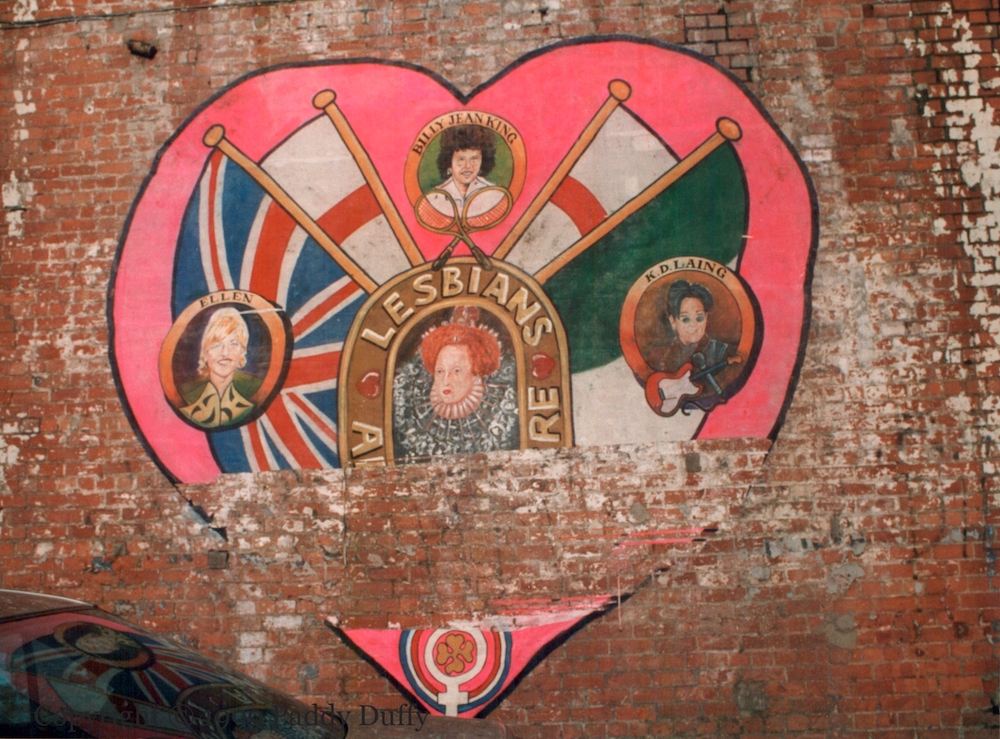
This is a fake mural, painted for the film The Most Fertile Man In Ireland (O’Connell 2005) which is set in Belfast. The mural doesn’t seem to have made the final cut but there’s another fake mural – Gloria Hunniford and Robert Emmet together in a frame of Celtic knot-work – at 7m40s, and another at 52m44s. You can play ‘spot the location’ for yourself by watching the film on youtube.

This one combines the Union Flag, Irish tricolour, Ulster Banner, and shape of the UVF emblem, with portraits of Ellen DeGeneres, Billy Jean King, KD Laing and Queen Elizabeth I.

(h/t Jonathan McCormick – Album 8)

Click image to enlarge
Copyright © 1999 Paddy Duffy
T00345

UN Day For The Eradication Of Poverty

“To be free of poverty is a human right.” October 17th, each year, is the United Nations’ International Day for the Eradication of Poverty. The mural shown above states that “12 of the 16 most deprived wards in Belfast are in W. Belfast”. 

Mural by Andrea Redmond and Margaret McCann sponsored by W. Belfast Economic Forum and the Falls Women’s Centre, showing children of the world under a rainbow and between a dolmen and a ?parrot?.

Dunlewey Street, west Belfast

Click image to enlarge
Copyright © 1997 Paddy Duffy
[T00211] T00212

No Consent, No Parade

Parading This mural demands that Orange Order marches have the consent of local residents in Derry, Garvaghy [Portadown], and lower Ormeau [south Belfast].

Parading was the central on-the-ground issue of the post-Agreement years (BBC). Resistance to Orange Order parades marching through CNR areas was led by local groups: in Derry, by the Bogside Residents’ Group, in Portadown, by the Garvaghy Road Residents’ Coalition, and in lower Ormeau by Lower Ormeau Residents Action Group. In each case, residents were appealing directly to the local lodges and to the police. (The Parades Commission would be established in 1998.)

In 1995, there was a three-day stand-off on the Gavraghy Road that resulted in a silent march without bands (CAIN). The police initially re-routed the 1996 march but reversed the decision at the last minute, citing the threat of loyalist violence, and forced residents off the street in order to accommodate the parade.

Rossville Street, Bogside, Derry

Click image to enlarge
Copyright © 1996 Paddy Duffy
T00190

Upper Springfield Development Trust

This is an in-progress image of a mural sponsored by and for the Upper Springfield Development Trust (web | until 1993 the Upper Springfield Development Forum) focusing on young people: “Mol an óıge agus tıocfaıdh sí.” (Praise youth/the young and it will flourish.”/”Youth responds to praise.”)

For a finished version, see the Peter Moloney Collection.

Signed by “Mo Chara” (Gerard “Mo Chara” Kelly) and “Spud” in the bottom right corner.

Whiterock Road, west Belfast

Click image to enlarge
Copyright © 1996 Paddy Duffy
T00188

Coffin Ship

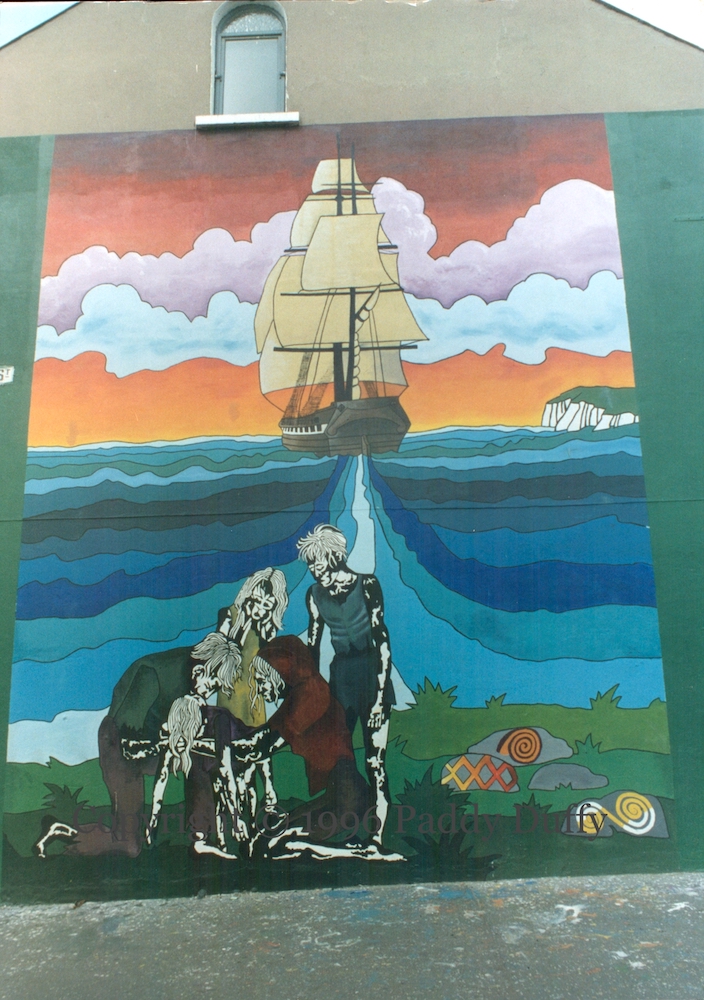
A million, and perhaps as many as 2 million – one in four Irish people – left Ireland between 1845 and 1855, many sailing on so-called “coffin ships” which had mortality rates of 30%. Another million died in the Great Hunger itself (Visual History), in most cases the proximate causes were fever and dysentery (WP | Irish Central).

Crocus Street, west Belfast. Perhaps by the same hand(s) that painted the Gorta Mór mural in Rossnareen.

Click image to enlarge
Copyright © 1996 Paddy Duffy
T00113

Travellers

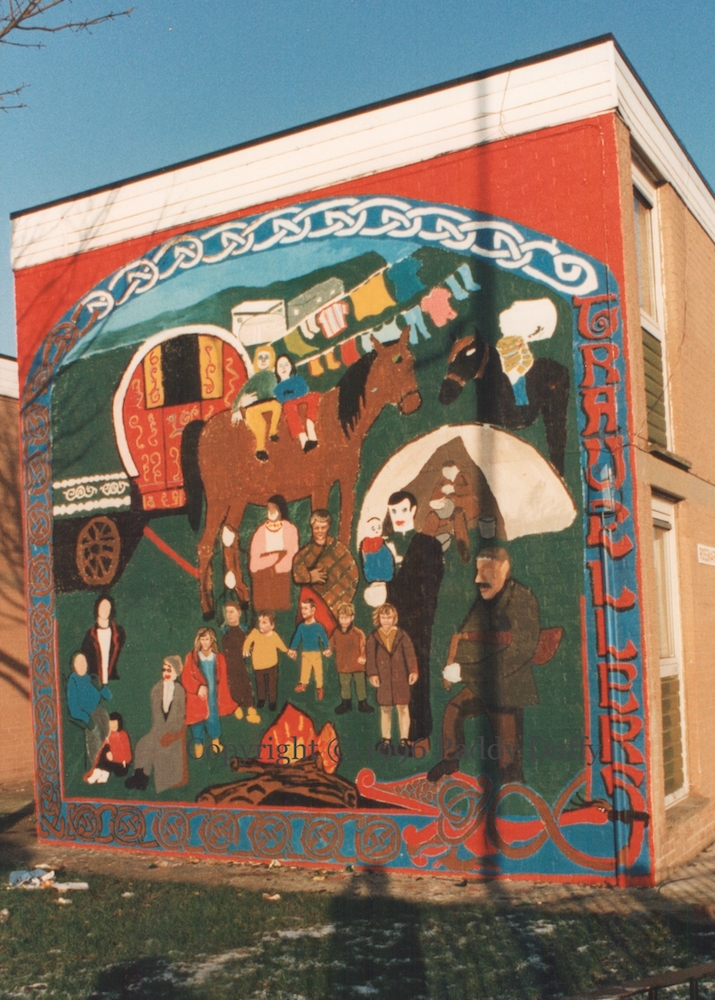
The immediate reason for this mural depicting traveller life is unknown. In 2006 (ten years after this mural) there were about 24,000 travellers living on the island of Ireland (WP | 1995 Report on travellers in Ireland (archive.org) | a good summary of the 2011 and 2016 numbers (CSO pdf).) About 2,000 were living in Northern Ireland, some at a site on the Glen Road (RTÉ has video from the site in 1987) close to this mural in Rossnareen.

Replaces the Alosa/Fuıseog mural.

Click image to enlarge
Copyright © 1996 Paddy Duffy (no date given)
T00183

Táın Bó Cúaılnge

This is an interesting mural from North Queen Street, if only because of its psychedelic colour-scheme and composite style.

The two bulls (presumably from the Táın though they are not the classic brown and white bulls) provide a centre, on either side of which we find Cú Chulaınn dying (and Tuan the eagle) and a dolmen. The horse on the right is perhaps Galloper. There are four faces superimposed on flying geese. The cranes Samson and Goliath are on the left (which suggests a cross-community sponsorship) and a Pride rainbow is on the right.

A wide shot of the whole can be seen in the Peter Moloney Collection. If you have any information about the piece, please get in touch.

North Queen Street, presumably at the bottom of the New Lodge (either where the playing pitch opposite (what was then) Artillery House (now Teach Ghráınne) is, or on a wall of Gallagher’s factory, where the car park for the shopping centre now is?).

Click image to enlarge
Copyright © 1988 Paddy Duffy
T00171 T00172