This Whiterock Road mural shows a blanketman/hunger-striker being watched over by a uniformed volunteer, on a large tricoloured bunting/drape at the feet of an angel holding a banner reading “blessed are those who hunger for justice“. Above are the words “Their hunger, their pain, our struggle“. The shields of the four provinces of Ireland and two shamrocks complete the mural.
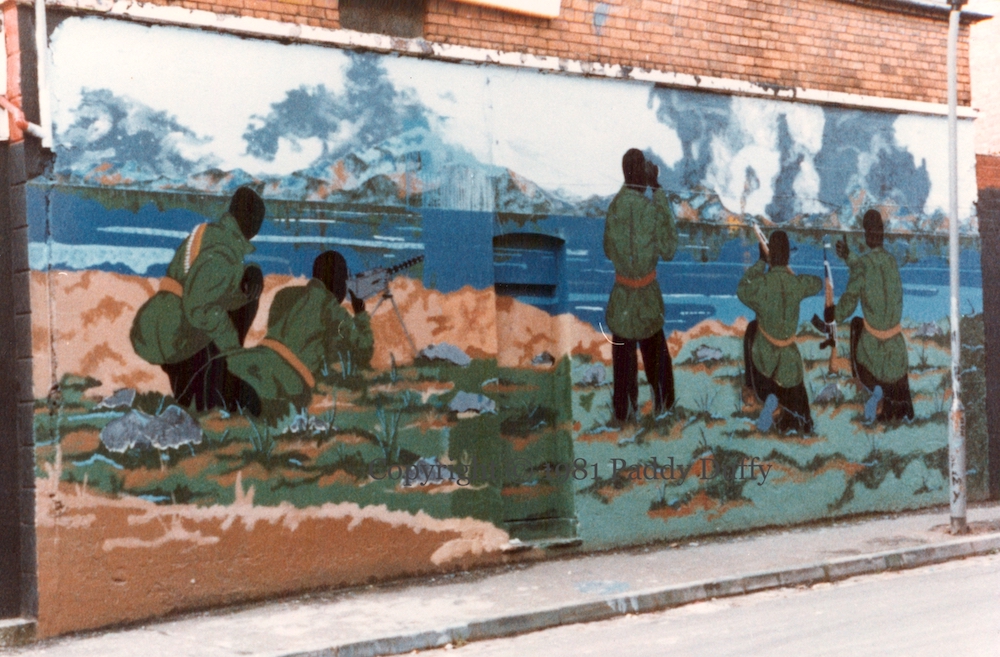
This mural depicts (one part of) the IRA’s 1979 ambush of the British Army at Narrow Water Castle, near Warrenpoint (WP), on the same day that Louis Mountbatten was killed (see 13 Gone But Not Forgotten).
depicting (from left to right) Ireland in the grip of a fist with a Union Flag cufflink, a prison guard whose mouth holds prison bars and the arm of a bleeding prisoner, and a naked figure in a tricoloured scarf crucified on a Union Flag.
There is a fourth panel to the right, of the island of Ireland bearing a cross “Made in Britain”.
At least three of the original images are by Jack Clafferty, a founder member of the Troops Out Movement (see the Peter Moloney Collection).
This is the second version of this mural, both from 1981. In the original – which can be seen in the Homer Sykes collection – the main panel was a large white rectangle with three volunteers with assault rifles and an RPG (and the signature in the bottom left, reading “Done by Beechmount youth against H Block”).
This version removes the gunmen and uses more of the main panel, describing “the shape of things to come” in a series of images showing of people rallying to the Irish tricolour, attacking a British soldier who falls among rubble. In the gable, the sunburst and Tricolour, with automatic rifle, remain. The words to the left read “I lie at night and try to think why / our lads in jail are prepared to die. // The British government sit back and laugh / but the people know that they are daft. // Four of our comrades have passed away / is there call for more to die[?] // O, British government use your sights / and give our lads their 5 just rights.”
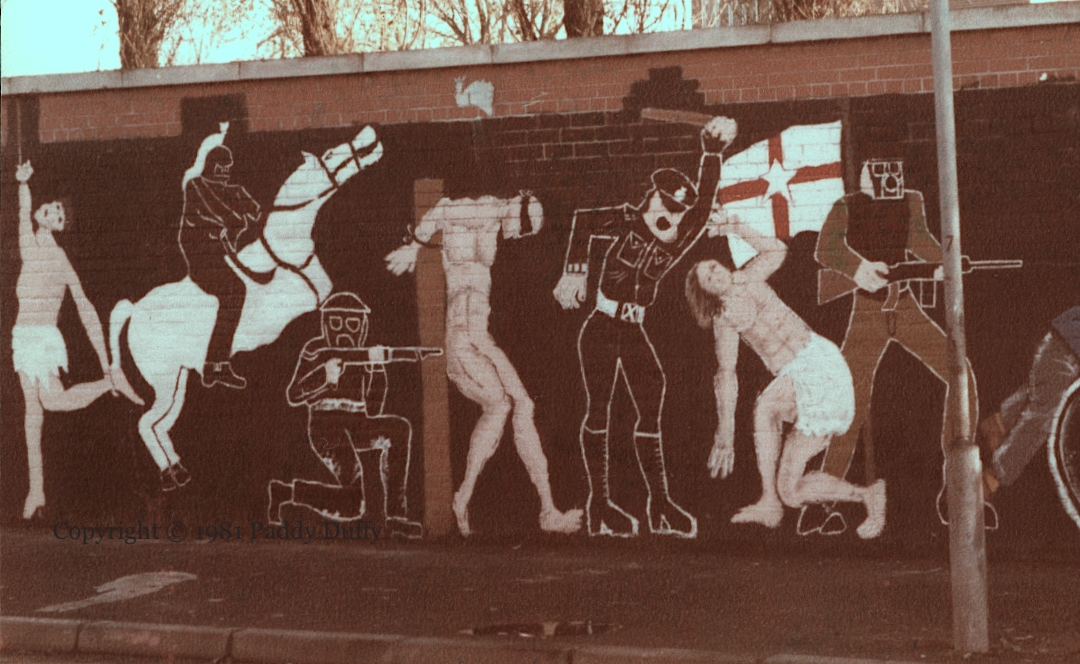
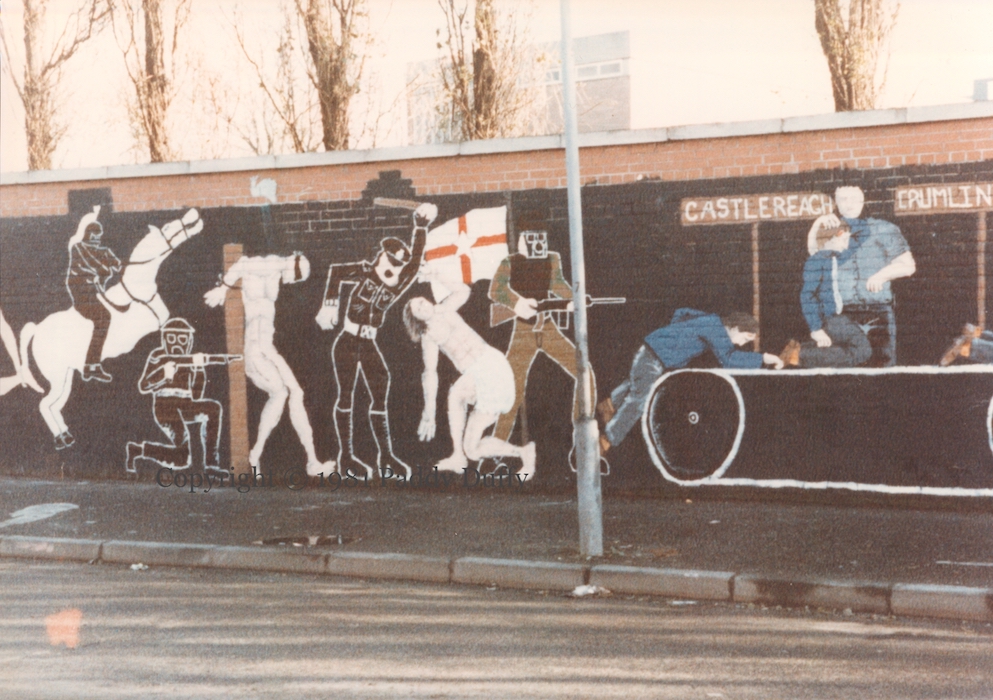
Jeff Perks’s 1979 linotype “The Training Ground” was reproduced on Beechmount Avenue in 1981. It depicts the history of the British Army in Ireland. Rolston (“Politics, Painting and Popular Culture: the Political Wall Murals of Northern Ireland”, Media, Culture and Society 9.1, 1987) claims (p. 19) that the image would have been familiar to nationalists from the cover of “Ireland: Voices For Withdrawal” (shown below). The baton-wielding policeman on the right was also reproduced in a famous 1996 Derry mural (“68-96 Nothing Has Changed” M01279).
Missing on the far left are four Cromwellian soldiers (see M00123); on the right, the arrested are loaded onto The Conveyor Belt.
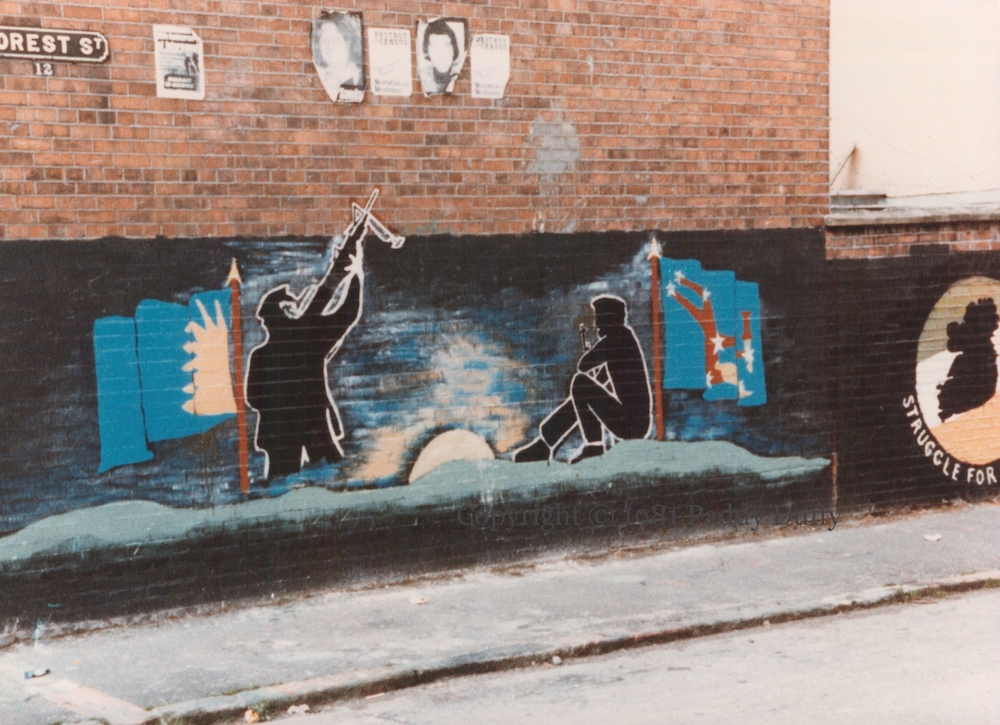
This two-part mural in Forest Street features (left) Sunburst and Starry Plough flags on pikes, on either side of two volunteers who are watching the sun rise/set and (right) “Struggle for freedom” below an outline of the island against the green-white-and-gold stripes of the tricolour.
Imagery of the devil was an occasional theme in 1980s muraling, perhaps because of the popularity of the English soccer club, Manchester United, who were known as the “red devils” and who re-introduced (Fabrik Brands) the red devil on its badge in 1973 (Sporting News). The team was popular with both CNR and PUL communities. The red devil was used by the UVF in Rathcoole in the late 70s (see D00375 and DS1 plate 38) and perhaps influenced this mural in CNR Springfield Road.
As far as we know, this is the only image of this mural (available on-line, at least).






 Paddy Duffy Collection