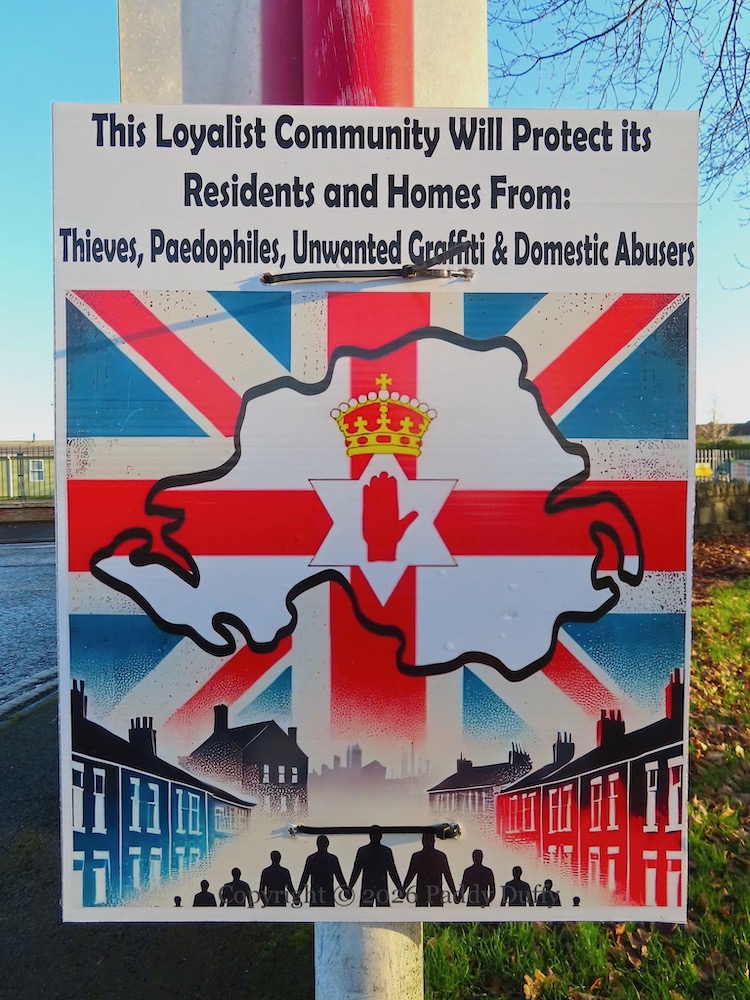
“The loyalist community will protect its residents and homes from: thieves, paedophiles, unwanted graffiti & domestic abusers.” The list of crimes makes no reference to denomination or ethnicity, but “loyalist” and the combined Union Flag (which is incorrectly rendered) and Ulster Banner suggest that the threat comes from those who identify insufficiently with the UK.
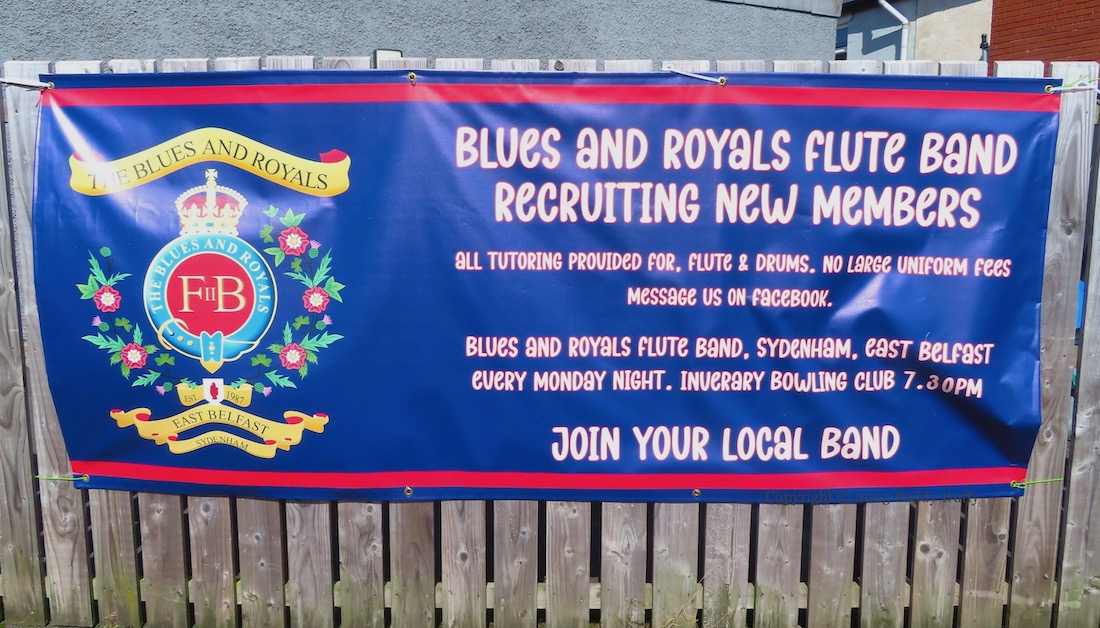
Above, a recruitment tarp for the Blues And Royals flute band (Fb).
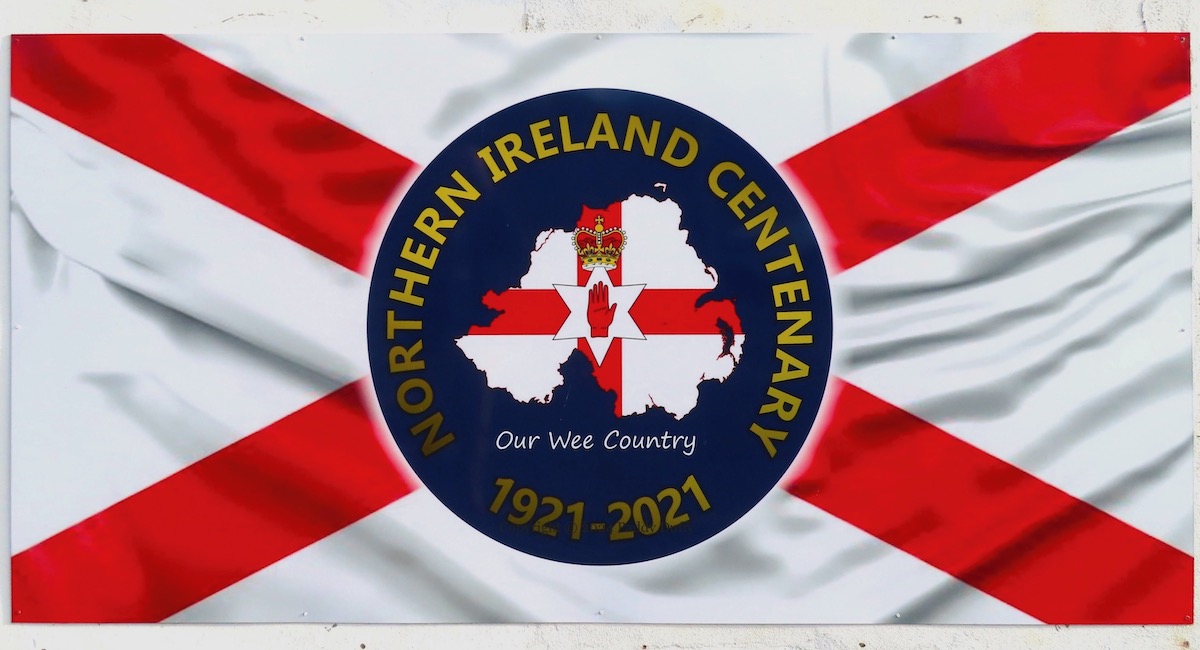
Below, (and on the wall above the flute band’s tarp) a NI Centenary board using the St Patrick’s saltire in the background. The saltire is an Anglo symbol of Ireland and was included in the Union Flag when the union was between Britain and Ireland and thus – like the word “Ulster” – has been reduced to signifying Northern Ireland after partition.
Three plaques at the Ballynafeigh Apprentice Boys social club on Blackwood Street:
“In loving memory of Allison Jane Smith – you’re missed so much by so many who knew you in Ballynafeigh”, “Celebrating the 100th anniversary of the foundation of Northern Ireland – Northern Ireland centennial 3rd May 2021”, “In memory of all our past members”.
The shutters of the Peppercorn café on the Woodstock Road were painted with a WWI theme back in 2015 (In Flanders Fields) and were re-painted in late 2020.
The first panel (above) shows “our wee country” – Northern Ireland, on the occasion of its centenary.
The second features the “Light Of Foot” (web) programme supporting the mental health of bandsmen in Scotland and Northern Ireland. “Marching mental health”, “It’s okay to talk”.
The final panel reproduces (in reverse direction) John Singer Sergeant’s painting Gassed – for a photographic version, also in east Belfast, see Observe The Sons Of Ulster. “Their sacrifice, our freedom.”
“Good vibes outside” is a series of “everyday adventure” guides from clothing brand Bleubird, which now has three physical shops, in Ballymena, Cookstown, and east Belfast, where you can find this street art by Cha Cha (Carla Hodgson ig) depicting many local adventure-spots – the list at the bottom suggests Wild Atlantic Way, Fermanagh Lakelands, Giants Causeway, Sperrins, Rathlin Island, Strangford Lough, Mourne Mountains.
Upper Newtownards Road, Ballyhackamore, east Belfast
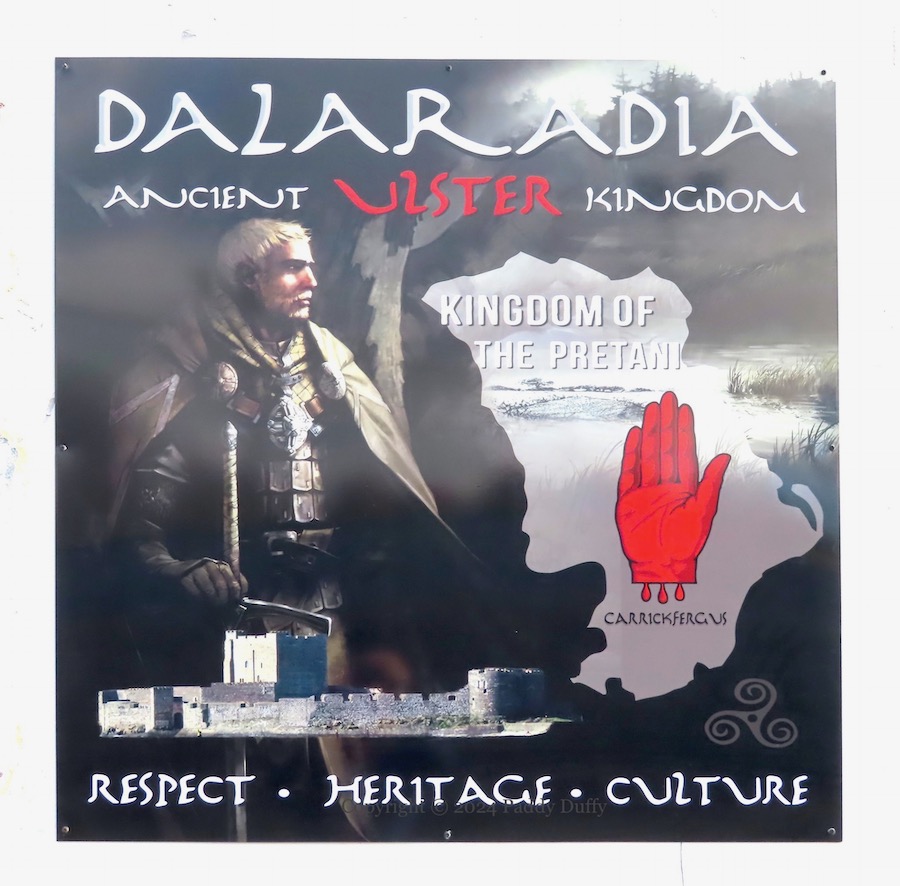
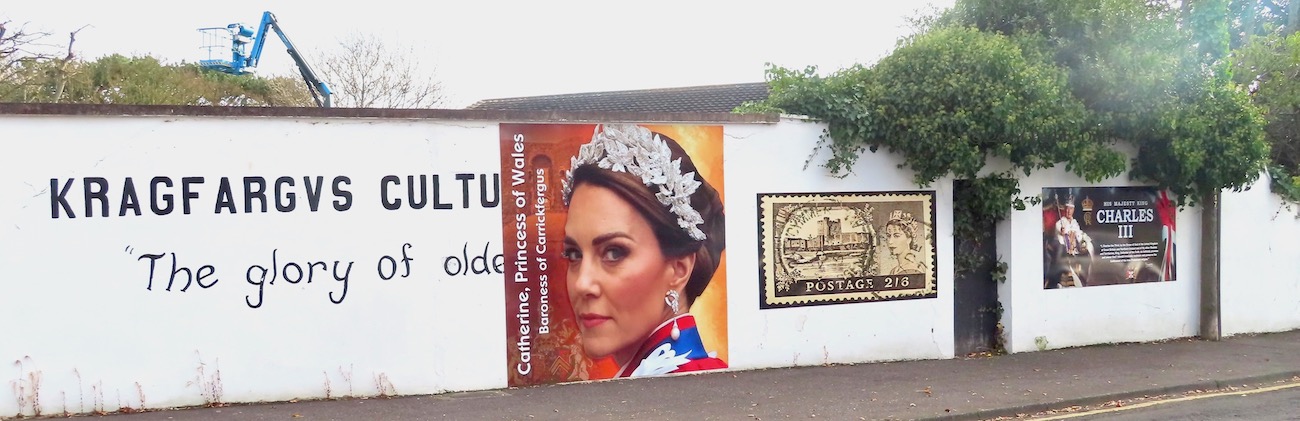
This entry updates the images seen in Kragfargus Cultural Corner, which now includes a portrait of Catherine (“Kate”) Middleton, Princess Of Wales and Baroness Carrickfergus (no “of”), alongside the tribute to King Charles III. The other person with a castle is Mr Tayto, who appears in the montage of famous faces on one of the NI 100 boards (fourth image).
The second mural along Ballee Way, Ballymena (between The Crown and The Lion Wears The Crown), is a tribute to the UDR [Ulster Defence Regiment], established in 1970 to replace the Specials and amalgamated with the Royal Irish Rangers in 1992 to form the Royal Irish Regiment. The mural shows a UDR soldier manning a checkpoint, on top of a free-floating Northern Ireland filled in with a Union Flag.
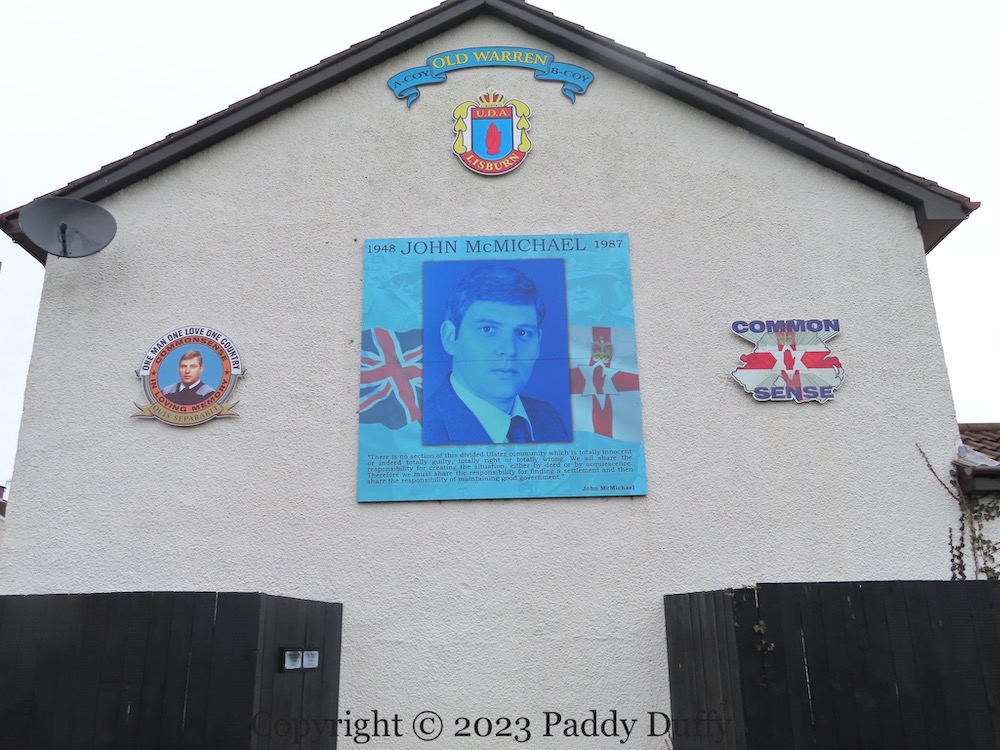
The South Belfast UDA/UFF commander John McMichael (1948-1987) was killed by an IRA car bomb. In addition to organising a team of assassins in the 70s and 80s, he founded a Political Research Group and wrote two documents proposing an independent Northern Ireland, 1979’s Beyond the Religious Divide and 1987’s Common Sense (available at CAIN), promoting the philosophy of ‘Ulster nationalism’. The quote on the board comes from the end of the Introduction to Common Sense:
“There is no section of this divided Ulster community which is totally innocent or indeed totally guilty, totally right or totally wrong. We all share the responsibility for creating the situation, either by deed or by acquiescence. Therefore we must share the responsibility for finding a settlement and then share the responsibility of maintaining good government.”
Above: “Old Warren A Coy/B Coy”. Right: “One man, one love, one country. Commonsense. In loving memory. Quis separabit.” around a portrait of McMichael. Left: “Common sense” with an Ulster Banner Northern Ireland.
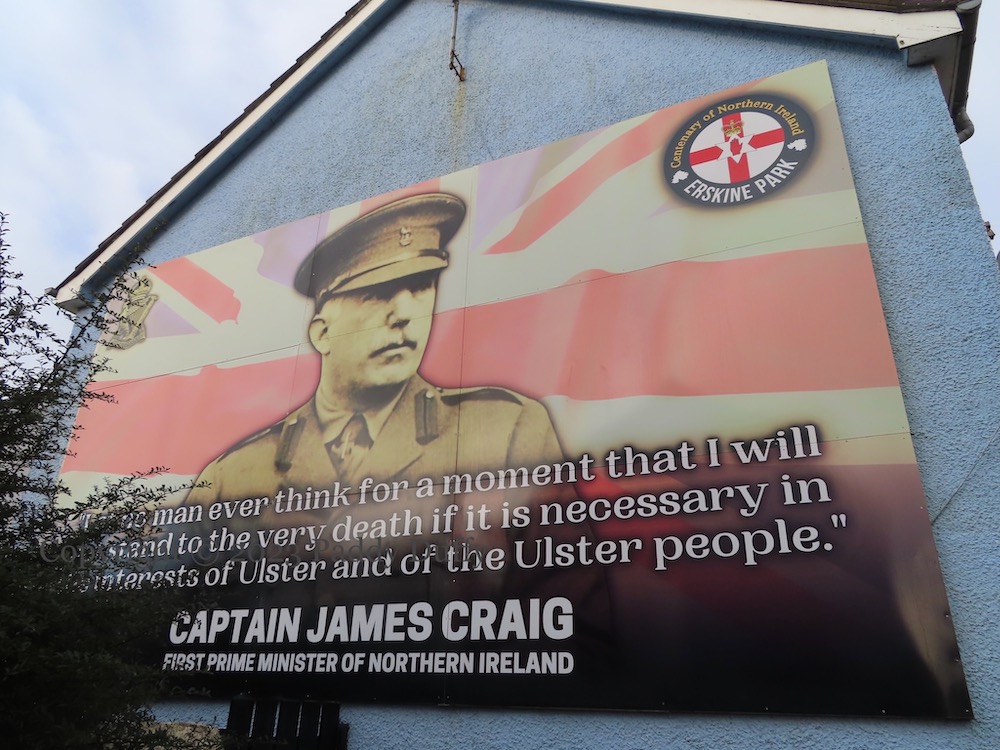
“‘Let no man ever think for a moment that I will not stand to the very death if it is necessary in the interests of Ulster and of the Ulster people.’ Captain James Craig, first prime minister of Northern Ireland.”
To go with the fighting words, Craig is shown here in military uniform – though he was a young man when joined the Royal Irish Rifles and served in South Africa for two years (1899-1901), with the Imperial Yeomanry and the Imperial Military Railways. As the politician who was instrumental in the Ulster Volunteers and the creation of Northern Ireland (and prime minister until his death in 1940), he is usually shown in civilian clothes – see e.g. Floreat Ultona | Ulster Welcomes Her King & Queen | Because He Loves What Is Behind Him.
The source of the quote is unknown – please comment or get in touch if you can say what it is from. It’s also not clear what uniform Craig is wearing – the cap badge is the ‘lion on crown’ used e.g. by officers of the Devonshire yeomanry; it is perhaps a officer’s dress uniform for the Imperial Military Railways (though see the IMR pouch badge). Craig was also assistant adjutant to the 36th Division (DIB).
Ballyclare Comrades football club – whose motto is ‘Nihil nisi optimi’ [nothing but the best] – was founded in 1919 by members of the local Great War ‘comrades’ association. That heritage is used here for the Ballyclare Protestant Boys flute band. In the centre, between images from WWI, the flowers of the four ‘home nations’ are joined by orange lilies, and in the shield are the lion and the unicorn from the coat of arms of the UK.
“To Flanders fields some men in our town were sent and along their way many would repent their priority goal to keep Ulster free that we may have freedom both you and me as part of Great Britain they fought and died and their names we will remember and remember with pride. Lest we forget. Comrades from Ballyclare. Nihil nisi optimi. The Comrades.” “Ballyclare Protestant Boys Est. 2004”








 Paddy Duffy Collection