
The emblem of the UFF is flanked by Ulster Banner and Union Flag.
Strone Park, Ballybeen, Dundonald.
Click image to enlarge
Copyright © 2023 Paddy Duffy
T01795
The emblem of the UFF is flanked by Ulster Banner and Union Flag.
Strone Park, Ballybeen, Dundonald.
Click image to enlarge
Copyright © 2023 Paddy Duffy
T01795
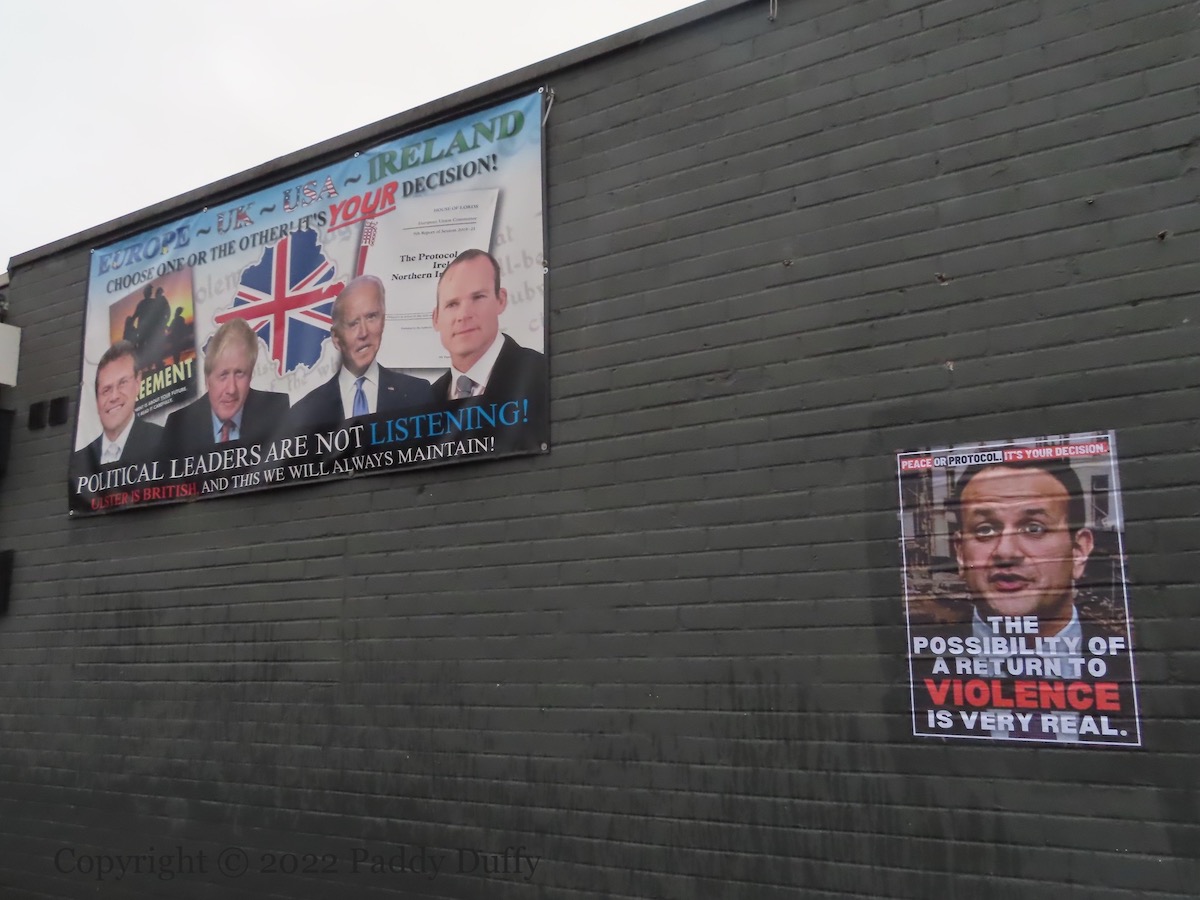
Left: After a break for the funeral of the Duke Of Edinburgh, the Loyalist Communities Council has resumed its protest of Brexit with a banner campaign (Irish News). The banner seems to be offering viewers the choice of one of four affiliations (“Europe – UK – USA – Ireland – choose one or the other! It’s your decision!) but the “correct” answer is at the bottom (and in the faded background of the Covenant): “Ulster is British and this we will always maintain!” even though “Political leaders are not listening!” (including, perhaps, Arlene Foster and the DUP.) The Belfast Agreement (Good Friday Agreement) allows people in Northern Ireland to identify themselves as Irish, British, or both.
Right: “Peace or protocol – it’s your decision”, aimed at Leo Varadkar on the day that he again became Taoiseach (Irish Times) and repeating his words back to him from a speech in 2018: “The possibility of a return to violence is very real”. At that meeting, Varadkar was anticipating violence by anti-Agreement republicans in response to customs posts on the Ireland-Northern Ireland border, and brought a newspaper describing the death of four customs officials, two lorry drivers, and three IRA volunteers at a Monaghan post in 1972 (BelTel).
The authors of this poster are not known, but the parallel statement (mutatis mutandis) would be that anti-Protocol agents – perhaps the “young loyalists” that the UVF “can no longer contain” (UK Daily; see also RTÉ from November) – might return to acts of violence such as the 1974 “Dublin & Monaghan Bombings” that killed 33 people – in the background of the poster is part of a photograph (included below) of bomb damage in Talbot Street – if the Protocol’s “Irish Sea border” is not removed.
Ballysillan Road and (below) Oakmount Drive (near Mount Vernon), north Belfast.

Click image to enlarge
Copyright © 2022 Paddy Duffy
T01656 [T01654] [T01655] T01663

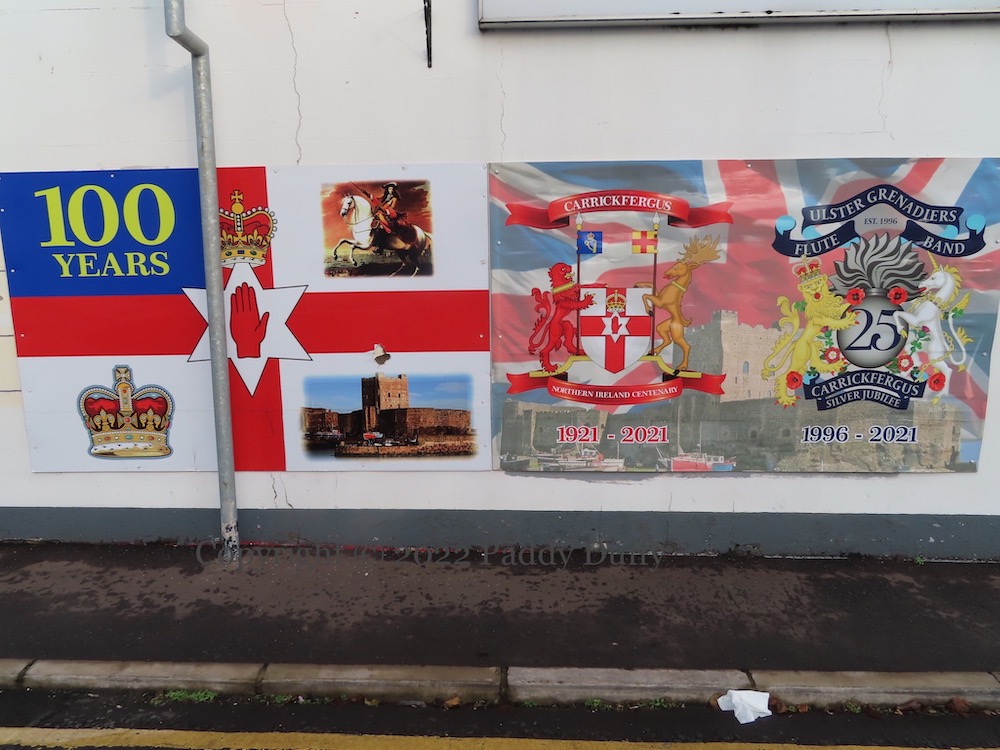
On the left of this memorial board in Carrickfergus are five portraits from the later life of the child who began life in Greece as Prince Philip of Greece and Denmark. The family was exiled during the Greco-Turkish War. He ended up in Britain where he later joined the navy and stopped using his titles when he became the British subject, Philip Mountbatten. When he married Elizabeth he became Prince Philip, Duke of Edinburgh. His life-time matches that of the Northern Irish state (see in the second image): he was born a month after its creation and died in 2021 at the age of 99, a month shy of its centenary.
These boards and banners are in Albert Road and Thomas Street, Carrickfergus, near the Orange lodge, (for which see On Foreign Fields). They are perhaps all sponsored by the Ulster Grenadiers flute band. “Carrickfergus says “No” to Irish Sea border”

Click image to enlarge
Copyright © 2022 Paddy Duffy
T01583 [T01584] T01585 T01582 [T01581]
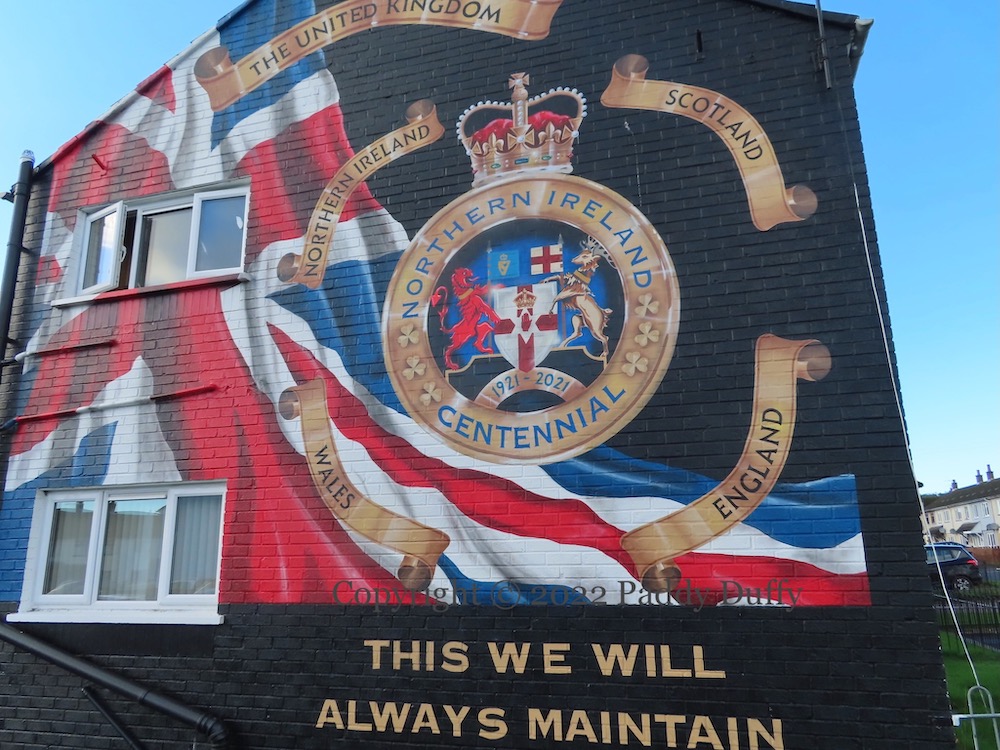
“This we will always maintain.” The Northern Ireland government’s coat of arms was approved for use in 1924, three years after the government was established. Its “supporters” – the red lion of Scotland and an Irish elk, carrying (respectively) Irish harp and De Burgh flags, and standing on a grassy mound with flax plants – were added later.
This mural celebrating the centenary of Northern Ireland’s creation, in the Woodburn estate, Carrickfergus, accurately shows the Tudor crown on the arms, as was used at the time of creation and prior to the Edwardian crown (WP).
Click image to enlarge
Copyright © 2022 Paddy Duffy
T01578 [T01579]
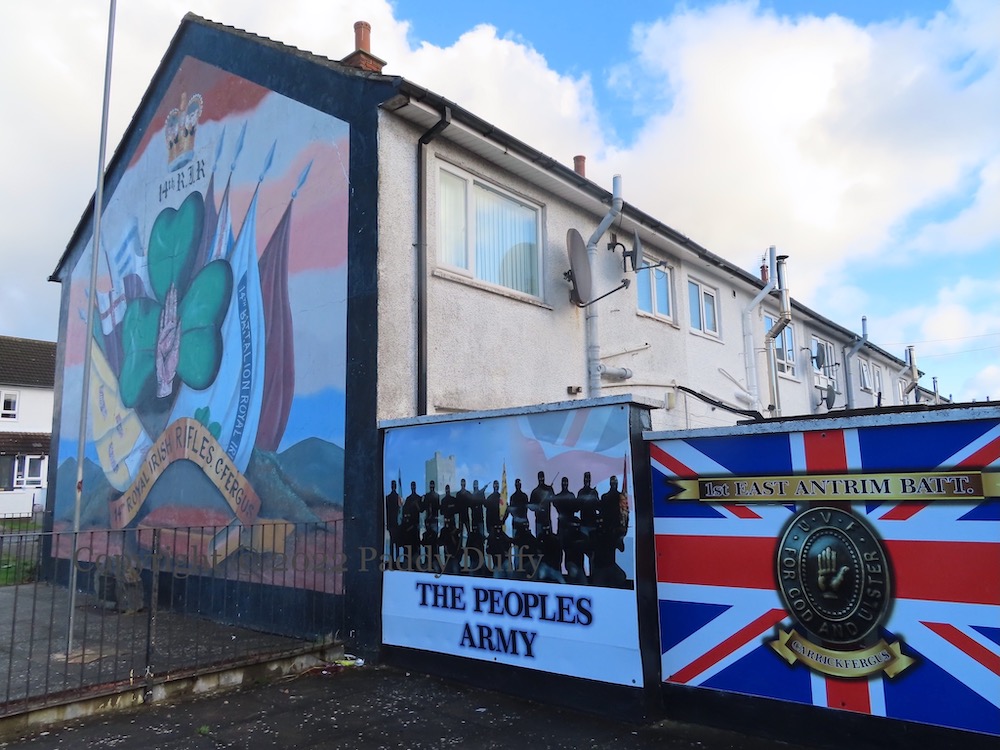
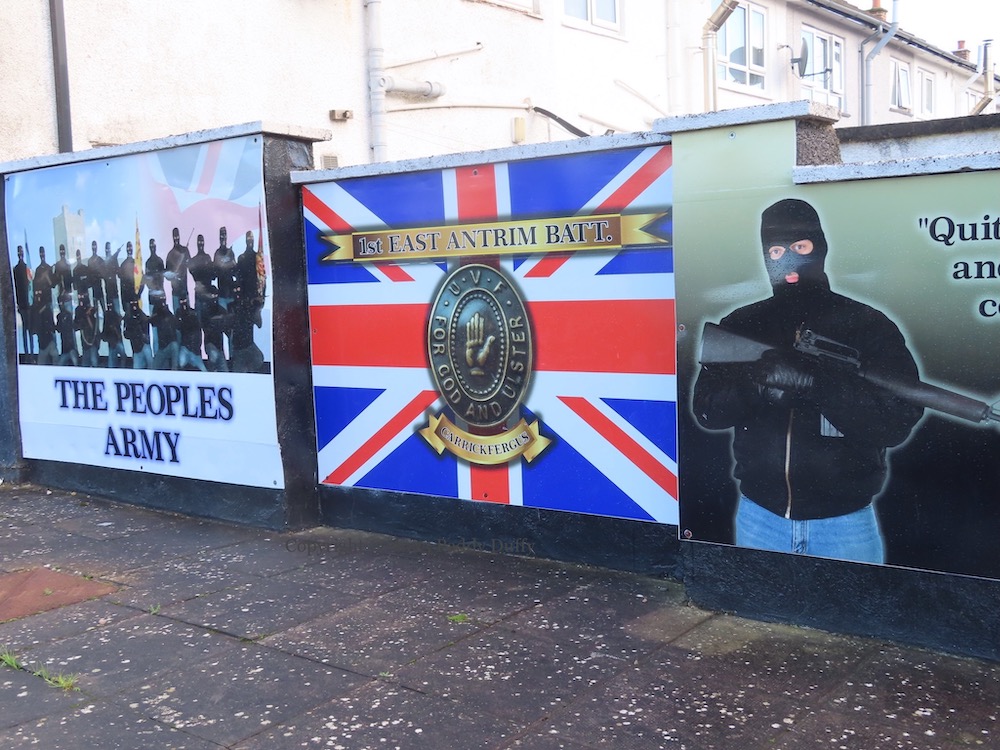
The new panels shown here re-re-image the side-wall of the mural on the left (see For Valour), which was dedicated to the Royal Irish Rifles of the Great War. We now see hooded UVF gunmen from the 1st East Antrim battalion, and an interesting quote from Edward Carson.
In September, 1914, six weeks after the Great War had begun, Edward Carson wrote to the Ulster Volunteers entreating “those who have not already responded” to “my call for Defenders of the Empire” to “enlist at once for the Ulster Division in Lord Kitchener’s Army”, fighting alongside “our fellow Britishers”: “Quit yourselves like men and comply with your country’s demand”. The impulse for the display of force shown here is the other, original, motivation for the paramilitary force, which Carson describes as “to defend our citizenship in the United Kingdom” (Strachan & Nally).
The Larches, Carrickfergus

Click image to enlarge
Copyright © 2022 Paddy Duffy
T01577 [T01574] T01575 T01576

“Loyalist Woodburn celebrates 100th anniversary Northern Ireland”. Maintain the union of (left to right) England (St George’s Cross), Wales (The Red Dragon), Northern Ireland (Ulster Banner), Scotland (St Andrew’s Saltire). Along the fence we have the NI coat of arms and Captain Sir Tom Moore.
Sandes Ct, Carrickfergus
Click image to enlarge
Copyright © 2022 Paddy Duffy
T01573

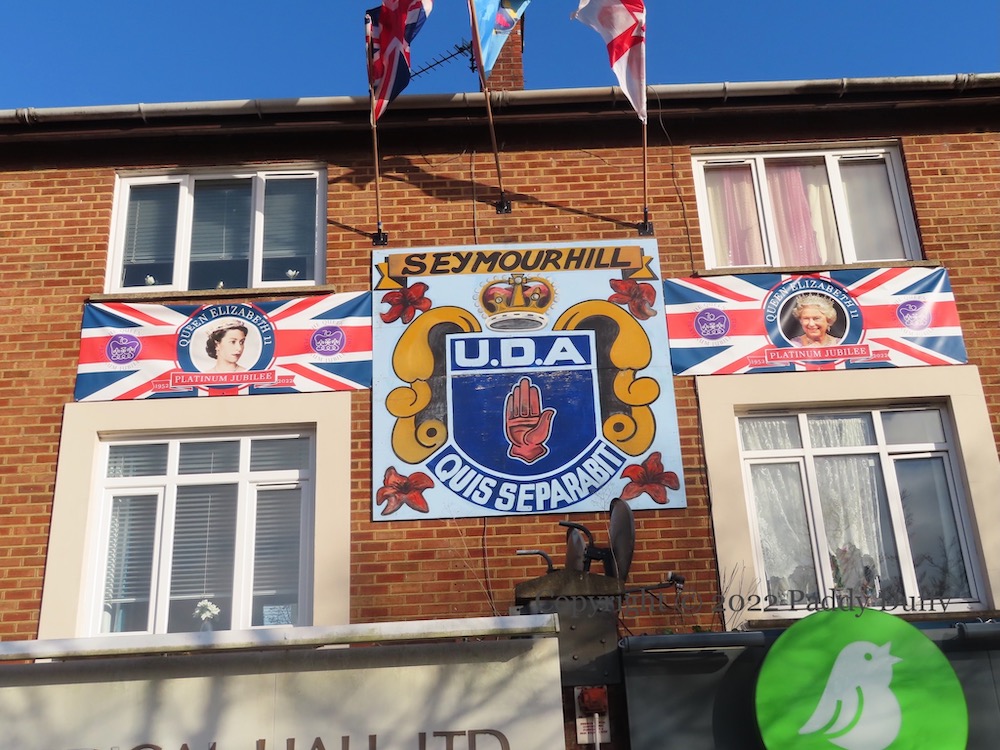
Above, a “Welcome to loyalist Seymour Hill” board with flags and poppies, and a (2021) tarp “Seymour Hill says no to the Irish Sea border”.
Below, Queen Elizabeth II 70th/platinum Jubilee banners remain on either side of the UDA board above the Seymour Hill shops, even after her death in September (previously there were two NI Centenary banners). There are orange lilies at the four corners of the UDA emblem.
Rowan Drive, Dunmurry
Click image to enlarge
Copyright © 2022 Paddy Duffy
T01525 T01526 [T01527]

The mural in Cluan Place goes back to (at least) 2002. It used to include the words “5 people shot, houses burned, houses bombed” but these have been painted out in this repainted version.
For Ian Ogle, see What Fire Does Not Destroy It Hardens.

Click image to enlarge
Copyright © 2022 Paddy Duffy
T01480 T01483

These three panels form a single installation at the top (Woodvale) end on the Shankill Road. The one above celebrates the ties between Belfast and the Stirling & District Campsie Club, a branch of one of the associated clubs of the Apprentice Boys Of Derry. It features the cannon “Roaring Meg” (“presented by the Fishmongers Company of London 1642″) which is used as the seal for the club, the club’s flag which includes a red hand of Ulster, the key to the gates, and the emblem and coat of arms of the Apprentice Boys.
“Formed on the 2nd May 1987 we have been at the forefront of loyalist culture in our area since then and were the first club in Scotland to have a Battle of the Somme Commemoration Parade. Since our inauguration we have formed many friendships with our brethren and bands from the province many of which are still active today. For many years the club has participated with Belfast Campsie Club at the closing of the gates parade in December. We have through the years had great affinity with the many bands from Belfast some who are unfortunately no longer with us. The club would like to thank the people of Belfast for their support and friendship through the years and to the people of the Shankill for giving us the privilege of this murals. No surrender.
The Campsie Club is the only Apprentice Boys Club to be named after one of the “Brave 13″. It is persumed presumed that Henry Campsie was the first man to shed blood in the Defence of Londonderry. Campsie was the inspiration behind the Shutting of the Gates and was severely wounded whilst leading his associates to secure the City Magazine and armoury. The emblem of the Roaring Meg was adopted as the Seal of the new club.”
The middle panel celebrates the Stirling Protestant Boys Flute Band and its association with the Shankill Road: “Stirling Protestant Boys Flute Band [Fb] were formed in February 2003 and to this day take part in parades across Scotland, England and Northern Ireland. The band has a great connection with our friends from Belfast, especially those from the Greater Shankill area. In November 2012 Stirling Protestant Boys were presented with the battle honours of the Young Citizen Volunteers and the 36th (Ulster) Division. The band would like to thank the people of the Shankill Road for their continued support.”
The third celebrates the Apprentice Boys contains a long description of the Shutting Of The Gates in December 1688 and the Siege Of Derry, which was ended with the breaking of the boom of the river Foyle in July 1689.


Click image to enlarge
Copyright © 2022 Paddy Duffy
T01419 T01420 T01421 [T01422]
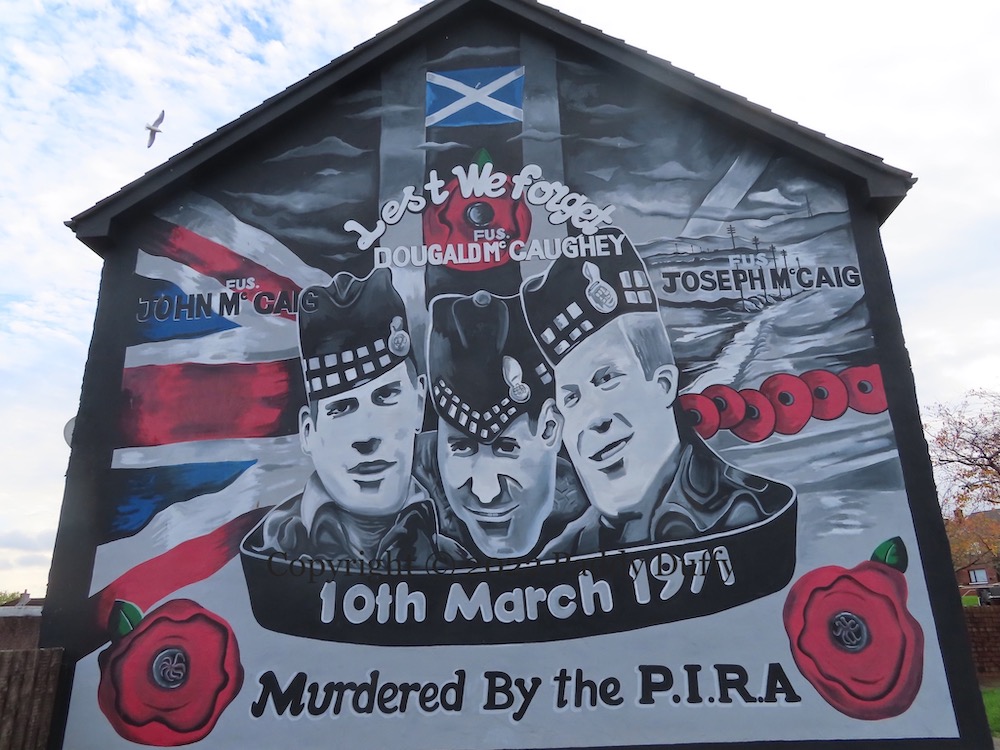
Highland Fusiliers Joseph McCaig (18), (his brother) John McCaig (17), and Dougald McCaughey (23) were lured by members of the (P)IRA from a city-centre pub to their deaths in the fields above Ligoniel in 1971 (WP). Their deaths contributed to the resignation of Chichester-Clark and the introduction of internment in August. There are monuments to the three men in Ballysillan and at the site of their deaths on White Brae depicted on the right of the mural – for images of the monuments see The Highland. This new Rathcoole mural to their memory replaces one to Queen Elizabeth II.
Owenreagh Drive, Rathcoole, Newtownabbey
Click image to enlarge
Copyright © 2022 Paddy Duffy
T01314
 Paddy Duffy Collection