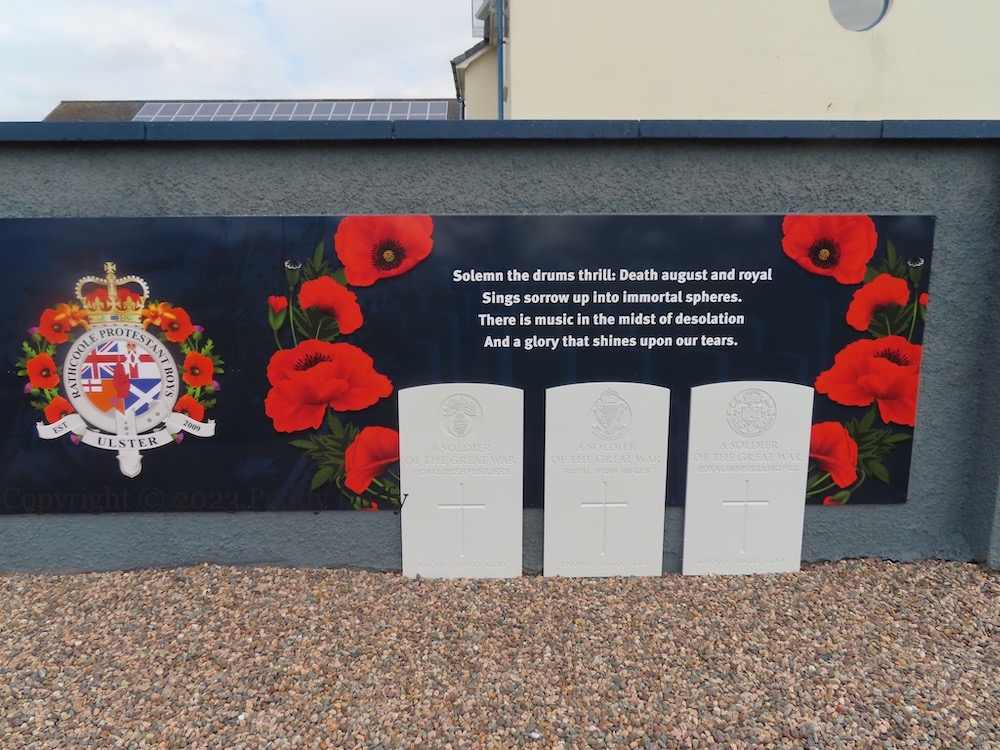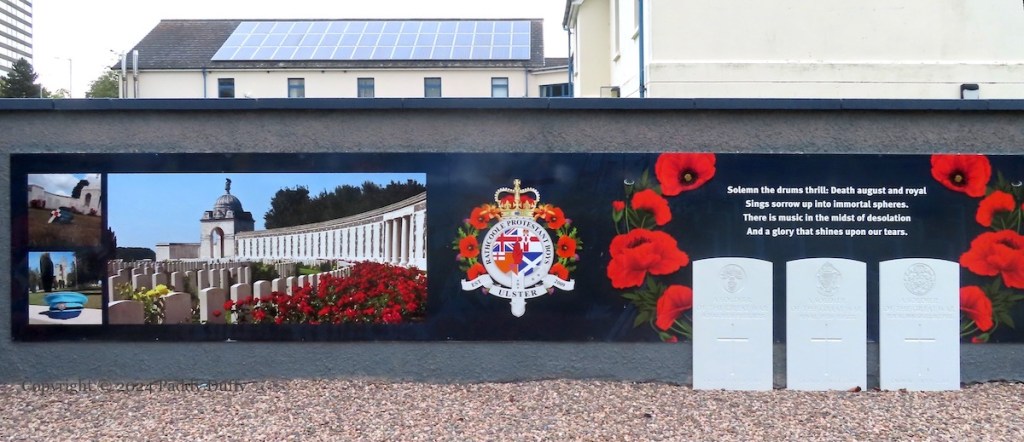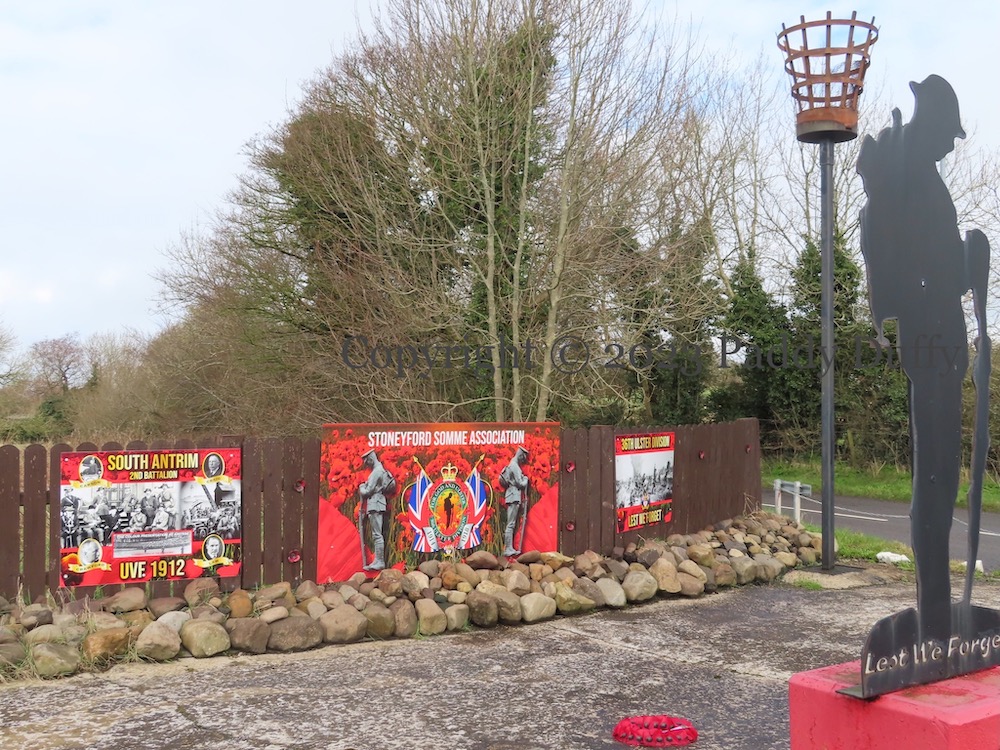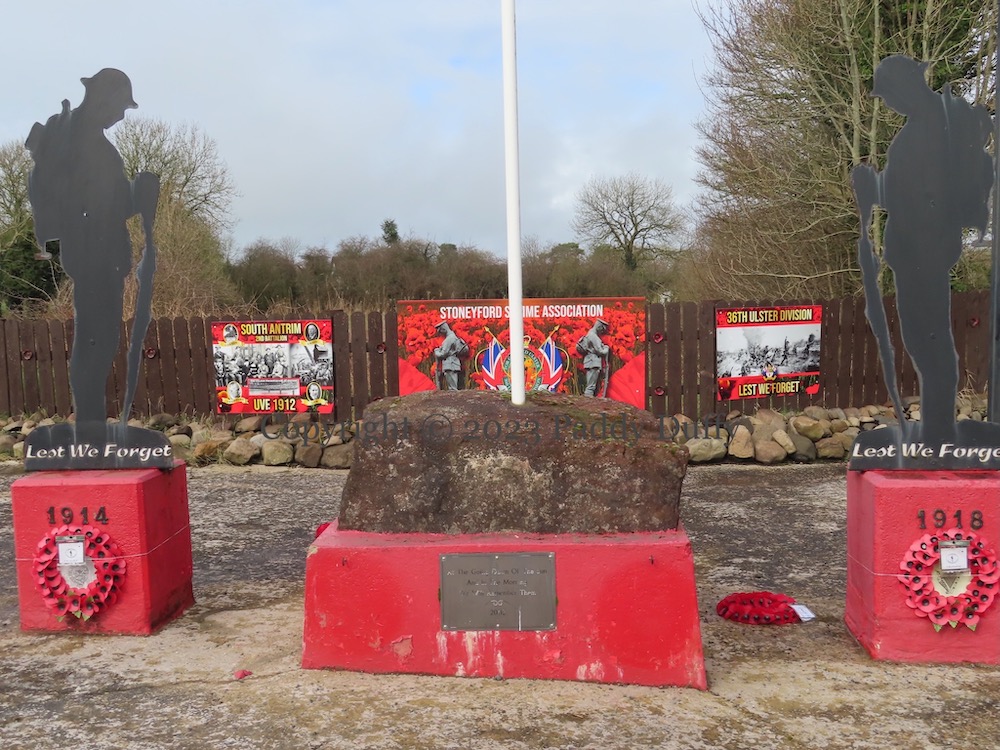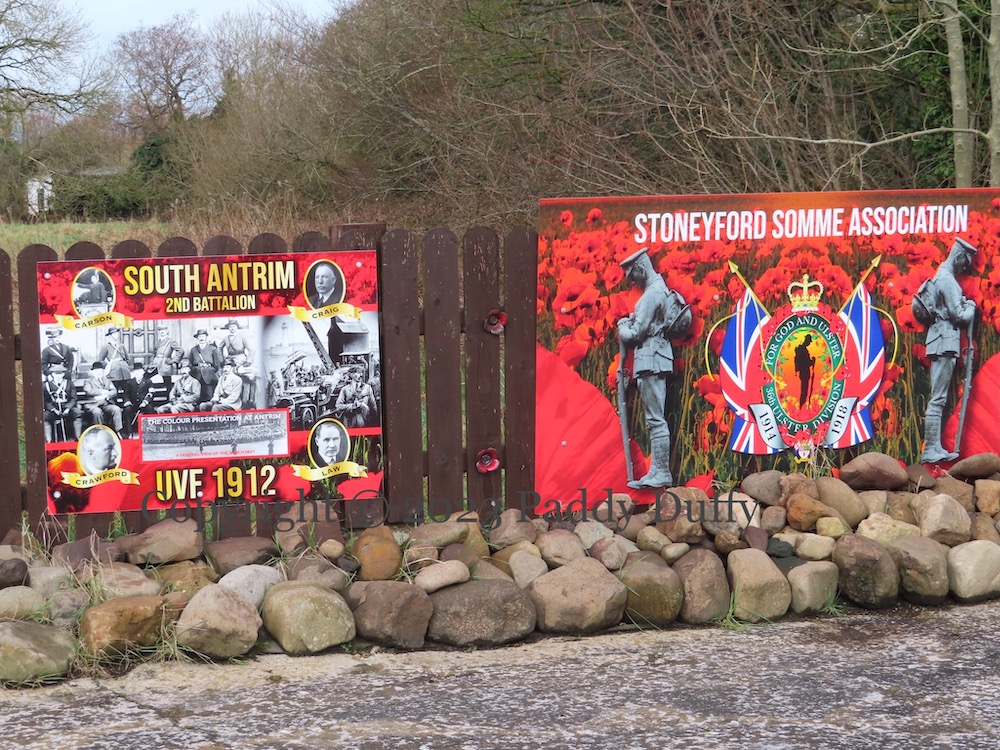
Boards have been added to the WWI memorial plaque in Stoneyford. On the right, the 36th Division go over the top in Beadle’s ‘Attack Of The Ulster Division’ (see Over The Top); the board on left more specifically commemorates the 2nd battalion of the South Antrim Ulster Volunteers, flanked by the leaders of the anti-Home Rule movement – Carson, Craig, Crawford, and Bonar Law.
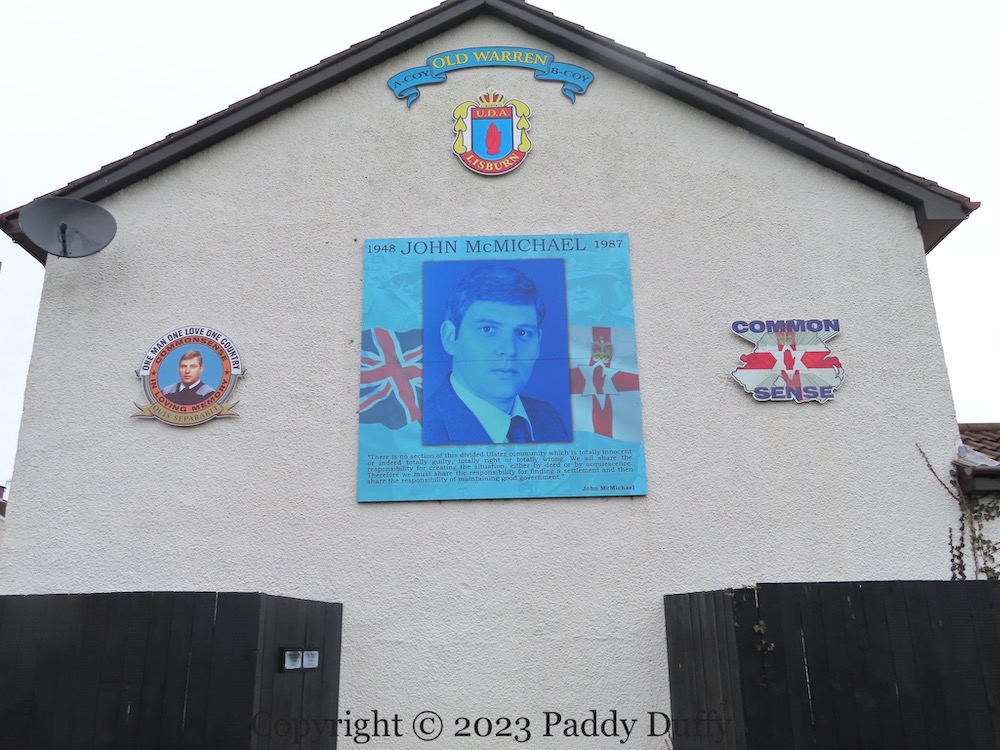
The South Belfast UDA/UFF commander John McMichael (1948-1987) was killed by an IRA car bomb. In addition to organising a team of assassins in the 70s and 80s, he founded a Political Research Group and wrote two documents proposing an independent Northern Ireland, 1979’s Beyond the Religious Divide and 1987’s Common Sense (available at CAIN), promoting the philosophy of ‘Ulster nationalism’. The quote on the board comes from the end of the Introduction to Common Sense:
“There is no section of this divided Ulster community which is totally innocent or indeed totally guilty, totally right or totally wrong. We all share the responsibility for creating the situation, either by deed or by acquiescence. Therefore we must share the responsibility for finding a settlement and then share the responsibility of maintaining good government.”
Above: “Old Warren A Coy/B Coy”. Right: “One man, one love, one country. Commonsense. In loving memory. Quis separabit.” around a portrait of McMichael. Left: “Common sense” with an Ulster Banner Northern Ireland.
There are Orange Order lodges in Ghana and Togo and there were previously lodges in South Africa and Nigeria (History Ireland | WP). A photo of the Ghanaian representative in the mural – Dennis Tette Tay – is included in this BBC article. The Canadian representative is perhaps from “Mohawk Loyal Orange Lodge No. 99” on the Mohawk Reservation at Desoronto, Ontario, Canada (Fb).
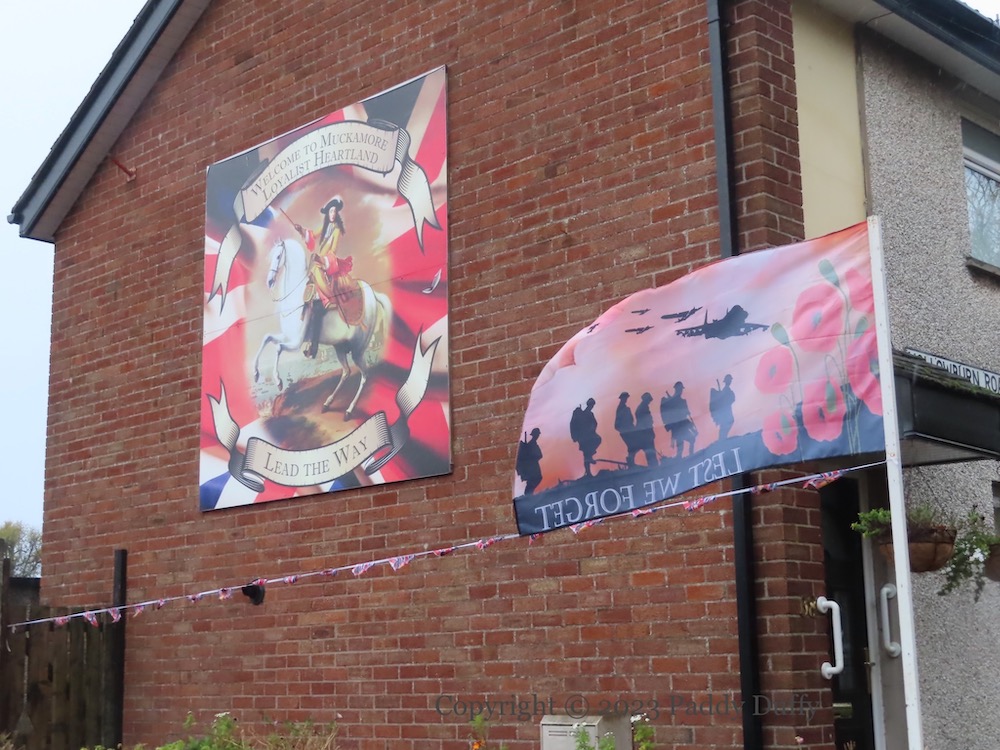
“Welcome to Muckamore, loyalist heartland – lead the way.” “In defence of our heritage and culture.”
In the Muckamore/Ballycraigy areas of Antrim the insignia of the LVF are still in place. “Lead the way” was the slogan of the LVF (see e.g. D01246 for a prominent instance in Ballycraigy). The organisation called a ceasefire and decommissioned some weapons in the years after the Agreement but persists in some form in Antrim (WP).
The Sons Of Ulster also used to use the slogan “Lead the way” (as described in J1947) but it is not present in the board shown in the recent (2022) Old Ulster’s Battle Cry.
The two boards below are on gables above Woodgreen, which is the site of the bonfire (ig) featured in the third image. They used to claim that it was the biggest bonfire (see C06695) but Craigyhill (in Larne) is more recently the tallest – see Commonwealth Handling Equipment.
There is also a memorial garden to Billy Wright in Ballycraigy – see M05203.
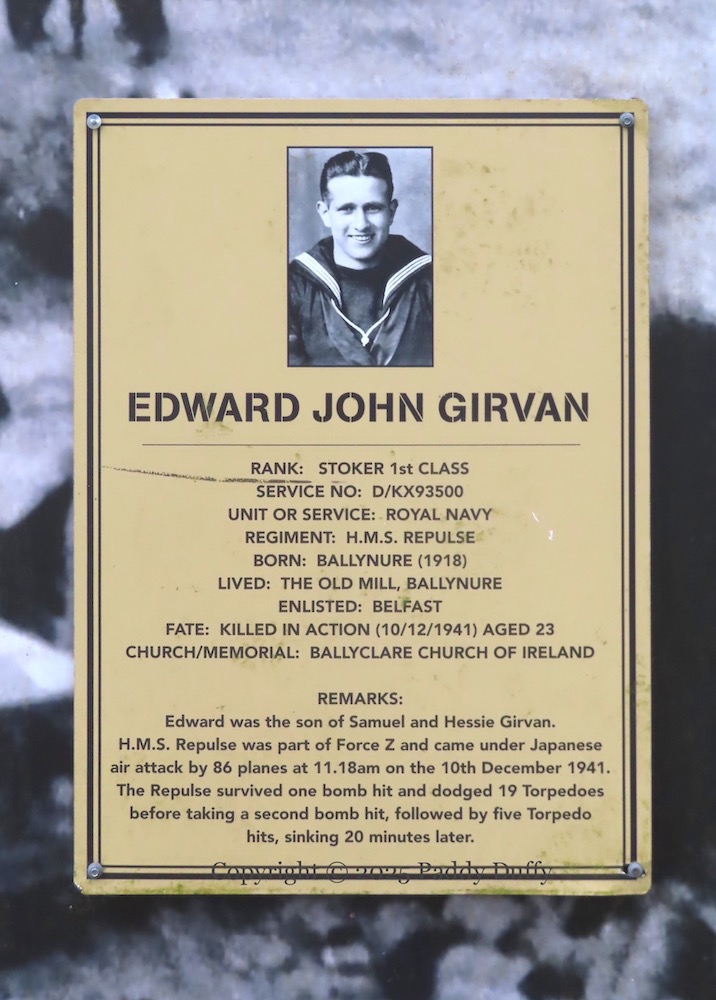
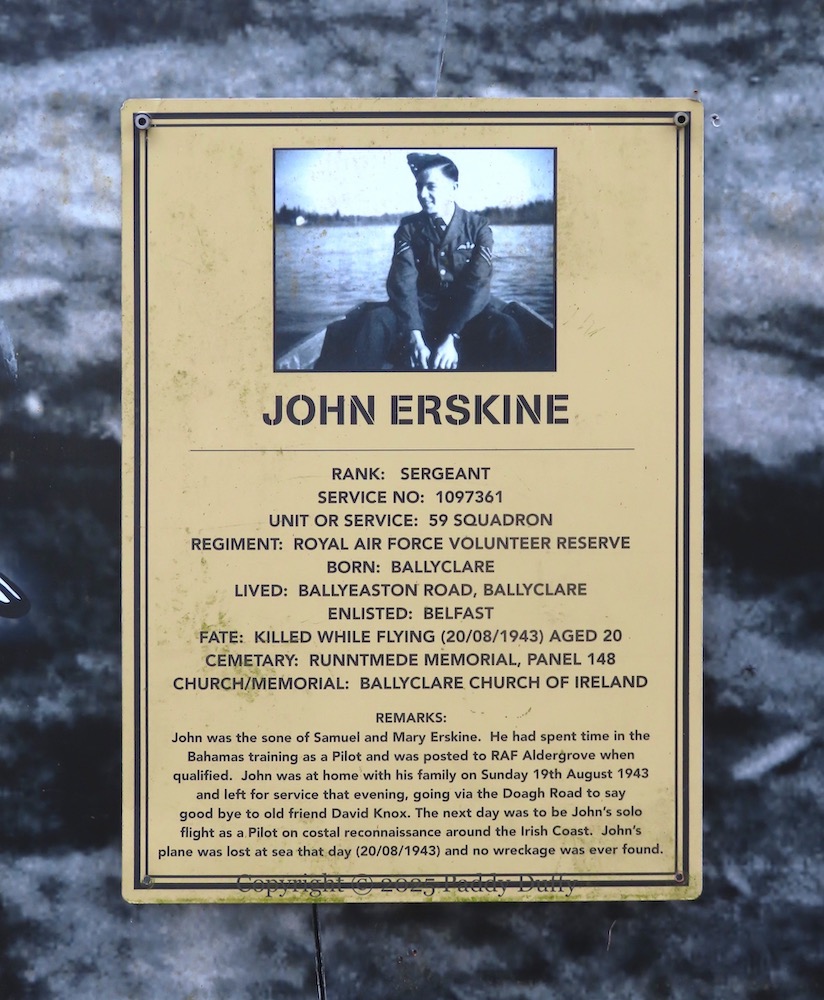
There is now a long board along the front. The two info plaques profile Edward Girvan and John Erskine, whose portraits are also featured in the larger mural, and between them are the emblems of the branches of the British Army: Merchant Navy, Navy, Army, and Air Force.
To the right of and out of frame in the image above, there is a Union Flag painted for the 75th anniversary of VE Day – see Street View.
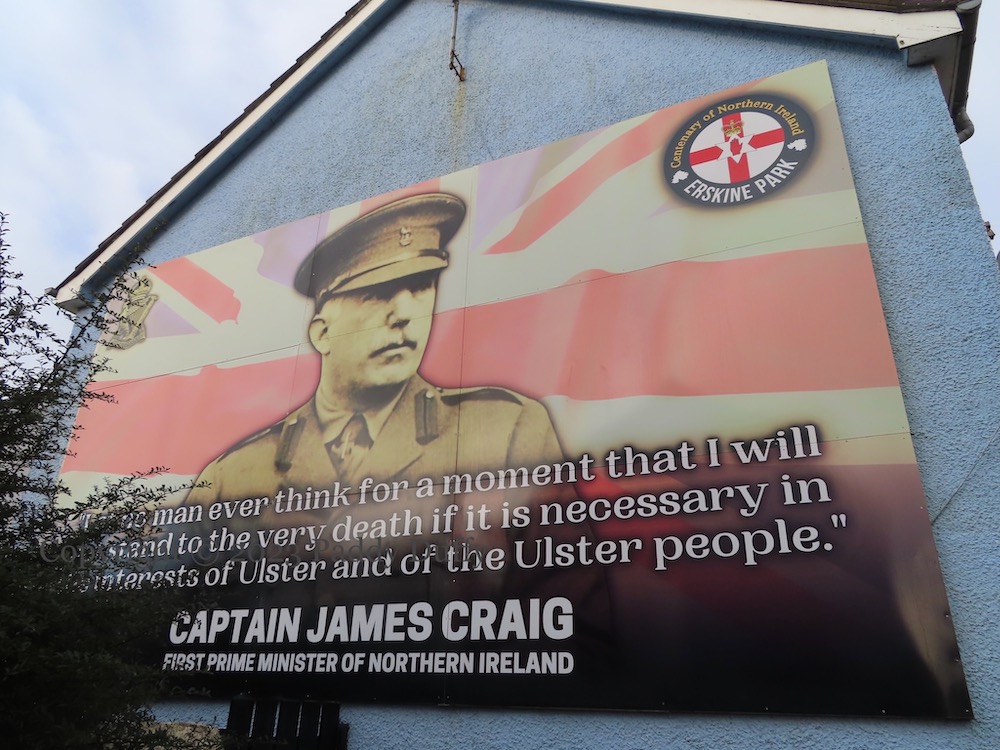
“‘Let no man ever think for a moment that I will not stand to the very death if it is necessary in the interests of Ulster and of the Ulster people.’ Captain James Craig, first prime minister of Northern Ireland.”
To go with the fighting words, Craig is shown here in military uniform – though he was a young man when joined the Royal Irish Rifles and served in South Africa for two years (1899-1901), with the Imperial Yeomanry and the Imperial Military Railways. As the politician who was instrumental in the Ulster Volunteers and the creation of Northern Ireland (and prime minister until his death in 1940), he is usually shown in civilian clothes – see e.g. Floreat Ultona | Ulster Welcomes Her King & Queen | Because He Loves What Is Behind Him.
The source of the quote is unknown – please comment or get in touch if you can say what it is from. It’s also not clear what uniform Craig is wearing – the cap badge is the ‘lion on crown’ used e.g. by officers of the Devonshire yeomanry; it is perhaps a officer’s dress uniform for the Imperial Military Railways (though see the IMR pouch badge). Craig was also assistant adjutant to the 36th Division (DIB).
The Pride Of Ballybeen is a flute band formed in 2014. Their band mural features the Union Flag and Ulster Banner flanking the red hand of Ulster on a six-pointed star against an orange field, surrounded by a crown and a garland pinned by a rose; the titular banner, below, is supported by shamrock and thistle.
Left: After a break for the funeral of the Duke Of Edinburgh, the Loyalist Communities Council has resumed its protest of Brexit with a banner campaign (Irish News). The banner seems to be offering viewers the choice of one of four affiliations (“Europe – UK – USA – Ireland – choose one or the other! It’s your decision!) but the “correct” answer is at the bottom (and in the faded background of the Covenant): “Ulster is British and this we will always maintain!” even though “Political leaders are not listening!” (including, perhaps, Arlene Foster and the DUP.) The Belfast Agreement (Good Friday Agreement) allows people in Northern Ireland to identify themselves as Irish, British, or both.
Right: “Peace or protocol – it’s your decision”, aimed at Leo Varadkar on the day that he again became Taoiseach (Irish Times) and repeating his words back to him from a speech in 2018: “The possibility of a return to violence is very real”. At that meeting, Varadkar was anticipating violence by anti-Agreement republicans in response to customs posts on the Ireland-Northern Ireland border, and brought a newspaper describing the death of four customs officials, two lorry drivers, and three IRA volunteers at a Monaghan post in 1972 (BelTel).
The authors of this poster are not known, but the parallel statement (mutatis mutandis) would be that anti-Protocol agents – perhaps the “young loyalists” that the UVF “can no longer contain” (UK Daily; see also RTÉ from November) – might return to acts of violence such as the 1974 “Dublin & Monaghan Bombings” that killed 33 people – in the background of the poster is part of a photograph (included below) of bomb damage in Talbot Street – if the Protocol’s “Irish Sea border” is not removed.
Ballysillan Road and (below) Oakmount Drive (near Mount Vernon), north Belfast.
On the left of this memorial board in Carrickfergus are five portraits from the later life of the child who began life in Greece as Prince Philip of Greece and Denmark. The family was exiled during the Greco-Turkish War. He ended up in Britain where he later joined the navy and stopped using his titles when he became the British subject, Philip Mountbatten. When he married Elizabeth he became Prince Philip, Duke of Edinburgh. His life-time matches that of the Northern Irish state (see in the second image): he was born a month after its creation and died in 2021 at the age of 99, a month shy of its centenary.
These boards and banners are in Albert Road and Thomas Street, Carrickfergus, near the Orange lodge, (for which see On Foreign Fields). They are perhaps all sponsored by the Ulster Grenadiers flute band. “Carrickfergus says “No” to Irish Sea border”