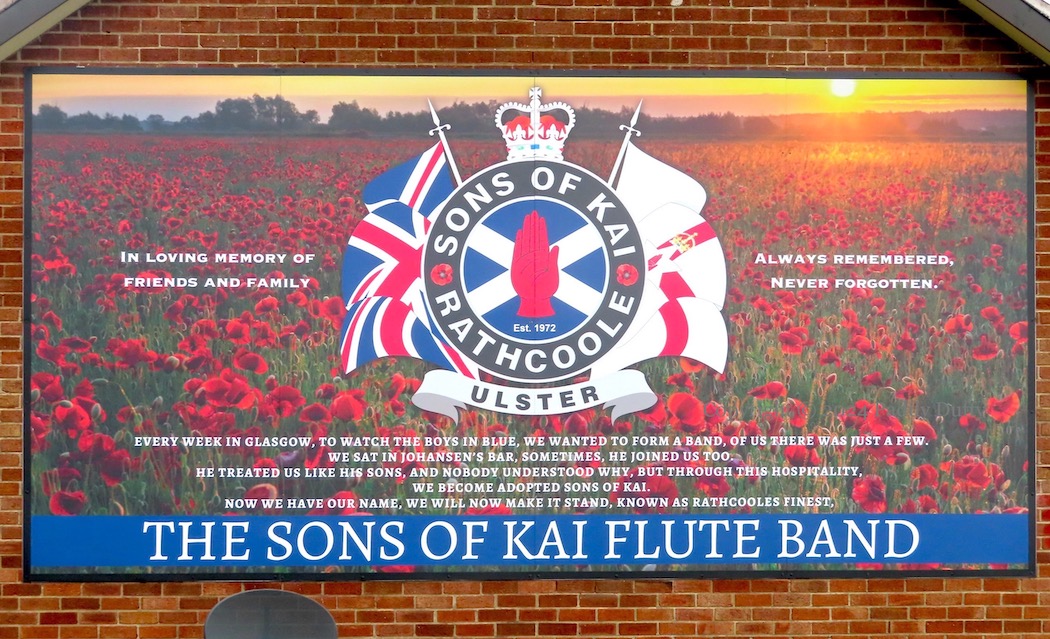
The ‘Lion Rampant’ in the crest of (Glasgow) Rangers FC comes from the Royal Banner Of Scotland (where it has a blue tongue and blue claws) (WP); the national flag of Scotland is the St Andrew’s Saltire, which appears in the centre of the trio at the top of this mural, between the red hand of Northern Ireland and the red lion. The “RFC” crest, including the word “Ready”, appeared on players’ shirts between 1990 and 1995 (WP).
There has been a version of this mural in Edgarstown, Portadown, since (at least) 2002, though previously it gave 1873 as the date of formation – see M04154 from 2008 and X00508 from 2011.
Steeple Veterans flute band is a part-time band drawing on “veterans” or “old boys” of the Steeple Defenders (which used to have a board nearby). The “older but no wiser” tag-line is exemplified by the fact that they dress up in costume each 12th for the return leg of the day– in 2023 they adopted Jurassic Park as their theme, with members dressed as dinosaurs, park rangers, and explorers. The black ribbons in the bottom corners are perhaps in memory of member David Johnston, who died last year (2023) (Belfast Live | BelTel).
Also included (below) is a tribute to Elizabeth II on the occasion of her platinum jubilee, a few months before she passed away in September, 2022, added next to the Somme mural seen in Ulster Volunteer Forces.
Kai Johansen was a Danish international who played for Rangers from 1965-1970, most famously scoring the only goal in the 1966 Scottish Cup final against Celtic (WP). He retired in 1970 and went on to manage two teams in South Africa, as well as owning businesses, including pubs and tanning salons, in Denmark and Scotland (Herald). The pub mentioned in the board above is perhaps “Kai Johansen’s Bar” at 564 Govan Road, Glasgow (images at Follow Follow).
“Every week in Glasgow, to watch the boys in blue/We wanted to form a band, of us there was just a few./We sat in Johansen’s bar, sometimes, he joined us too./He treated us like his sons, and nobody understood why/But through this hospitality, we become adopted sons of Kai./Now we have our name, we will now make it stand./Known as Rathecoole’s finest, the Sons Of Kai flute band.”
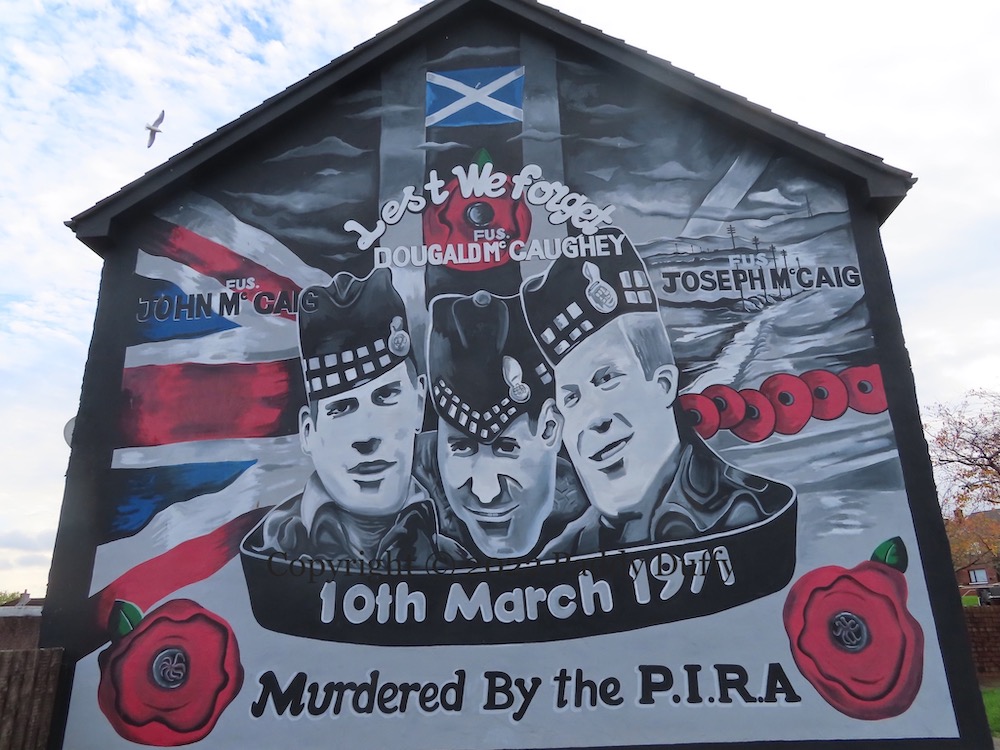
March 10th was the 52nd anniversary of the killings of three Highland Fusiliers, Dougald McCaughey and teen-aged brothers Joseph and John McCaig, who were drinking in a city centre pub and lured to their deaths in north Belfast at the hands of the (Provisional) IRA. The killings led to the resignation of NI prime minister James Chichester-Clark and an increase, to 18, in the minimum age for service (WP).
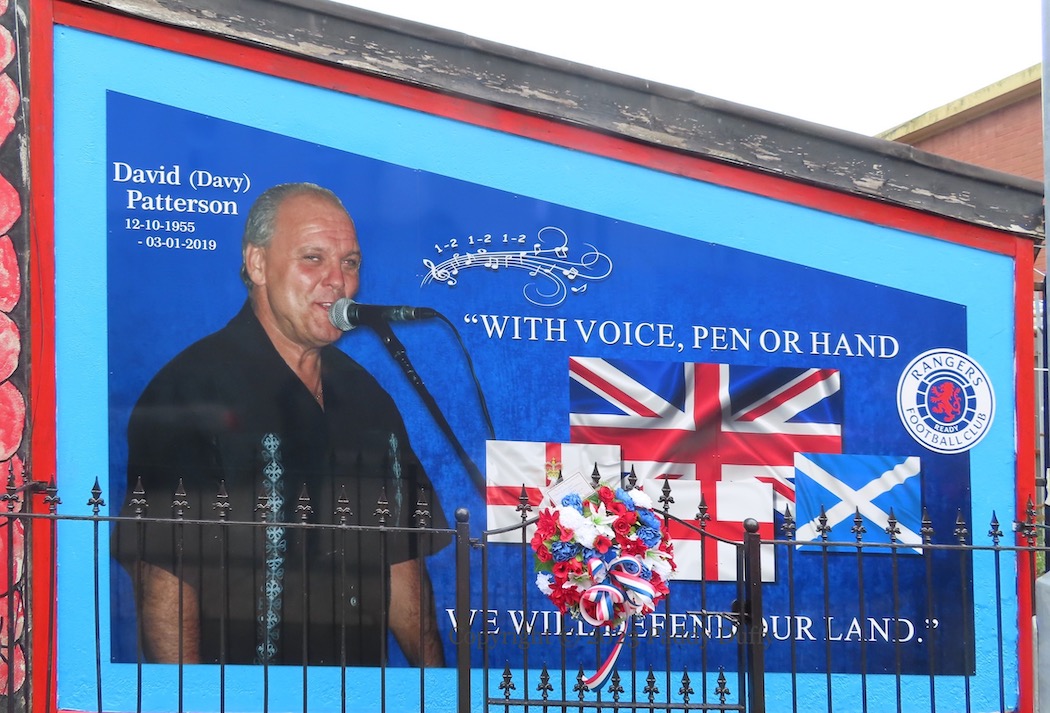
“With voice, pen or hand we will defend our land.” David (Davy) Patterson (12-10-1955 – 03-01-2019) was a member of the 1st East Belfast Rangers Supporters Club (Fb) and Albertbridge Glentoran Supporters Club (Funeral Times). This memorial board is the side-wall to the Somme Society mural (see Their Name Liveth Forevermore) and the Red Hand Commando memorial garden in Hunt Street, east Belfast.
On February 21st, 1988, 23 year-old Aidan McAnespie was shot in the back by 18 year-old Grenadier Guardsman David Holden at a British Army checkpoint in Aughnacloy, Co. Tyrone as he (McAnespie) walked to the nearby GAA club. In November (2022), Holden was convicted of manslaughter by gross negligence (BBC | Belfast Live) and he was sentenced yesterday to three years, suspended for three years, thus avoiding jail unless he is sentenced for some additional crime (BBC | BelTel | UTv | Irish Times). He is the first British soldier convicted since the Agreement of a Northern Ireland killing; he might be the only one, as legislation is pending in Westminster that would end prosecutions (RTÉ video | Sky New video). The legacy legislation was discussed previously in Was This Lawful? | Soldier A-Z | Come For One, Come For All | Paras Fight Back | Stop The Witch Hunt.
The banner shown above was hanging on the railings at Laganside Courts, Oxford Street: “Operation Banner supporters group, Belafst and Scottish branch. Our veterans are heroes, not criminals. Leave our Operation Banner veterans alone and stop appeasing Sinn Fein/IRA terrorists.” “Operation Banner” is the name given by British forces to their operations in Northern Ireland from 1969 to 2007; since then, the deployment of British forces in Northern Ireland has been known as “Operation Helvetica” (Irish News).
“Loyalist Woodburn celebrates 100th anniversary Northern Ireland”. Maintain the union of (left to right) England (St George’s Cross), Wales (The Red Dragon), Northern Ireland (Ulster Banner), Scotland (St Andrew’s Saltire). Along the fence we have the NI coat of arms and Captain Sir Tom Moore.
Highland Fusiliers Joseph McCaig (18), (his brother) John McCaig (17), and Dougald McCaughey (23) were lured by members of the (P)IRA from a city-centre pub to their deaths in the fields above Ligoniel in 1971 (WP). Their deaths contributed to the resignation of Chichester-Clark and the introduction of internment in August. There are monuments to the three men in Ballysillan and at the site of their deaths on White Brae depicted on the right of the mural – for images of the monuments see The Highland. This new Rathcoole mural to their memory replaces one to Queen Elizabeth II.
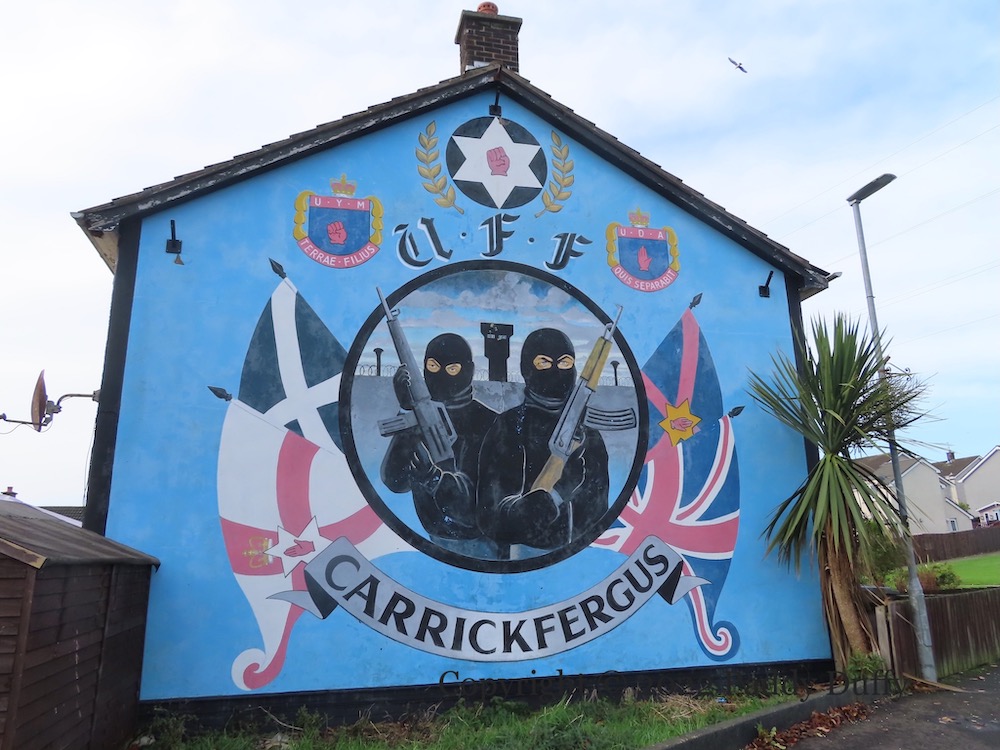
The upper flag on the right-hand side of this mural – purple saltire on a blue background with star and red hand – is the proposed flag of Ulster nationalists. The position was espoused by the UDA of the 1970s, under the guise of the political parties the Ulster Loyalist Democratic Party and the Ulster Democratic Party, and for a time by the Red Hand Commandos under the Ulster Loyalist Central Coordinating Committee.
For the previous (identical) version, see UFF Carrickfergus in the Peter Moloney collection.
The board on the left explains the composition of the Union flag as a combination of the saltire of Saint Andrew of Scotland, the cross of Saint George of England, and the saltire of Saint Patrick of Ireland. As the text notes, the saltire is much later than the saint: “The association with Saint Patrick dates from the 1780s, when the Order of Saint Patrick adopted it as an emblem. This was a chivalric order established in 1783 by George III. It is often suggested that it derives from the arms of the powerful FitzGerald dynasty [which dates to the 12th century].”
The text ends oddly: “The saltire has occasionally served unofficially to represent Northern Ireland and [has] been considered less contentious than other flags flown there.” Similar language is used on the symbols.com page for the Saltire.
The central board, shown above, shows a young Patrick (without the clerical garb in which he is often portrayed) against the backdrop of Slemish mountain, where Patrick is thought to have tended sheep as a young slave to a local chieftain, c. 401 AD and developed his Christian faith.
The board on the right shows a ship racing towards shore, superimposed over a 1659 map of Ulster by Blaeu. “The Red Hand Of Ulster: According to legend Ulster had at one time no rightful heir. It was agree that a boat race should take place and that whoever’s hand first touched the shore would become king. One contended, upon seeing that he was losing the race, cut off his hand and threw it ashore to win. O’Neill is said to have been the chieftain who cut his hand off to become the King of Ulster. The Red Hand is a key emblem of Ulster’s identity, an ancient and powerful symbol that is traditionally shown as a blood red hand.”
The colourings of the Saint Patrick profile are by children from the nearby Donegall Road Primary School.
The boards were unveiled on March 10th, 2016 by first minister Arlene Foster who remarked that the saint had become “very Gaelicised” and this — and the presence of Irish tricolours at parades — deterred unionists from celebrating “the patron saint of everybody in Northern Ireland” (Belfast Telegraph; also contains video of the launch). Anglicanism venerates saints but Presbyterianism does not, generally taking the “communion of saints” to refer to all members of the church.