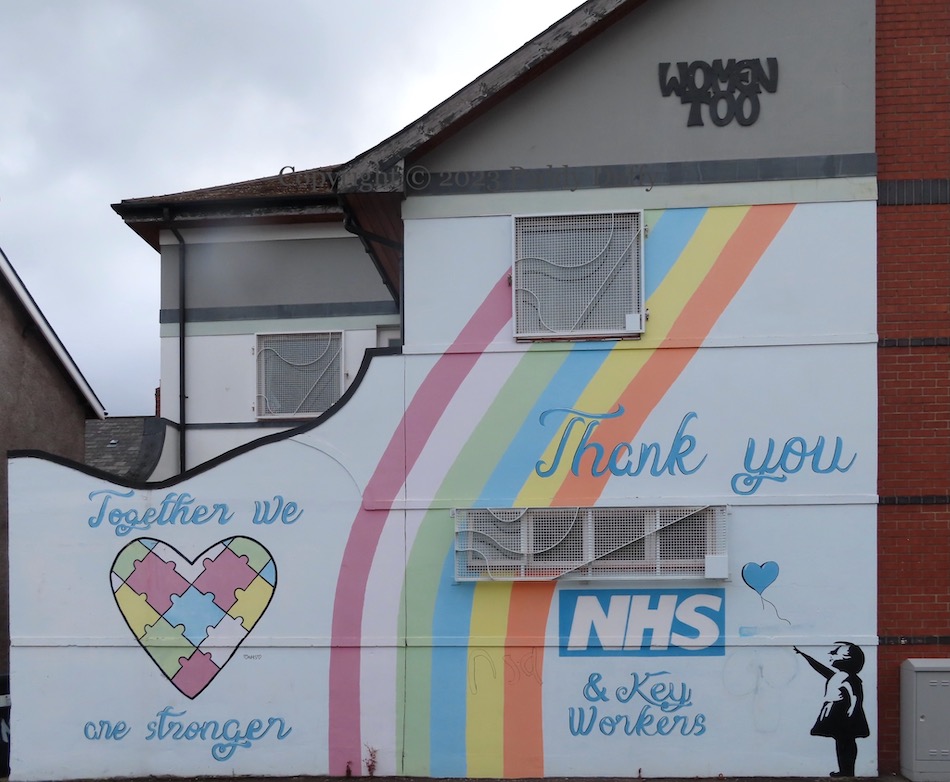
“Thank you NHS & key workers” – this is a Covid-era wall-painting in the Village, south Belfast, illustrating togetherness with a heart of interlocking jigsaw pieces and a rainbow of various colours.
Kilburn Street, replacing Women Too (whose title can still be seen in the eave above this painting), and on the other side of the Women’s Centre from Allowed To Dream, We Learn To Fly.
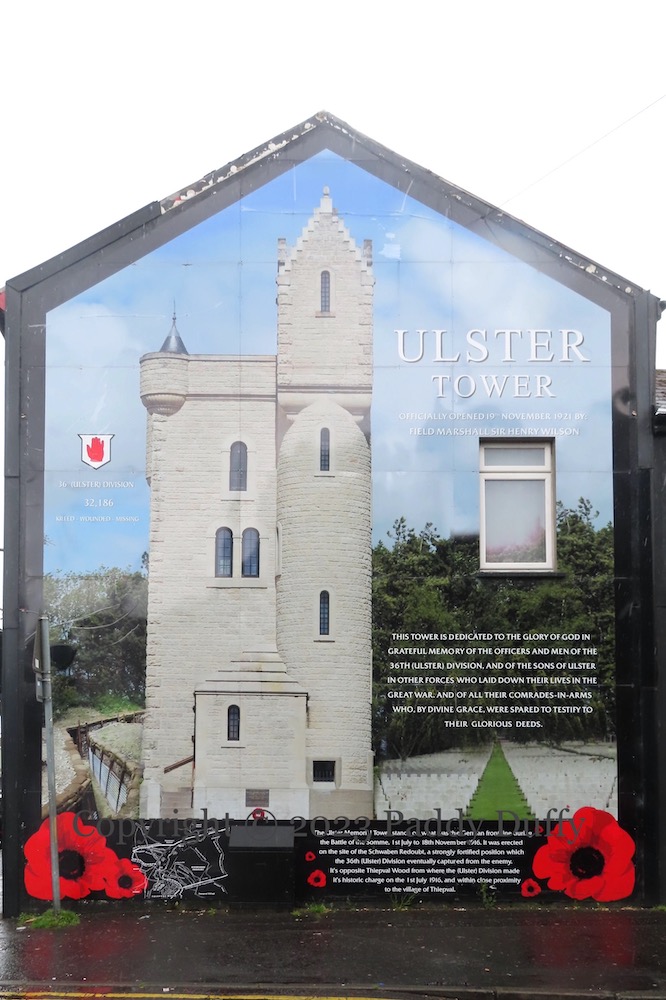
The map in the lower left corner of this WWI commemorative mural shows the defensive lines of both the Allies and the Central Powers. As the inscription on the mural describes, the Ulster Tower is situated close to the Schwaben Redoubt, the primary objective of the 36th Division on the first day of battle.
“Ulster Tower, officially opened 19th November, 1921, by Field Marshall Sir Henry Wilson.” “This Tower is dedicated to the glory of God in grateful memory of the officers and men of the 36th (Ulster) division, and of the sons of Ulster in other forces who laid down their lives in the Great War, and of all their comrades-in-arms who, by divine grace, were spared to testify to their glorious deeds.” “The Ulster Tower stands on what was the German front line during the Battle Of The Somme, 1st July to 18th November 1916. It was erected on the site of the Schwaben Redoubt, a strongly fortified position which the 36th (Ulster) Division eventually captured. It’s opposite Thiepval Wood from where the (Ulster) Division made it’s [sic] historic charge on 1st July 1916, and within close proximity to the village of Thiepval.” “32,186 killed, wounded, missing.” “Greater love hath no man than this that a man lay down his life for his friends.”
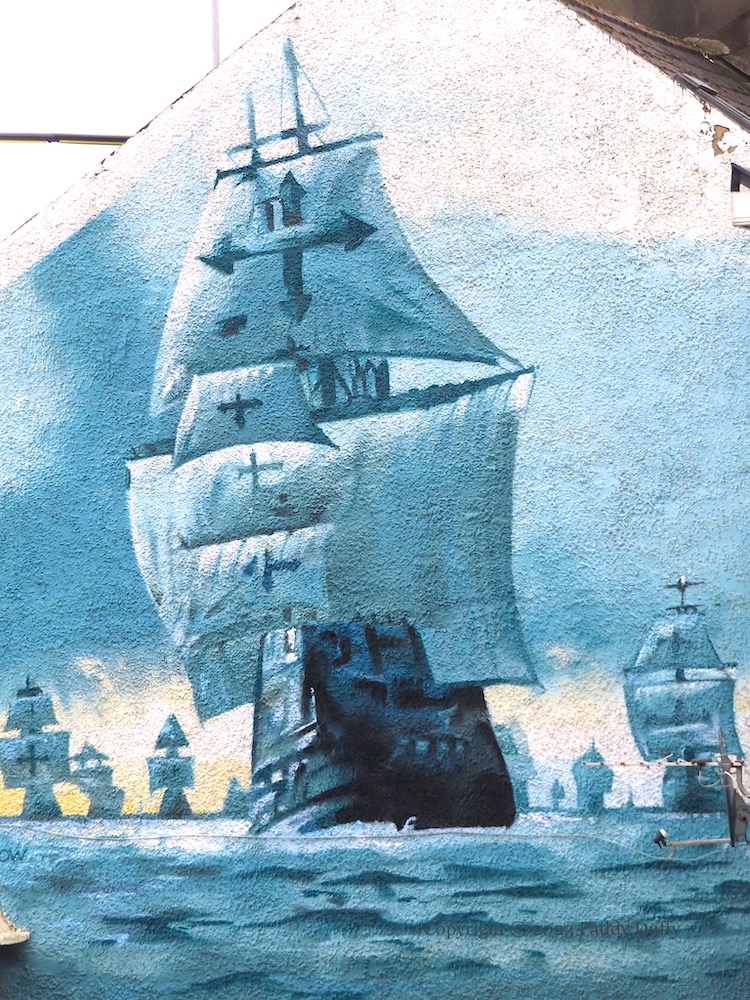
The Spanish galleass La Girona, one of the 130 ships that made up the armada that was unsuccessful against the English in 1588, docked at Killybegs, County Donegal, for repairs to her rudder (WP). When she departed, she got only as far as Lacada Point near Ballintoy, County Antrim, before sinking in a gale with the loss of roughly 1,300 lives and a substantial treasure that was recovered (in part) by Sorley Boy McDonell (portrayed in a Ballycastle mural) and (in part) by modern divers in 1968 (BBC).
Donegal Road, Killybegs, with a bonus image of the docks from the fish shop in Conlin Road.
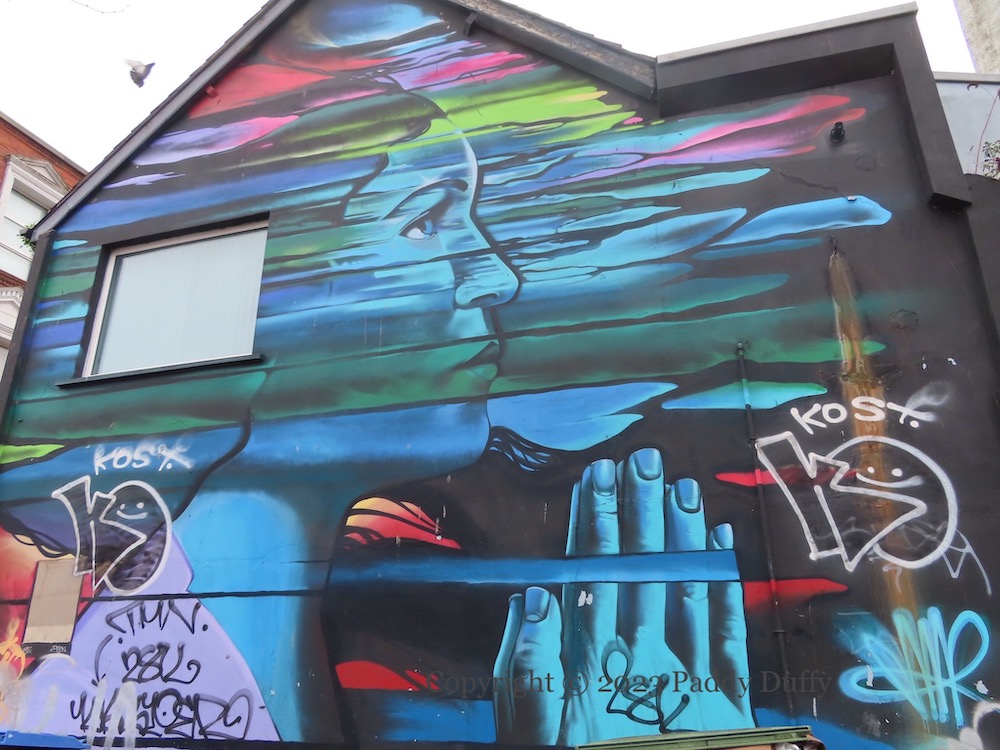
The Ballyhackamore mural by Ed Hicks (ig) – painted along with murals by emic and Alana McDowell – is on the eastern side of Eastleigh Crescent, so that when looking at it the viewer is looking away from the city and towards the … hills – perhaps Scrabo country park.
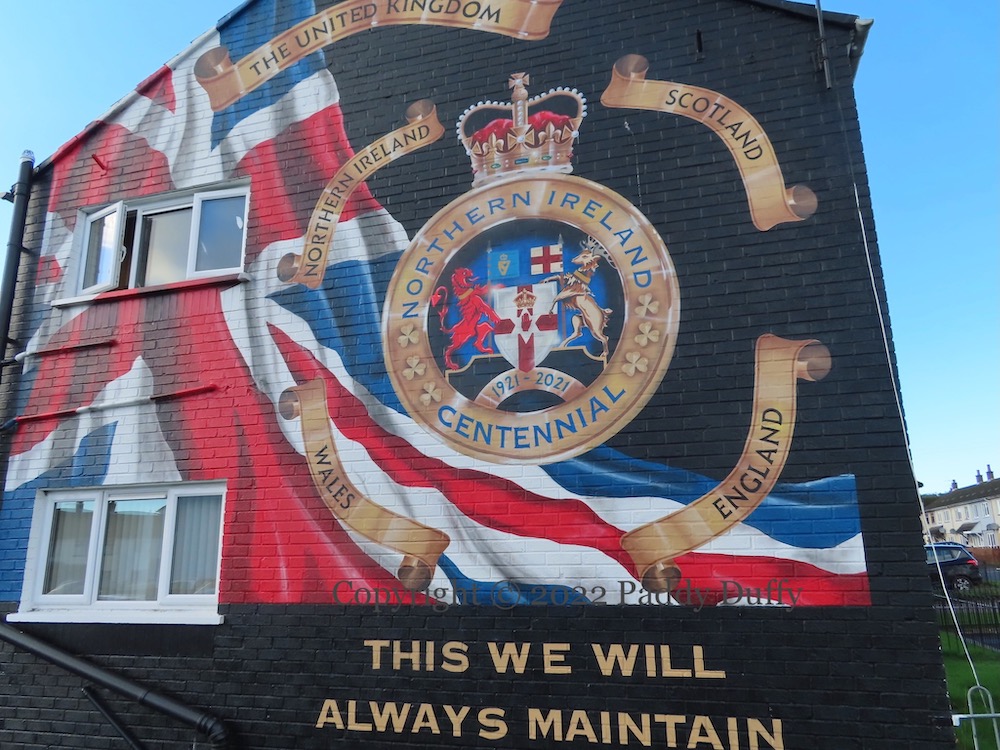
“This we will always maintain.” The Northern Ireland government’s coat of arms was approved for use in 1924, three years after the government was established. Its “supporters” – the red lion of Scotland and an Irish elk, carrying (respectively) Irish harp and De Burgh flags, and standing on a grassy mound with flax plants – were added later.
This mural celebrating the centenary of Northern Ireland’s creation, in the Woodburn estate, Carrickfergus, accurately shows the Tudor crown on the arms, as was used at the time of creation and prior to the Edwardian crown (WP).
MTO (Fb) was in Belfast for Culture Night 2014 and painted a large piece entitled “Son of Protagoras”. The ancient biographer Diogenes Laertius reports that Protagoras was driven from Athens and his books burned because he wrote that it was impossible to know whether or not the gods existed. On Fb, MTO adds a description of the Northern Irish “peace” lines, perhaps suggesting that religious adherence continues to be an enemy of peace: in his painting, a dove has been pierced by arrows bearing the cross of the Knights of Malta and the Latin cross.
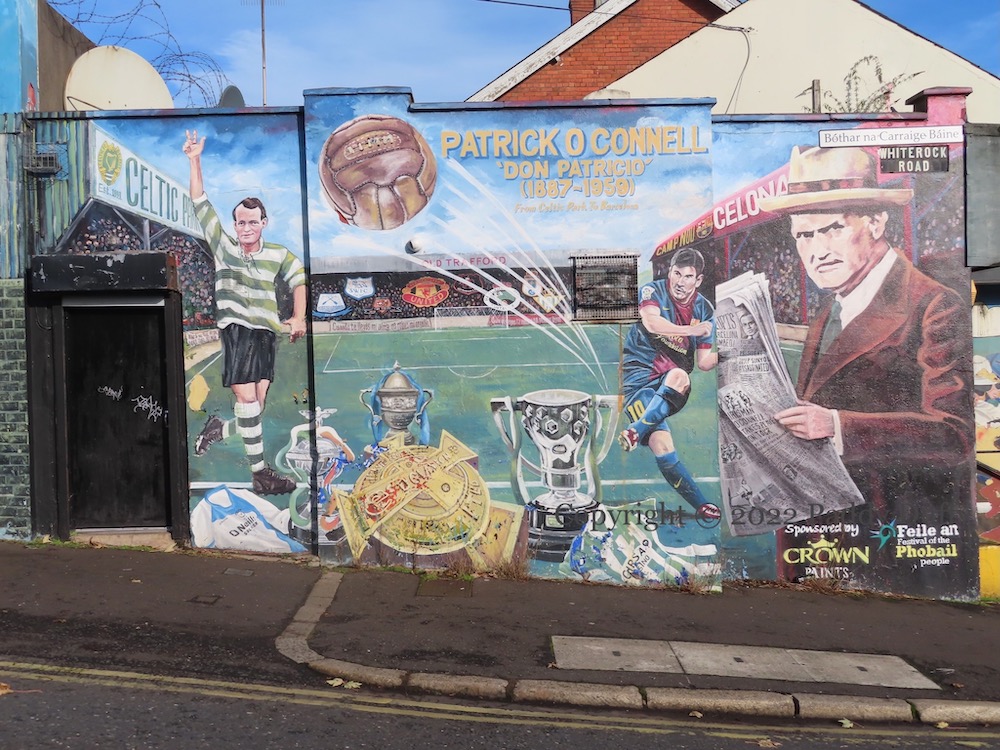
As a player, the Dublin-born Patrick O’Connell started with Belfast Celtic before moving on to various English and Scottish clubs, including a period at Manchester United at the time of WWI. He then went on to manage a string of Spanish clubs. As manager (“Don Patricio”) of Barcelona during the Spanish civil war, he accompanied the club on their tour of Mexico and the United States. The money from the tour saved the club from bankruptcy but 12 of the 16 players went into exile in Mexico and France. (WP) Barcelona returns to the US this month (2015-07) for games against the LA Galaxy, Manchester United, and Chelsea. (FCBarcelona)
The newspaper in the mural above crams all of this news onto one page: “Civil war erupts in Spain – Barcelona bombed”, “Football suspended – President [of FC Barcelona] Josep Sunyol assassinated” [by Franco’s troops] (WP); “Irishman O’Connell takes players on tour – FC Barcelona saved from extinction”; “Funds lodged in Switzerland”. In the bottom left-hand corner of the newspaper is Robert Capa’s famous photograph of ‘The Falling Soldier’, purporting to show a Republican soldier at the very moment he is struck by a bullet and dies. The image is now thought to have been staged (WP).
The player on the right is Lionel Messi. The Argentinian forward is shown in front of the Spanish League cup, which Barcelona won in the year the mural was painted (2014-2015) with a goal from “La Pulga” (“the flea”) – Messi is 5’7″ but four-time world player of the year.
The stands of three football stadiums are shown in the background: Belfast Celtic’s Celtic Park (“Paradise”), Manchester United’s Old Trafford, and Barcelona’s Camp Nou. The Old Trafford stands bear the emblems of the teams Patrick O’Connell played for and managed: Liffey Wanderers (whose shirt is also featured, on the left), Sheffield Wednesday, Hull City (The Tigers), Manchester United, Dumbarton, Real Racing Club de Santander, Real Oviedo, and Real Betis Balompié (also shirt on the right).