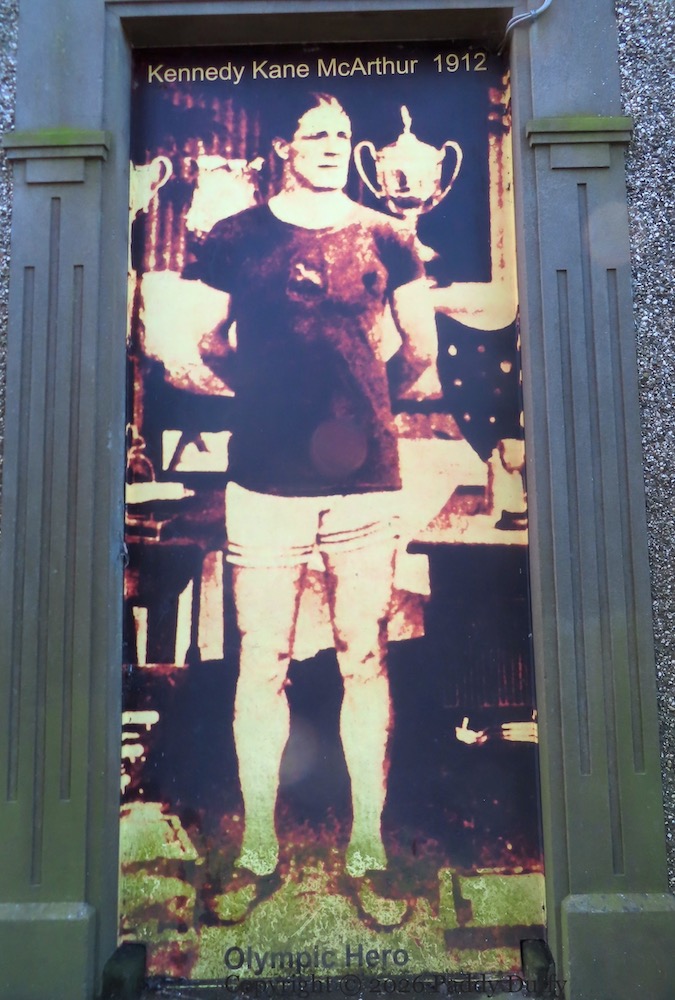
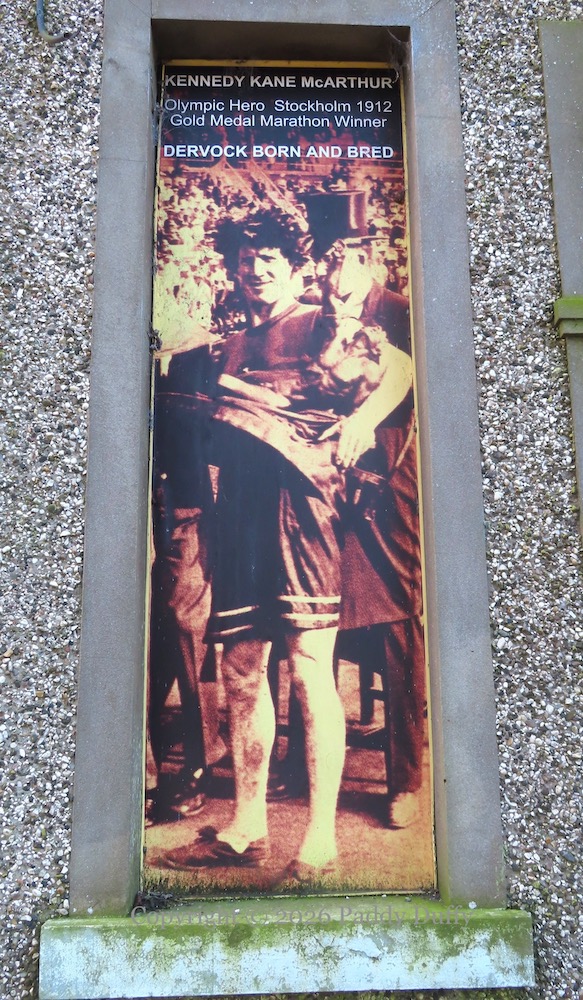
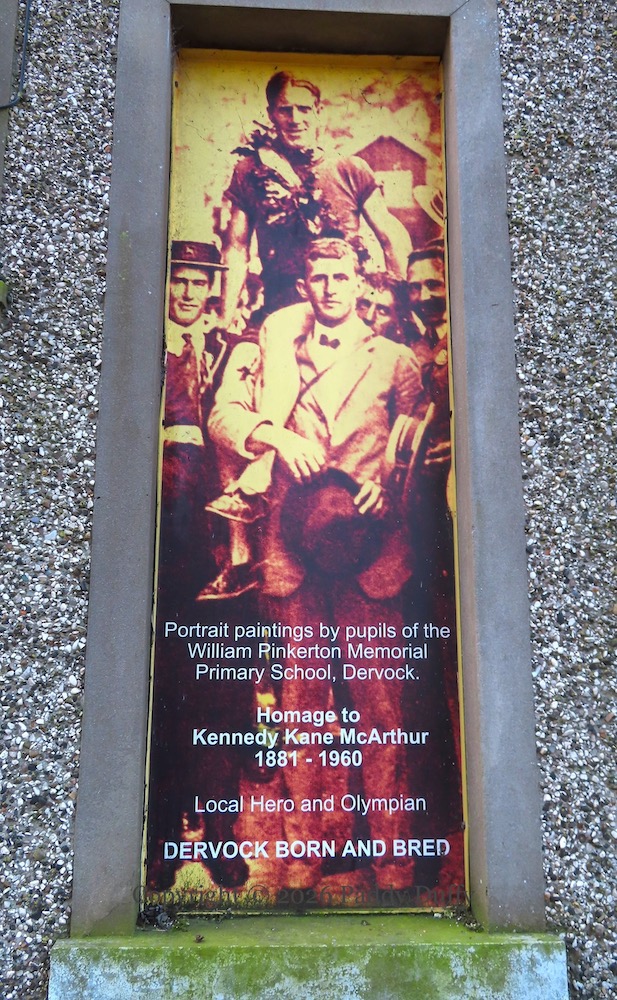
“Kennedy Kane McArthur, Olympic hero, Stockholm 1912, gold medal marathon winner. Dervock born and bred.”
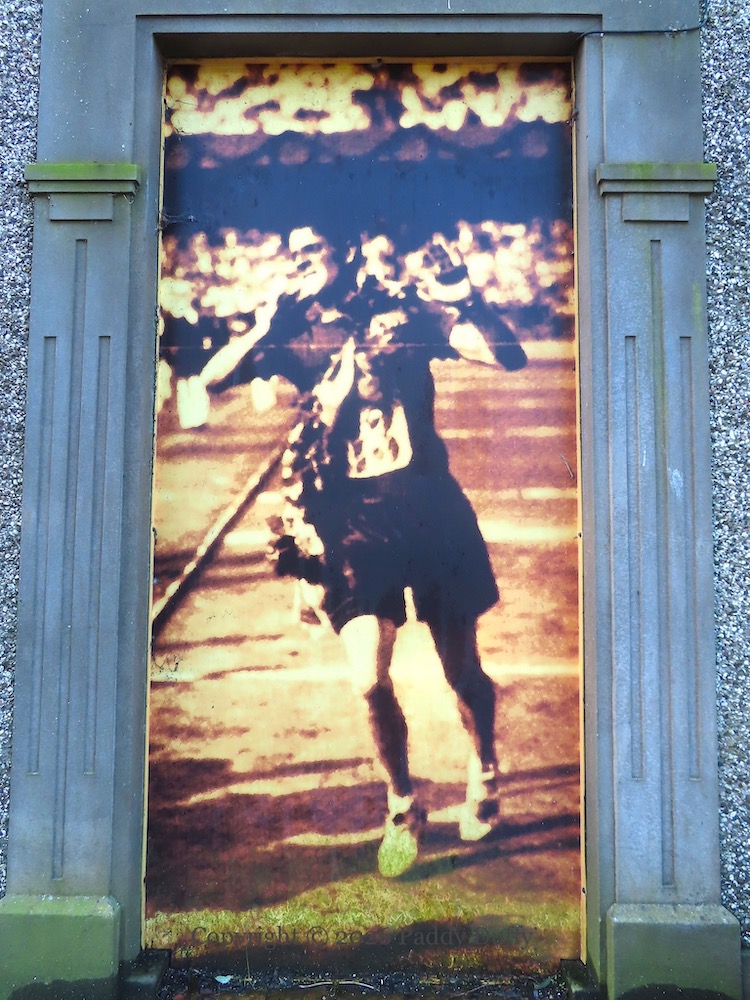
Ken McArthur emigrated from Dervock to Johannesburg, South Africa, at age 20 and ran his first marathon at 28. Four years later, he represented South Africa at the Olympics and was victorious in the marathon (WP). There is footage of the race at olympics.com.
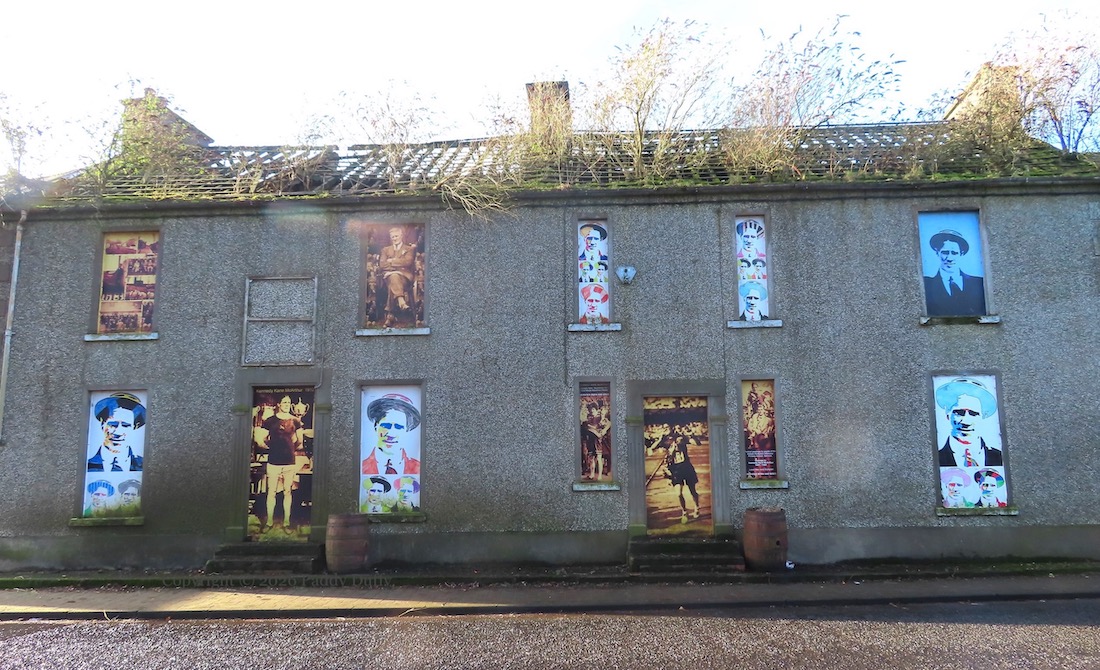
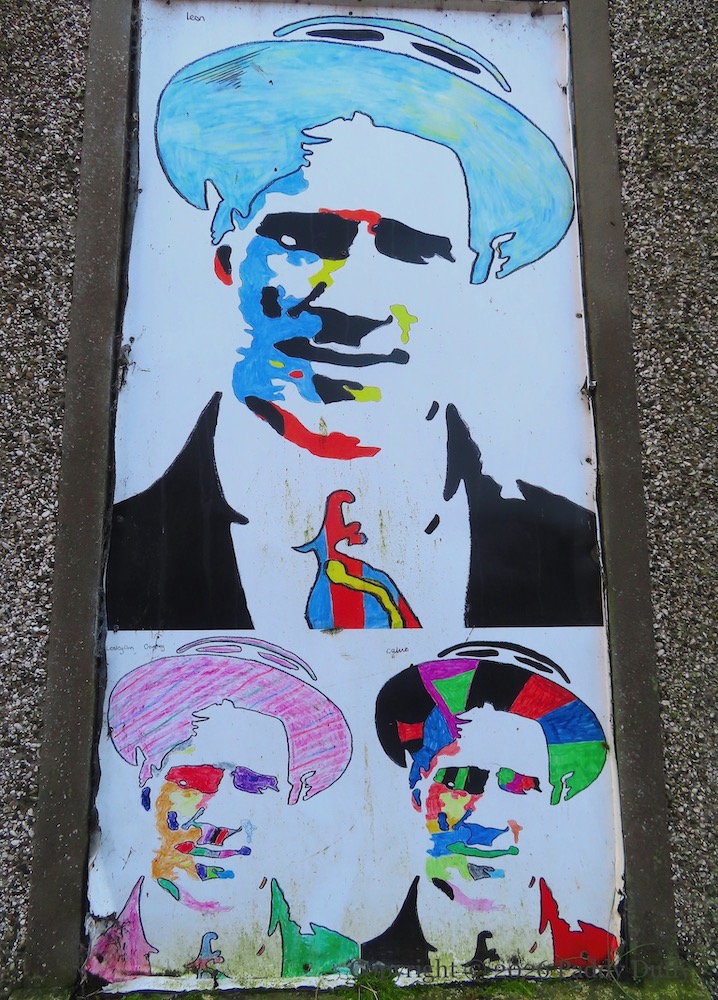
“Portrait paintings by pupils of the William Pinkerton Memorial primary school, Dervock. Homage to Kennedy Kane McArthur, 1881 – 1960, Local hero and Olympian. Dervock born and bred.”
Castlecat Road, Dervock
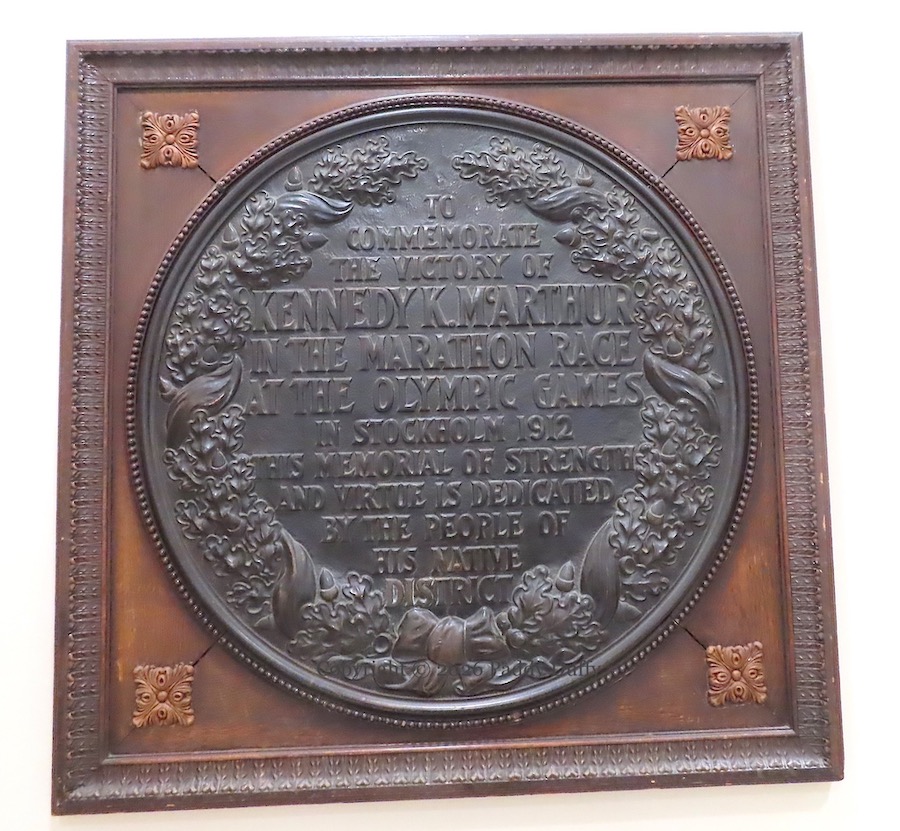
The large medallion is in the visitor centre in Townsend Street, Ballymoney. It reads, “To commemorate the victory of Kennedy K. McArthur in the marathon race at the Olympic Games in Stockholm 1912. This memorial of strength and virtue is dedicated by the people of his native district.”
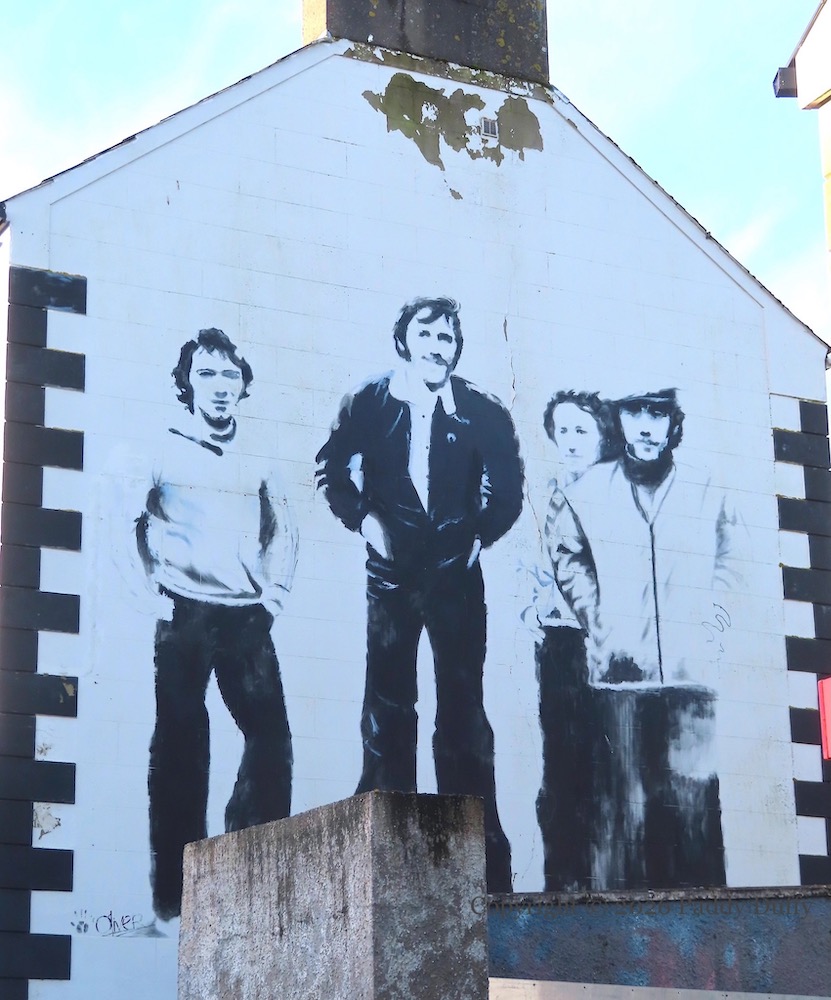
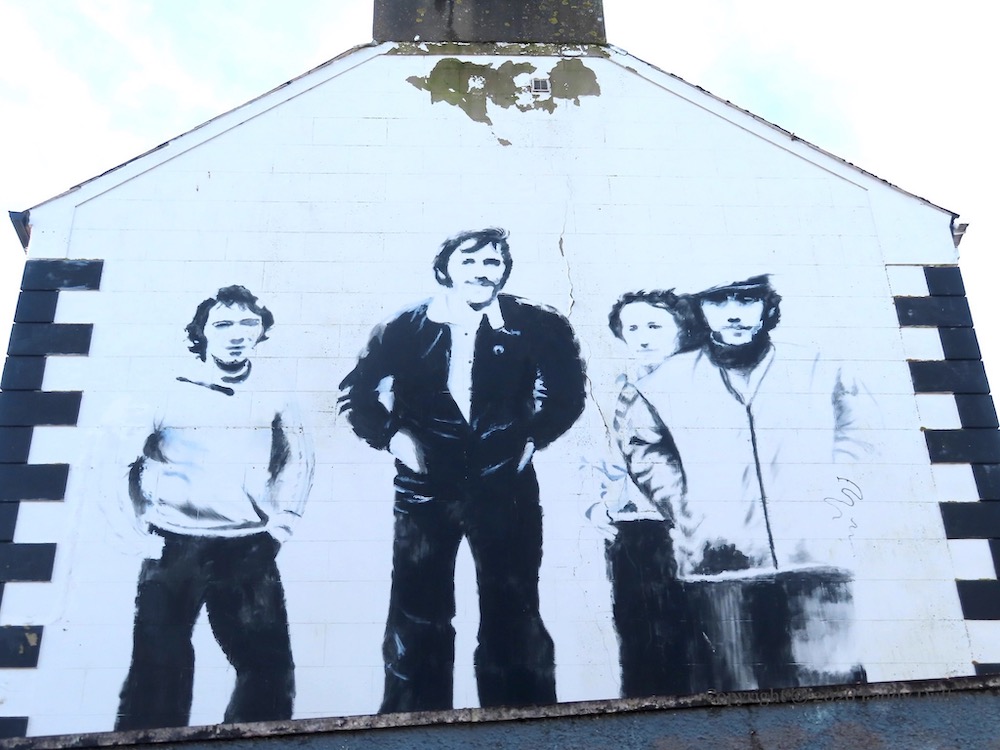
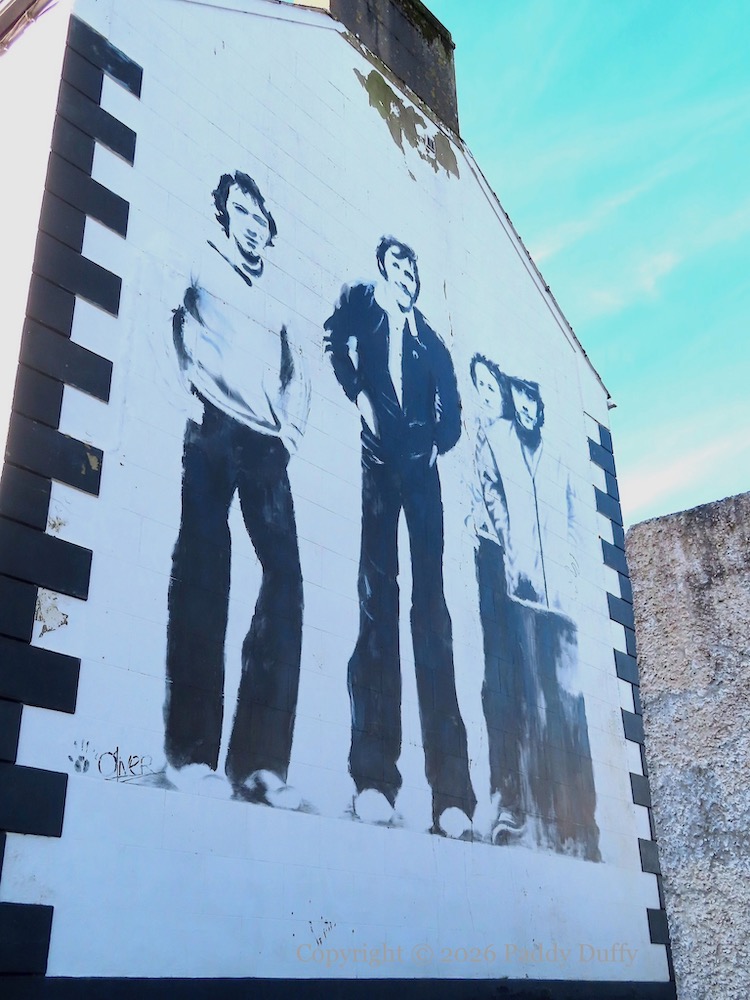
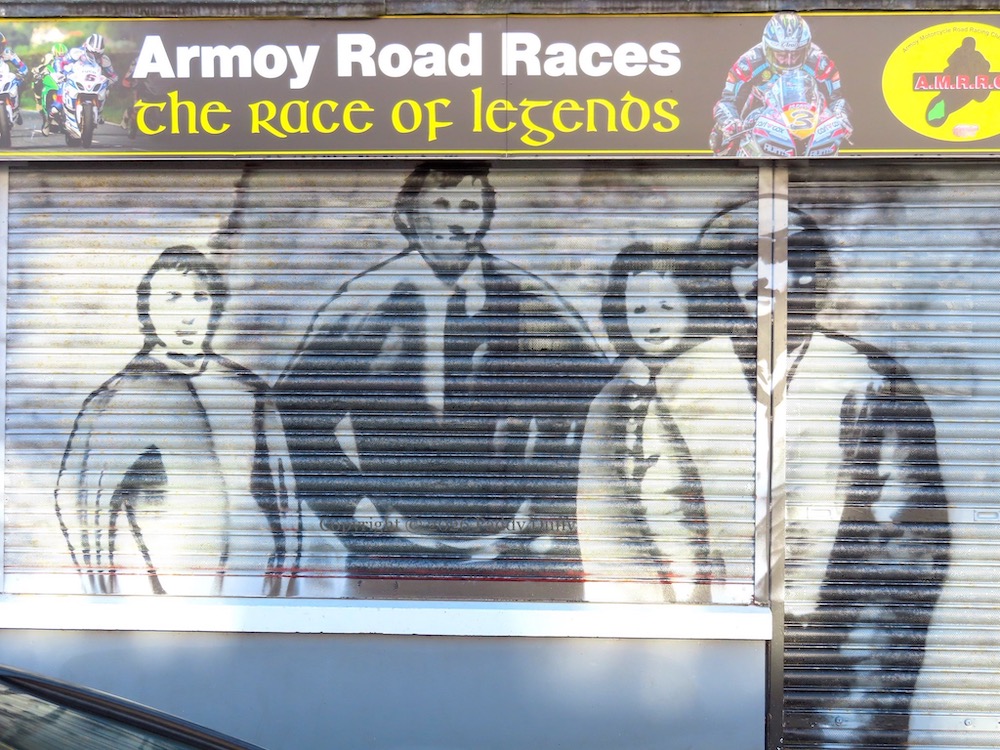
The “Armoy Armada” was (l-r) Joey Dunlop, Frank Kennedy, Jim Dunlop, Mervyn Robinson (AMRRC). The four formed a team of motorcycle racers from 1977 until 1979 when Kennedy was injured in the North West 200. In memory of the quartet, the Armoy Road Races have been held every July since 2009.
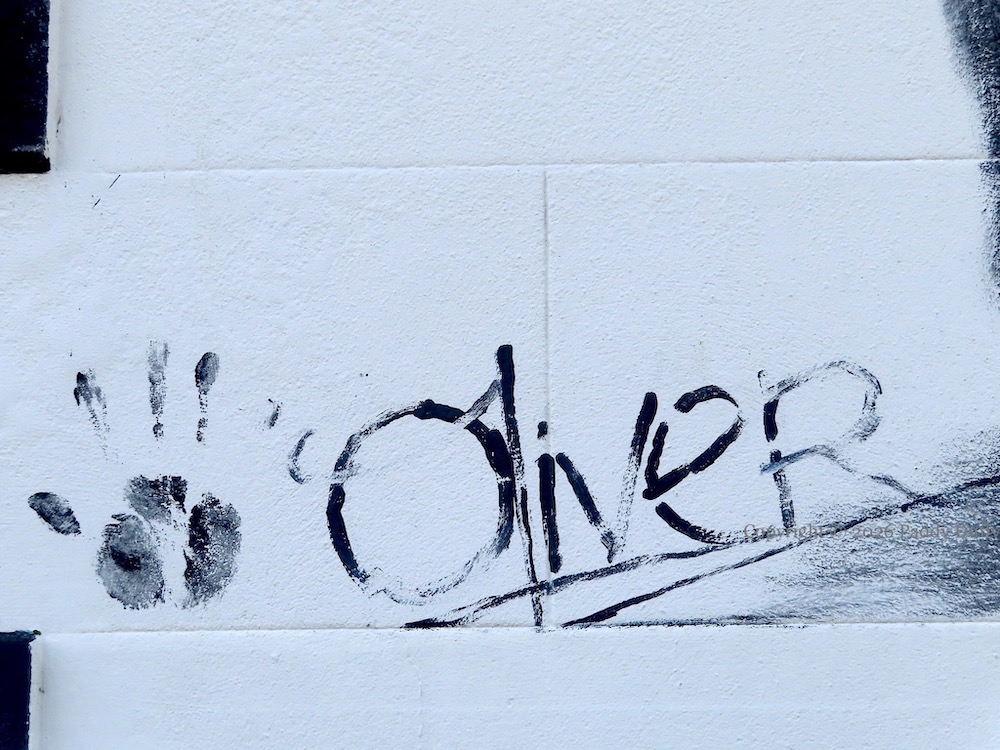
This mural was painted by Oliver McParland (web) in 2020 on a gable of a fast-food shop in Armoy. (For the original photograph, see Classic Motorbikes.) The cruder version in the final image, below, is also in Main Street, on the shutters of the Armoy Motorcycle Road Racing club.
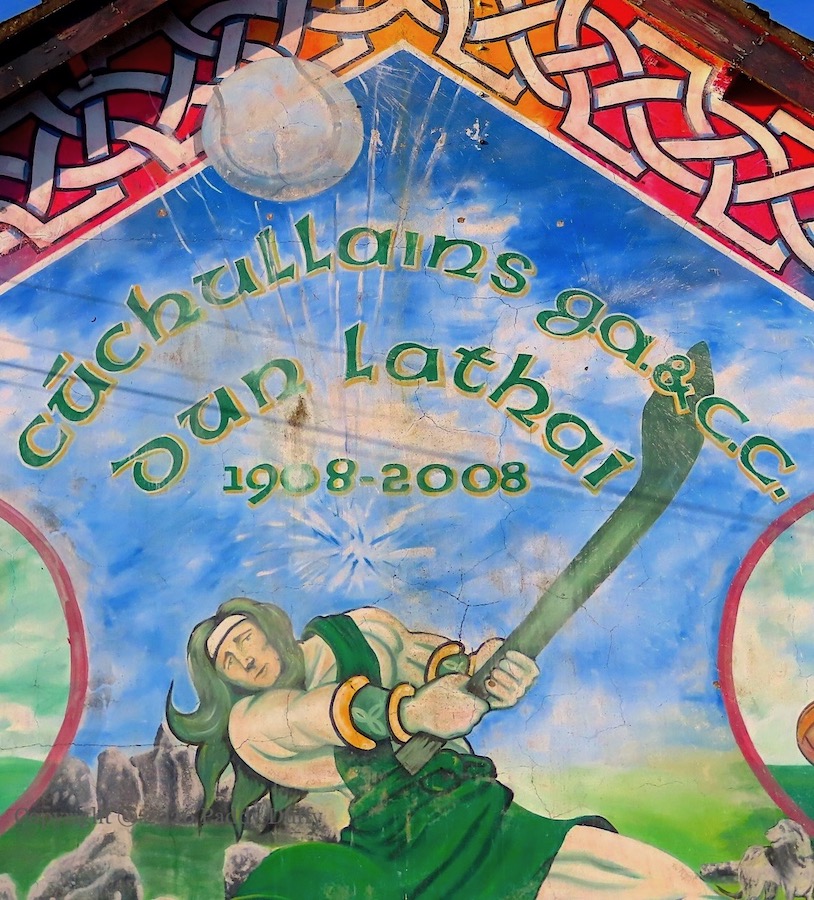
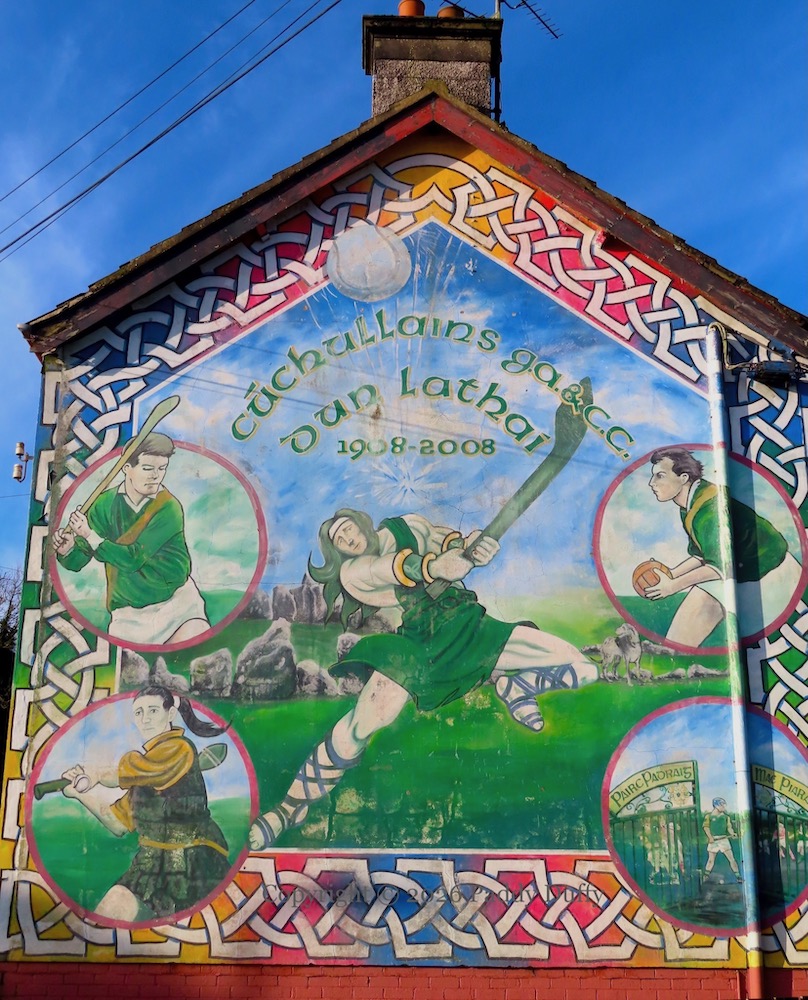
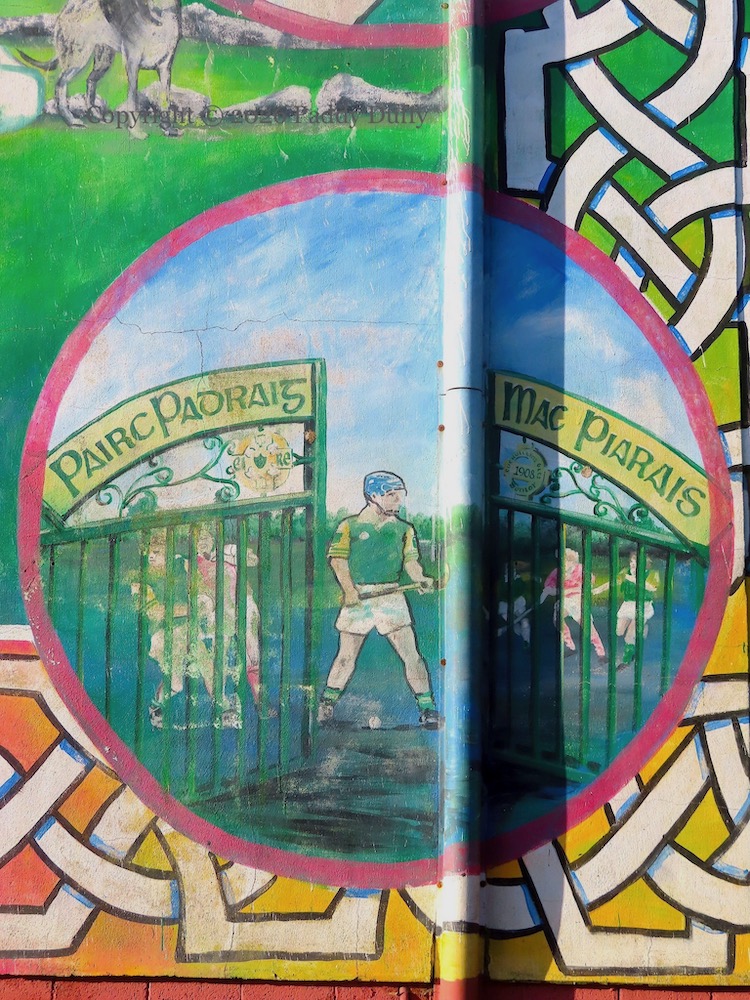
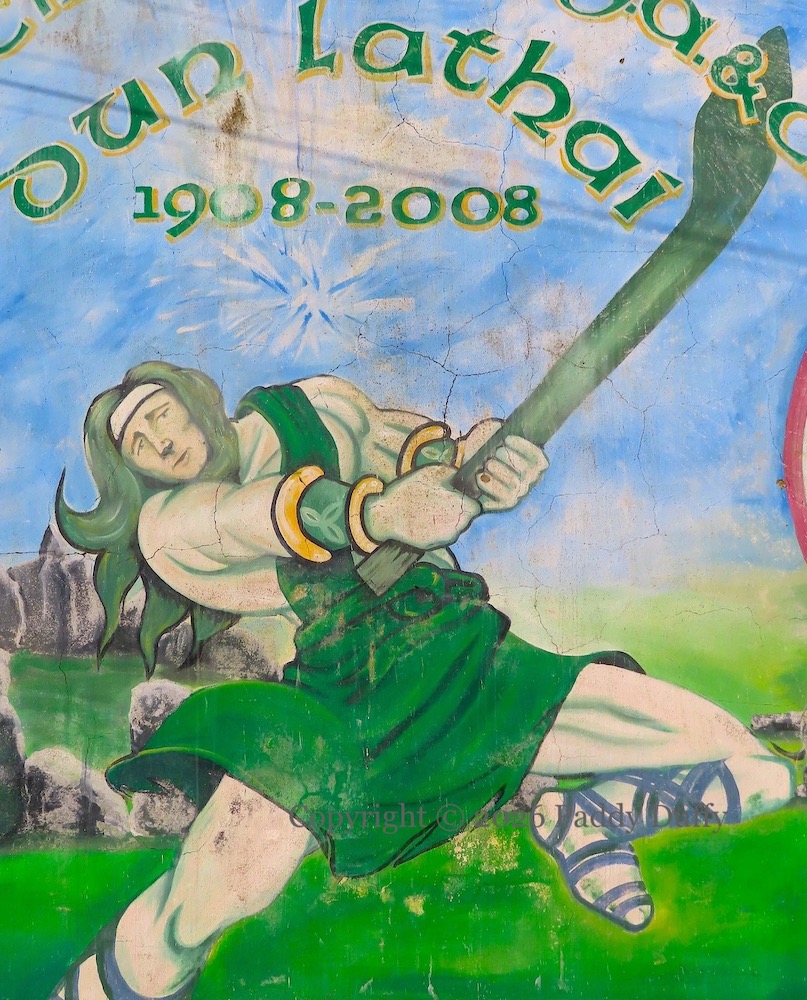
Dunloy Cuchullains (Fb) is a “GA & CC” [Gaelic athletic & camogie club] in Dunloy [Dún Lathaí], County Antrim. The club was founded in 1908 by Andy Dooey, Bob Black, Dan Boyle and Paddy McCamphill (NI Archive | GAA oral history). Home games are played at Páırc Mhıc Phıaraıs on Bridge Road. The club was Antrim senior football champions in 2025 (RTÉ).
The mural was painted for the club’s centenary in 2008 on the gable of Lilac Terrace in Tullaghans Road in the centre of the village. The central figure is inspired by Jim Fitzpatrick ‘Hurling Match’ (Visual History).
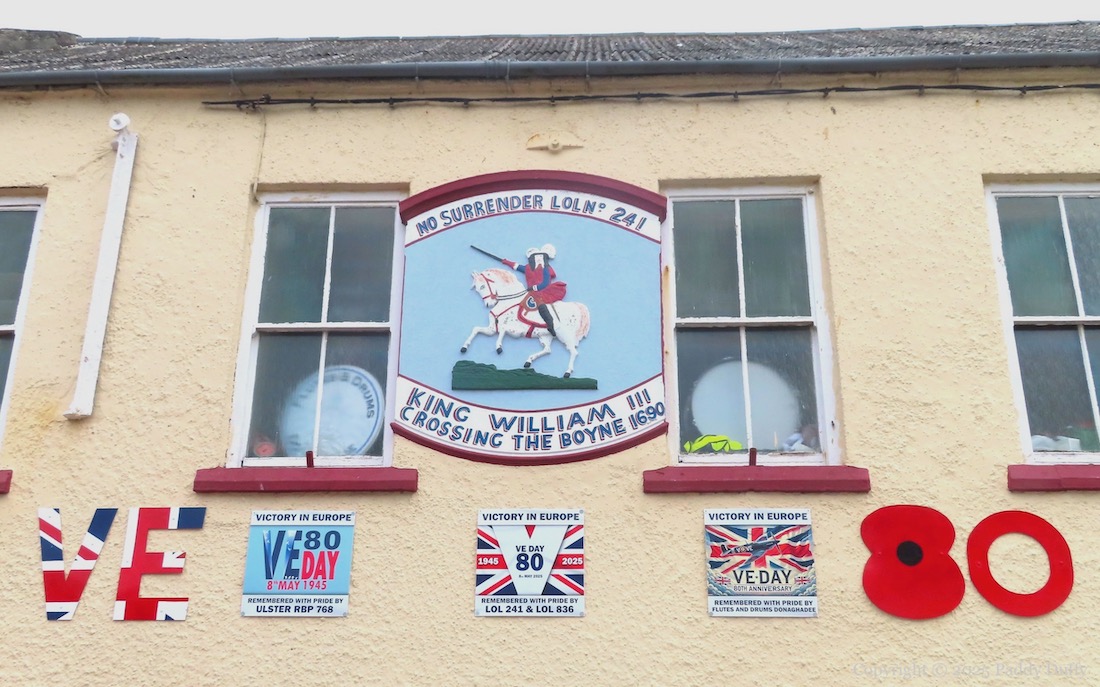
This image of King Billy crossing the Boyne in 1690 is on the No Surrender lodge (LOL 241) in Donaghadee. King William III’s victory in Ireland is celebrated annually on July 12th, with parades and gatherings of fraternal lodges and flute bands.
William’s victory is joined here by a number of small boards commemorating the 80th anniversary of Victory In Europe, on May 8th, 1945, “remembered with pride” by Orange lodges 241 and 836 (Brother Henry Ferguson Memorial), Royal Black Preceptory 768 (Ulster), and Flutes And Drums Donaghadee (Fb).
Manor Street, Donaghadee, replacing two Platinum Jubilee boards.
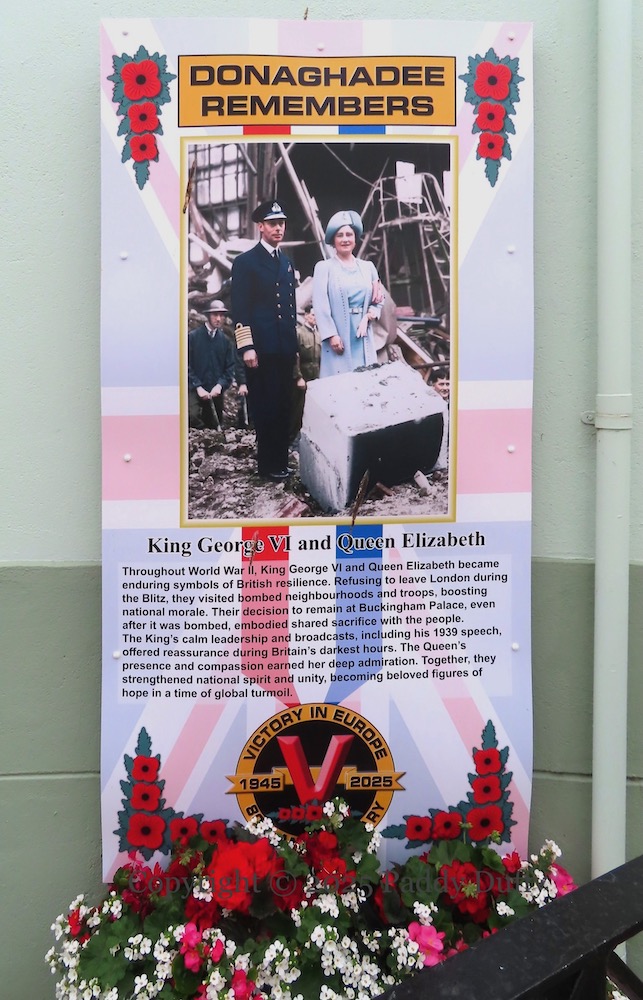
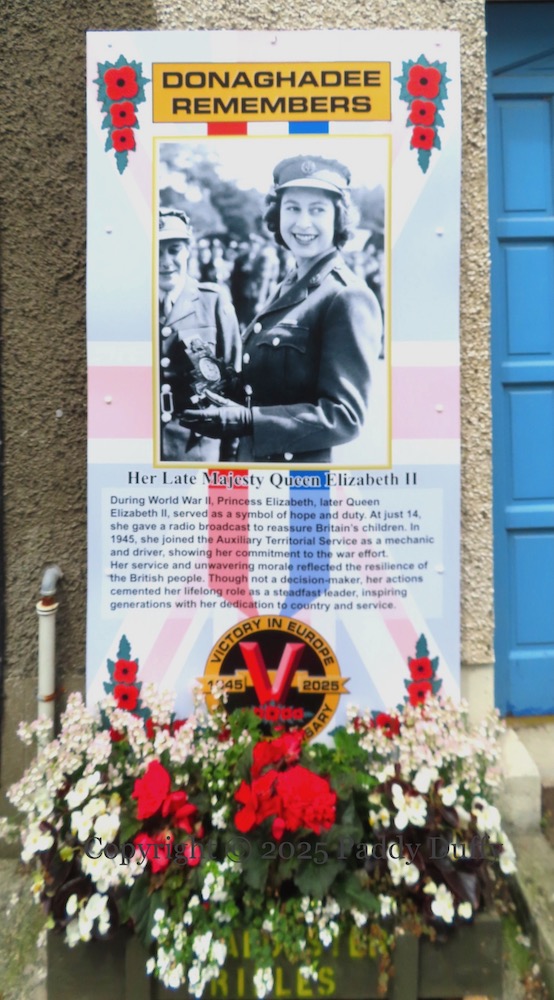
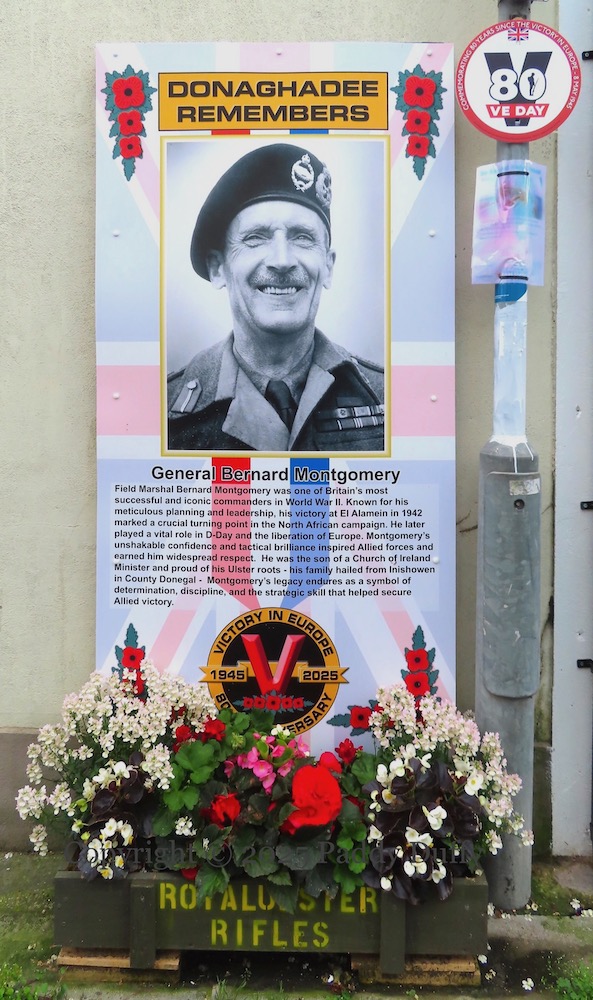
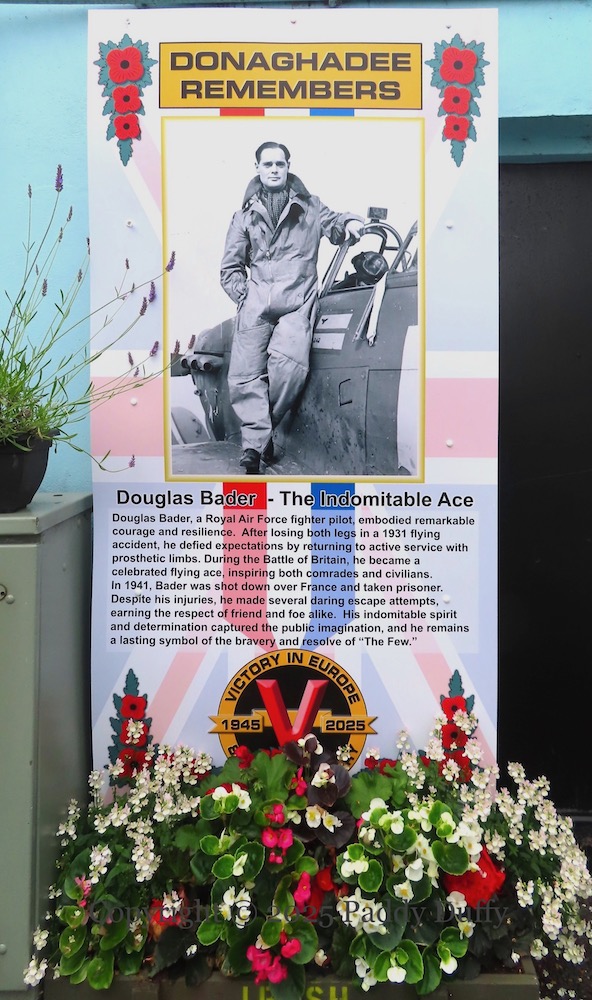
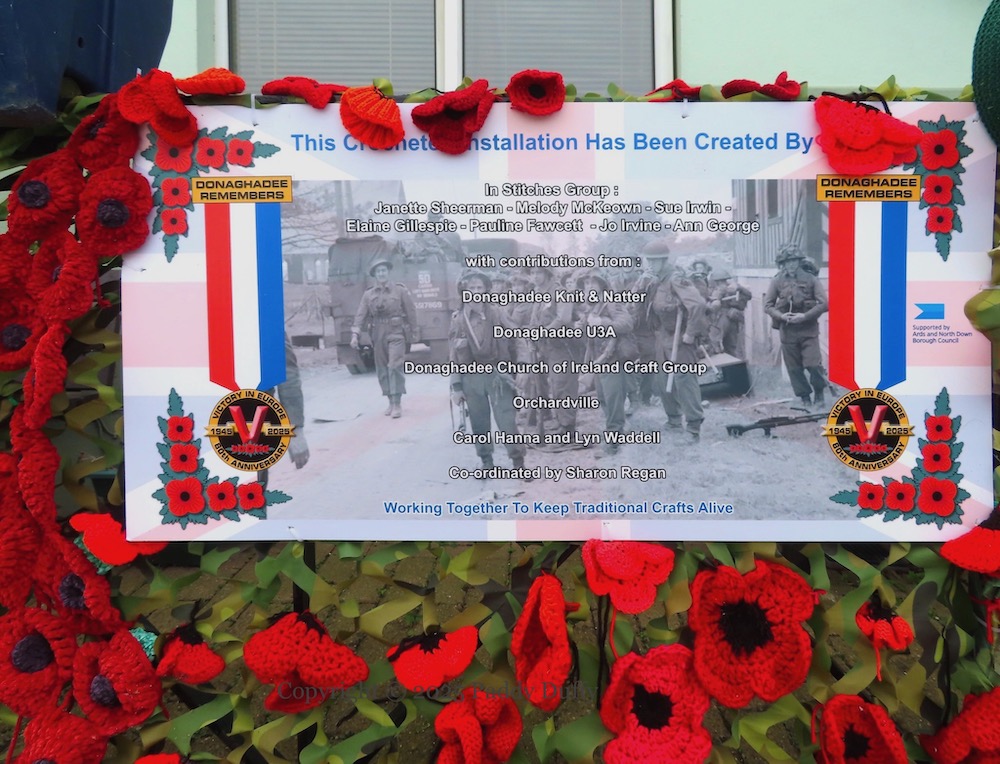
As part of the town’s VE Day celebrations, Donaghadee mounted a series of flower boxes, information boards, and crocheted poppies, along Hunter’s Lane (which runs between High Street and the Parade). Also included are small panels to twenty-three local soldiers who died during the War.
“Donaghadee Community Development Association [Fb], in collaboration with Donaghadee Community Partnership, Donaghadee Historical Society [Fb] and the In Stitches Group, is proud to present this floral and educational display in commemoration of the 80th anniversary of Victory in Europe. With support from Ards and North Down Borough Council, First Presbyterian Church, Abbeyfield, Wesley Housing and local residents, this project brings history to life in the heart of our town. / On 8th May 1945, the guns across Europe fell silent. After six years of devastating conflict, Nazi Germany surrendered unconditionally, marking the end of the Second World War in Europe. VE Day – Victory in Europe Day – was met with celebration, relief, and solemn reflection. Across the United Kingdom and the Commonwealth, crowds rejoiced, even as they grieved for the fallen and the irrevocable loss left in war’s wake. This display honours the 23 men and women from Donaghadee who gave their lives in service during World War II. We remember them with pride, gratitude, and sorrow. Through a series of commemorative panels, we also highlight the stories of eight wartime figures – from global leaders to everyday heroes – whose courage shaped history. / This is more than an remembrance. It is a space to reflect, to learn, and to give thanks. As we mark this significant anniversary, we commit ourselves anew to the values of peace, unity, and understanding. Let us remember – not only what was lost, but also what was won: the enduring freedom we enjoy today.”
The eight notable figures are: “Winston Churchill, the voice of defiance”, “King George VI and Queen Elizabeth”, “Her late majesty Queen Elizabeth II”, “Dame Vera Lynn, the forces’ sweetheart”, “Lt Col Blair Mayne, SAS trailblazer”, “Violette Szabo, the courageous spy”, “General Bernard Montgomery”, “Douglas Bader, the indomitable ace”.
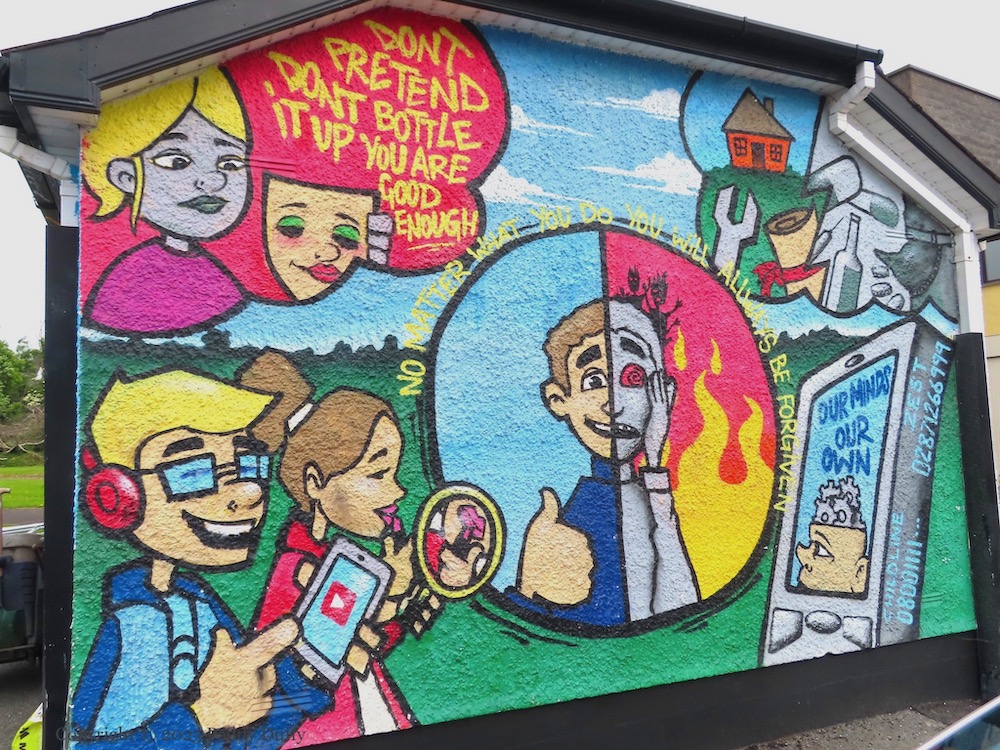
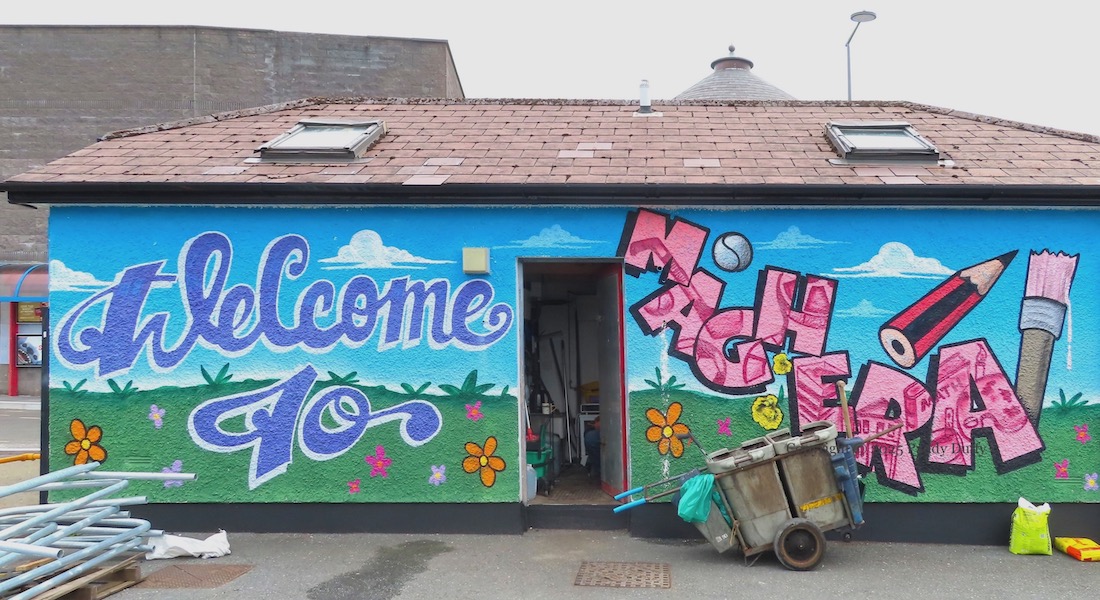
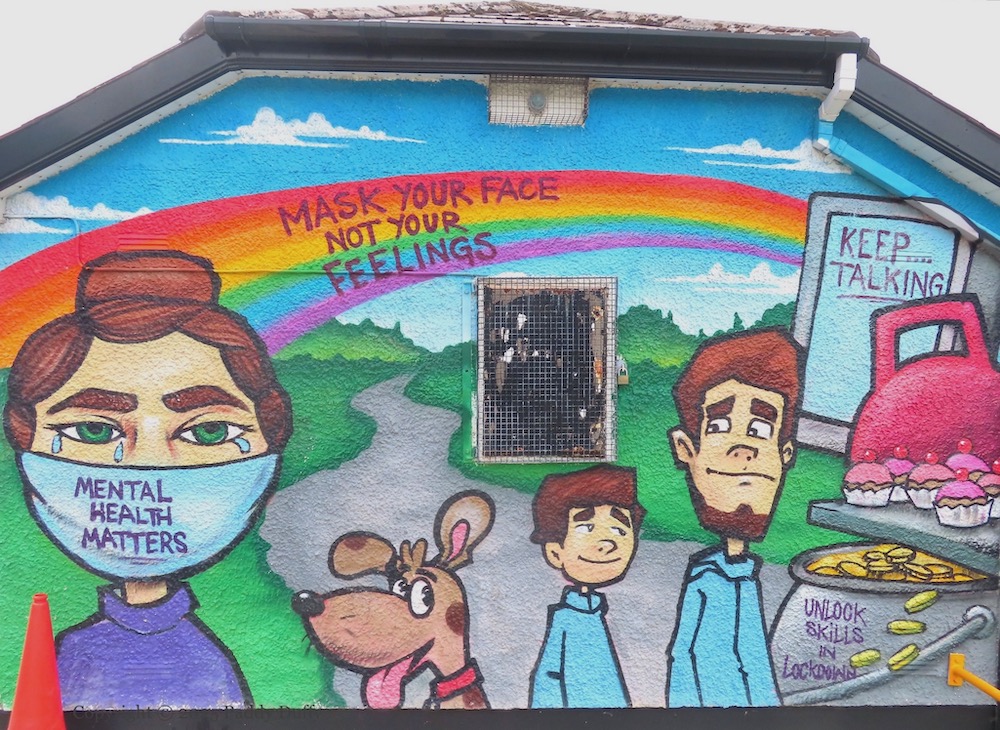
“Welcome to Maghera”. These images are of the lockdown-era art on the public bathrooms in Maghera, with a variety of mental-health messages: “Don’t pretend. Don’t bottle it up. You are good enough”, “No matter what you do, you will allways [sic] be forgiven”, “Our mind’s our own”, “Mask your face, not your feelings”, “Mental health matters”, “Unlock skills in lockdown”,
Charles Thomson was born in Maghera in 1729 and moved to North America in 1739. He served as the secretary of the Continental Congress and signed the Declaration of Independence. He helped design both the front and back of the nation’s Great Seal in 1782. (WP)
He is honoured in his home town by the board shown here. Thomson’s design for the reverse of the seal – the all-seeing eye over an unfinished pyramid (WP) – appears in the eagle’s left-hand wing, and his preliminary sketch, with wing-tips pointed downward (WP), in the right-hand wing.
Text of the information panel: “The Final Design of the Great Seal – June 20, 1782. On June 13, 1782, Congress asked Charles Thomson to come up with a suitable design for America’s Great Seal. With the reports and drawings of the three committees before him, he set to work. Thomson had served the past eight years as the Secretary of the Continental Congress where he acquired a reputation for fairness, truth, and integrity. Well-versed in the classics, he was once a Latin master the Academy of Philadelphia. Although today he is not a well-known founder, Charles Thomson was at the heart of the American Revolution. Thomson incorporated symbolic elements from all three committees with ideas of his own to create a bold and elegant design. He made a sketch and wrote a description of his preliminary design. For the front of the Great Seal, Thomson drew an American bald eagle and for the centrepiece he a [sic] placed the shield upon the eagle’s breast. Thomson envisioned an eagle “on the wing and rising.” In the eagle’s right talon is an olive branch. In its left, a tightly drawn bundle of arrows. Thomson said these symbols represent “the power of peace and war.” In the eagle’s beak, he placed a scroll with the first committee’s motto: E Pluribus Unum ‘Out of Many, One’. For the crest above the eagle’s head, Thomson used the radiant constellation of thirteen stars suggested by the second committee. He described the light rays as “breaking through a cloud.” For the reverse side of the Great Seal, Thomson used Barton’s (third committee) suggestion: an unfinished pyramid with the eye of Providence in its zenith, but added a triangle around the eye (like the first committee did). He also created two new mottos: Novus Ordo Seclorum ‘A New Order of the Ages’ and Annuit Coeptis ‘Providence has Favoured Our Undertakings’. After consulting with William Baron, the position of the eagle was changed to “displayed” (wings spread with tips up) and the chevrons on the shield were changed to the vertical stripes we see today.”












 Paddy Duffy Collection