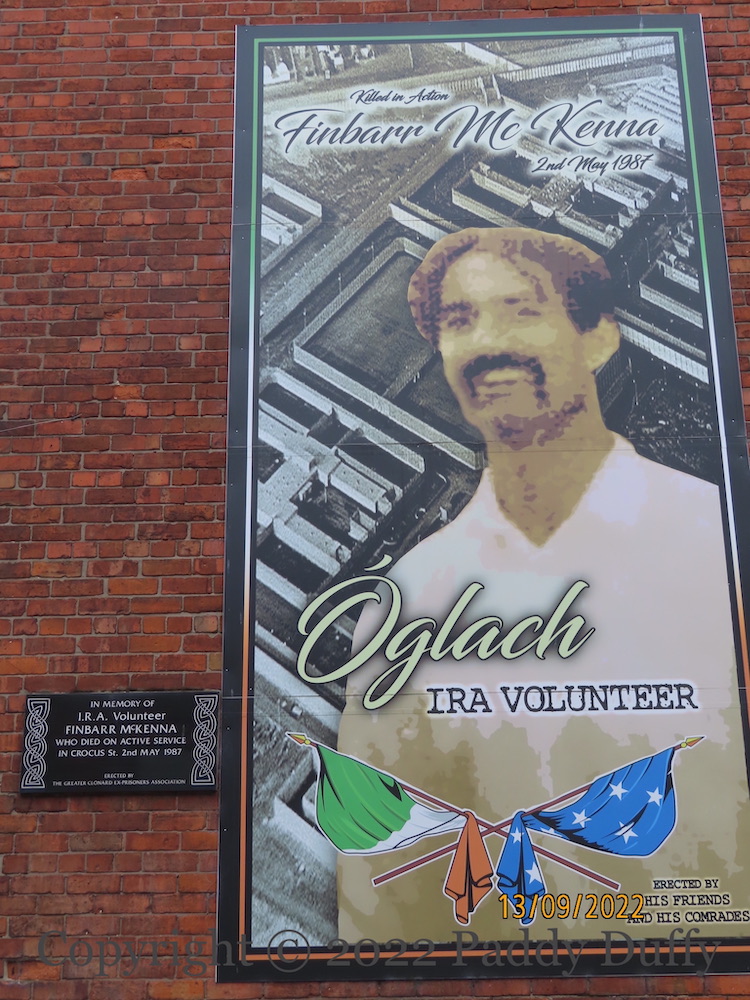
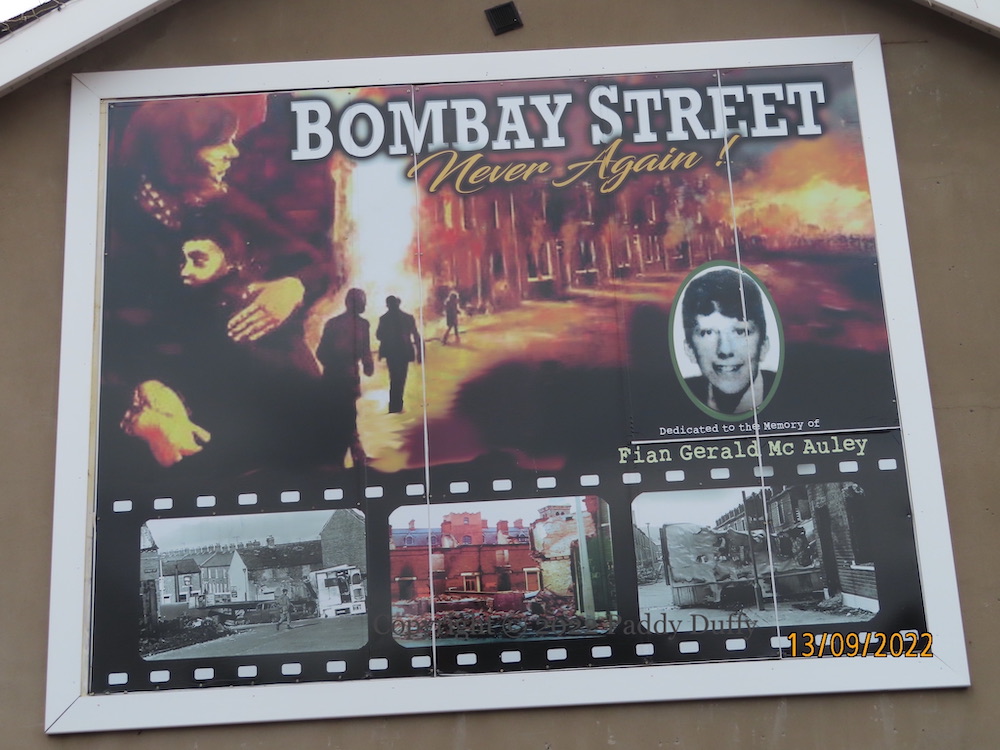
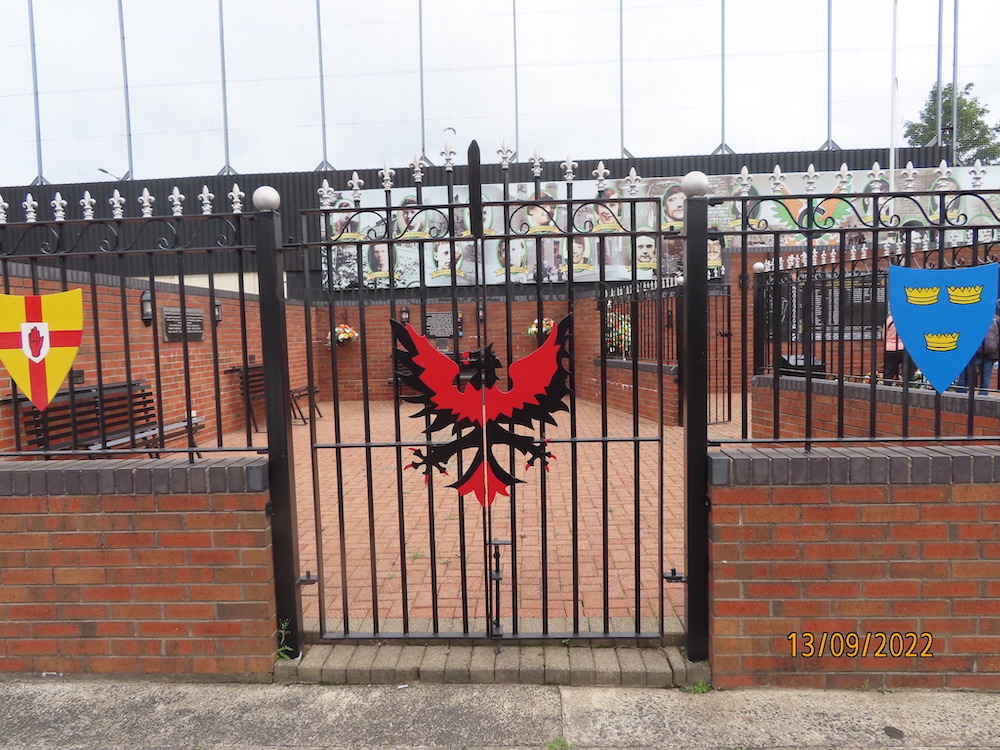
15 year-old Fıan Gerald McAuley was the first member of the IRA to die in the Troubles. He was shot in Waterville Street by a loyalist sniper while helping people move from burned-out homes in Bombay Street, along which the “peace” line separating the Falls and Shankill now runs, overlooking the Clonard Memorial Garden, site of the service for the 50th anniversary of McAuley’s death.
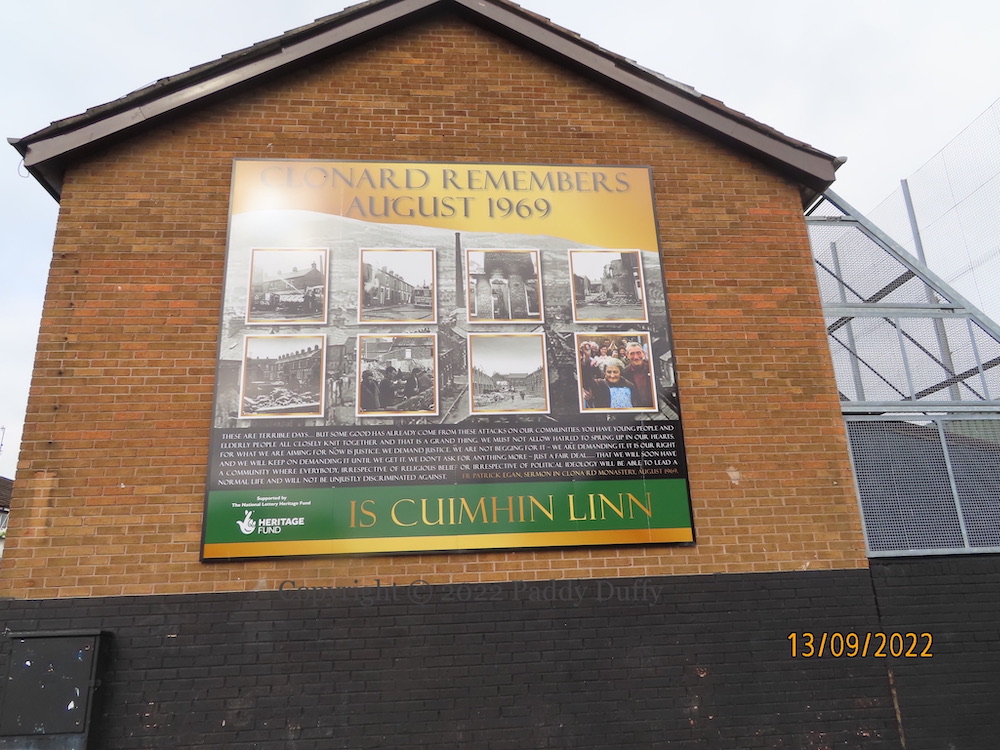
“Is cuımhın lınn.” To commemorate the beginning of the Troubles, a series of events was organised by the Belfast 1969 Pogroms Commemoration Committee, in Clonard, Falls, and Ardoyne, including a photographic exhibition, documentary screenings, panel discussions, a play, a mass, and murals (Irish News), including The Pogrom Of August 1969 and the one above, in Bombay Street, which used to run between the Shankill and Falls but after the riots and burnings of August 1969 was split in two by a so-called “peace” line.
“These are terrible days … but some good has already come from these attacks on our communities. You have young people and elderly people all closely knit together and that is a grand thing. We must not allow hatred to spring up in our hearts. For what we are aiming for now is justice. We demand justice. We are not begging for it – we are demanding it. It is our right and we will keep on demanding it until we get it. We don’t ask for anything more – just a fair deal … that we will soon have a community where everybody, irrespective of religious belief or irrespective of political ideology will be able to lead a normal life and will not be unjustly discriminated against.” – Fr Patrick Egan, sermon in Clonard Monastery, August 1969 (youtube).
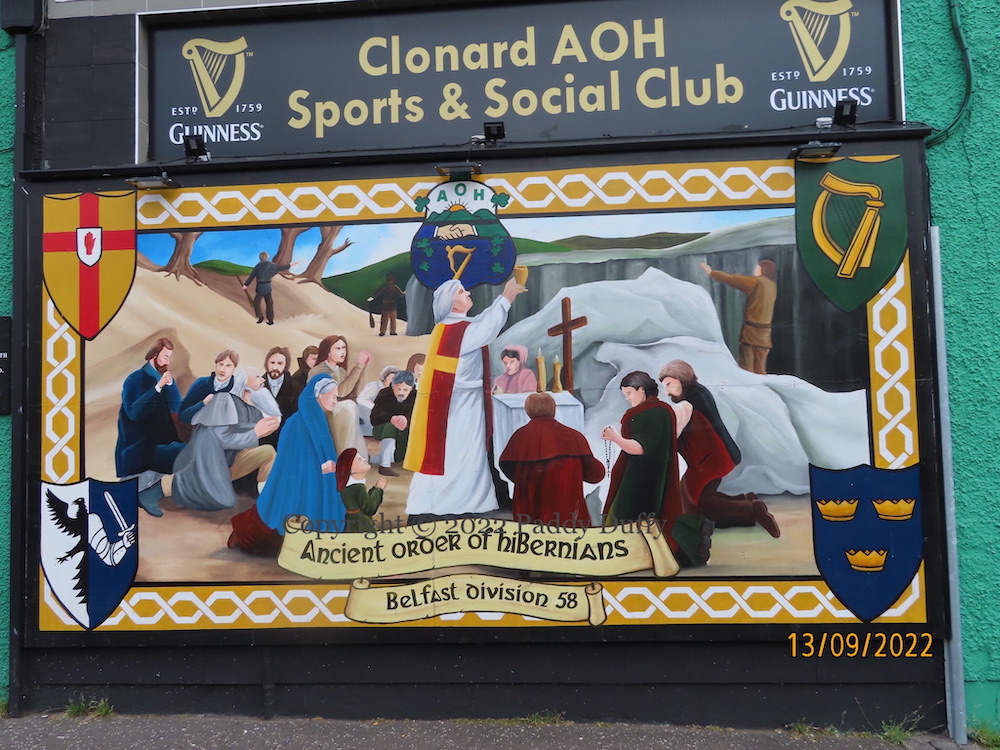
A Penal law of 1695 forbade the practice of Catholicism and “dissenter” forms of Protestantism –anything other than Anglicism, forcing people and priests to worship in secret. Although the precise date of the founding of the Ancient Order Of Hibernians is shrouded by the existence of various other Catholic fraternal and defensive organisations such as St Patrick’s Fraternal Society and the Ribbonmen – the AOH history page gives 1838 in Pennsylvania – the order traces its roots back to Penal times and in particular to the Defenders in 1784, which arose to protect Catholics from the (Protestant) Peep-O-Day Boys and in defiance of Penal laws forbidding Catholics to bear arms (WP). The Belfast division (58) of the AOH is in Clonard Street.
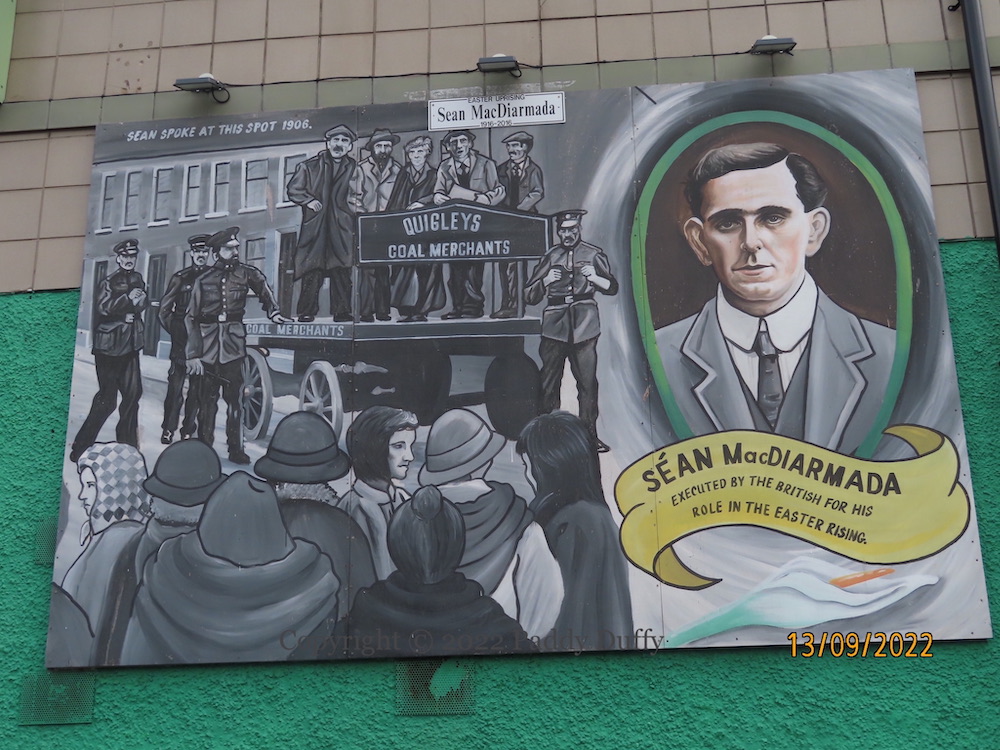
Seán Mac Dıarmada was born in Leitrim, left for Glasgow at age 15, but after two years returned to Belfast in 1905 (working on the trams) and – according to the new mural above – spoke from the back of a coal lorry in Clonard Street, outside the Clonard branch of the Ancient Order Of Hibernians. Mac Dıarmada was for a short time an AOH member, before moving on to the Irish Republican Brotherhood and Irish Volunteers, which led to his participation in the 1916 Easter Rising and execution on May 12th of that year.
The title of this post is historian F.X. Martin’s assessment of Mac Dıarmada, quoted in a pamphlet on Mac Dıarmada from the National Library Of Ireland, which includes reproductions of letters from and about Mac Dıarmada. The NLI made more letters available today (2016-02-08). (See also this Irish Times write-up).
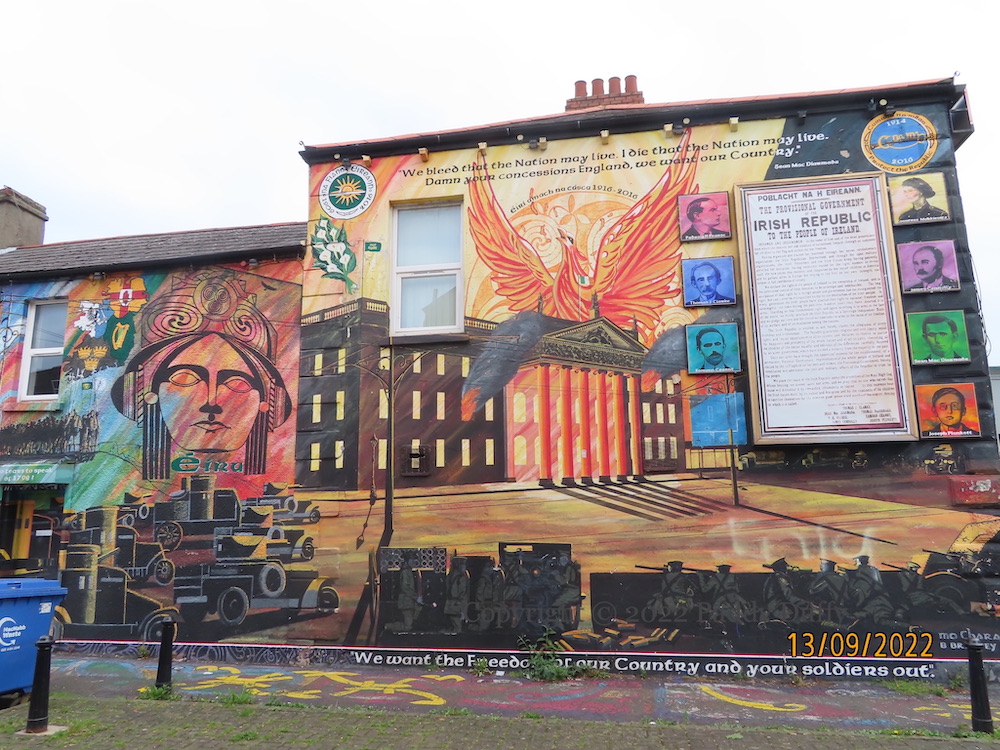
Arrayed against the forces of the British Army (which are shown in armoured cars and in sniping positions in the foreground of the mural, along the whole length of the wall) are various symbols of Irish nationalism: Oliver Sheppard‘s 1911 statue of Cú Chulaınn dying; the pikemen of the 1798 Rebellion (featured yesterday: Éırí Amach 1798); the four provinces of Ireland; Érıu the mythological queen of Ireland/Éıre as designed by Richard J King/Rísteard Ó Cíonga; Easter lilies; the emblems of Na Fıanna Éıreann and Cumann Na mBan on either side of a quote from (The Mainspring) Sean MacDiarmada “We bleed that the nation may live; I die that the nation may live. Damn your concessions, England: we want our country”; a phoenix rising from the flames of the burning Dublin GPO (inspired by Norman Teeling’s 1998 painting The GPO Burns In Dublin); the GPO flying an ‘Irish Republic’ flag; portraits of signatories and other rebels — (left) Padraig H. Pearse, Thomas J Clarke, Eamonn Ceannt, Thomas MacDonagh, (right) Countess Markievicz, James Connolly, Sean MacDiarmada, Thomas Plunkett; the declaration of independence, placed over the advertising box of AA Accountants – see the in-progress shot below. For more work-in-progess images, see yesterday’s post, Éırí Amach 1798. At the very bottom is a quote from the mother of Gerard ‘Mo Chara’ Kelly, Harriet Kelly: “We want the freedom of our country and your soldiers out.”
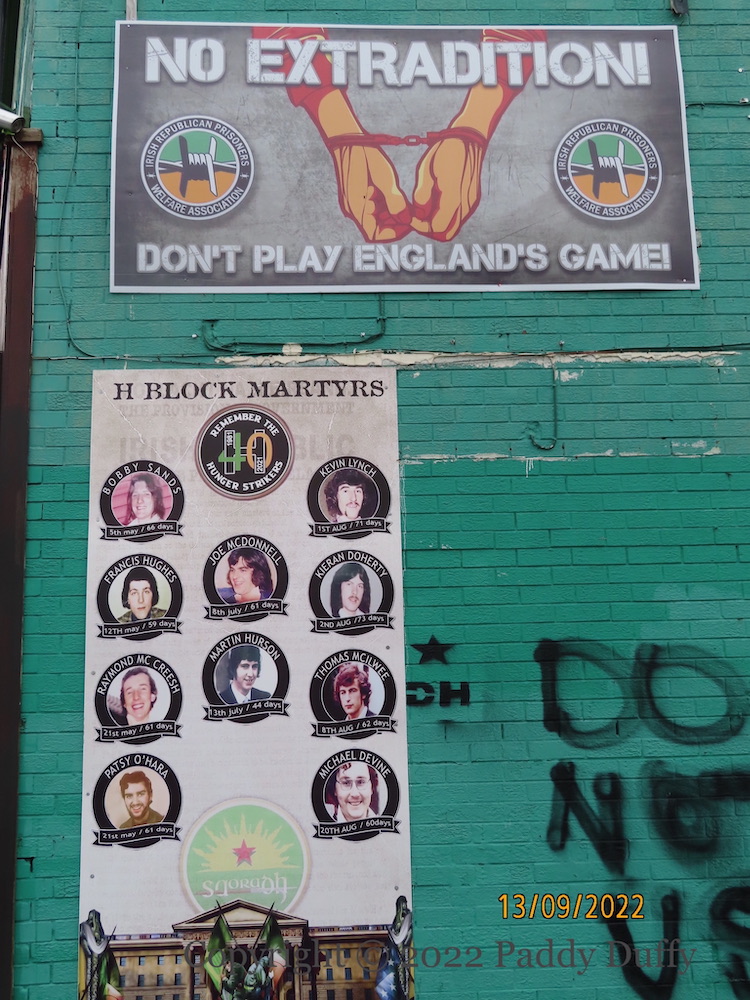
“No extradition! Don’t play England’s game” – after years of legal wrangling, Liam Campbell was extradited to Lithuania on charges of procuring weapons for the Real IRA (BBC | Saoradh). See previously: Silence Is Complicity. Cıarán Maguire was handed over to the PSNI by Gardaí in April 2021 (Donegal Daily).
Braemar Street, west Belfast, with a 40th anniversary hunger strike board below.
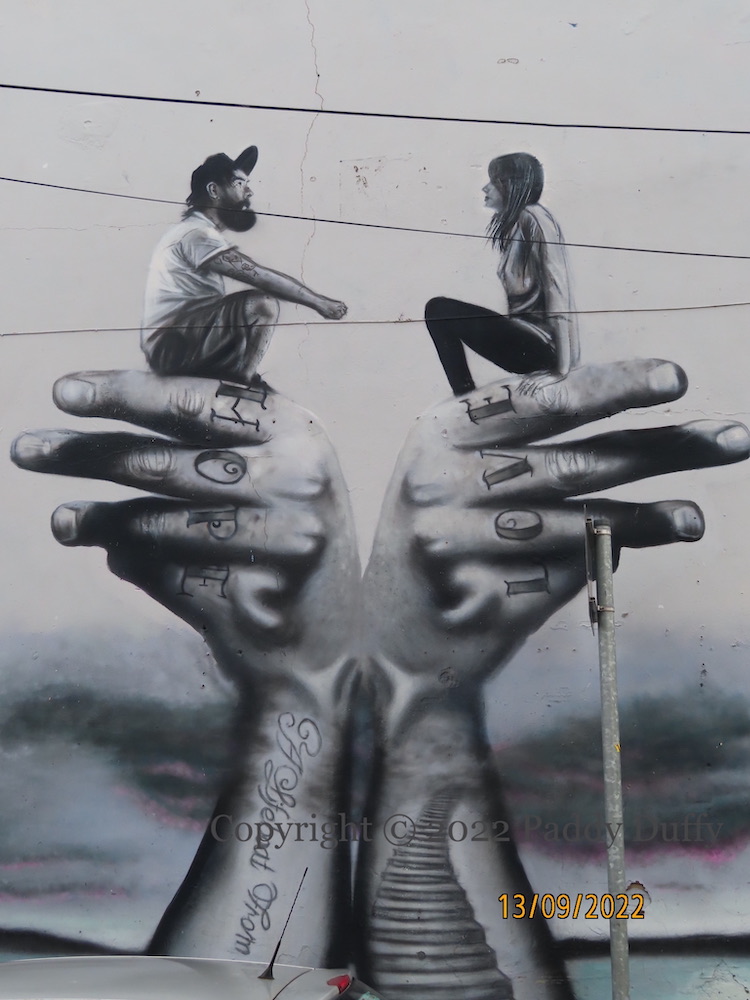
emic (Eoin McGinn Fb | Web |Tw) has been at work on the Falls Road painting a mural for the Suicide Awareness & Support Group. Two figures face each other, seated on the index fingers of hands tattooed with “hope” and “love”.
“Don’t join the PSNI” – This Lasaır Dhearg board takes the “poster officer” from the 2021 recruitment campaign and puts them against a backdrop of riot officers firing plastic bullets. “17 people have been killed by plastic bullets, including 8 children.” “It is believed that the PSNI retain a stockpile of over 50,000 deadly plastic bullets.” The British state does not use plastic bullets anywhere but occupied Ireland.” “The PSNI is not a normal police force.” Here is the 2021 Amnesty report on the use of water cannon and “Attenuating Energy Projectiles” in the north. In November, relatives of Carol Ann Kelly went to Stormont to call for an end to the use of plastic bullets (BelTel).
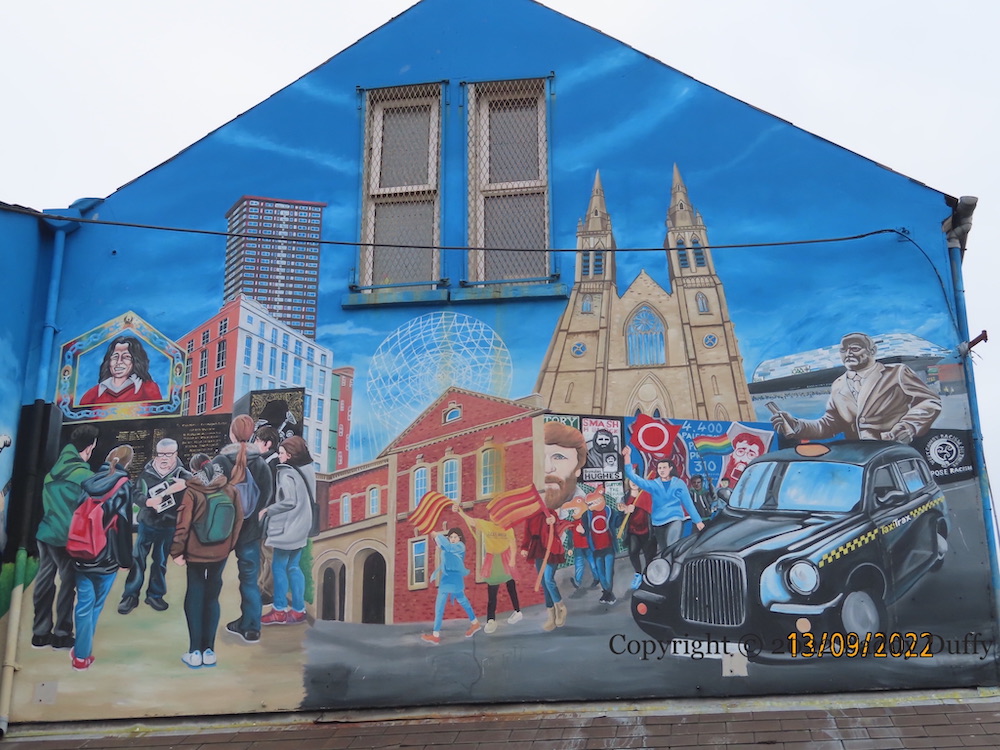
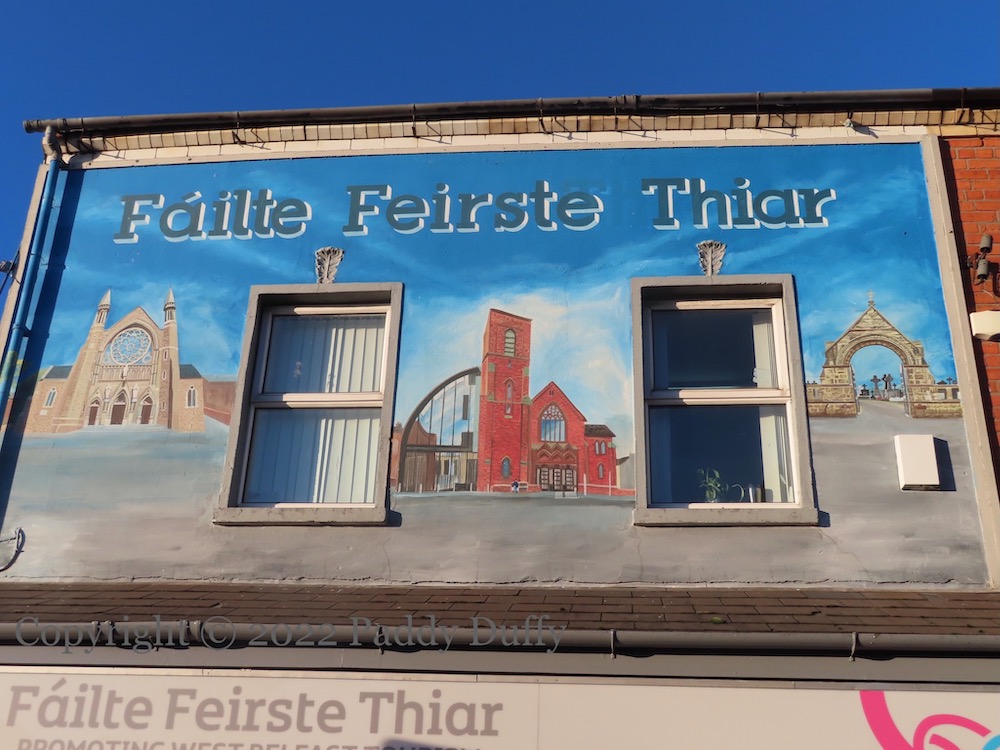
“Welcome to West Belfast.” The sights of nationalist west Belfast are depicted in (part of) a new mural by Mickey Doherty and Marty Lyons on the side wall of the tourist office. From left to right: The (2015) Bobby Sands mural in Sevastopol Street, tourists being introduced to the IRA D Company memorial garden on the lower Falls by Peadar Whelan, Conway Mill, Divis tower, RISE at the bottom of Broadway (better known as the “Balls on the Falls”), the Falls library, the “international wall” in 2012 (with marchers in support of a nondescript international cause, crocodiles for the Irish language, and gay rights), St Peter’s pro-cathedral, a black taxi, the Connolly statue outside Comhaırle Phobaıl an bhFál, and the model for the new Casement Park stadium.
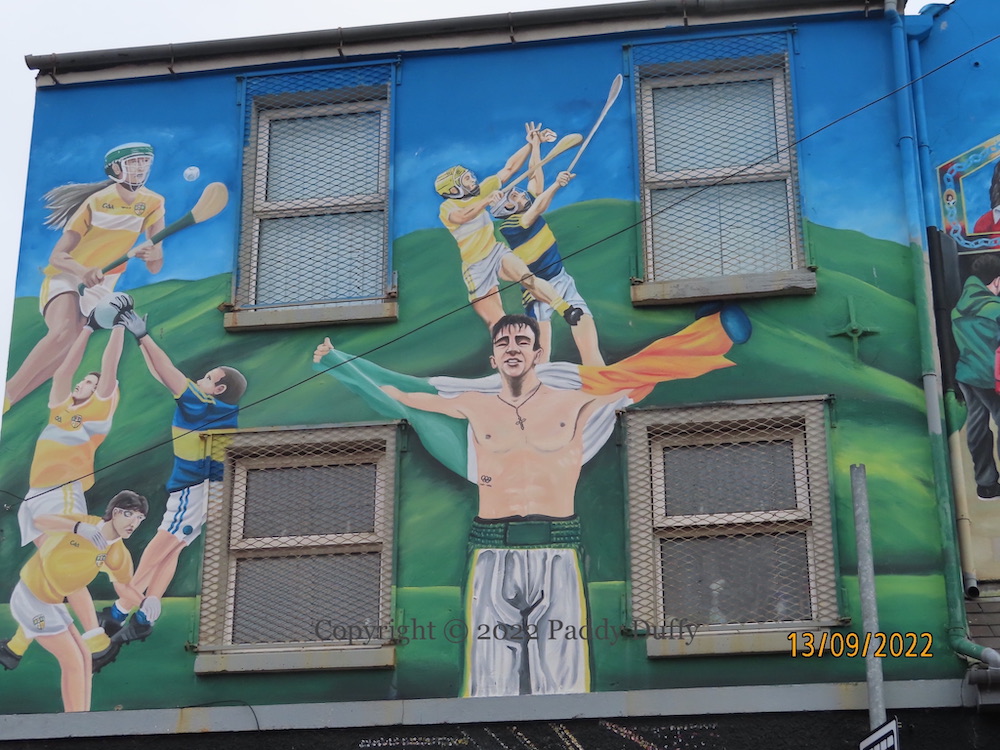
Below: Michael Conlan (tw | ig) won his first title and tenth professional bout on Saturday night (December 22nd), in Manchester, by defeating Englishman Jason Cunningham (BBC). He is featured here alongside the traditional Gaelic games of hurling, camogie, football, and handball.


 Paddy Duffy Collection