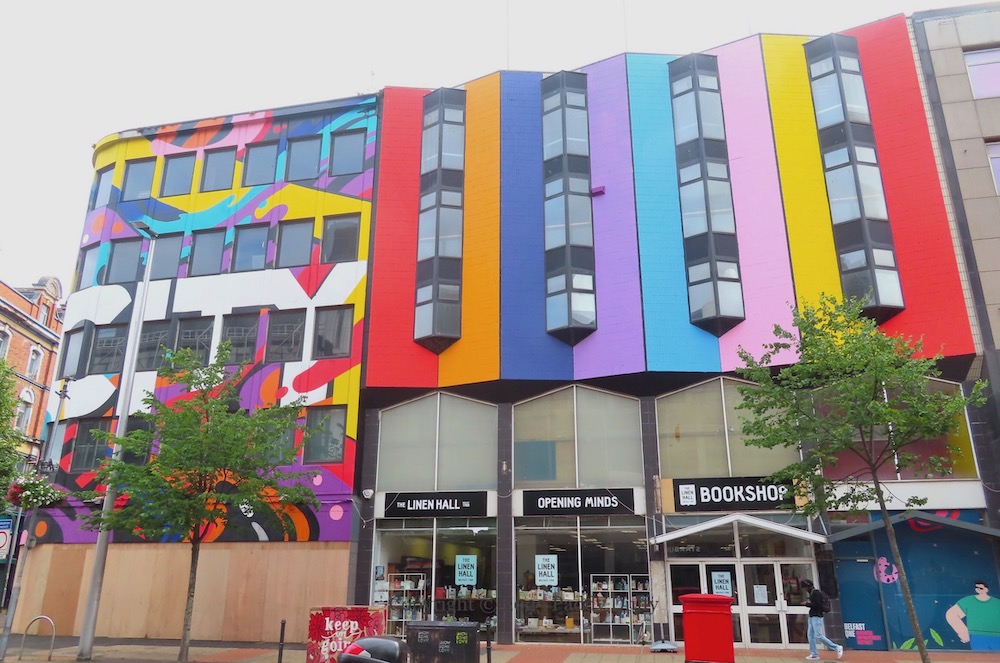
The growth-stages of the flax plant, from seedling to flower are illustrated from right to left on four unused shop-fronts along Linenhall Street, Belfast (next to the British Heart Foundation mural).
The official title of the piece, painted by Visual Waste (web) and sponsored by the Linen Quarter BID (web) is “Seeding Success”. After flowering, the plant produces fruit/capsules which contain seeds (WP image).
These are images of a “legal” spray-paint wall, in Little Patrick Street. The wall was launched on July 4th (Belfast City Council) with FGB (web) from Seedhead Arts on hand to welcome those who braved the rain (including Codo (ig), Feoiliteach (ig), and Dash (ig)).
One writer got there a day earlier, however, to claim “FIRST” and note that “great minds think alike, apparently!!!” – perhaps meaning that the wall is generally covered with tags and writing, and might well return to that state. The comments to posts by Seedhead Arts (ig) and Belfast City Council (ig) contain some reaction from writers to the claims that the wall is the first legal wall and that is might “help deter graffiti and tagging”. An Instagram account has been set up for the wall and any other legal walls that are so designated.
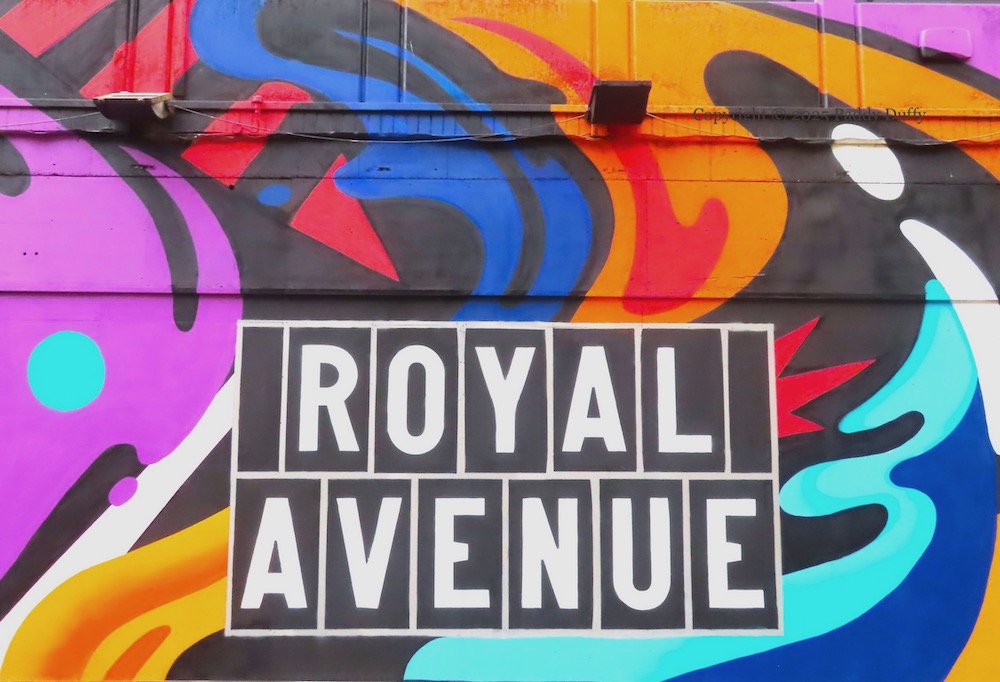
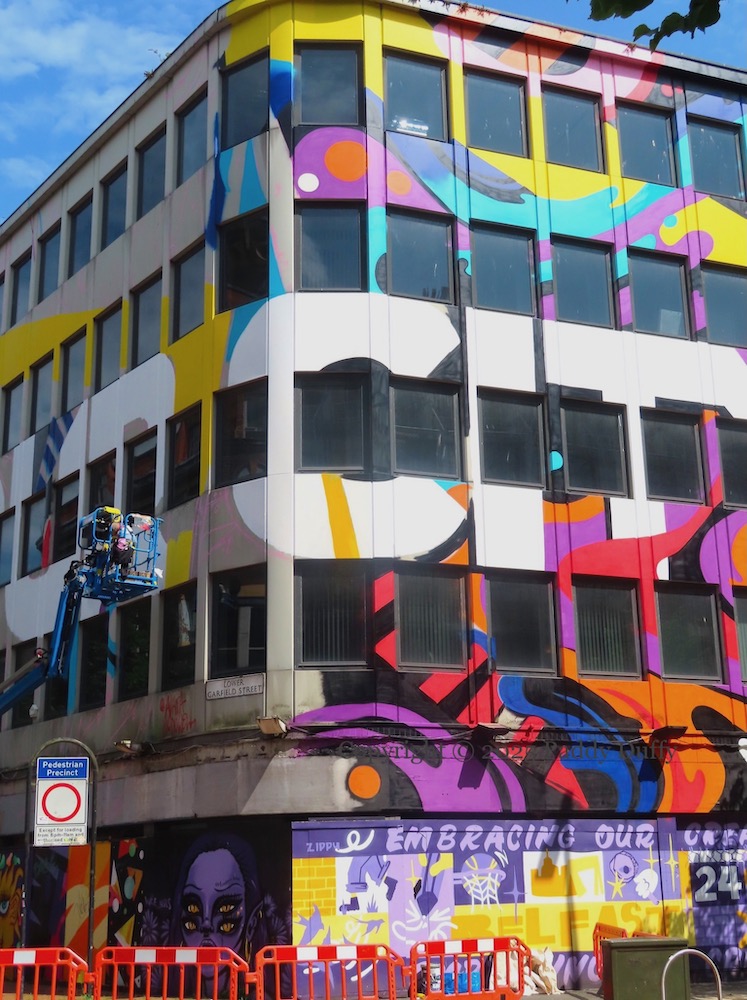
Leicester House (Future Belfast), at the junction of Royal Avenue and Lower Garfield Street, and the adjacent Hampden House (Future Belfast), on Royal Avenue. Both buildings (51-63 Royal Avenue) are vacant (the Leicester since 2016) and are part of the long-awaited Tribeca redevelopment – see 2019’s To Be Continued. In the meantime, the façades of the buildings have been given a facelift by Alana McDowell (ig). Below are three in-progress shots from June 20th.
Here are only three of many painted utility boxes that have been recently painted as part of the on-going Belfast Canvas project, begun in 2020.
These three pieces are … ‘Hang In There’ by CG Chimp (Chaingun on ig) on the Holywood Road in east Belfast, ‘I (Heart) Pool!’ by PaperSleeve/Niamh McWilliams (web) on Donegall Road in south Belfast, and an abstract piece by Bláthnaıd Ní hAogáın (ig) in University Square, Belfast city centre.
For about 140 painted boxes, from the Belfast Canvas project and otherwise, see the Visual History page for the boxes.
This is new street art by Friz (web) and KVLR (web) and Rob Hilken (web) in Bank Square, presenting a contemporary take on the Belfast coat of arms – the original can be seen in this City Council page.
Belfast became a city in 1888 and from that time onward the sea-horse on the right – both officially and in the new piece – wears around its neck a “mural crown”, a crown that looks like the walls of a city.
The wolf in the official coat of arms is “gorged and chained”. In the new art, the only sign of the wolf’s chain is the metal zipper slider on its tracksuit.
(An 1892 book (archive.org) claims that the chained wolf, while itself a familiar image in heraldry and civic arms, is borrowed specifically from the Chichester coat of arms in tribute to Arthur Chichester, prosecutor of the Nine Years’ War against the O’Neills in Ulster and subsequently Lord Deputy Of Ireland and developer of the village of Belfast into a town (DIB | WP), but we can find no other source to this effect nor any image of the Chichester arms that includes supporters.)
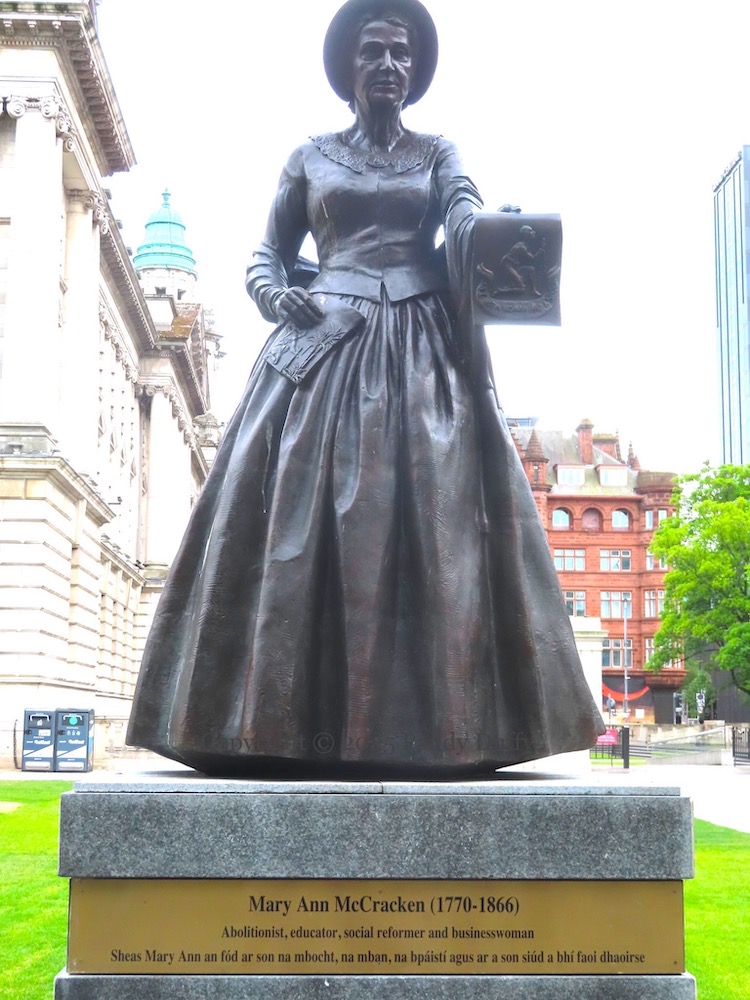
“Mary Ann McCracken (1770-1866) Abolitionist, educator, social reformer and businesswoman. Sheas Mary Ann an fód ar son na mbocht, na mban, na bpáıstí agus ar son sıúd a bhí faoı dhaoırse. [Mary Ann stood up for the poor, women, children, and for those who were enslaved.]”
“Mary Ann McCracken’s feminist ideals and commitment to the principles of Equality, Liberty, Fraternity applying equally to the Rights of Woman defined her participation in the United Irish Movement.” For McCracken’s connection to the 1798 Rebellion, see These Are Times That Try Men’s Souls.
The statue was unveiled in the grounds of Belfast City hall together with a statue to Winifred Carney on International Women’s Day (March 8th) 2024; both statues were produced by Ralf and Naomi Sander (BCC).
A statue to Winifred Carney was unveiled, along with another to Mary Ann McCracken, in the grounds of Belfast City Hall on Friday, March 8th (BCC). At her left hand is a typewriter. Carney was a qualified secretary and typist, and became secretary of the Irish Textile Workers’ Union in 1912, in which position she met James Connolly, who was secretary of the Belfast branch of the ITGWU. The 1913 manifesto addressed ‘To The Linen Slaves Of Belfast’ (marxists.org), exhorting “our toiling sisters” in the mills to join the organisation, was signed by Carney, Connolly, and Ellen Gordon.
Her uniform, and the amorphous pistol (or holster?) in her right hand, refer to her membership of Cumann Na mBan and participation in the Easter Rising of 1916. Carney was in the GPO when it was taken over and was among those who surrendered at the end; during the occupation she typed up dispatches from the Moore Street headquarters. A News Letter editorial described the statue as smuggling terrorists onto the grounds of city hall.
“Winifred Carney, born in Bangor, was a suffragist and a committed trade unionist. She was an organiser in the Irish Textile Workers’ Union and became James Connolly’s personal secretary, political confidante and friend. In 1913, She and Connolly wrote the Irish Textile Workers’ Union manifesto entitled ‘To the Linen Slaves of Belfast’. It was a time when Belfast workers, mostly women and children, were working long hours in horrific conditions, barefoot and hungry. “D’oıbrıgh Winnie ar son oıbrıthe Bhéal Feırste, go háırıthe ar son na mban agus na bpáıstí a bhíodh ag obaır sna muılte ar fud na cathrach. “Many Belfast mills are slaughterhouses for the women and penitentiaries for the children.” Chomh maıth leıs an obaır a rınne sí ar son na gceardchumann, ba Phoblachtánach í Winnie a bhí ına ball de Chumann na mBan agus d’Arm Cathartha na hÉıreann. As an officer in the Irish Citizen Army, Winnie was present with Connolly in the Dublin General Post Office during the 1916 Easter Rising and has since become known as ‘the typist with the Webley’. Carney stood as a Sınn Féın candidate in the 1918 elections, but in an ‘unwinnable’ seat. She retained her commitment to socialism and in 1924, Winifred joined the Northern Ireland Labour Party. Here she met her future husband, George McBride, like her a committed socialist. George was a Protestant from Shankill Road who fought at The Battle of the Somme with the 36th (Ulster) Division. Tá Winnie curtha ı Reılıg Bhaıle an Mhuılınn ar Bhóthar na bhFál ın ıarthar Bhéal Feırste.”
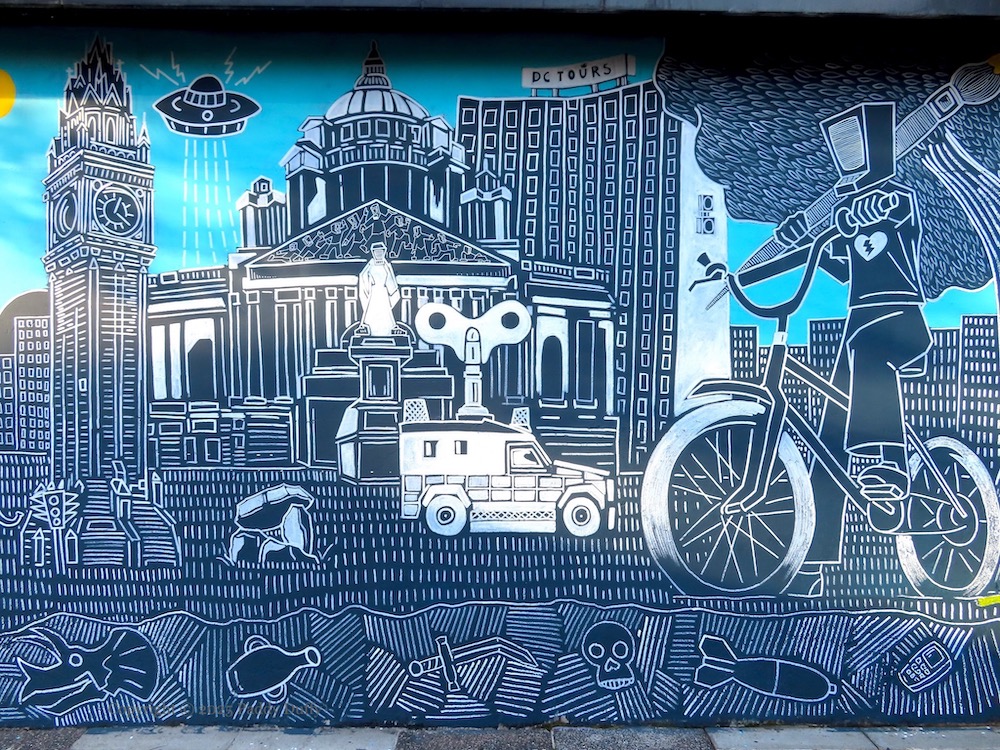
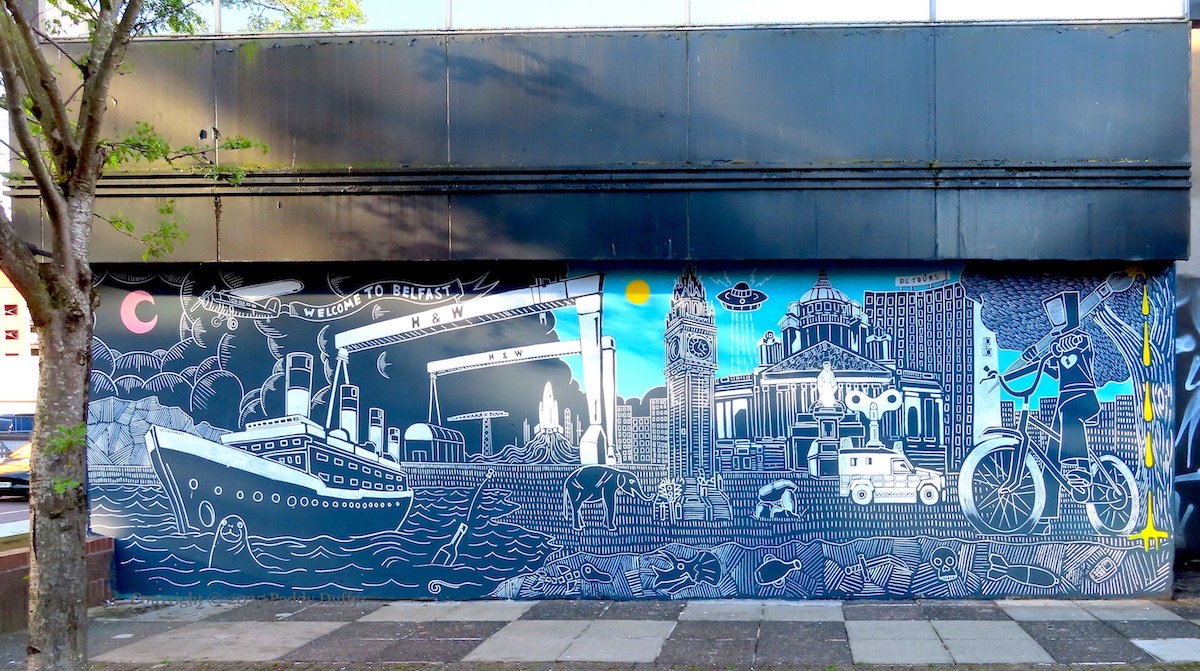
This is the new piece by Leo Boyd (web) for DC Tours, replacing Belfast Romances on Great Victoria Street. It is full of Belfast icons – Titanic, Sammy the seal, Samson & Goliath, Shiela the elephant, the Albert Clock, city hall, the Europa hotel – as well as some familiar Boydisms such as the wind-up police land-rover and the paintbrush cyclist who is responsible for the pink moon and the yellow sun.