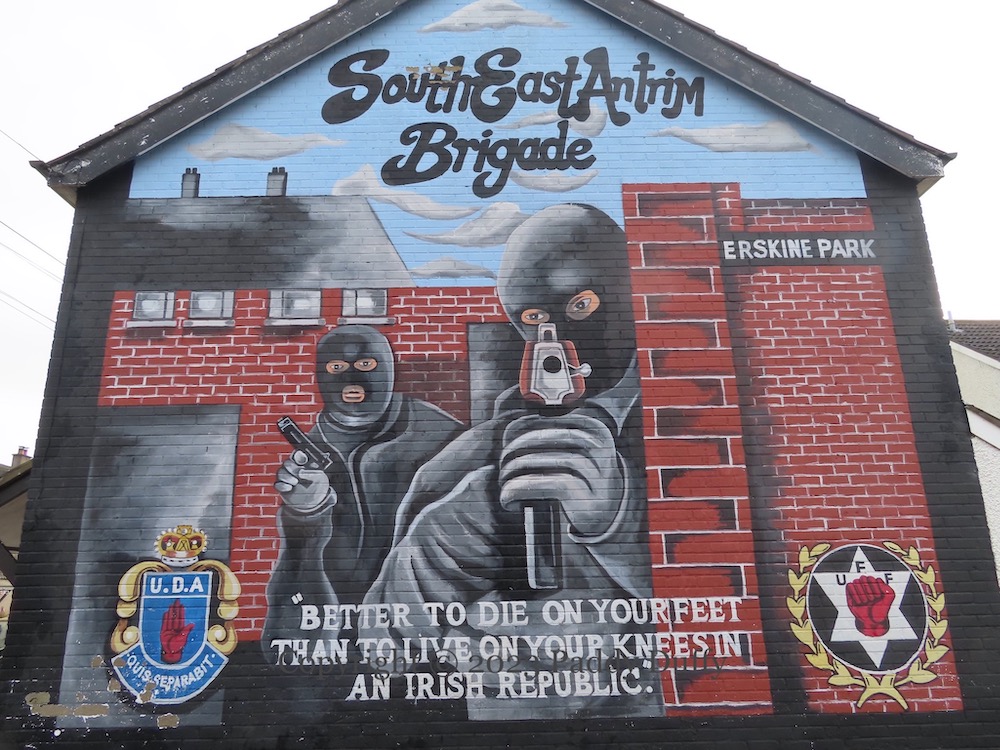
UDA volunteers in balaclavas stand ready to defend Erskine Park (Ballyclare) against forces (from the south? from Britain?) that would implement ‘home rule’ in (north-east) Ireland.
“South East Antrim Brigade – “Better to die on your feet than to live on your knees in an Irish republic.” (A slogan from Mexican revolutionary Emiliano Zapata.)
“The UDA formed in 1971 as an umbrella for Loyalist Vigilante groups being formed. There [sic] role to defend the Protestant community from IRA violence. They remain today. Ask yourself this question: When the battle has been finally won, will I be able to stand and be counted amongst the men won it? Make sure the answer is yes – join your local unit of the UDA. Your country needs you.” This is an addition to the panels shown in Show No Mercy, Expect None Back.
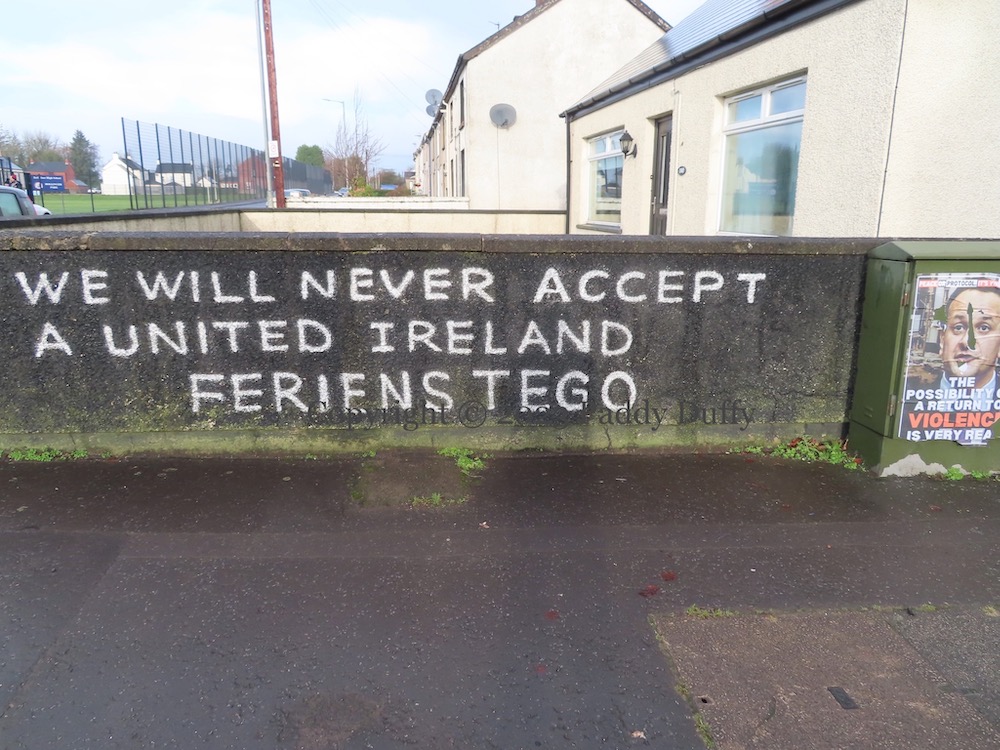
And (on the other side of the street) the tarp is an addition to ‘We Will Never Accept A United Ireland’. “We remember our culture, from the siege of Derry to the battle of the Boyne. ‘No Surrender’.”
Ballyclare Comrades football club – whose motto is ‘Nihil nisi optimi’ [nothing but the best] – was founded in 1919 by members of the local Great War ‘comrades’ association. That heritage is used here for the Ballyclare Protestant Boys flute band. In the centre, between images from WWI, the flowers of the four ‘home nations’ are joined by orange lilies, and in the shield are the lion and the unicorn from the coat of arms of the UK.
“To Flanders fields some men in our town were sent and along their way many would repent their priority goal to keep Ulster free that we may have freedom both you and me as part of Great Britain they fought and died and their names we will remember and remember with pride. Lest we forget. Comrades from Ballyclare. Nihil nisi optimi. The Comrades.” “Ballyclare Protestant Boys Est. 2004”
“When Ulster men are proudly glad of the land where they were born/And when England’s cry for help was heard we told them have no fear/For across the flanders fields we send our Ulster Volunteers.”
These are just a few lines from the song First Of July Morn and are used here to recall how the Ulster Volunteers – formed to fight against the imposition of Home Rule – became the 36th Division in WWI, and suggest that the British government should continue to support the Northern Ireland state beyond its one-hundedth anniversary and the current impasse over the NI Protocol of Brexit as a reward for loyalty.
The song’s alternate titles “England’s Treachery” or “Englishman’s Betrayal” give a better feel for the attitude of the whole thing: that England betrayed Ulster by having “sold away” the three counties of Donegal, Cavan, and Monaghan, and that “Ulster men” should “never more be led away, to fight in foreign lands/Not to die, for someone else’s cause, at an Englishman’s command” (youtube). The application to the current situation would then be that loyalism cannot rely on the good nature of the English and should ready itself for “perfidious Albion” to (try to) give away the six counties as well.
“Ballyclare says no to a Irish Sea border.” “Loyalist Ballyclare will never accept an border in the Irish Sea.” “The Belfast Agreement has been broken – the deal’s off.”
Ballynure Rd/Main Street, Ballyclare, next to The Comrades.
Side by side in Erskine Park, Ballyclare: a memorial to the 36th (Ulster) Division of the World War of 1914-1918 and “Thank you NHS and all key workers” of the global pandemic, 2020-2023.
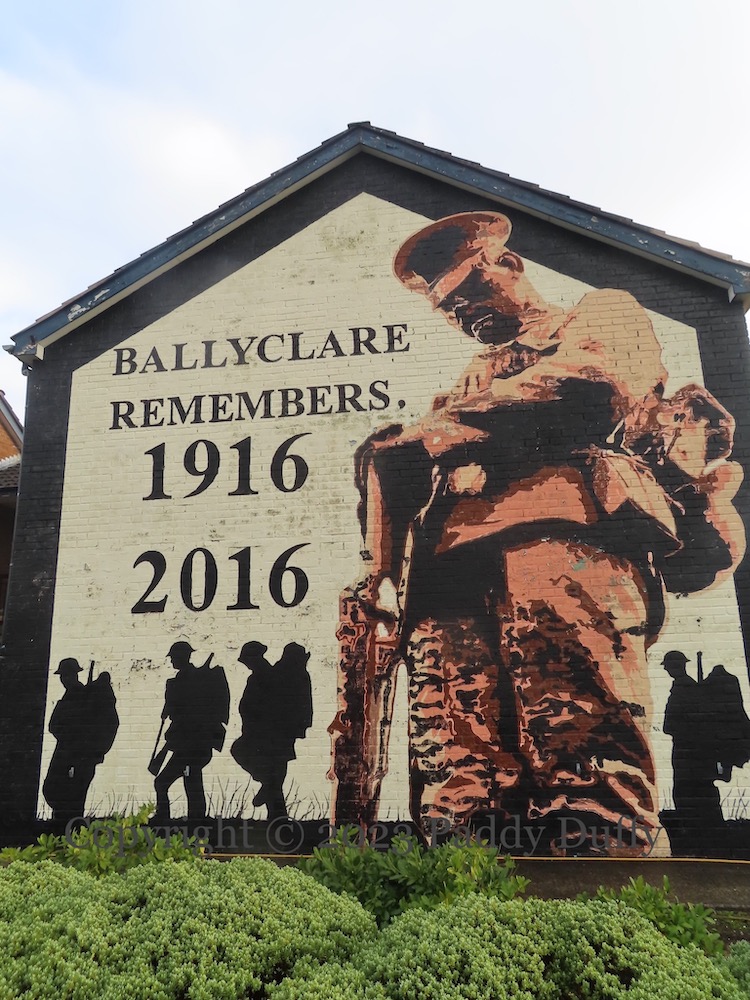
This is a UVF/YCV mural in Grange Drive, Ballyclare, celebrating and commemorating soldiers from the Ulster Volunteers who went on to serve in the 36th (Ulster) Division in WWI and in particular at the Somme. The central panel shows soldiers bearing the Division’s standard (painted in colour in an otherwise black-and-white mural and in the style of the (US) Marines ‘Iwo Jima’ Memorial (WP)) which comprises the Union flag, harp insignia of the Royal Irish Rifles, and the red hand of Ulster on a field of shamrocks.
The other panels show uniforms of the Ulster Volunteers, a Protestant woman defending the fields, soldiers going over the top, and soldiers bowed at a UVF memorial.
Also included, below, is an ‘over the top’ image from a substation at the very top of the estate.
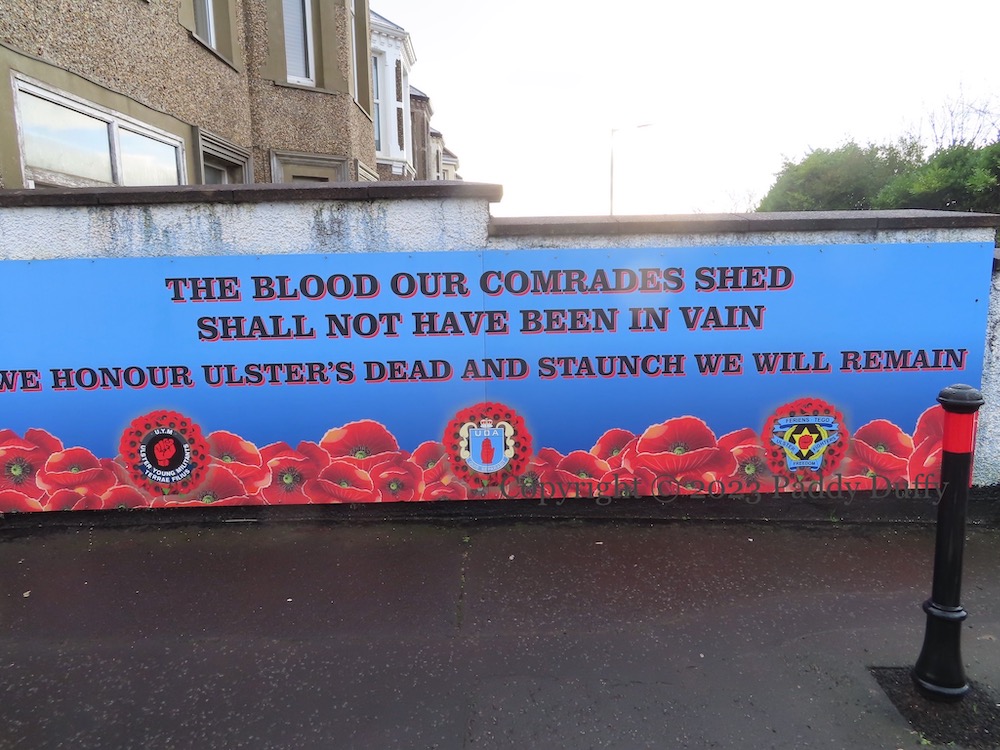
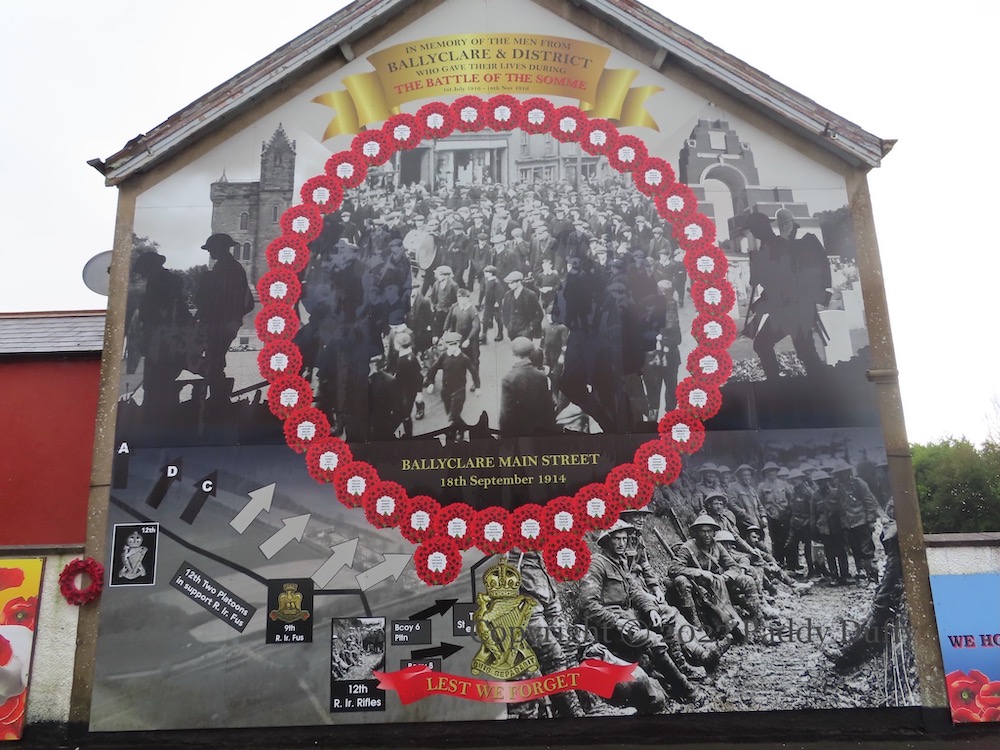
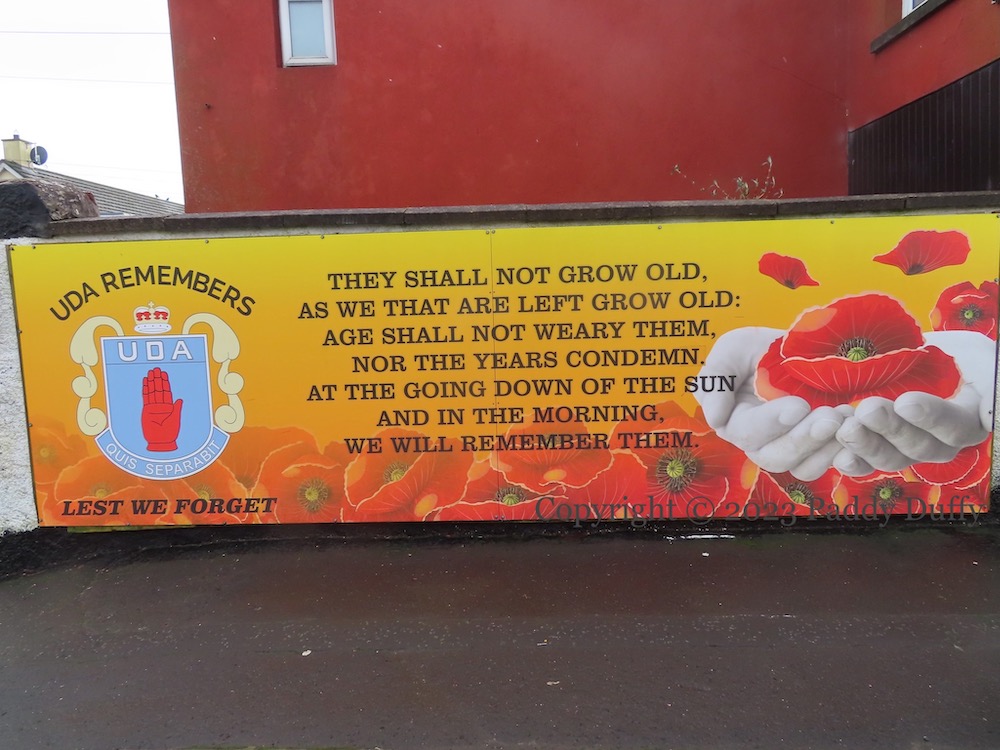
This is an update to the WWI ‘Ballyclare & District’ mural in Charles Drive. Originally, in 2016 there was ‘South East Antrim’ lettering on the side-wall to the right; in 2019 the orange board with words from Binyon’s For The Fallen (shown last below) was added to the left; on the right now is the board shown above: “The blood of our comrades shed/Shall not have been in vain/We honour Ulster’s dead/And staunch we will remain.” The same lines were used in Ballymoney and in Cloughfern.
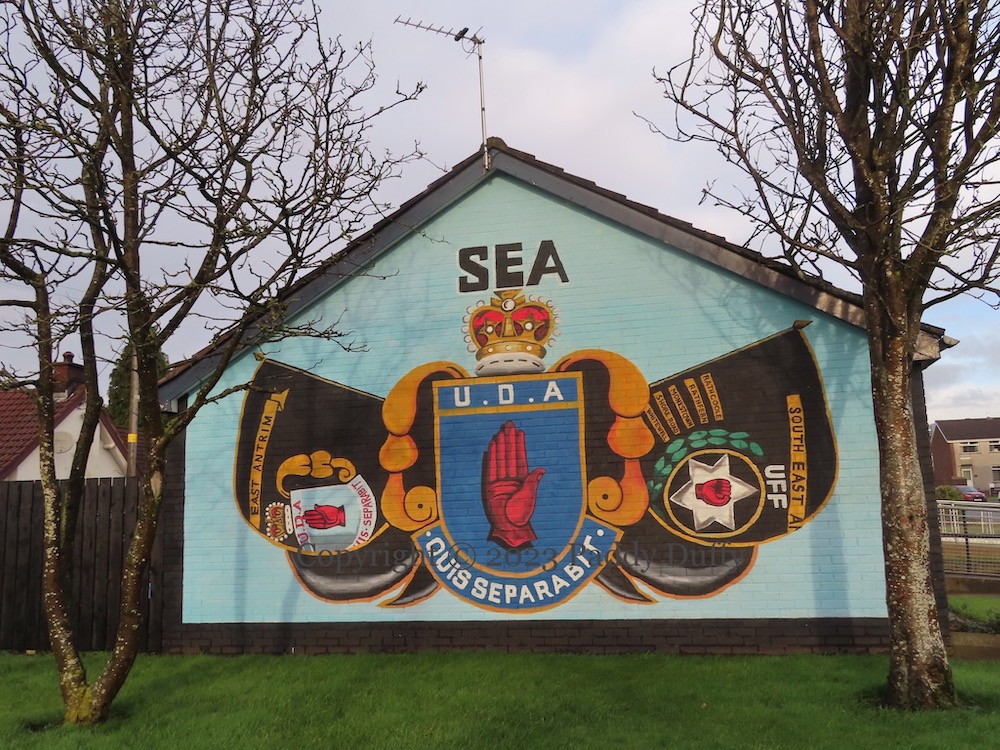
An explicitly UDA mural returns to the Grange estate (Ballyclare); the previous Young Guns board fell down. Two men were imprisoned in October (2022) (Belfast Live) and November (4NI), the former from the estate, in connection with investigations into the Ballyclare UDA in February, 2021. Two others were arrested in Larne and Ballyclare in September (BelTel).
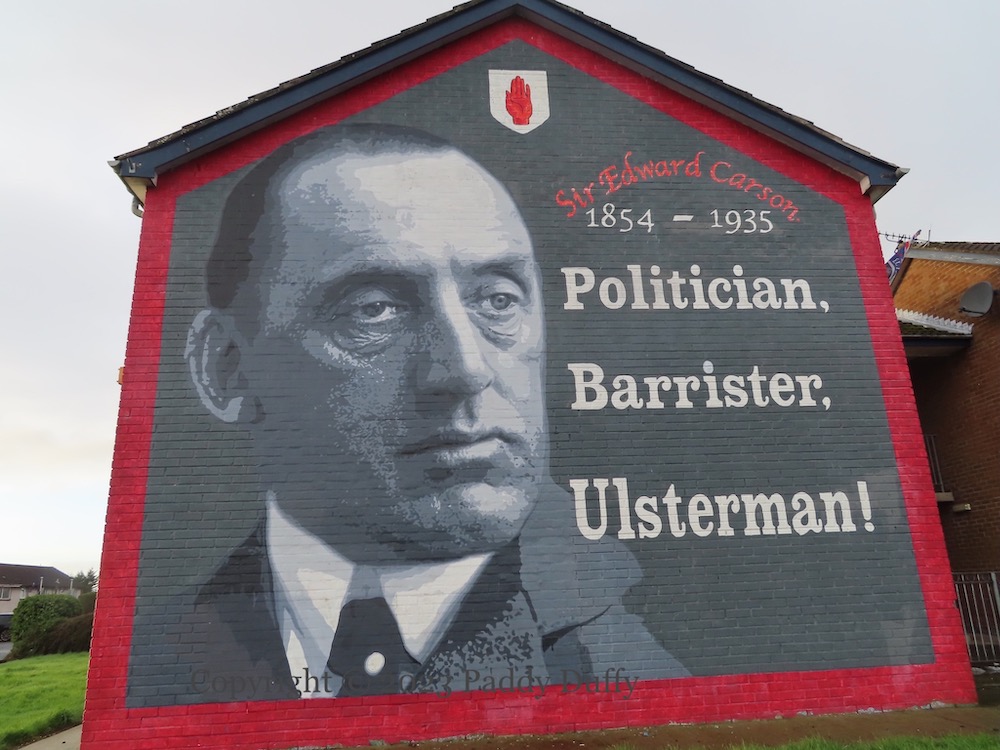
Sir Edward Carson, 1854-1935, was born and raised in Dublin, and practiced law there for many years, but he is most famously associated with the Unionist campaign against Home Rule and the creation of “a Protestant province of Ulster” and eventually the six-county state of Northern Ireland.




 Paddy Duffy Collection