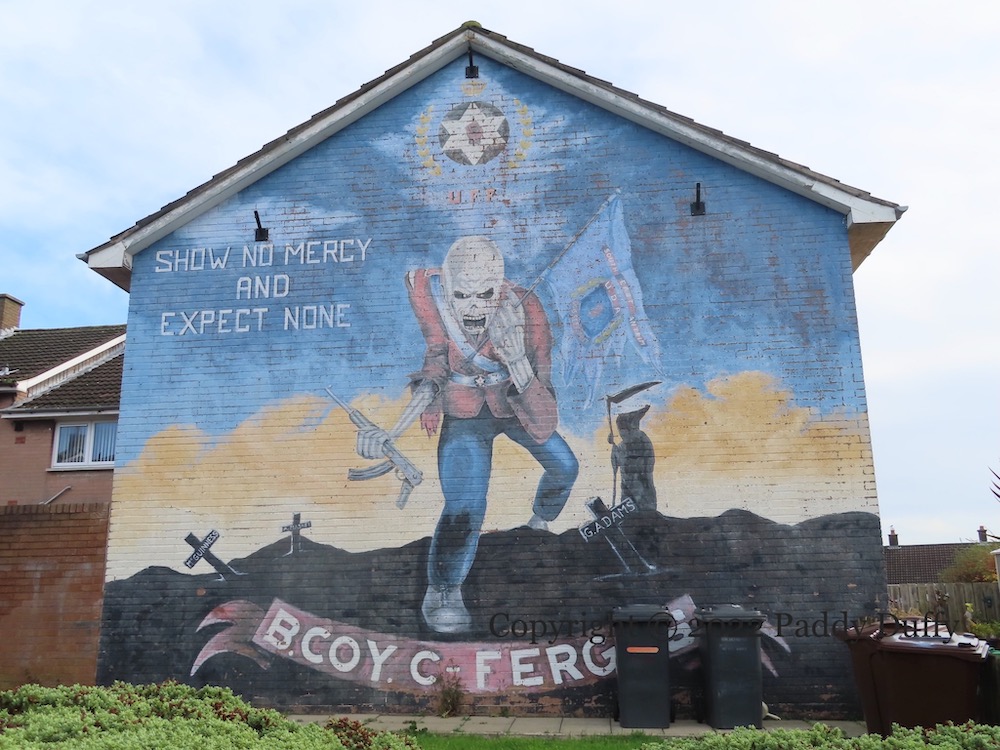
“Show no mercy and expect none”. Iron Maiden’s Eddie the trooper, armed with an assault rifle and carrying a UDA flag, leads the grim reaper over the graves of “G. Adams”, “McGuinness” and “A. Maskey”. UDA/UFF mural in Castlemara, Carrickfergus.
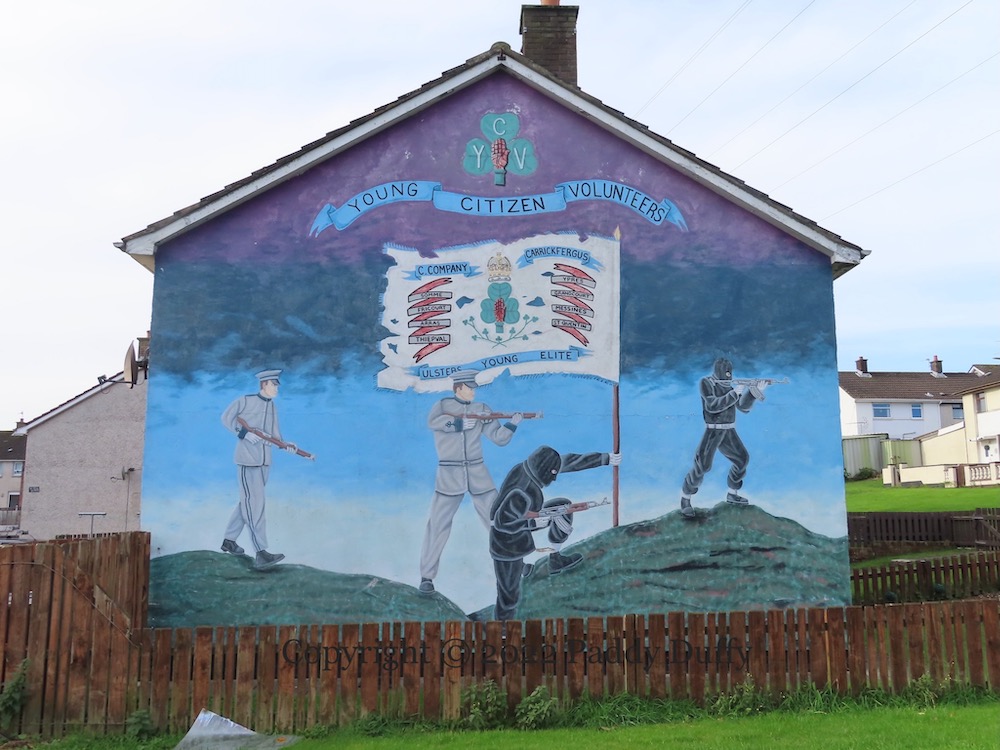
The Young Citizen Volunteers of 1912 eventually joined the Ulster Volunteers (in 1914) as the 14th battalion of the Royal Irish Rifles and part of the 36th (Ulster) Division (WP). In 1972 the name was resurrected for use as the youth wing of the UVF (WP). In the wide shot, below, this history is presented as a continuous movement from left to right; a modern-day hooded gunman climbs out of a WWI trench with one hand on a YCV flag.
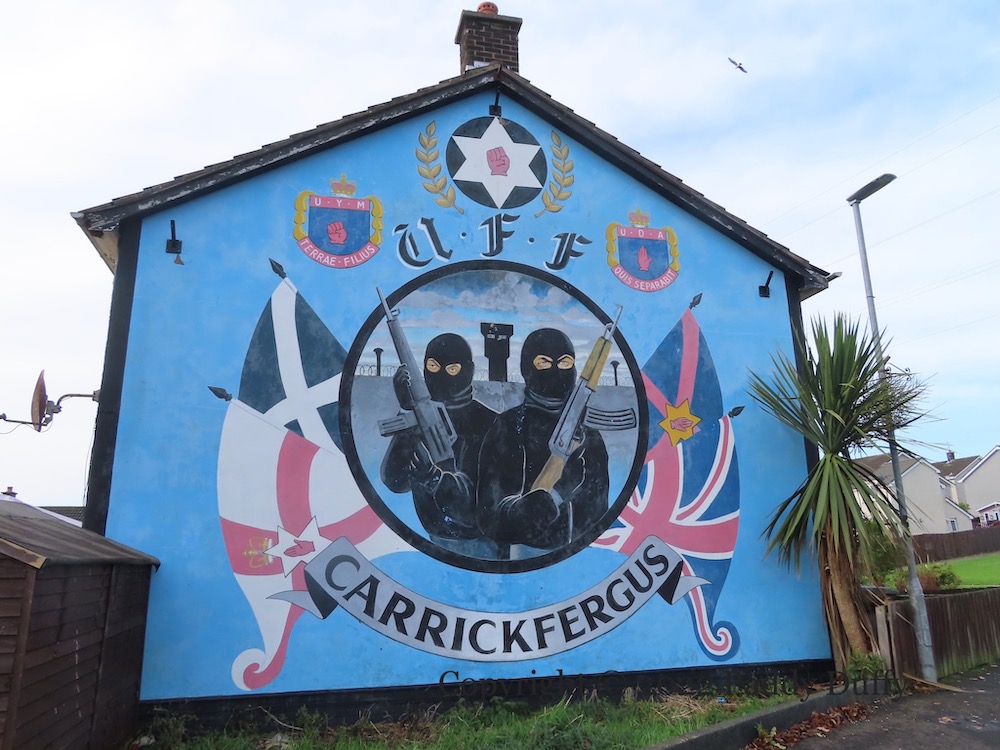
The upper flag on the right-hand side of this mural – purple saltire on a blue background with star and red hand – is the proposed flag of Ulster nationalists. The position was espoused by the UDA of the 1970s, under the guise of the political parties the Ulster Loyalist Democratic Party and the Ulster Democratic Party, and for a time by the Red Hand Commandos under the Ulster Loyalist Central Coordinating Committee.
For the previous (identical) version, see UFF Carrickfergus in the Peter Moloney collection.
William III, statholder of Holland, landed at Torbay, England, in November, 1688 with 250+ ships and 30,000 men in order to overthrow the Catholic convert James II who had become king in 1685. As he came ashore he proclaimed “the liberties of England and the Protestant religion I will maintain.” As king of England, William was automatically made king of Ireland, but he and his forces had to go to Ireland to win the island from James and the forces loyal to him. Schomberg had already successfully besieged Carrickfergus in 1689 when William landed in June 1690.
The mural reproduces the illustration from a postcard.
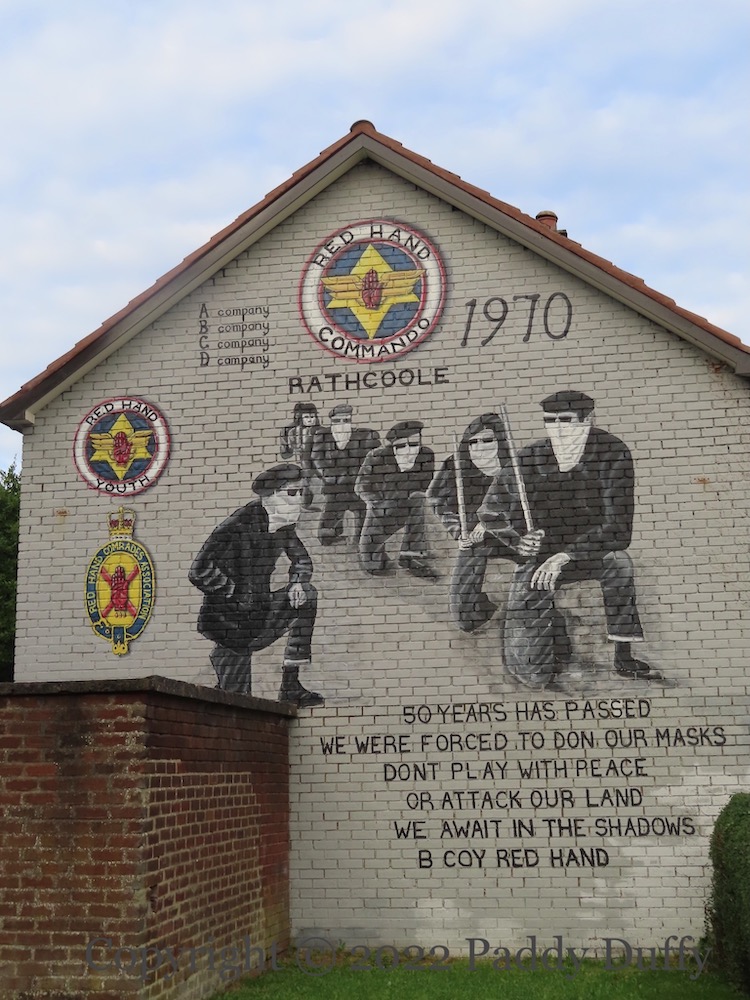
Ten years after ending its armed campaign, the Red Hand Commando in 2017 applied to be de-proscribed, on the basis that it had given up its arms in 2009 and transformed itself into an ‘old comrades association’ (see the emblem in the bottom left of the wide shot) (BBC | NewsLetter). According to this mural, however, B company is ready to reform in response to those who “play with peace”, fifty years later (or so – the mural claims the group was founded in 1970; other sources give 1972 (WP cites Peter Taylor).
“50 years has passed/We were forced to don our masks/Don’t play with peace/Or attack our land/We await in the shadows/B Coy Red Hand”
The lobster street art by Glasgow-based SMUG (ig) is unfortunately being impinged upon by lights, fencing, and a shed belonging to the Ulster Sports Club.
This is and old (2009) repaint of the mural in the Markets to IRA volunteers: They are: Tony Nolan, Joseph Downey, Frank Fitzsimons, Joey Surgenor, Paul Marlowe, Jim Templeton, and Brendan Davison.
One of the first casualties of the Easter Rising, on the evening of Good Friday, was Belfast-born Charles Monahan (Charlie Monahan, Cathal Ó Monacháın/Ó Muıneacháın), who died along with Con Keating and Daniel Sheehan in a motor accident in Kerry, when their car – which only had one headlamp – was driven off a pier. His body was not found until October 30th. The driver, Tommy McInerney – shown here studying a map – survived. This mural is in the Markets; Monahan is also claimed by east Belfast and a 2006 mural to him was painted on Mountpottinger Road (Visual History).
“Born in Riley[‘s] Place in the Market area of Belfast, Charles was one of many people who left Belfast to take part in the events leading up to the Easter Rising. Charles[‘s] role was to meet up with 3 other vols and help guide Roger Casement (top left) land a ship full of weapons. On the 21st April, 1916, the driver took the wrong road and drove off the pier into the Laune at Ballykissane. Charles, 37, drowned along with two of his comrades.”
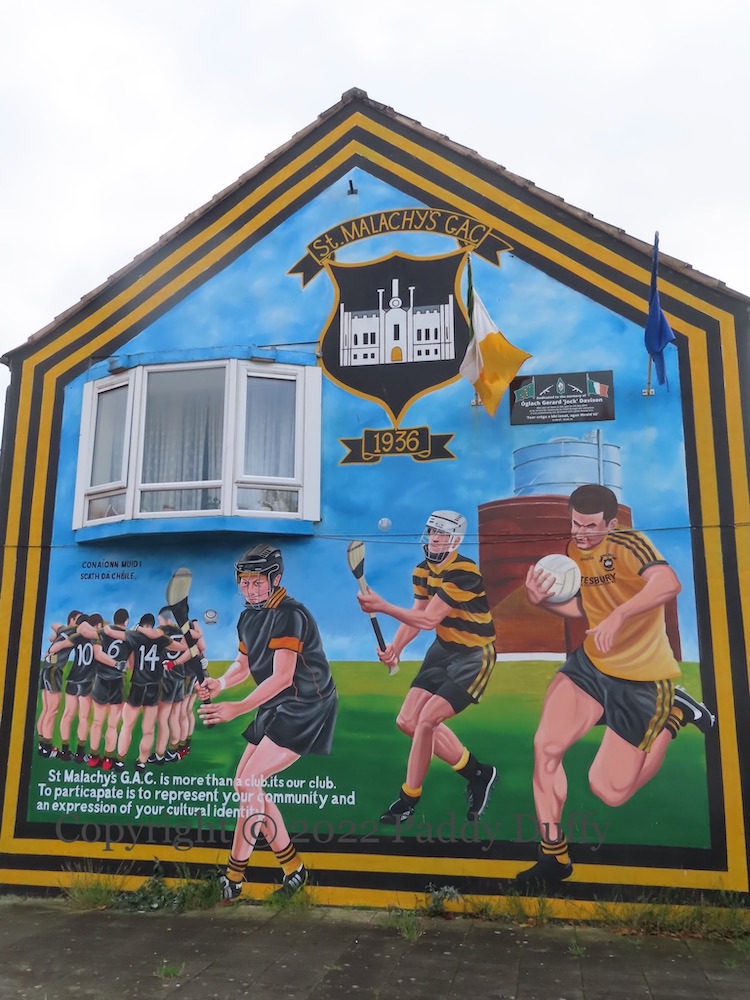
“Saint Malachy’s G.A.C. is more than a club. It’s our club. To participate is to represent your community and an expression of your cultural identity.”
This is the 2021 repaint of the mural celebrating Gaelic games in the parish of St. Malachy/Naomh Maolmhaodhóg, in the Markets area of Belfast. The parish church – featured in the top centre – has a celebrated fan-vaulted ceiling (WP). This mural, on the other hand, features a bay window.
“Conaíonn [Cónaíonn] muid ı scath dá chéıle” is a straightforward rendering of the epigrammatic “Ar scáth a cheıle a mhaıreann na daoıne”, which was included in the previous version – see Cultural Identity.