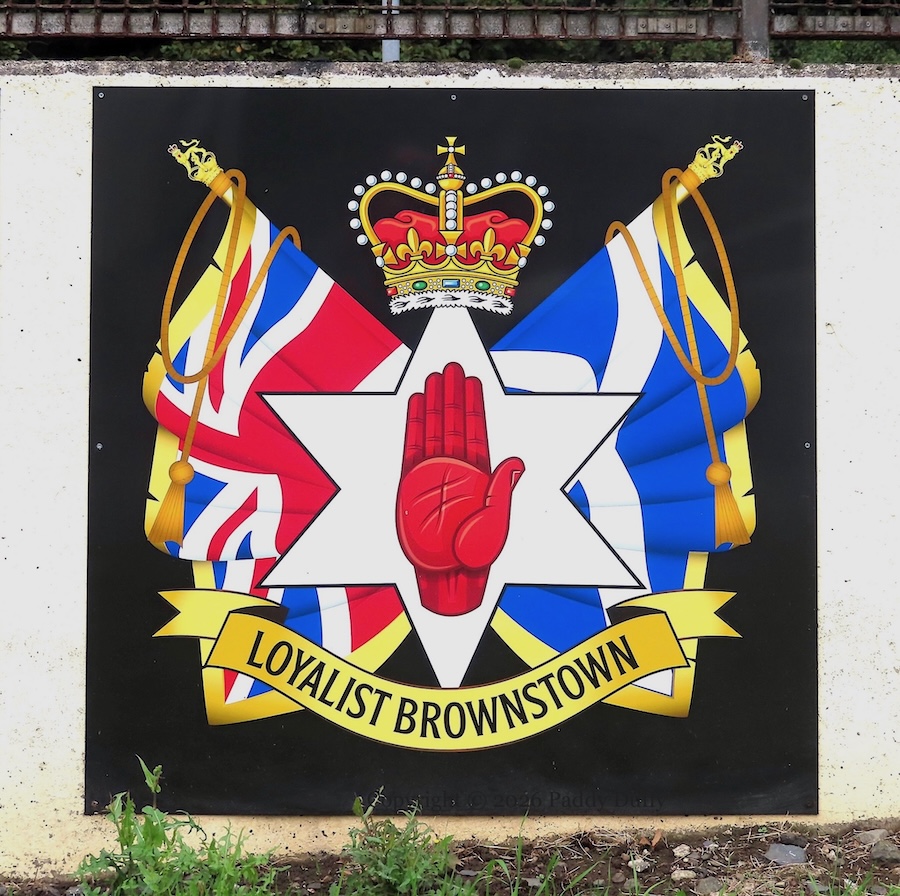
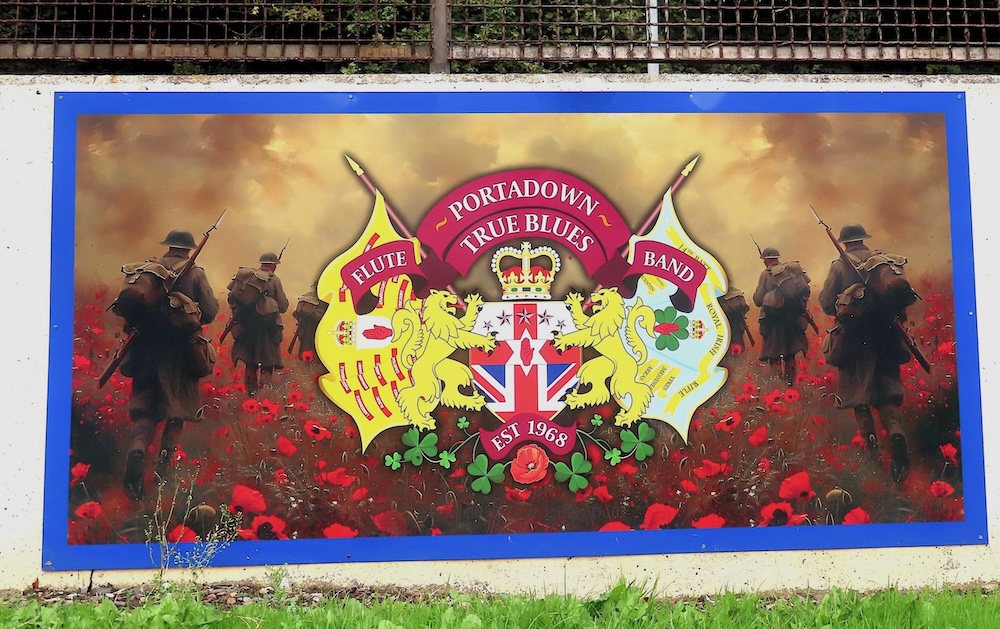
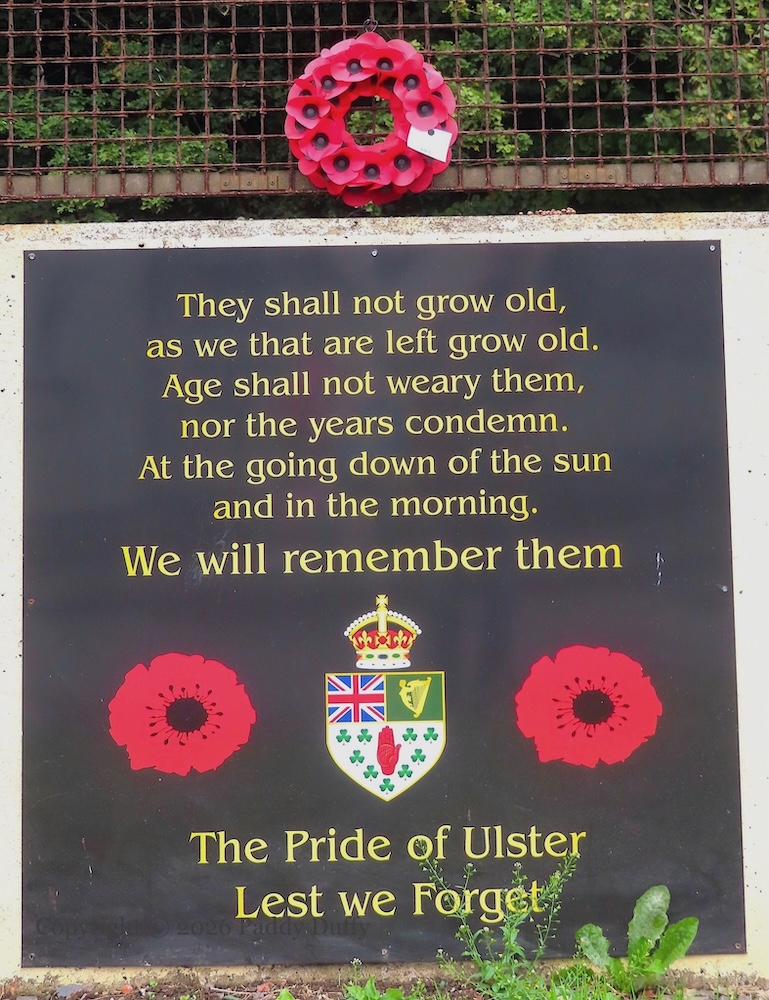
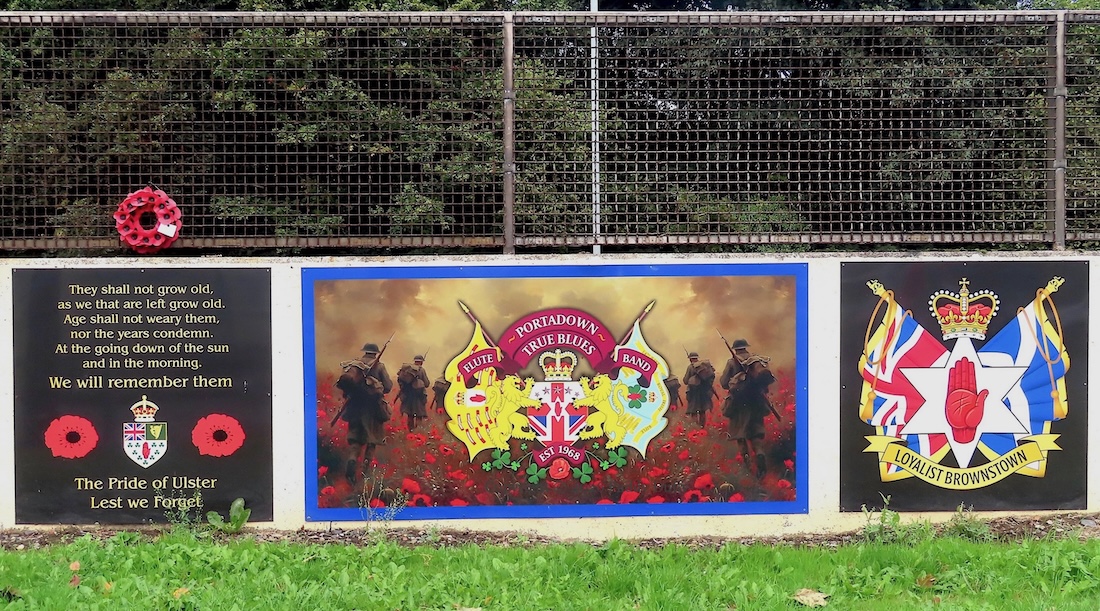
“Portadown True Blues flute band, est. 1968 [Fb].” This is a trio of boards at the top of the Brownstown estate, on the fence overlooking the “Northway” that separates Brownstown from Edgarstown. The flute band draws from both estates and has murals in both.
Both the main panel (immediately below) and the one to the left features WWI soldiers and the 36th Division – the band is associated with the Mid-Ulster brigade UVF (see the old Edgarstown mural in the Peter Moloney Collection).
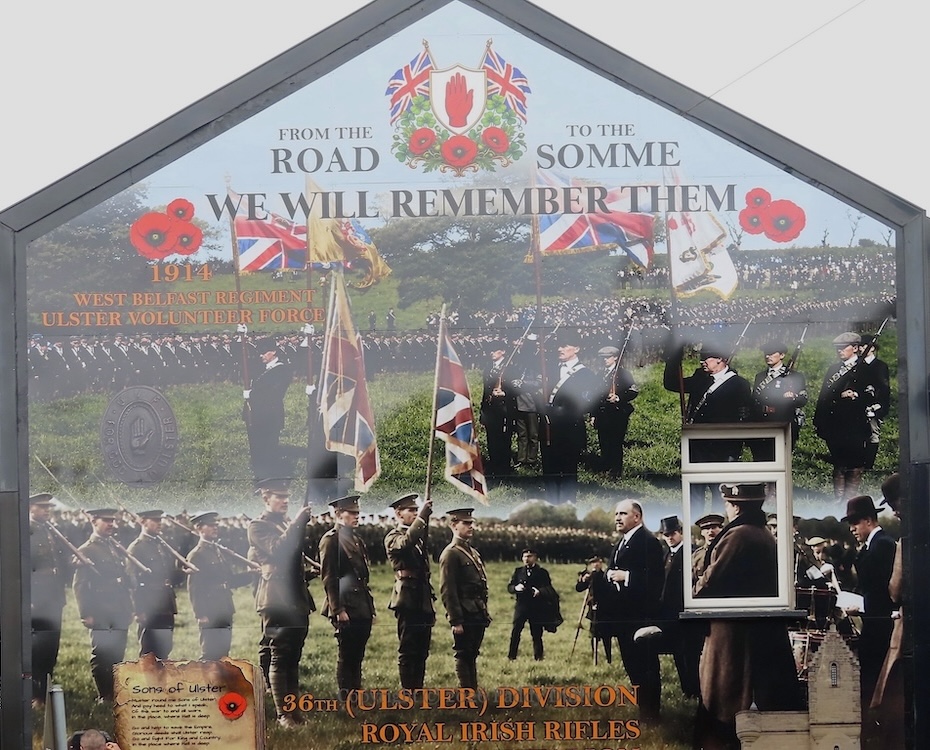
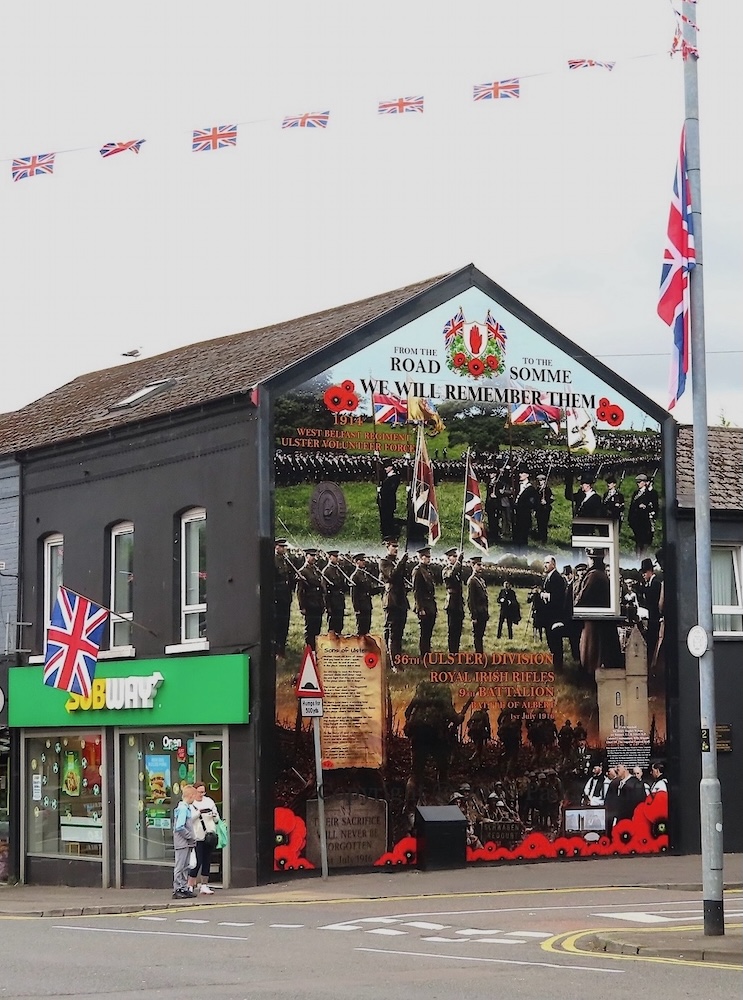
“1914 West Belfast regiment, Ulster Volunteer Force – 36th (Ulster) division, Royal Irish Rifles.” Men from the West Belfast Ulster Volunteers – which included the Shankill and Woodvale areas – joined the 9th battalion of the Royal Irish Rifles, which became part of the 107th brigade of the 36th division.
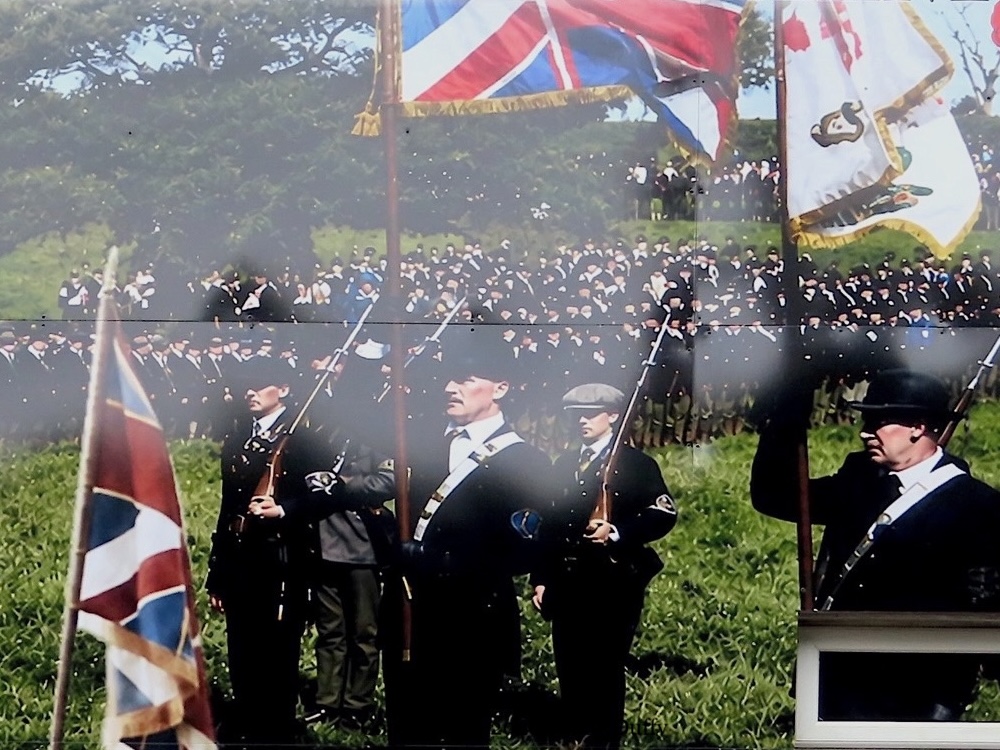
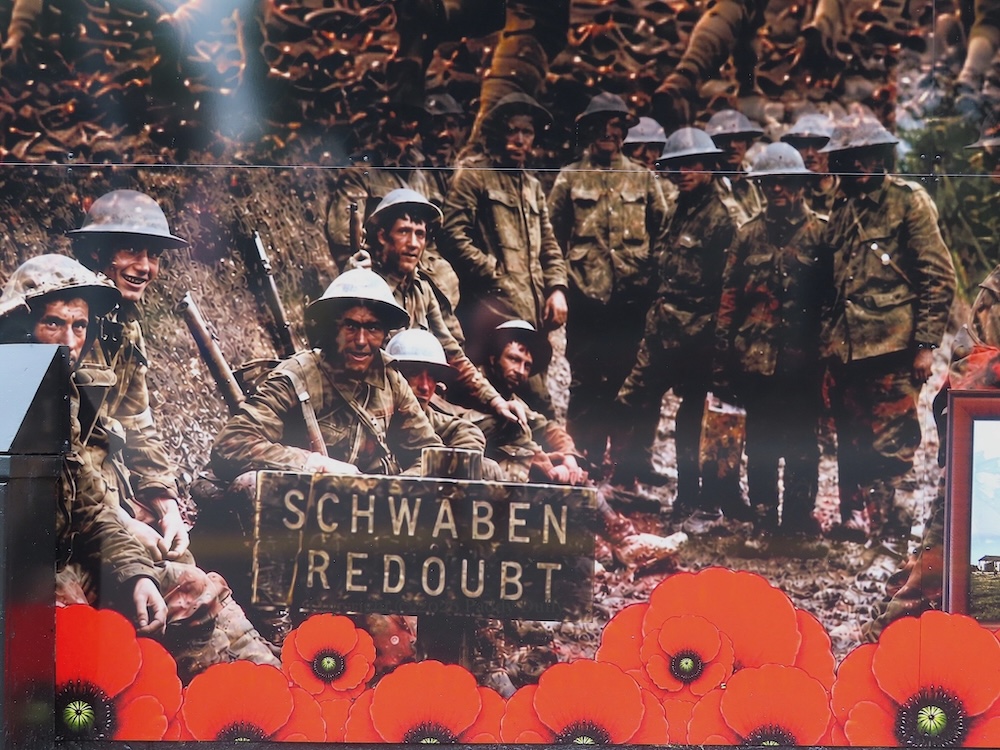
The main part of this new gable-sized board places two colourised photographs on top of each other. The first (upper) photo shows shows the first and second battalions of the West Down regiment being presented with their colours in May, 1914 (CyberProd). The second (lower) photo shows the first and second battalions of the West Belfast regiment receiving the Kings colours in May, 1914 (CyberProd).
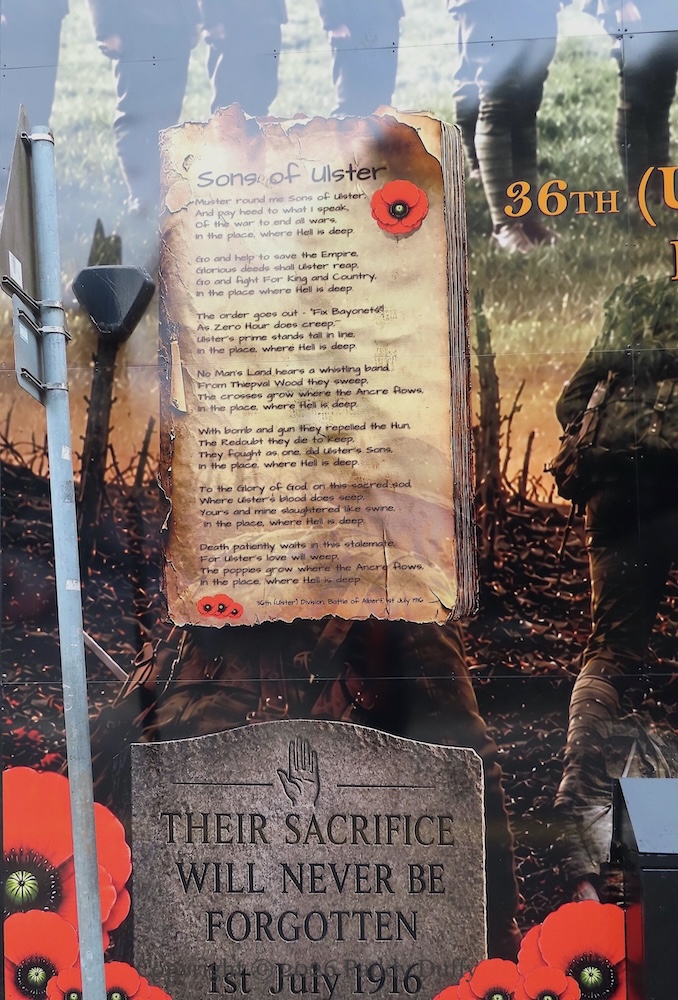
In the bottom left corner is a poem called “Sons of Ulster” written on a scroll: “Muster round me Sons of Ulster,/And pay heed to what I speak,/Of the war to end all wars,/In the place where hell is deep.//Go and help to save the Empire,/Glorious deeds shall Ulster reap./Go and fight for King and Country,/In the place where hell is deep.//The order goes out – “Fix Bayonets!”/As Zero Hour does creep,/Ulster’s prime stands tall in line,/In the place where hell is deep.//No-Man’s Land hears a whistling band,/From Thiepval Wood they sweep./The crosses grow where the Ancre flows,/In the place where hell is deep.//With bomb and gun they repelled the Hun,/The Redoubt they die to keep./They fought as one did Ulster’s Sons,/In the place where hell is deep.//To the Glory of God on this sacred sod,/Where Ulster’s Blood does seep,/Yours and mine slaughtered like swine,/In the place where hell is deep.//Death patiently waits in this stalemate,/For Ulster’s love will weep,/The poppies grow where the Ancre flows,/In the place where hell is deep.”
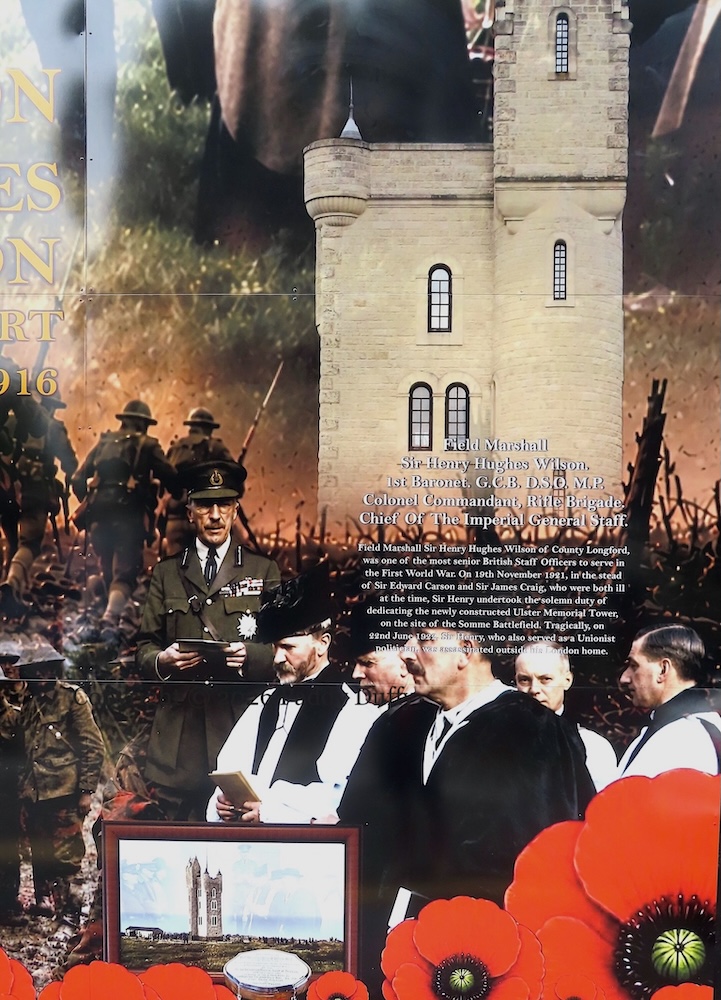
In the bottom right, the Ulster Tower is dedicated: “‘Field Marshall Sir Henry Hughes Wilson, 1st Baronet, GCB, DSO, MP, Colonel Commandant, Rifle Brigade, Chief Of The Imperial General Staff. Field Marshall Sir Henry Hughes Wilson of County Longford, was one of the most senior British Staff Officers to serve int he First World War. On 18th November 1921, in the stead of Sir Edward Carson and Sir James Craig, who were both ill at the time, Sir Henry undertook the solemn duty of dedicating the newly constructed Ulster Memorial Tower, on the site of the Somme battlefield. Tragically, on 22nd June 1922, Sir Henry, who also served as a Unionist politician, was assassinated outside his London home.”
Conway Street, Shankill, west Belfast, replacing Ulster Tower.
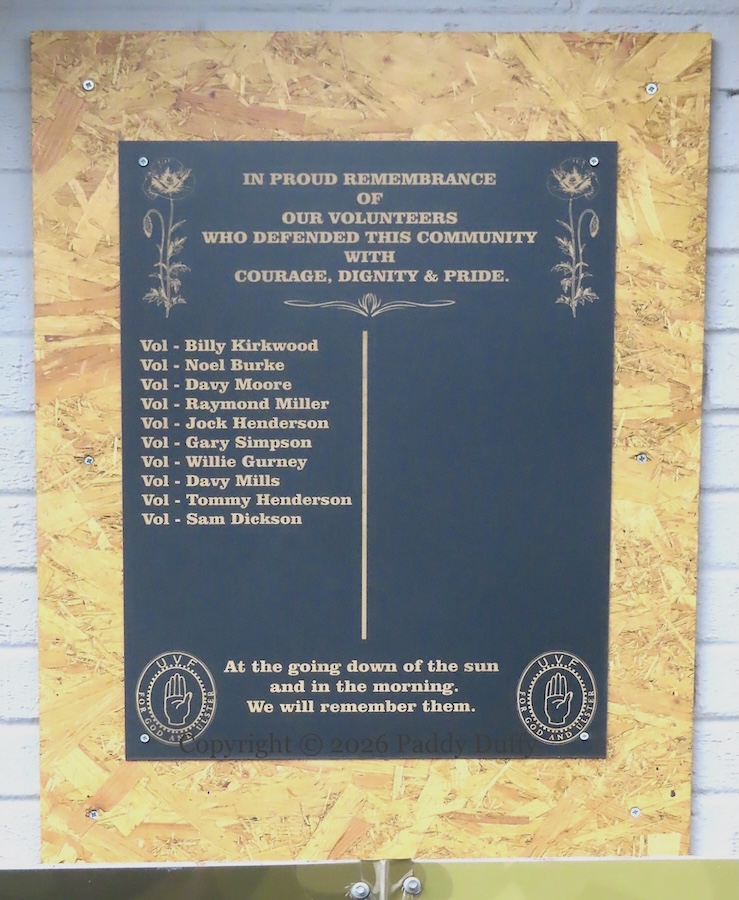
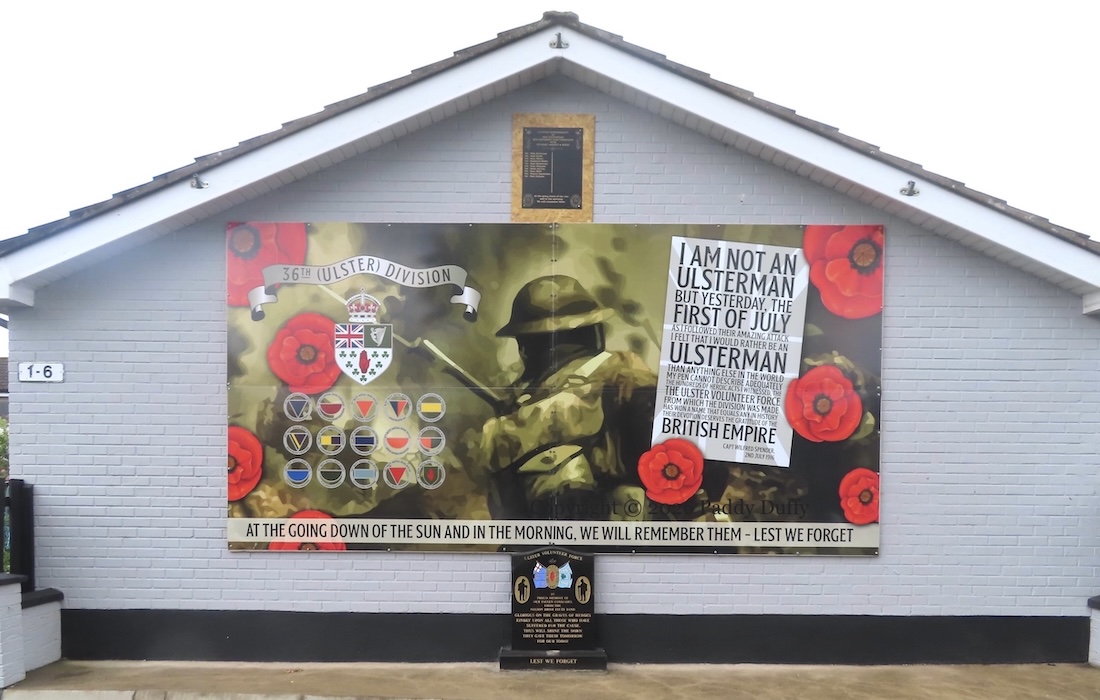
A UVF roll of honour has been added in the apex above the small memorial garden (now reduced to a single stone) in the Caw, Londonderry: “In proud remembrance of our volunteers who defended this community with courage, dignity & pride: Billy Kirkwood, Noel Burke, Davy Moore, Raymond Miller, Jock Henderson, Gary Simpson, Willie Gurney, Davy Mills, Tommy Henderson, Sam Dickson”. None of these appear to have died during the Troubles itself. There was previously a plaque to four volunteers who died in 1975.
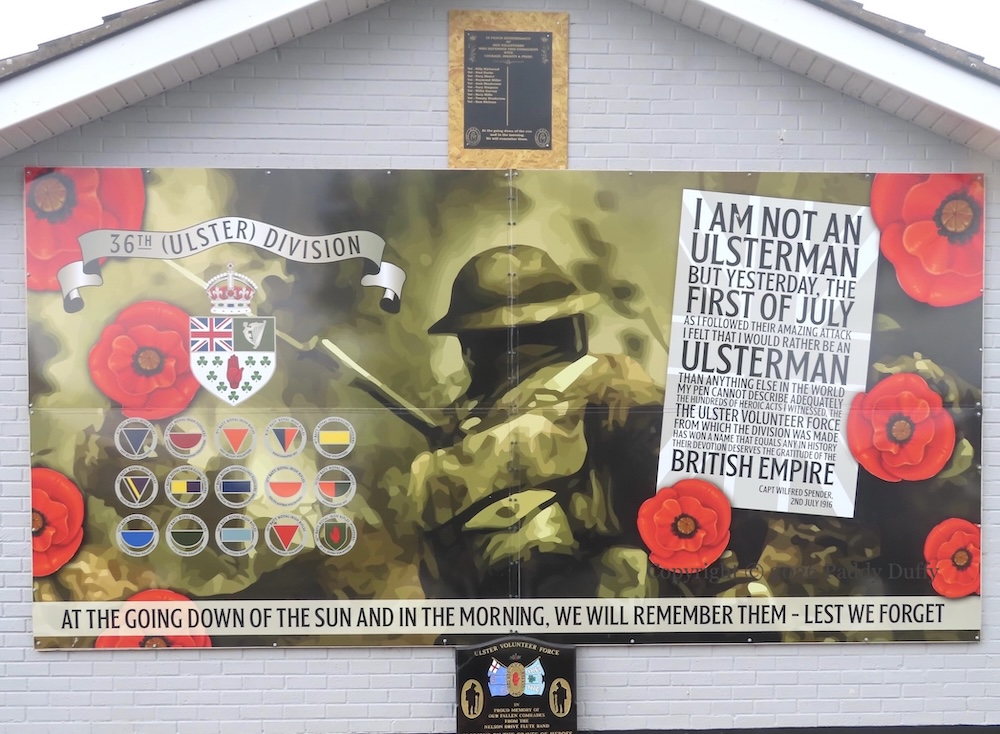
And Wilfrid Spender’s report on the 36th Division on the first day of the battle at the Somme (July 1st, 1916) is on the right – for the text, see Their Amazing Attack.
Sperrin Park, Caw, Londonderry, replacing Undefeated.
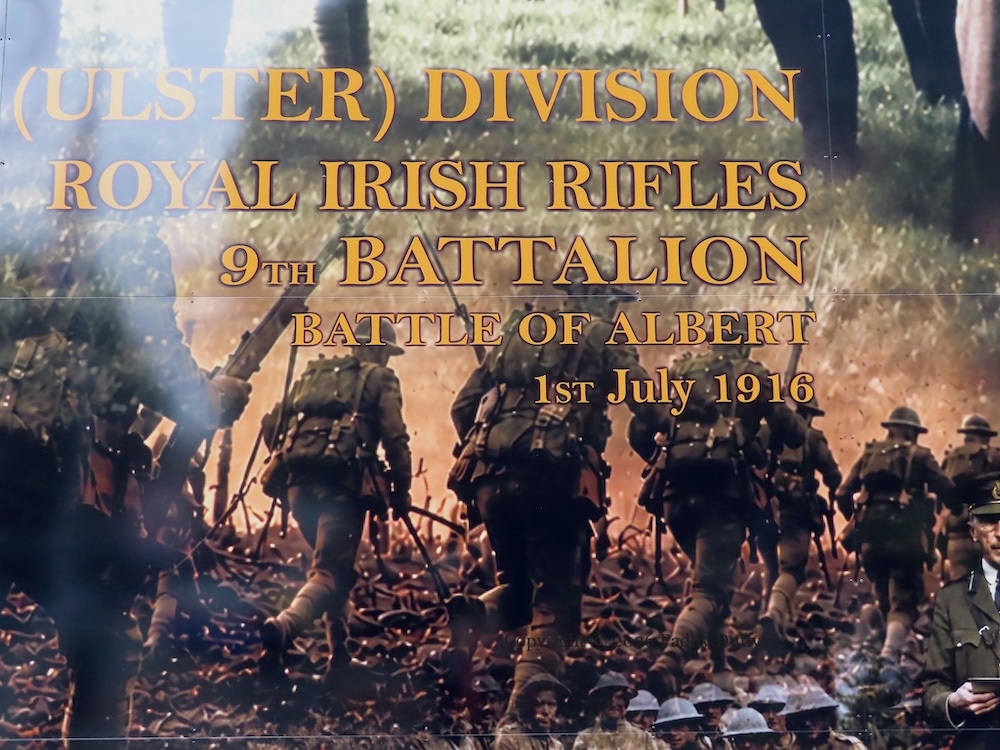
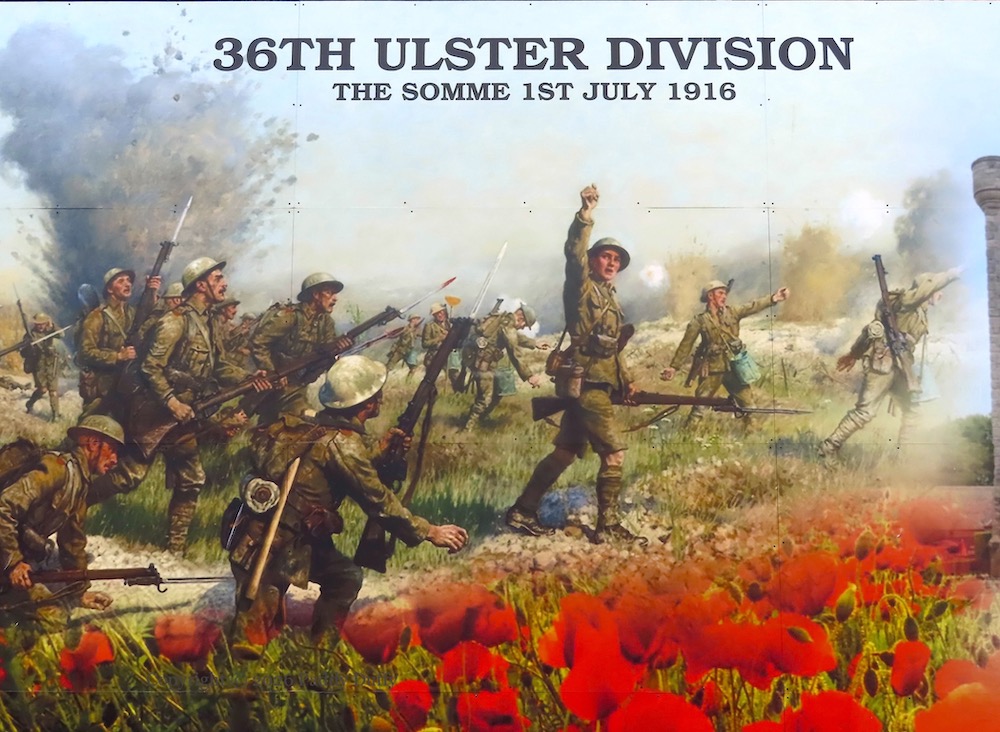
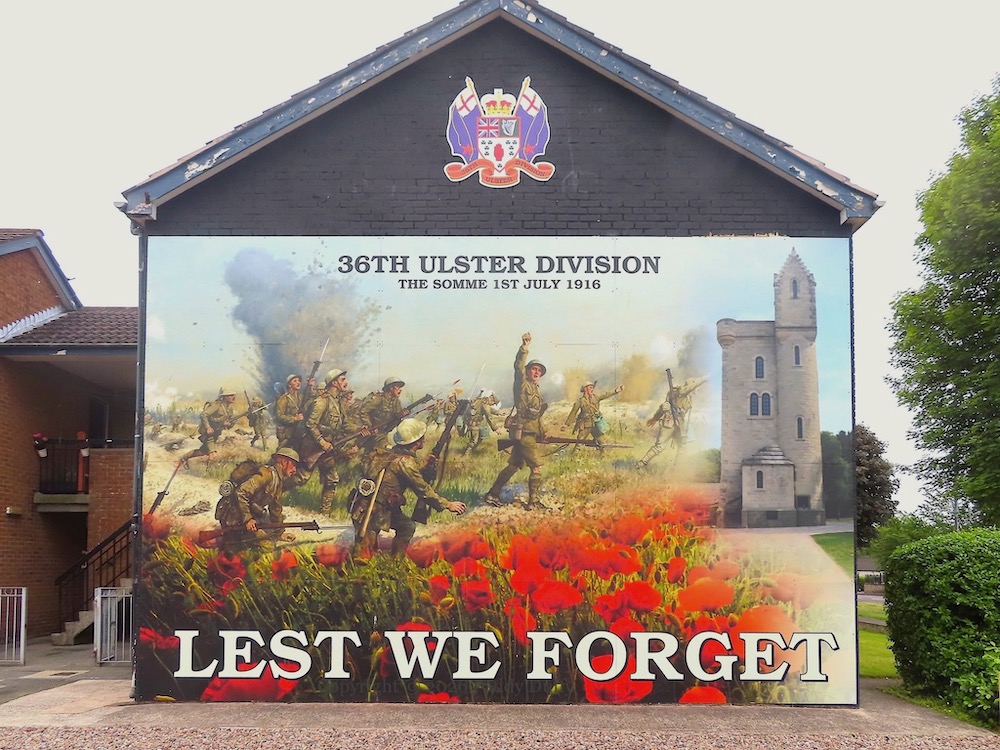
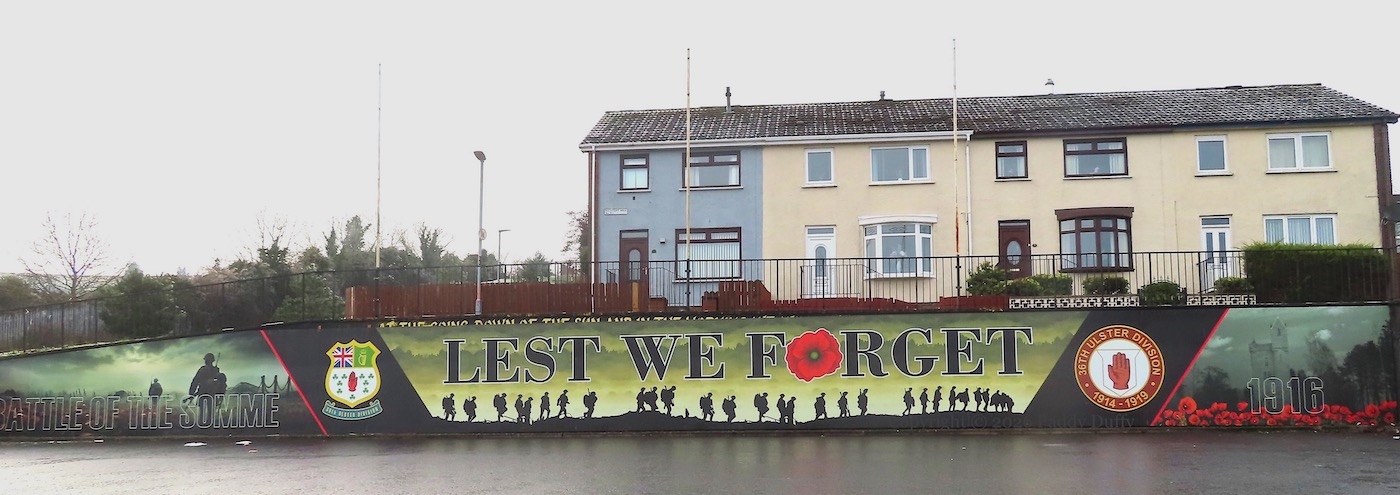
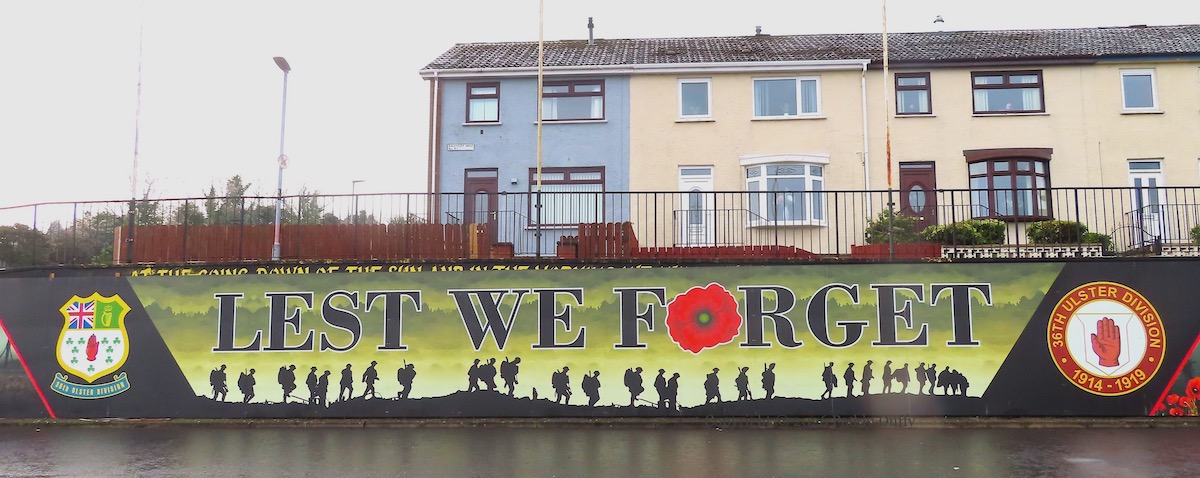
“Lest we forget.” JP Beadle’s painting “Battle Of The Somme: Attack Of The Ulster Division” shows soldiers of the 36th Division bravely going to their death on July 1st, 1916. The original painting hangs in Belfast City Hall (militaryprints.com). In the board shown here, a foreground of poppies has been added, along with the Ulster Tower in Thiepval, France, on the right.
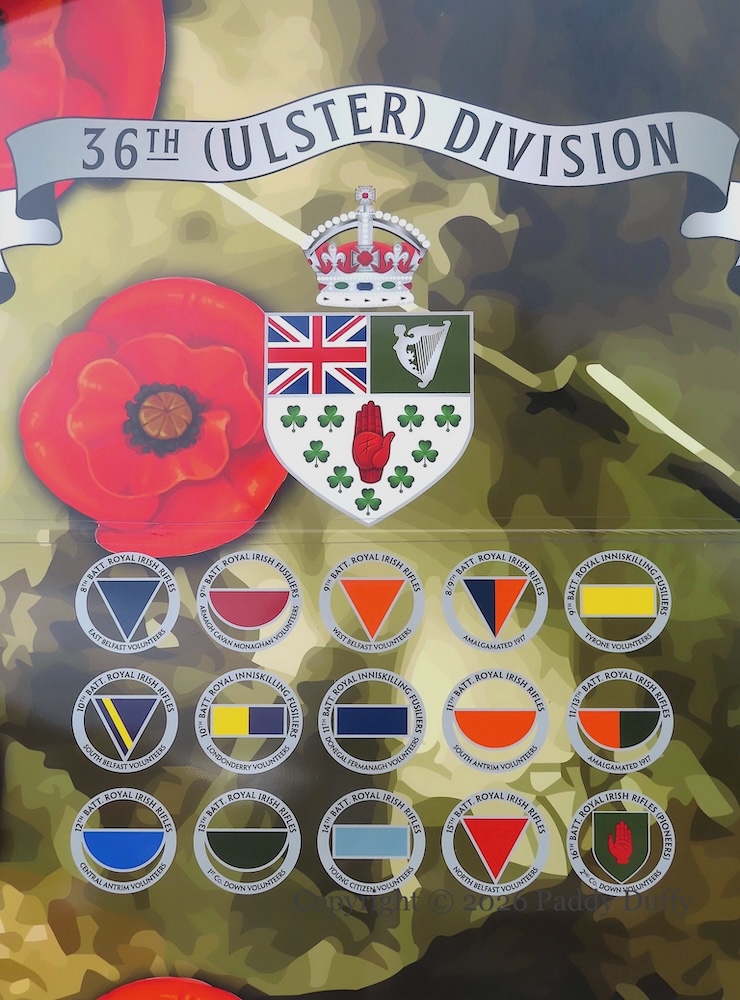
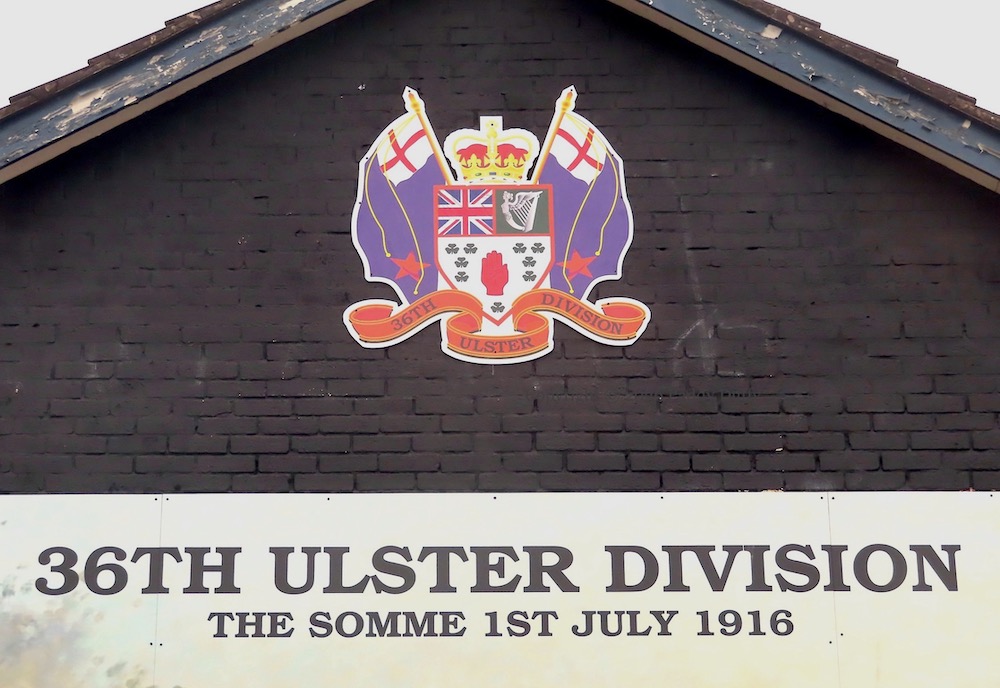
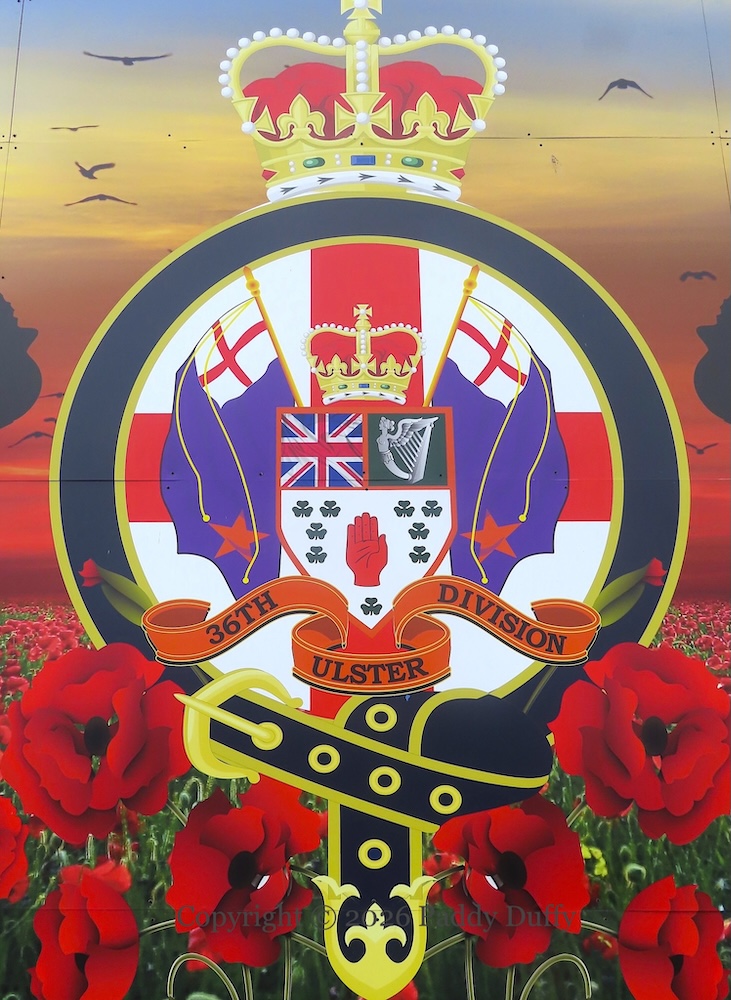
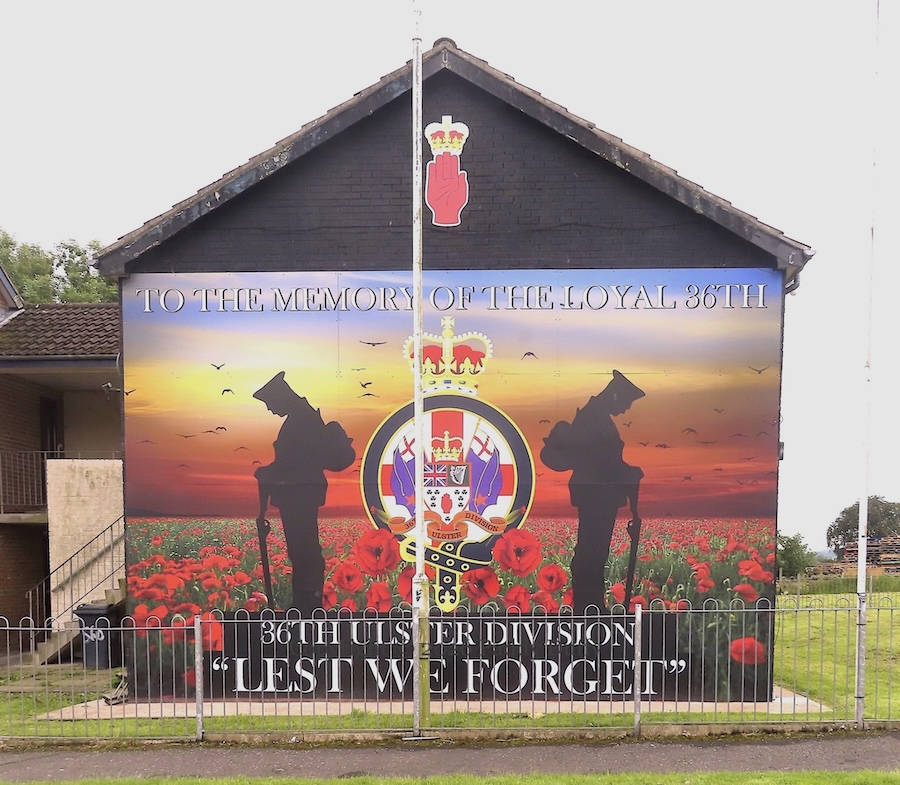
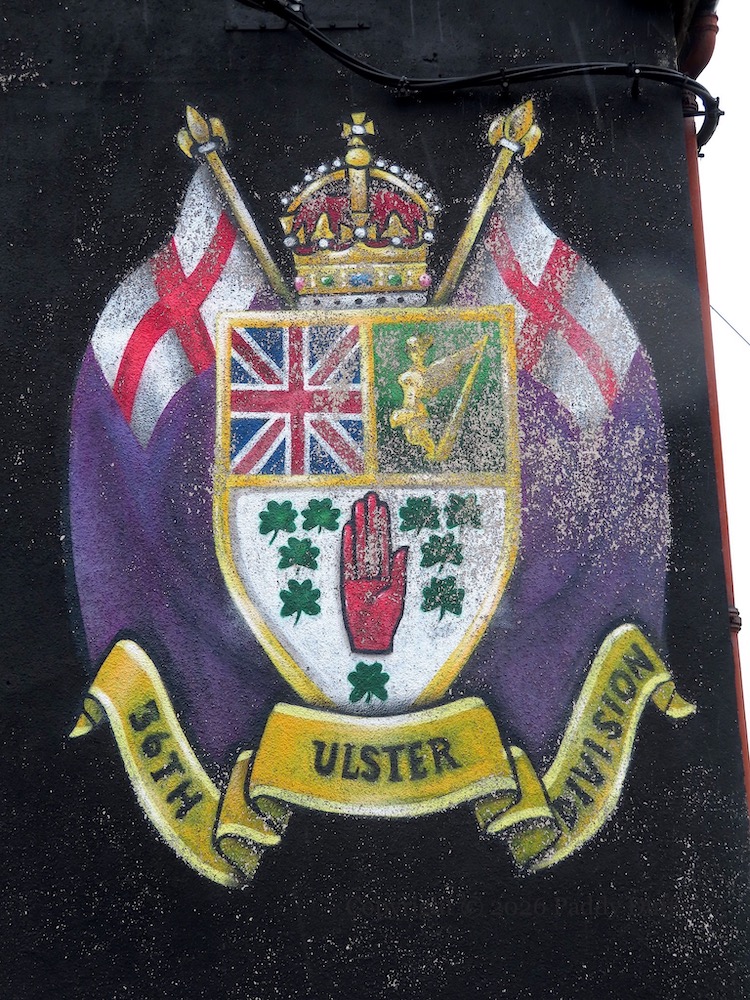
“To the memory of the loyal 36th”. The emblem of the 36th (Ulster) Division – shown in close-up above – is a modern one, perhaps from the 2000s. The 36th’s emblem in WWI was a simple red (left) hand, while this one involves a crest combining a Union Flag, Maid Of Erin harp (emblem of the Royal Irish Rifles), and a red (right) hand on a field of nine shamrocks, below a crown and flanked with UVF flags. These are flags of the modern UVF; according to Sam’s Flags, the flags of the Ulster Volunteers (1913-1914) looked like regimental flags.
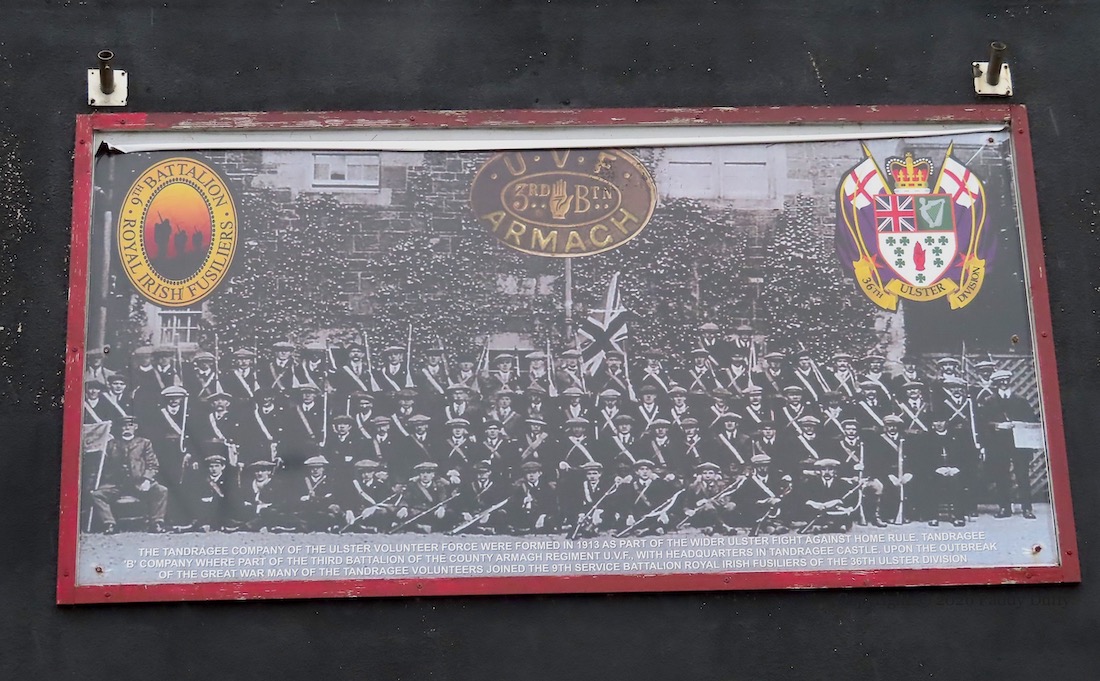
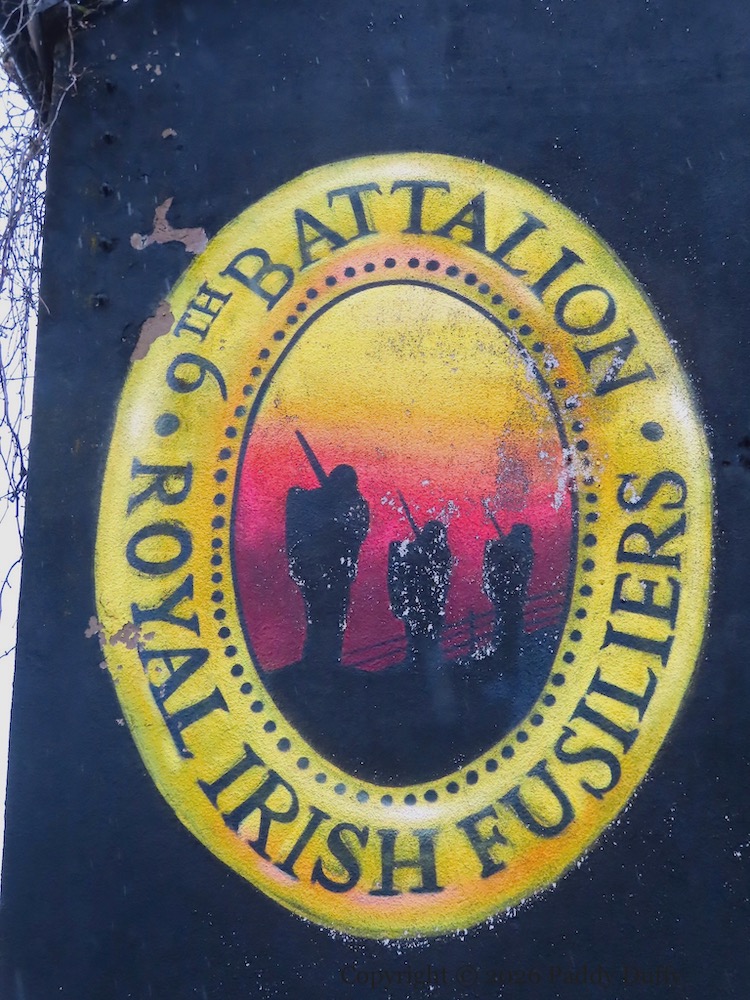
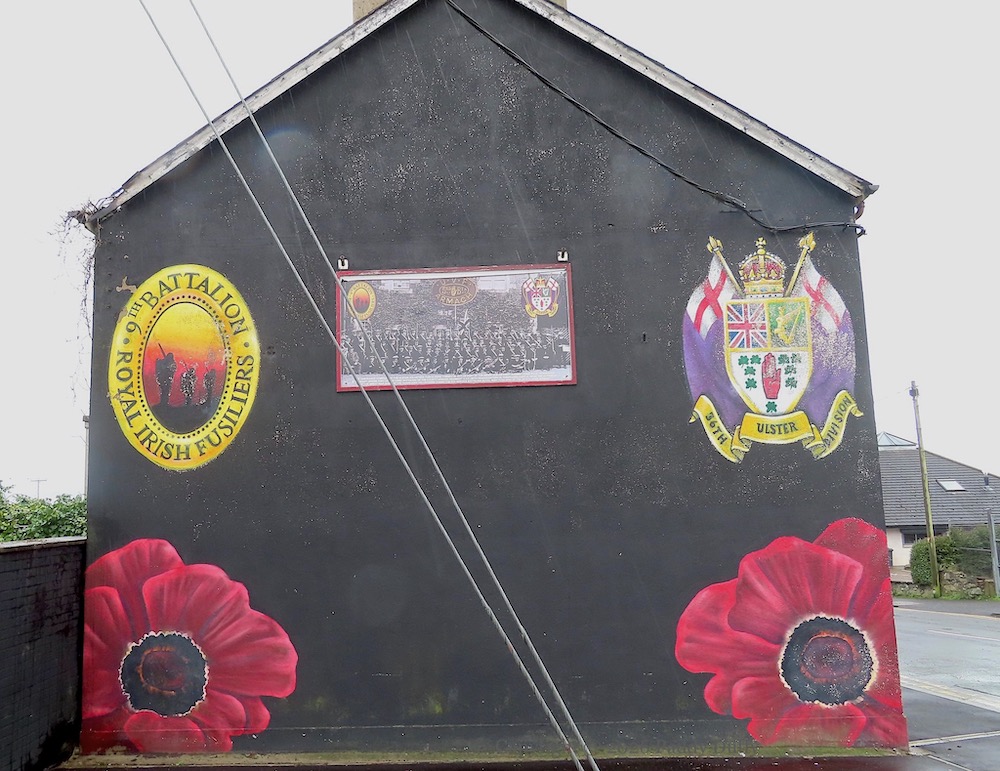
“The Tandragee company of the Ulster Volunteer Force were formed in 1913 as part of the wider Ulster fight against Home Rule. Tandragee ‘B’ Company where [were] part of the third battalion of the County Armagh Regiment UVF with headquarters in Tandragee Castle. Upon the outbreak of the Great War many of the Tandragee Volunteers joined the 9th Service Battalion Royal Irish Fusiliers of the 36th (Ulster) Division.”
The 9th battalion comprised volunteers from Armagh, Monaghan, and Cavan.
For a fuller version of the photograph, see Cyberprod.
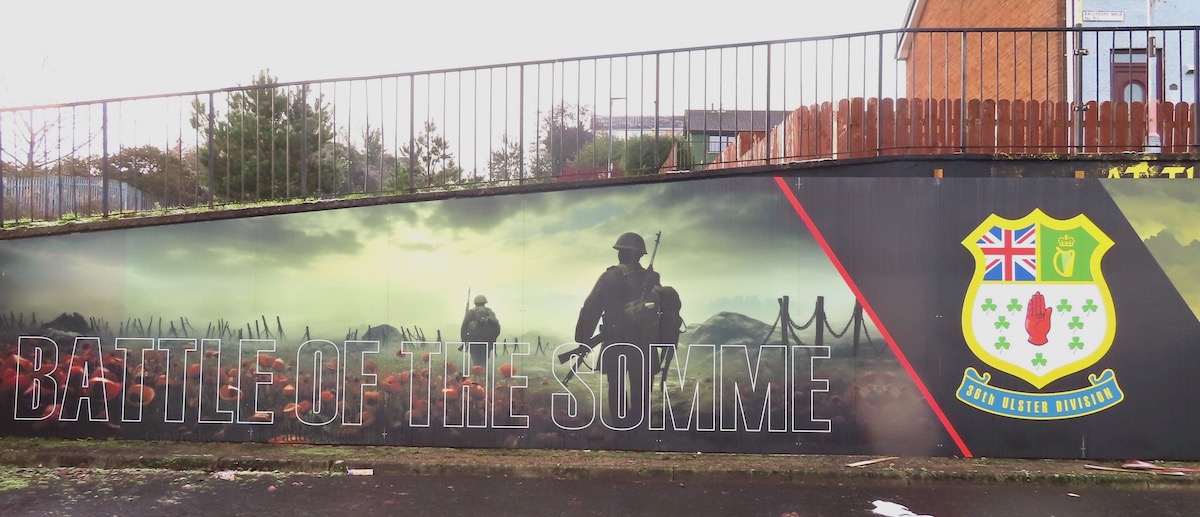
The badge or insignia of the 36th (Ulster) Division most frequently seen in murals is the one on the left of this board in Ballyduff, combining a red hand on a field of shamrocks with the Union Flag and the harp of the Royal Irish Rifles. The simpler insignia of the 36th Division on the right is being seen more frequently – it features a left-handed red hand, while the other uses a right-handed red hand, as do the flags of Ulster and of Northern Ireland.
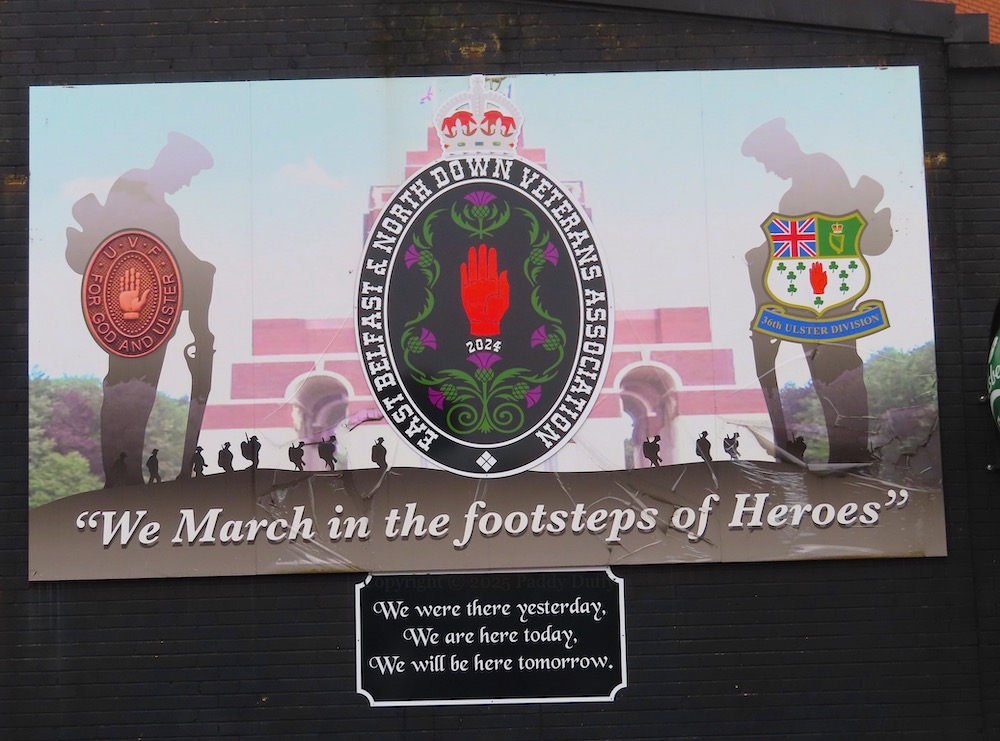
This is a new version of the board seen in 2022, in which the central emblem was of the 8th battalion of the Royal Irish Rifles, whereas it is now of the “East Belfast & North Down Veterans’ Association”.
Below, a small plaque reading “We were there yesterday, We are here today, We will be here tomorrow” has been added
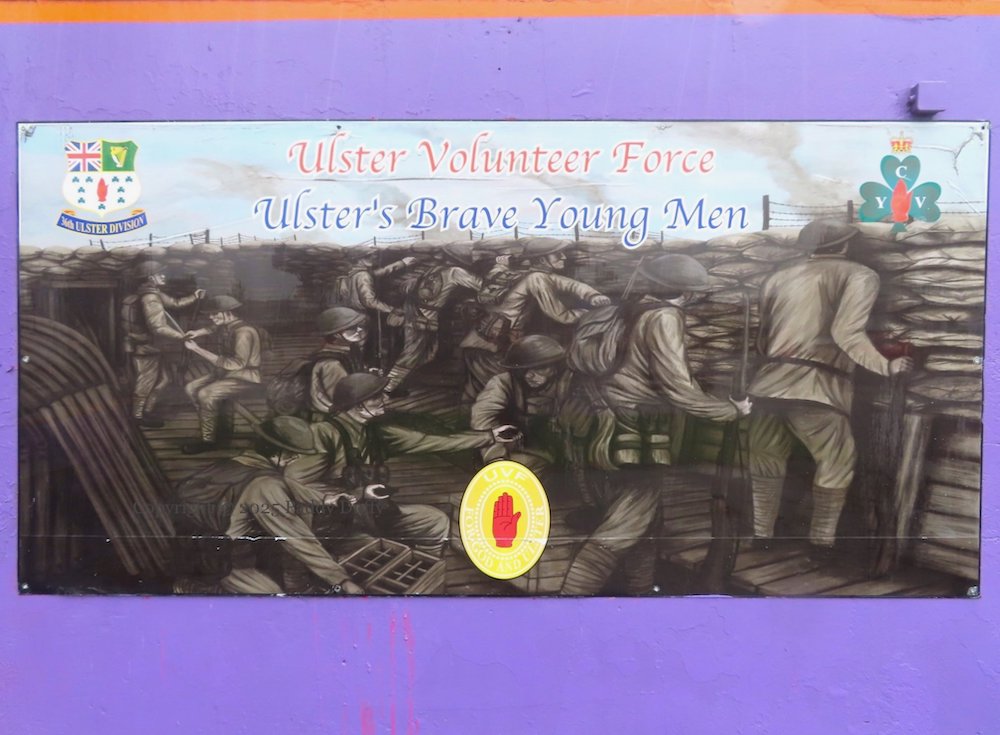
The background to the Avenue Road “Memorial to the 36th (Ulster) Division and to other men of Ulster who served in the Great War 1914 – 1918” has been repainted in the purple and orange of the UVF and the wall simplified by the removal of two smaller boards to each side of the main board (above) which shows soldiers looking out over the edge of a WWI trench. (For the the previous boards, see the Peter Moloney Collection.)
The seat is dedicated to “Jack”, an 11-year-old member of the Avenue Road Memorial flute band who died in 2019 (News Letter), with boxing gloves and emblem of the NI soccer association. 2 Timothy 4:7 says, “I have fought the good fight, I have finished the race, I have kept the faith.”
Avenue Road, Lurgan
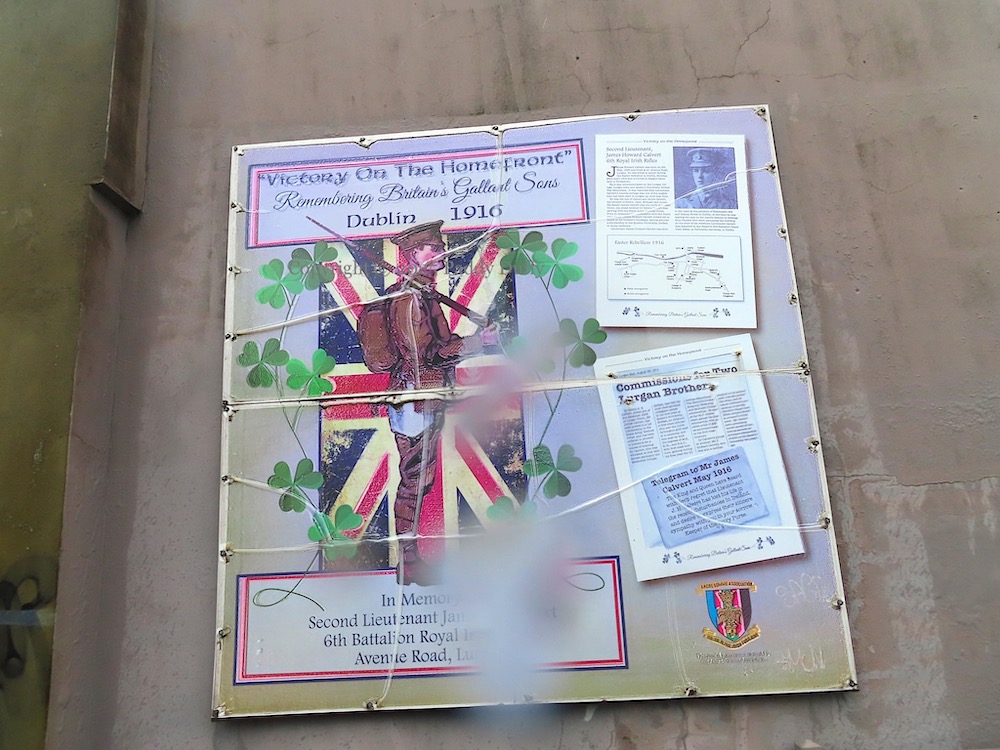
The final image is of a board in nearby King’s Park Mews to a soldier who died on “the homefront” – Dublin during the 1916 Rising – Second Lieutenant James Howard Calvert of the 6th Royal Irish Rifles.Calvert lived at 41 Avenue Road, Lurgan.
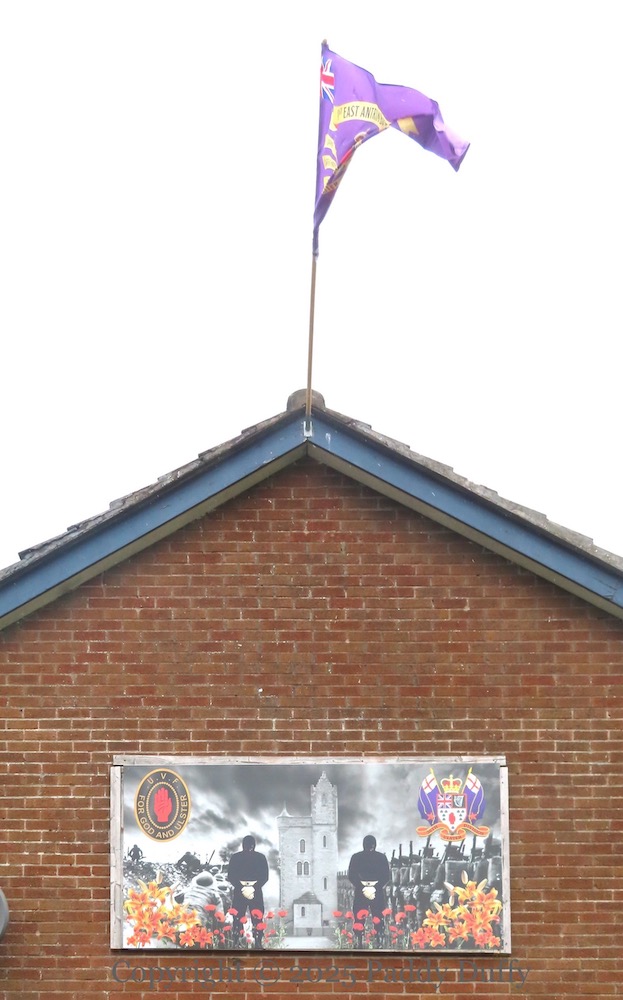
Modern UVF volunteers in balaclavas stand with heads bowed on either side of the Ulster Tower in Thiepval, standing among orange lilies and red poppies.
On the left the 10th Scottish Rifles (AWM) commence a raid, below the emblem of the Ulster Volunteer Force, and on the right, the Royal Fusiliers appear to march off to war in a press photograph (Flickr), below the emblem of the 36th (Ulster) Division.
In Grange Drive, Ballyclare, on the same as wall, and using part of the frame from, a previous UDA board: Young Guns.




 Paddy Duffy Collection