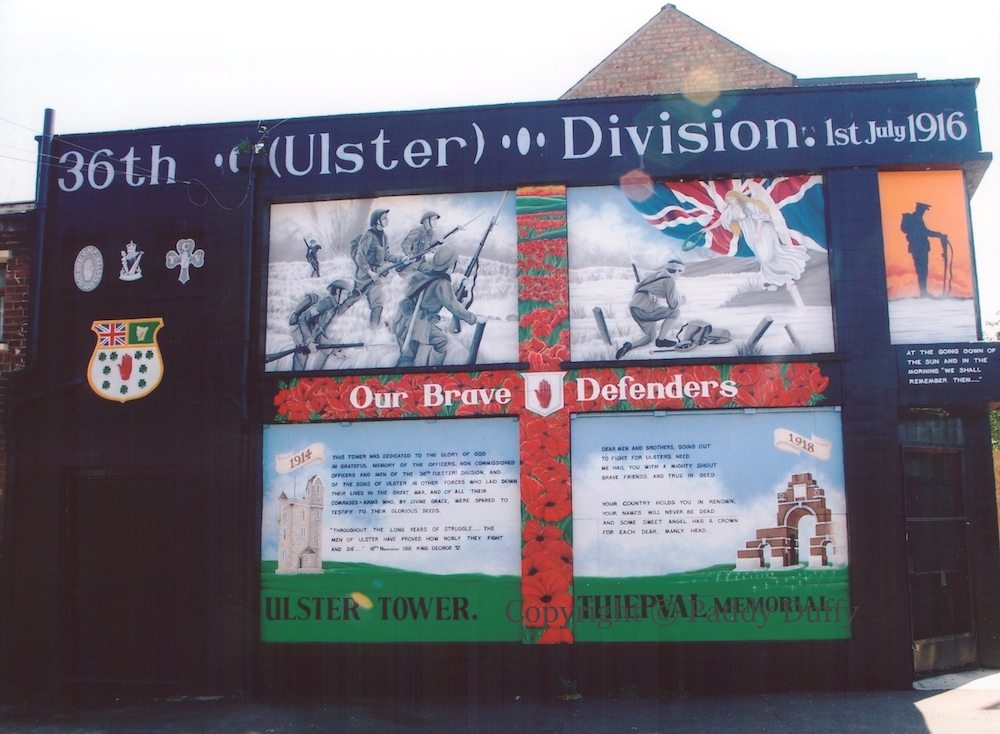
Our Brave Defenders

The four main panels of the mural (above) show
the men of the 36th going over the top on the first day of the Somme (1st July 1916),
the “angel of Mons” (WP),
Ulster Tower (“This tower was dedicated to the glory of God. In grateful memory of the officers, non commissioned officers and men of the 36th (Ulster) Division, and of the sons of Ulster in other forces who laid down their lives in the great war, and of all their comrades in arms who, by divine grace, were spared to testify to their glorious deeds. ‘Throughout the long years of struggle …. the men of Ulster have proved how nobly they fight and die’ – 16th November 1918 King George V”),
and
Thiepval Memorial (“Dear men and brothers, going out/to fight for Ulster’s need/we hail you with a mighty shout/brave friends, and true in deed.//Your country holds you in renown/your names will never be dead/and some sweet angel has a crown/for each dear, manly head.”)

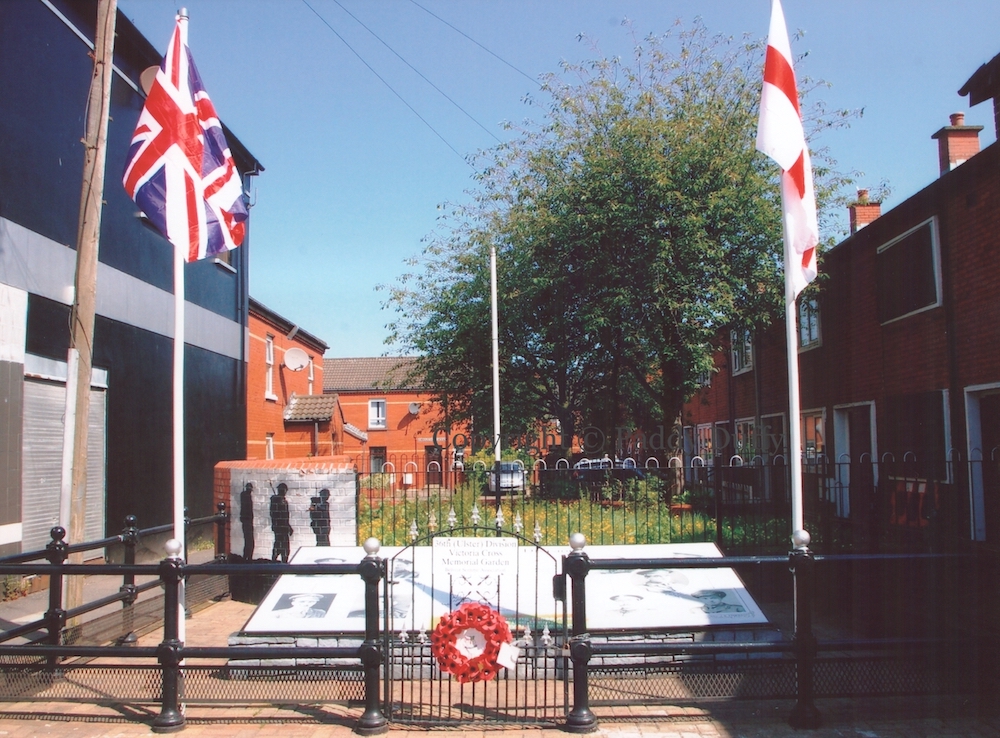
The memorial garden features the Victoria Cross winners from the 36th (Ulster) Division. For close-ups, see the Peter Moloney Collection.

St Leonard’s Crescent (the old Newcastle Street) in east Belfast
Click image to enlarge
Copyright © 2011/2012 Paddy Duffy
T00679 T00680
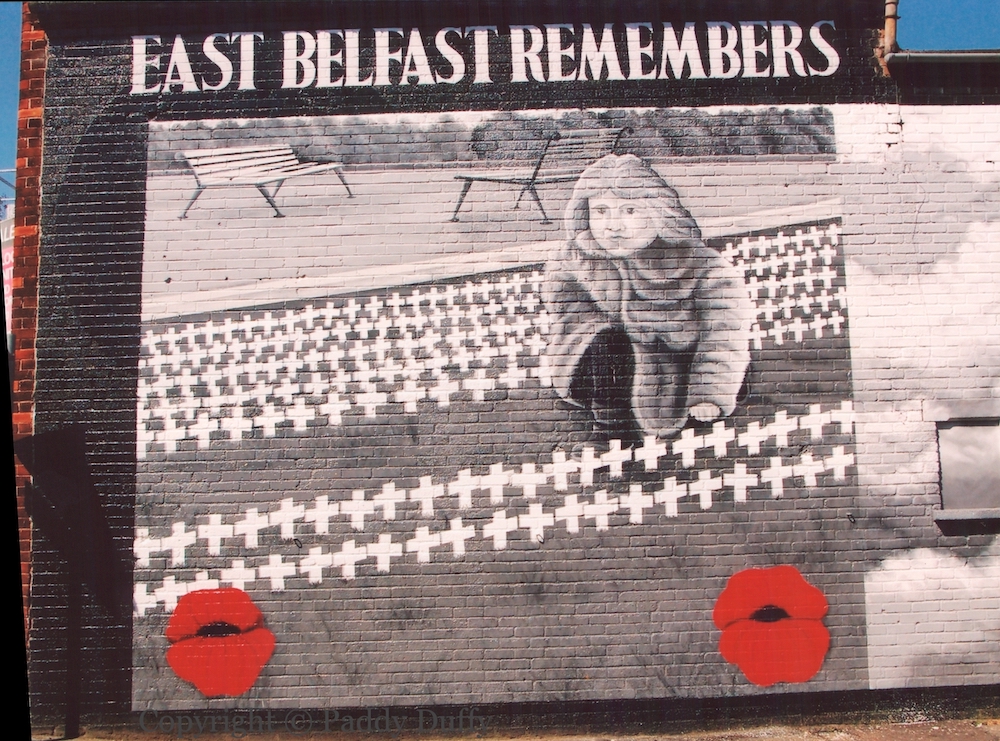
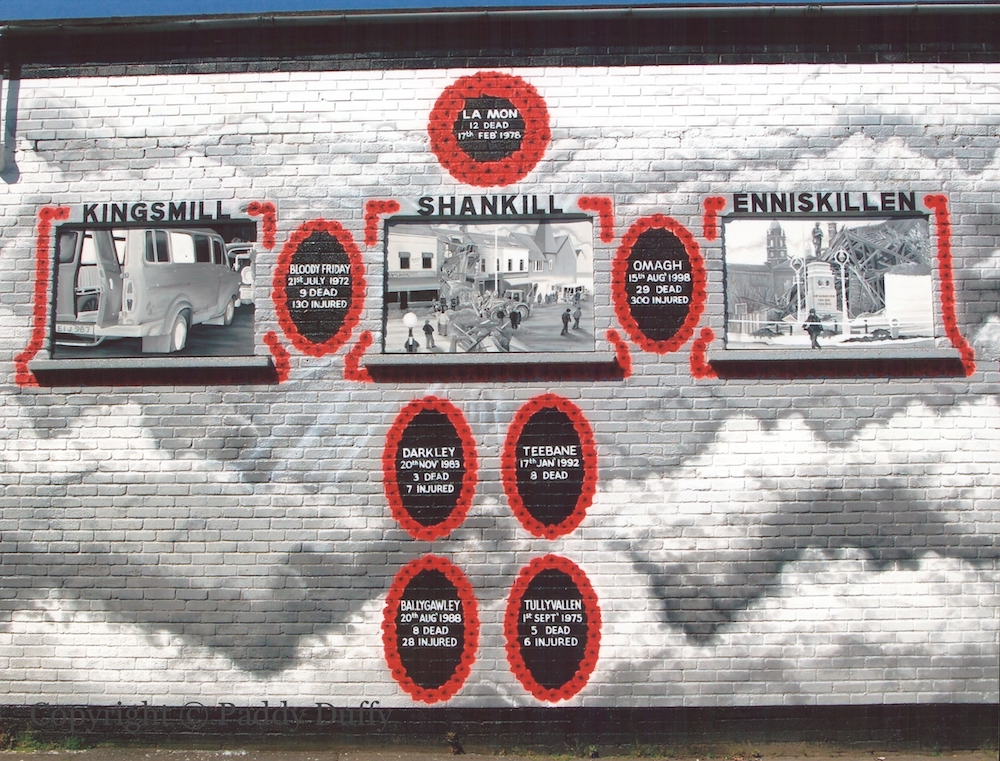
East Belfast Remembers

East Belfast remembers both the Great War and the victims of various attacks during the Troubles: in pictures: Kingsmill – Shankill – Enniskillen; in garlands of poppies: La Mon 12 dead 17th Feb 1978, Bloody Friday 21st July 1972 9 dead 130 injured, Omagh 15th Aug 1998 29 dead 300 injured, Darkley 20th Nov 1983 3 dead 7 injured, Teebane 17th Jan 1992 8 dead, Ballygawley 20th Aug 1988 8 dead 28 injured, Tullyvallen 1st Sept 1975 5 dead 6 injured.

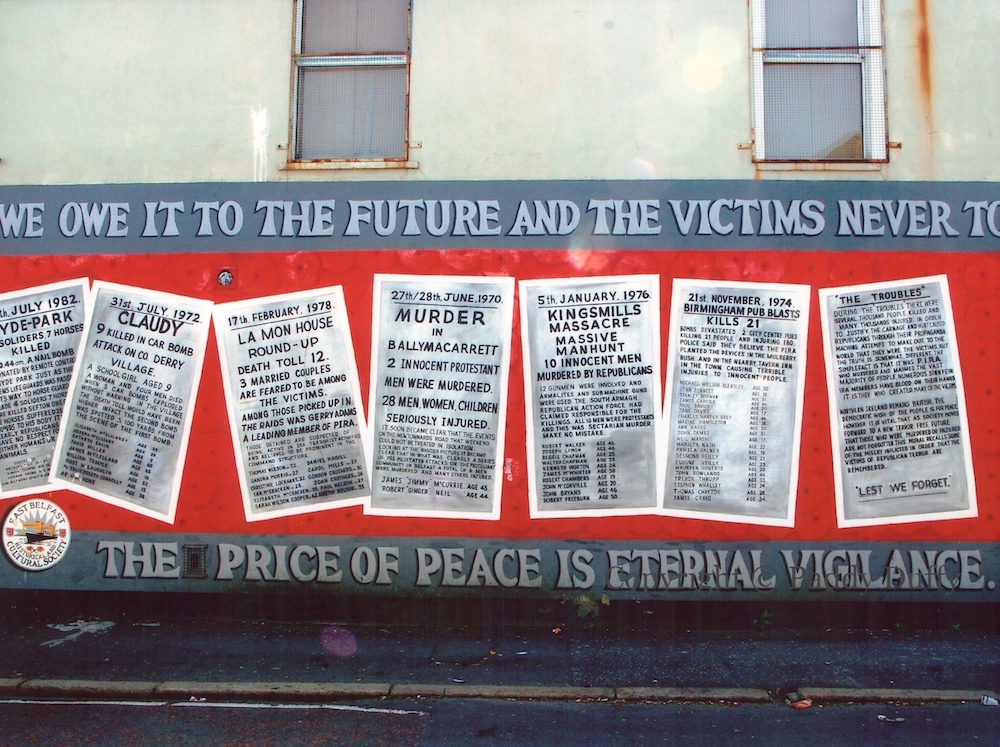
On the facing wall is a similar mural about deaths during the Troubles: “”The Troubles” – During the “Troubles” there were several thousand people killed and many thousands injured. In order to justify the carnage and hurt caused republicans through their propaganda machine attempt to make out to the world that they were the victims, but the truth is somewhat different. The simple fact is that it was PIRA who murdered and maimed the vast majority of people[.] [N]umerous Sinn Fein-IRA members have blood on their hands[.] It is they  who created many of the victims. Northern Ireland remains British. The democratic wish of the people is for peace. However[,] it is vital that as society moves forward to a new terror[-]free future that those who were murdered or injured are not forgotten. This mural recalls some of the misery inflicted[,] in order that the victims of republican terror are not forgotten. “Lest we forget.”” “We owe it to the future and the victims never to forget the past – the price of peace is eternal vigilence.”

Individual panels recount the deaths at Hyde Park, Claudy, La Mon House, Ballymacarrett, Kingsmills [Kingsmill], and Birmingham.

Sponsored by the East Belfast Historical And Cultural Society – see Visual History 10.

Derwent Street, east Belfast

Click image to enlarge
Copyright © 2011/2012 Paddy Duffy
T00683 T00681 [T00682]

RMS Titanic

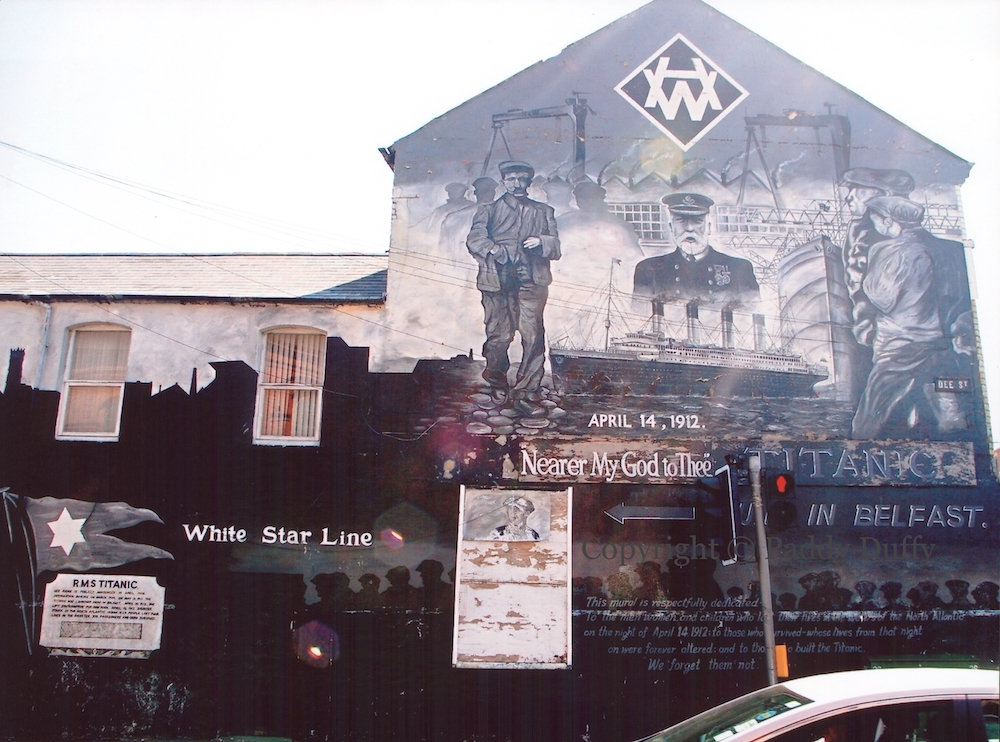
“Her name is publicly announced in April 1908. Designation begins in March 1909. On May 31. 1911, the Titanic was launched here in Belfast, April 10, 1912. She left Southampton for New York. April 14, 1912 disaster struck in the North Atlantic ocean, 1523 people lost their lives in the disaster, 705 passengers and crew survived.” “This mural is respectfully dedicated to the men, women and children who lost their lives in the waters of the North Atlantic on the night of April 14, 1912: to those who survived – whose lives from that night on were forever altered; and to those who built the Titanic [at Harland and Wolff]. We forget them not.”

Pictured in the centre of the mural is Captain Edward John “Ted” Smith.

Dee Street, east Belfast, teplacing an earlier Titanic mural.

Click image to enlarge
Copyright © 2012 Paddy Duffy
T00704 [T00705]

HMS Belfast

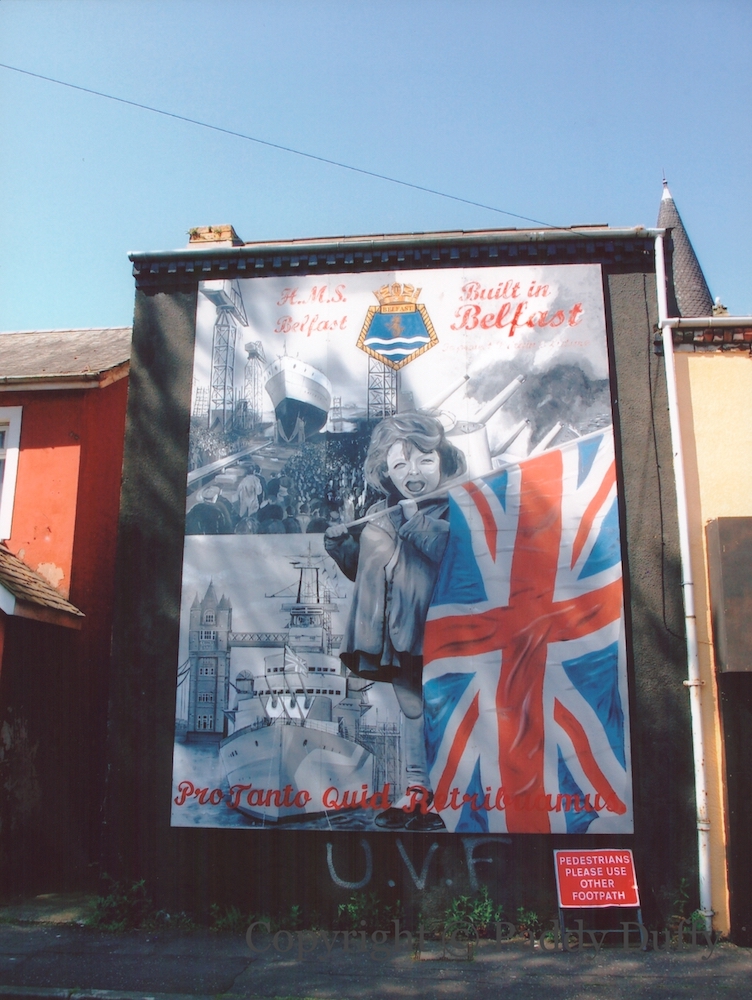
“HMS Belfast – built in Belfast to protect Britain’s future. Pro tanto quid retribuamus. [What shall we give in return for so much? – the motto of Belfast city]”. The mural shows HMS Belfast being launched on March 17, 1938. After serving in WWI and Korea, the ship is now a tourist attraction in London.

Tower Street, east Belfast

Click image to enlarge
Copyright © 2012 Paddy Duffy
T00710 [T00711]

The Elementary Right

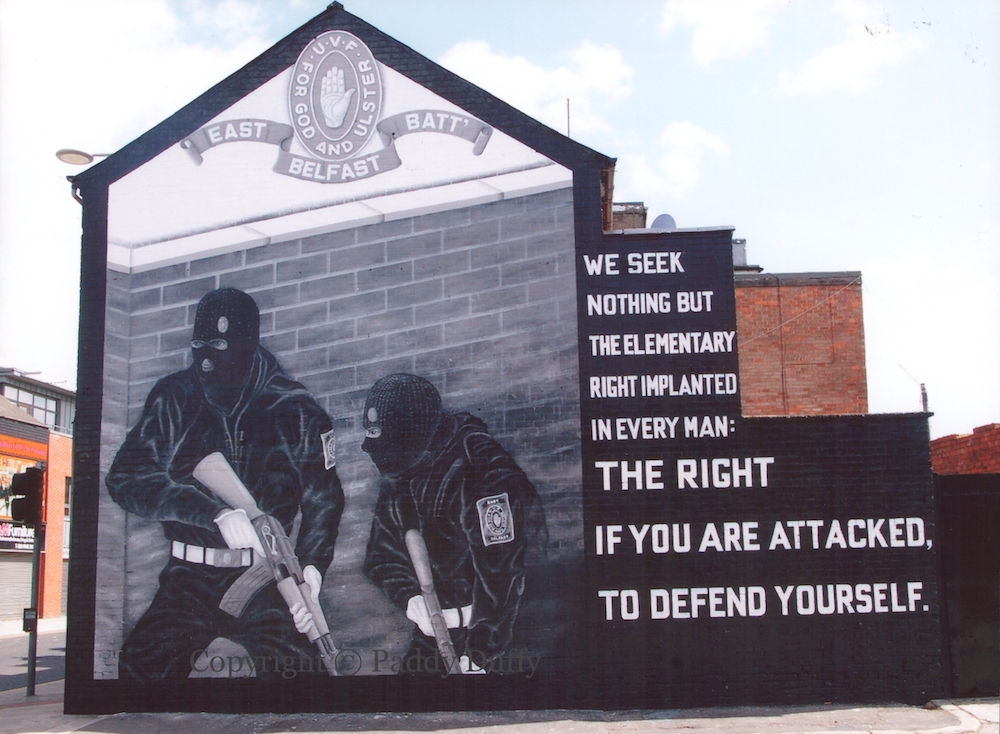
“We seek nothing but the elementary right implanted in every man: the right if you are attacked, to defend yourself.” Hooded gunmen return to east Belfast, replacing a mural for the Glentoran Community Trust.

It’s not clear who the UVF felt attacked by in 2011; it is possible that this mural is also about local muscle-flexing in addition to sectarian politics or attention from the police.

Newtownards Road at the old Bright Street, east Belfast

Click image to enlarge
Copyright © 2011/2012 Paddy Duffy
T00662 [T00667] [T00709]

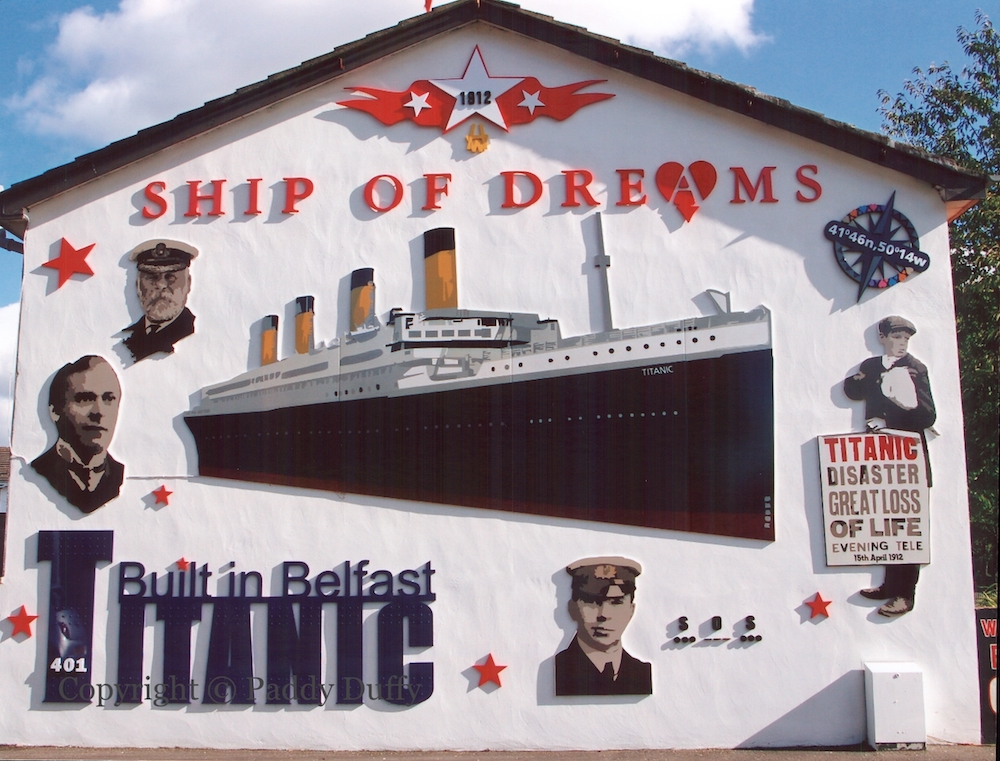
Ship Of Dreams

“Built in Belfast.” The White Star Line ship Titanic sank in the Atlantic in the early morning of April 15th, 1912, a thousand miles from New York (the co-ordinates are given in the top right), having been launched from Belfast’s Harland & Wolff shipyard, which is near this mural in east Belfast.

The portraits are of Captain Edward Smith, architect Thomas Andrews, Jack Phillips (wireless officer), and paperboy Ned Parfett.

Kenilworth Place, Ballymacarrett, east Belfast

Click image to enlarge
Copyright © 2011/2012 Paddy Duffy
T00661

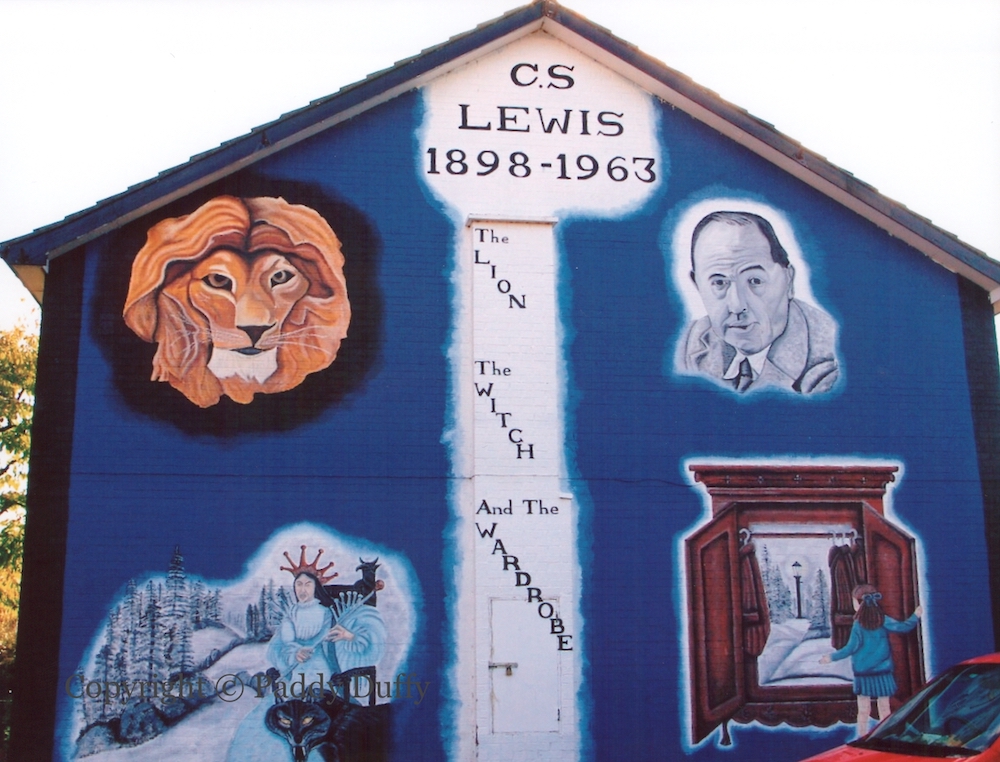
CS Lewis

CS Lewis (1898-1963) was born and reared in Belfast until age 9. He was wounded at Arras in WWI and studied at Oxford after the war. He is most noted for work in Christian apologetics and children’s fiction, especially The Lion, The Witch, And The Wardrobe, written in 1950.

Convention Court, Ballymacarrett, east Belfast

Click image to enlarge
Copyright © 2008/2009/2010/2011/2012 Paddy Duffy
T00660

The World Wars In Lower Shankill

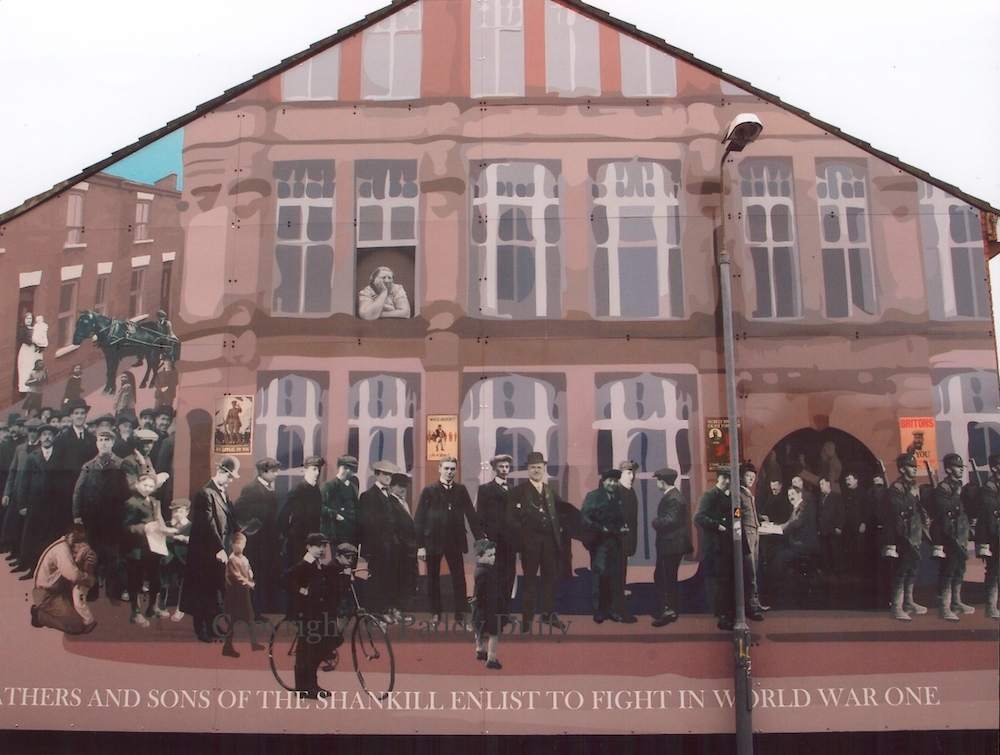
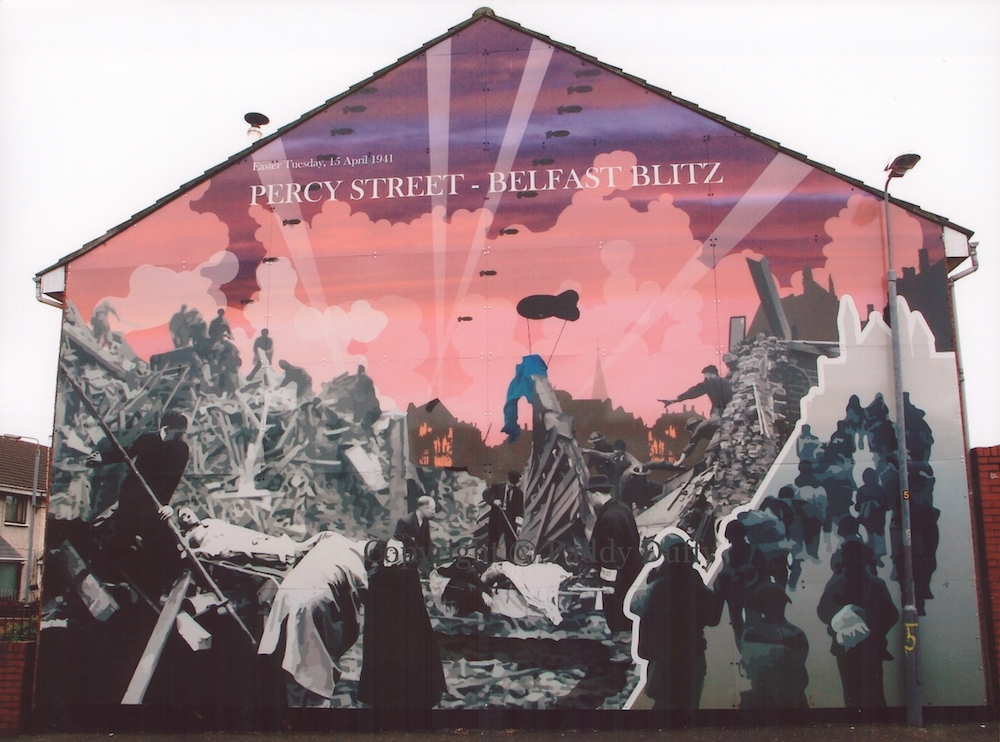
Here are three murals/boards by Steven Tunley for the Re-Imaging Communities programme in Dover Place, lower Shankill.

From left to right: “Fathers and sons of the Shankill enlist to fight in World War One”, “Belfast blitz – Easter Tuesday, 15 April 1941”, and “VE Day – 8th May 1945”.

Dover Place, Shankill, west Belfast

Click image to enlarge
Copyright © 2009/2010/2011/2012 Paddy Duffy
T00657 T00658 T00659

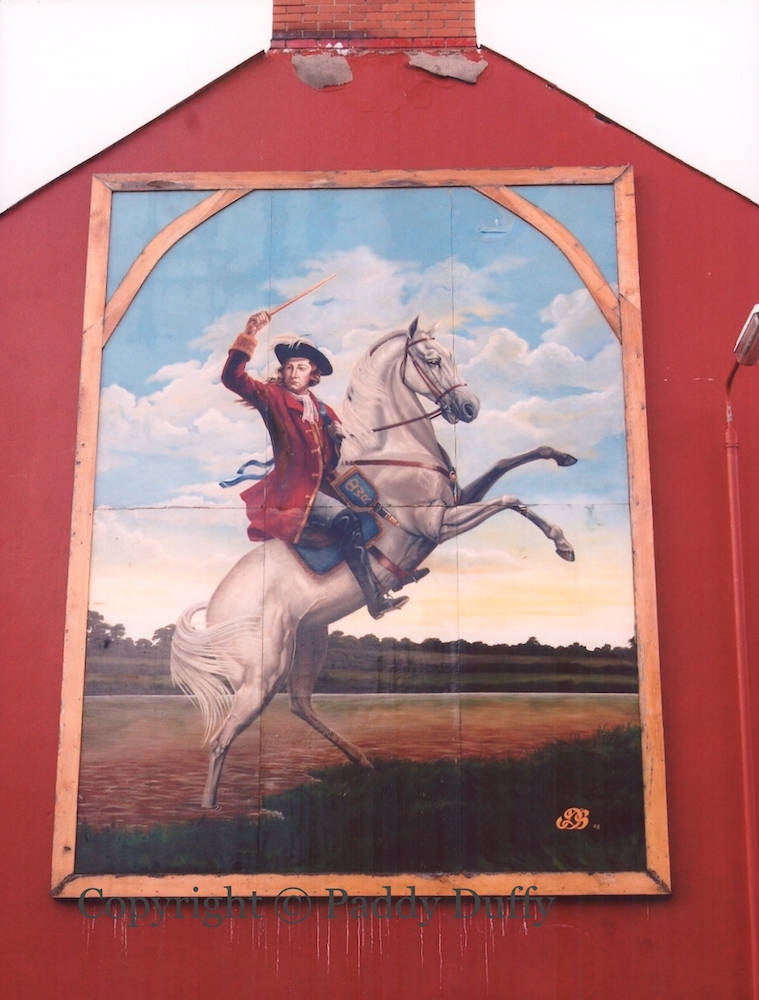
King William At The Boyne

The Village Eddie is re-imaged with a painting of King Billy at the Boyne by John Darren Sutton.

“The first unionist mural was painted in 1908 on the Beersbridge Road in East Belfast by shipyard worker John McLean. It depicted King William at the Battle of the Boyne. This was the start of mural painting becoming a key element in the annual unionist celebration of the Battle of the Boyne, culminating in the Orange Order parades of July 12th. Murals, bunting, arches, painted flagstones, marked out the route of marches as well as adorning countless local areas. Between 1908 and the 1970s the vast bulk of unionist murals depicted King William at the Boyne. Other murals depicted the sinking of the Titanic, the 36th Ulster [sic] Division at the Battle of the Somme, and various royal weddings and anniversaries. Each unionist working class area vied with the neighbouring areas to have the best decorations for the Twelfth. As part of this rivalry, King William murals were painted and repainted year after year, with some surviving through six or more decades. The longest-surviving mural in the South Belfast area was in Rockland Street. It depicted King William on his white horse at the Battle of the Boyne. Painted first in the mid-1920s, it survived until the mid-1990s, when it became a victim first of the heat from an adjacent bonfire, and then of redevelopment. The King William murals began to fade from the walls in the 1970s, to be replaced with murals depicting flags and other inanimate emblems. Overall, the number of murals declined significantly in this decade. In the mid-1980s mural painting in unionist areas came under the control of loyalist paramilitary groups. From that point, the vast majority of murals in unionist areas depicted armed and hooded men. In recent years, the debate on mural painting inside and outside loyalist paramilitary organisations has led to the decline of the military iconography. This debate has led to many positive changes taking place throughout Northern Ireland and in January 2008 Greater Village Regeneration Trust secured funding through the Re-imaging Communities Programme to transform a number of areas within the village. This programme was established to help communities in both rural and urban areas to focus on positive ways of expressing  their culture and identity and to encourage the creation of vibrant and attractive shared spaces. Thanks to the overwhelming support and participation of the local community in the Re-imaging process. Local organisations, community leaders, residents and young people have worked closely with artists to tackle the displays of redundant sectarian imagery and replacing these with positive expressions of wider cultural celebration.”

Tavanagh Street, Village, south Belfast

Click image to enlarge
Copyright © 2011/2012 Paddy Duffy
T00648