
Belgian artist Kitsune (ig) added monarch butterflies to the Dunbar Street/Link side of Common Market food hall (web) in August.

Click image to enlarge
Copyright © 2023 Paddy Duffy
T03170 T03069
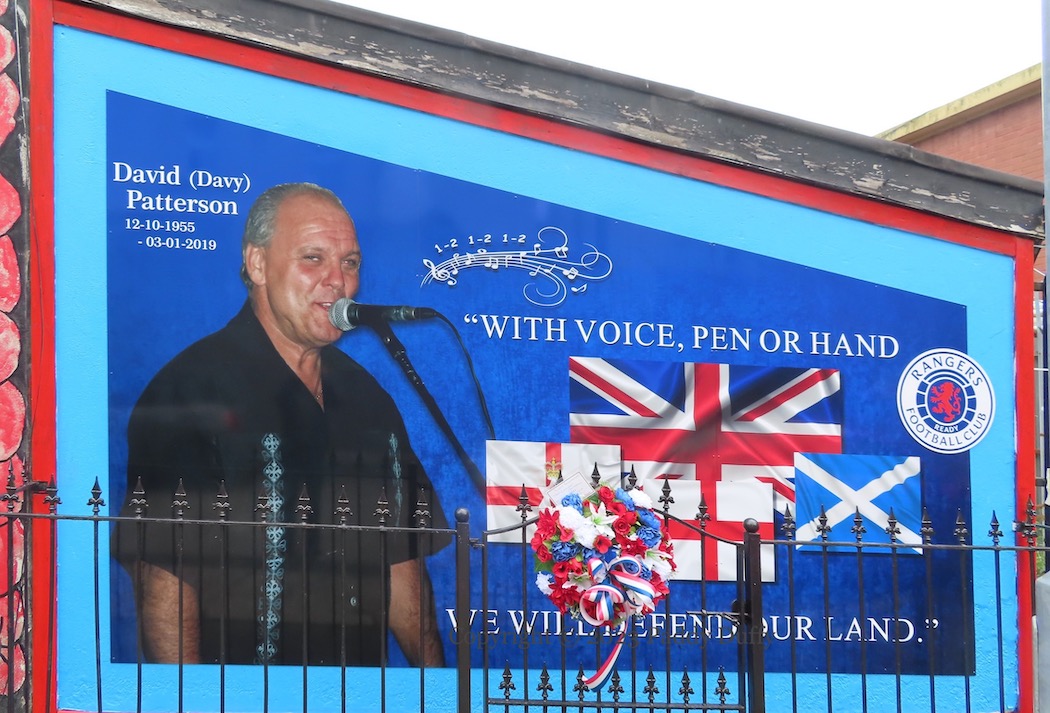
“With voice, pen or hand we will defend our land.” David (Davy) Patterson (12-10-1955 – 03-01-2019) was a member of the 1st East Belfast Rangers Supporters Club (Fb) and Albertbridge Glentoran Supporters Club (Funeral Times). This memorial board is the side-wall to the Somme Society mural (see Their Name Liveth Forevermore) and the Red Hand Commando memorial garden in Hunt Street, east Belfast.
Click image to enlarge
Copyright © 2023 Paddy Duffy
T03157 [T03156]

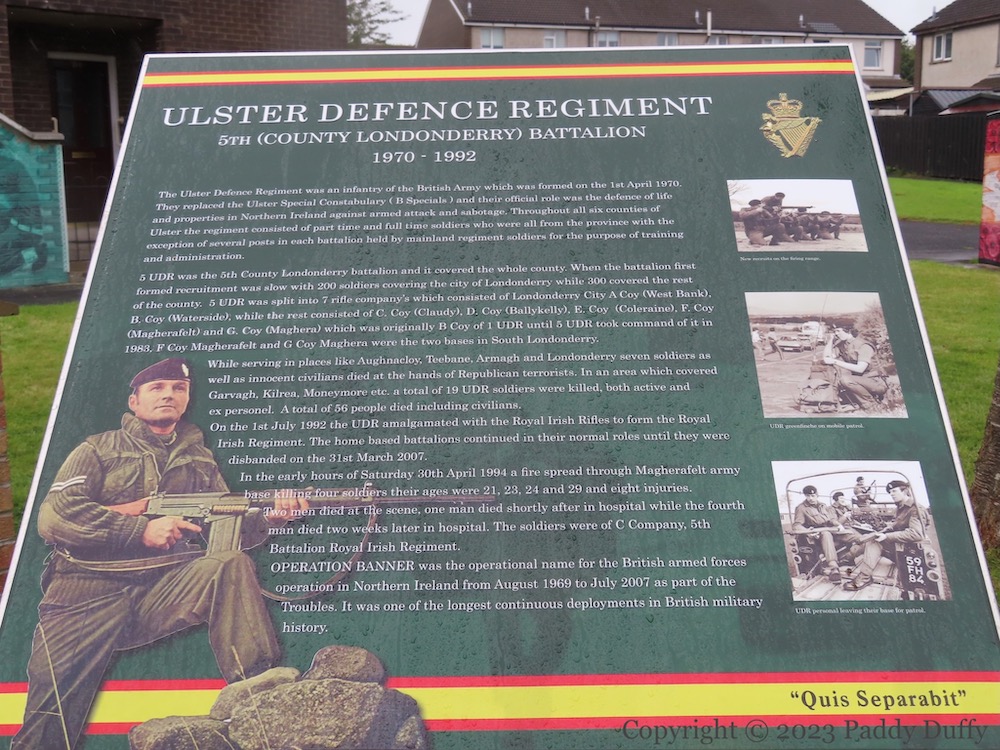
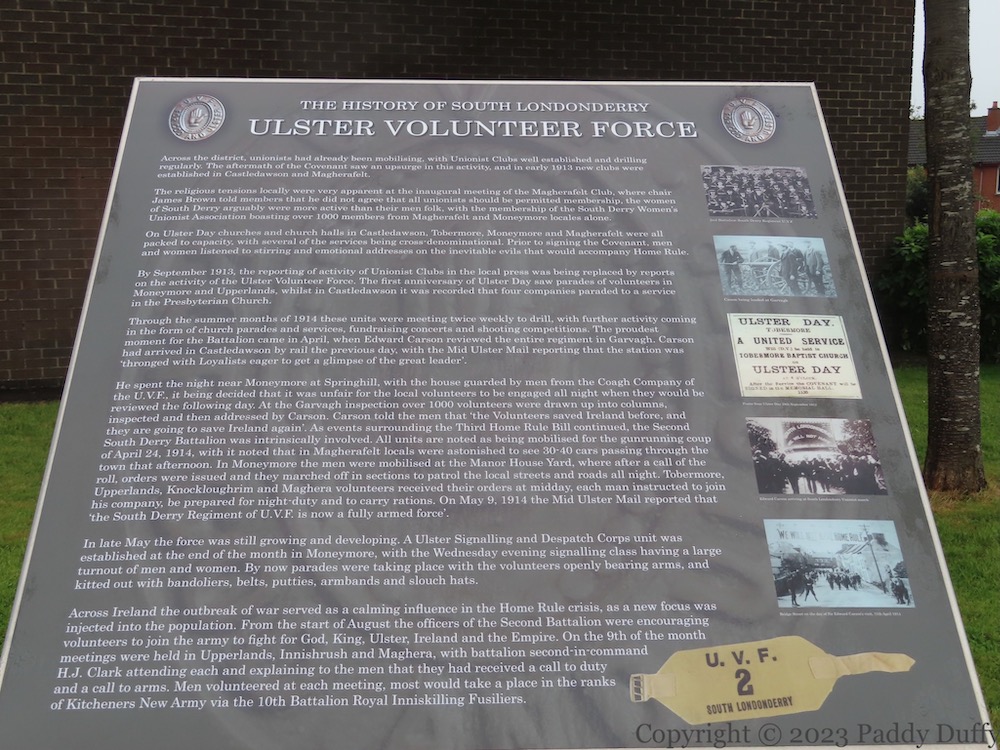
This selection of images from Leckagh Drive, Magherafelt, focuses on the memorials to the dead of WWI (and WWII in the mural above), with an additional board commemorating the UDR 5th (County Londonderry) battalion); there is also a mural and some plaques commemorating (modern-day) UVF volunteers, which will be in tomorrow’s post.
The board shown in the final image provides a history of the South Londonderry volunteers from towns such as Magherafelt, Castledawson, Moneymore, and Tobermore. Edward Carson reviewed the volunteers in April 1914. Later that same month, arms were received from the weapons landed in Larne. In the Great War, the men from the area served in the 10th battalion of the Royal Inniskilling Fusiliers in the 109th brigade of the 36th Division.


Click image to enlarge
Copyright © 2023 Paddy Duffy
T03155
T03142 [T03141]
T03143 T03144 T03146

“Always remembered by the officers and volunteers of South Londonderry/Randalstown Ulster Volunteer Force.” This memorial mural and plaque in Magherafelt names Charlie Wright, Jonathan Wallace, Ken Wilkinson, and Ian McArthur.
Of these, Wilkinson seems the most well-known, as he served as a PUP representative for the area. He commented on sectarian tensions in Randalstown in 1999 (An Phoblacht) and in Coleraine in 2009 (Irish Examiner), and spoke against sueprgrass trials in 2011 as a member of FAST (Irish Times | see previously FAST and FASTing For Human Rights And Justice); he was accused of intimidation of Catholics in Antrim in 2003 (An Phoblacht). He stood for a number of elected positions (e.g. 2013) but was unsuccessful.
Ostensibly for his stand against drug-sellers, in 2010 a pipe-bomb (BBC), and in 2011 a make-shift car-bomb (BelTel), were placed against his home and he received death threats in 2013 (politics.ie). He died in 2021 (BelTel | News Letter | Irish News).
The plaque in the memorial garden (shown below) reads, “This plaque is dedicated in memory of all of the loyalist people of Ulster who have suffered at the hands of the enemies of our land. Lest we forget.”
The mural in the background can be seen in Leckagh Remembers The Fallen.
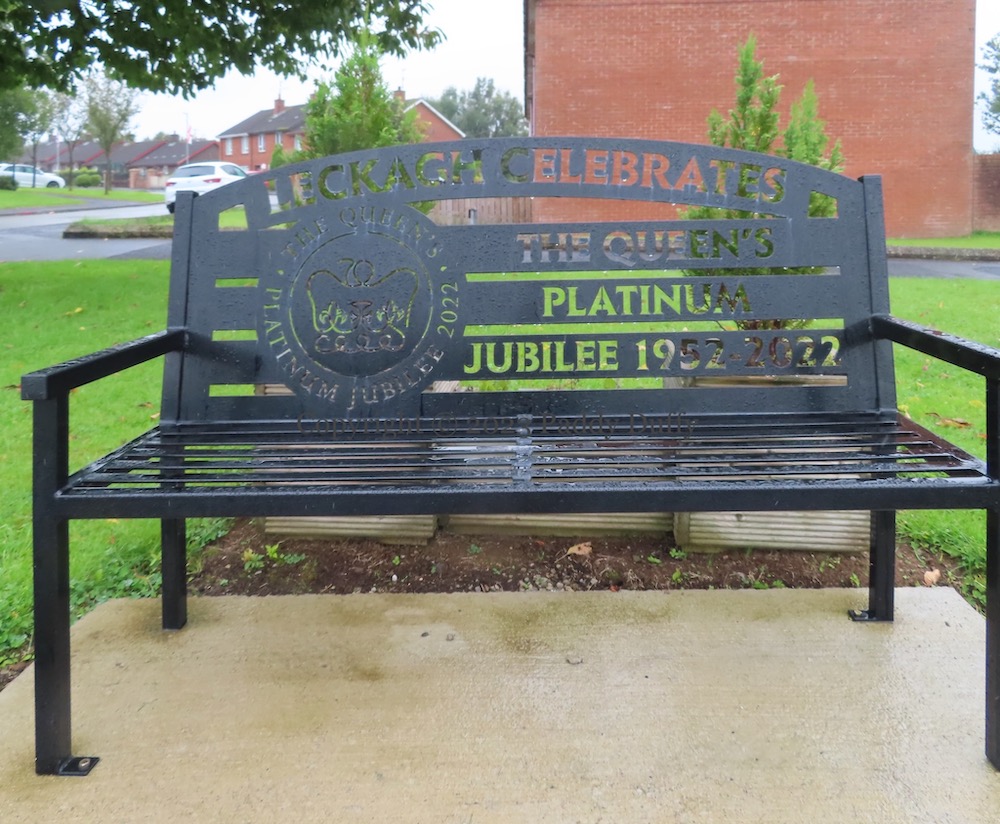
Also included is a nearby bench celebrating the platinum jubilee of Queen Elizabeth II.
Leckagh Drive, Magherafelt.


Click image to enlarge
Copyright © 2023 Paddy Duffy
T03151 [T03152] T03153 [T03154]
T03147
T03145

This UDA board on the eastern side of the Leckagh estate names six men who “gave everything in defence of our civil and religious liberties”: Lindsay Mooney (remembered also in the Fountain and Lincoln Court areas of Londonderry), Benny Redfern (this board replaces a board dedicated to Redfern alone), Cecil McKnight (Waterside), Gary Lynch (Waterside), Ray Smallwoods (Lisburn), William Campbell (Coleraine).
“North Antrim – Londonderry – Tyrone brigade”, “Remembered by all South Londonderry & Tyrone 6th batt.”
For the Ulster Volunteers/UVF memorials in the middle of the estate, see Leckagh Remembers The Fallen and Pause, Reflect, Remember.
Click image to enlarge
Copyright © 2023 Paddy Duffy
T03148
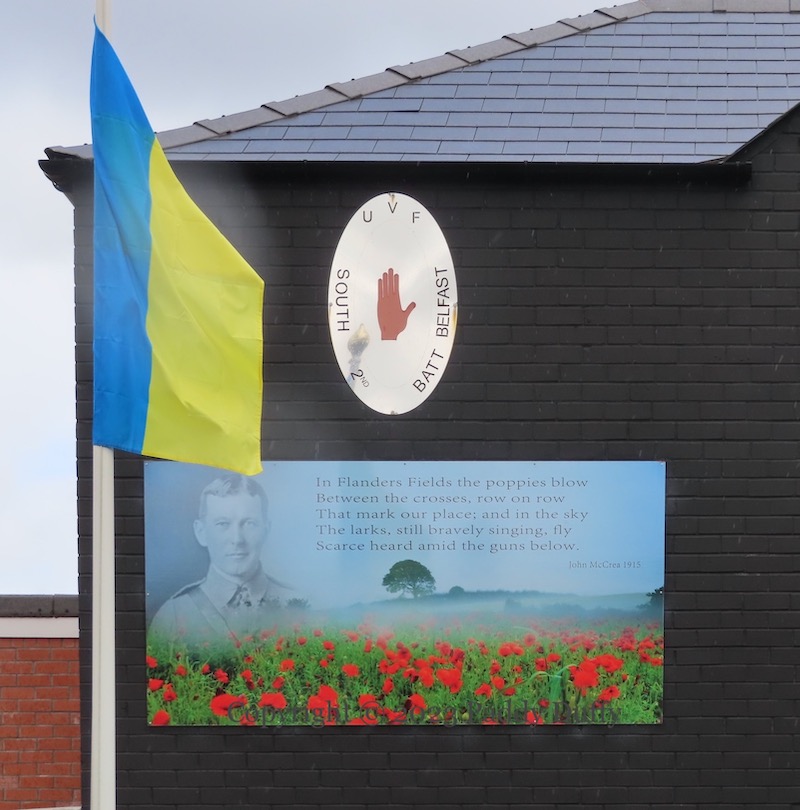
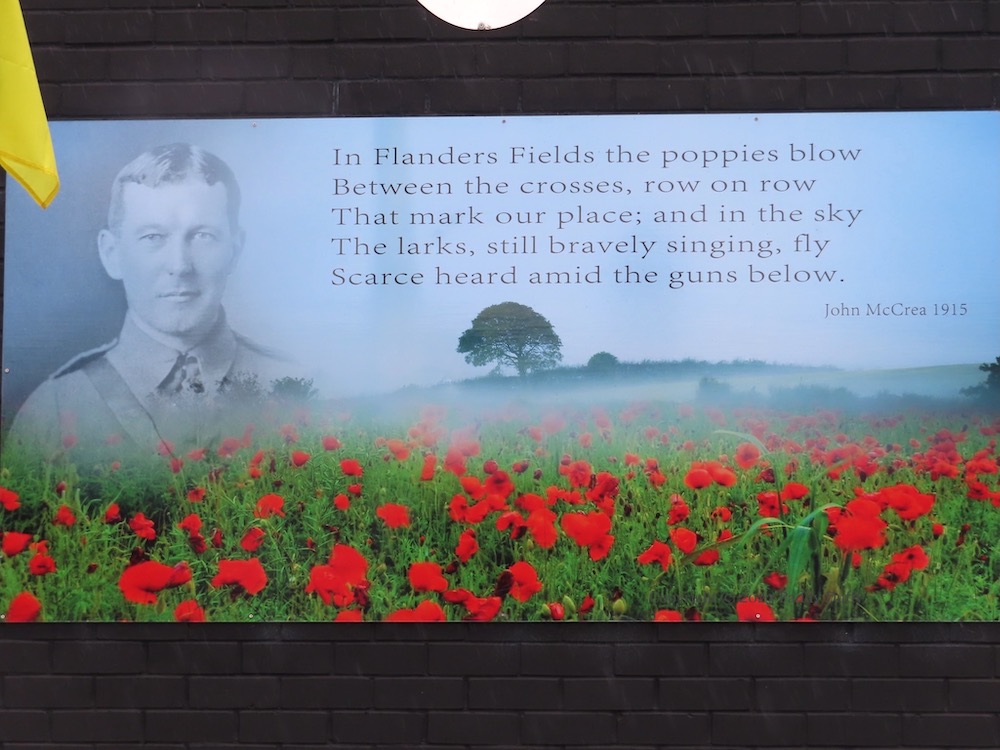
The house next to the Village memorial garden got an extension at the back in 2020 and with it the left-hand part of the house’s gable wall was extended upward (compare with the images from 2017 in Continuing Conflicts). The board with a verse from McCrea’s In Flanders Fields was present previously, but has been raised, and above it there now stands a red-hand emblem of the “UVF 2nd batt. south Belfast”.
Click image to enlarge
Copyright © 2023 Paddy Duffy
T03093 T03092
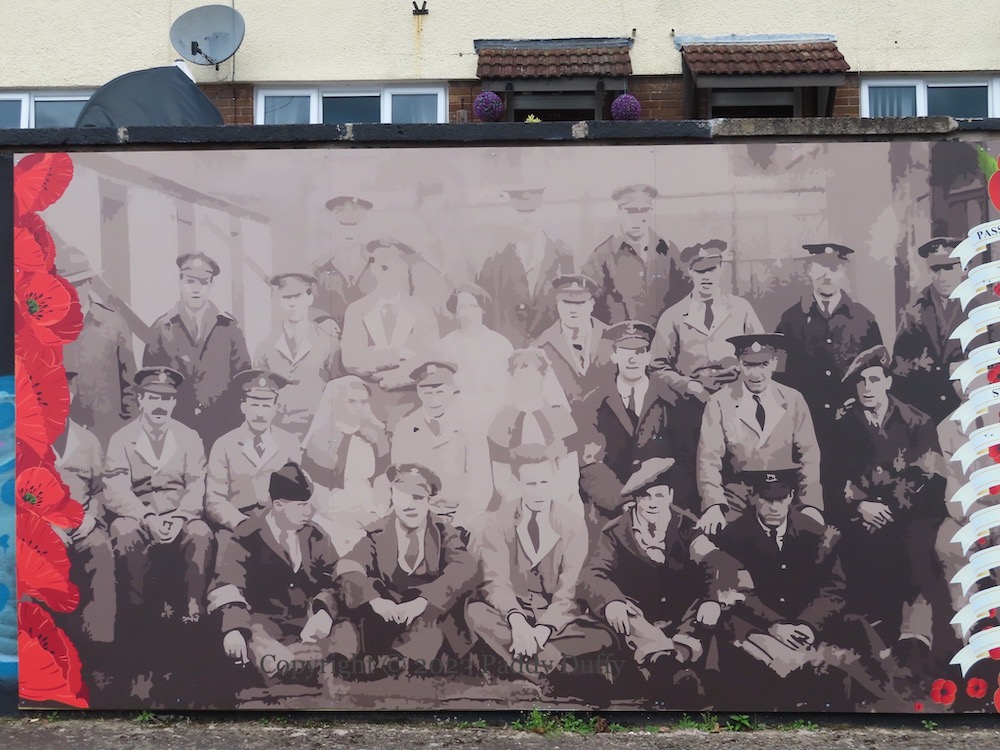
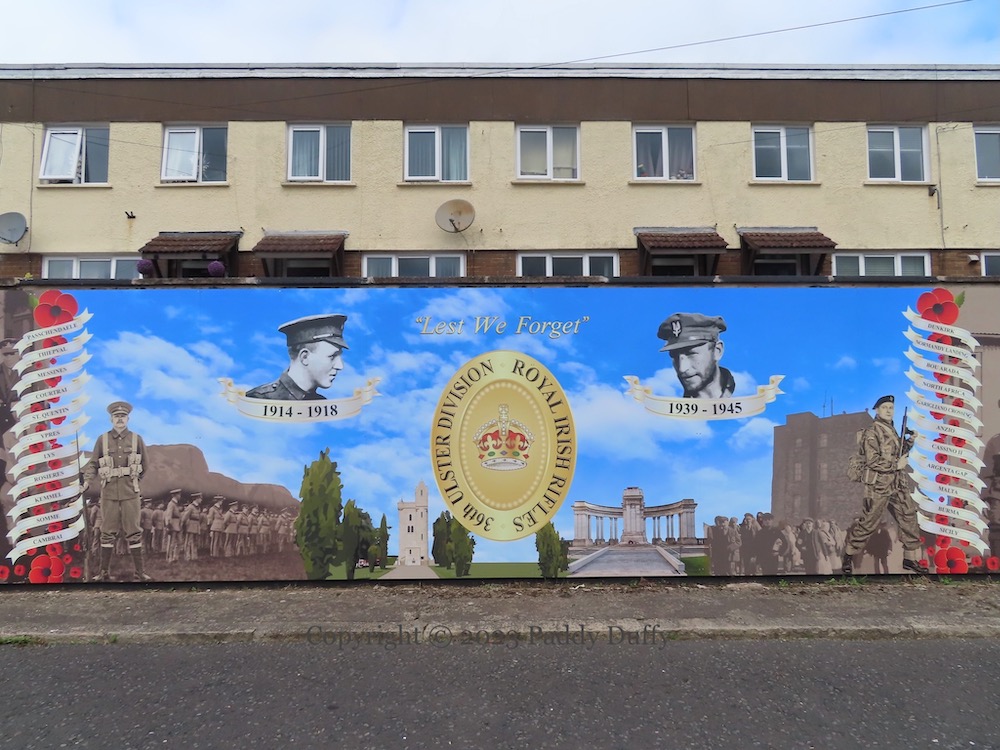
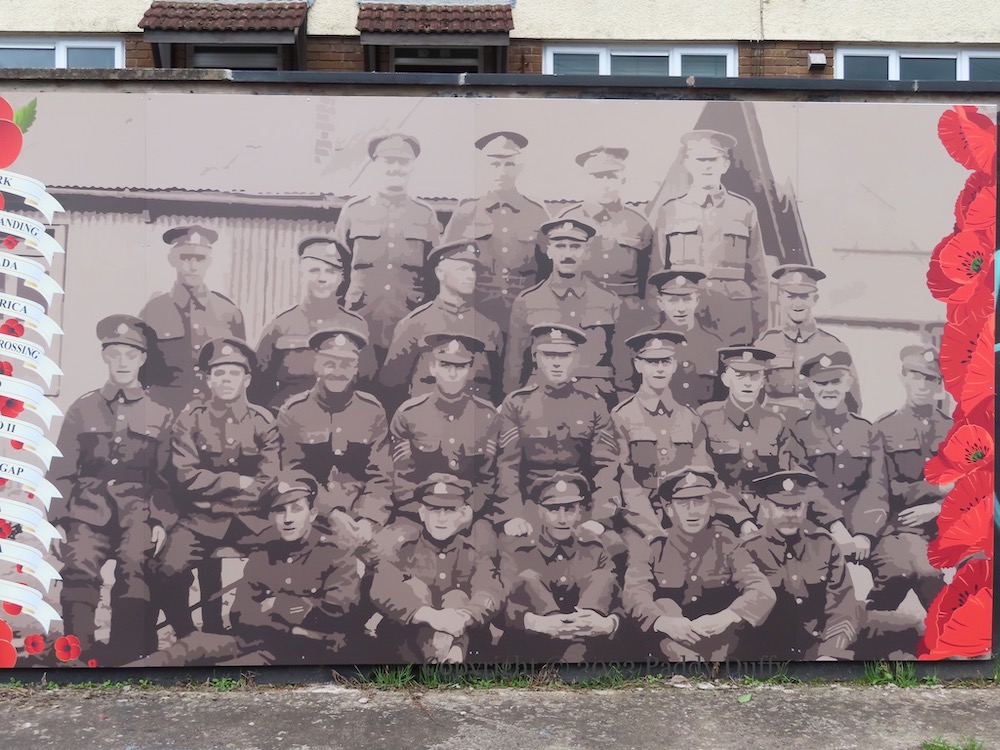
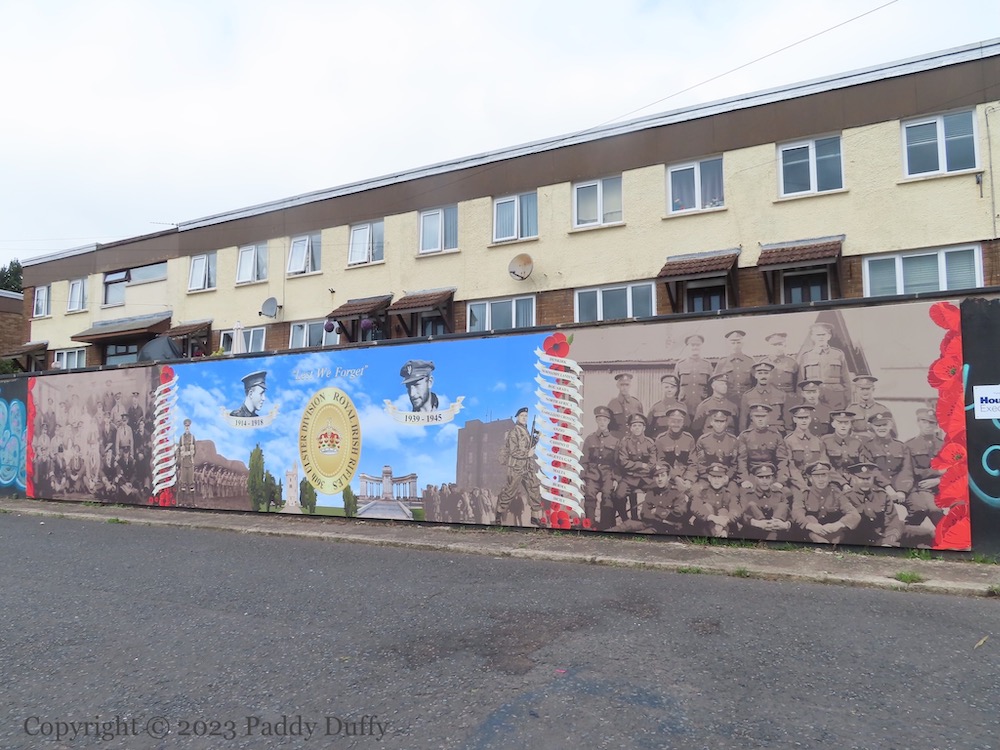
After WWI, the Royal Irish Rifles became the Royal Ulster Rifles (and later became part of the Royal Irish Rangers). This board prioritises WWI as the Rifles were part of the 36th Division. The hero of WWI portrayed in the central panel is William McFadzean, awarded the VC for falling on two live grenades in the trenches on July 1st, 1916. McFadzean is familiar from many previous murals both individually and in the company of other VC winners; for his family home in Cregagh, see Rubicon.
Alongside McFadzean, the hero of WWII is Blair “Paddy” Mayne, who was only briefly in the Ulster Rifles before making his name in the Parachute Unit (later, and better, known as the SAS). His many medals of honour are shown in an old Newtownards mural, though he was denied the VC.
Click image to enlarge
Copyright © 2023 Paddy Duffy
T03128 T03129 T03130 T03127

This is the new Sam Rockett mural in the Woodvale, replacing the mural seen in Murdered By Cowards. The old mural just featured Rockett, who died in August, 2000, in the feud between the UVF and lower Shankill UDA. This new mural also features the “ethnic cleansing” of Torrens in 2004.
Torrens sits between Cliftonville, Ardoyne, and the lower Oldpark, and was one of the many historically mixed areas in north Belfast that, with the Troubles, became increasingly segregated and separated from neighbouring areas by “peace” lines. Jarman (1996) provides eye-witness testimony of the dispute in Torrens in 1996 which saw Catholic families leave the area. Its proximity to Ardoyne (and Cliftonville), however, meant that over the next few years the houses were gradually abandoned by Protestants, culminating in 2004 when ten of the remaining Protestant families moved out of the area, alleging persistent intimidation and employing the term term “ethnic cleansing” – a term the poem to the right of the mural uses three times.
The area was eventually redeveloped from 2008-2012, with the Wyndham Street “peace” line coming down and Elmgrove Street being opened to the Oldpark Road.
The line in the poem “the resistance formed a steady band” is unclear – it might refer to loyalists being bussed into Torrens in 1996 (see the testimonies in Jarman); if it refers to B Company it would make a connection to Rockett. As it is, the connection between the two elements of the mural (if any is intended) seems to be that Rockett was from the lower Oldpark, near Torrens.
Sources:
John Darby, Intimidation In Housing, 1974. At CAIN.
Neil Jarman, On The Edge, 1996, which also covers the exodus from nearby Cliftonpark Avenue. At CAIN.
1996 AP footage on youtube
2004: BelTel | BBC | Guardian | Republican News | An Phoblacht
“In the name of Ireland’s cruel game/Oh, land that once sang freedom’s song/Now marred by ethnic cleansing’s wrong.//Echoes of anguish haunt the Protestants of Torrens,/Ethnically cleansed, a sinister goal,/Their weapon honed, to exact a toll.//Families robbed of essence and space,/fuelled by hated, to erase their trace.//Against the darkness, spirits sincere,/Hand in hand across the land,/the resistance formed a steady band.//Ethnic cleansing’s horrors unveiled at last,/Hearts of courage, unbreakable souls,/Truths unfurled, their power untold,/A captured scene of the evil deeds done.”
The in-progress images are from August 17th and 18th. The mural was completed for the anniversary of Rockett’s death on August 23rd. The source for the central image (of furniture being loaded into a lorry) is unknown.


Click image to enlarge
Copyright © 2023 Paddy Duffy
T03131 T03132
T03097 [T03098] T03124

RNU unveiled a new monument in Milltown as part of their Easter Rising commeration on April 9th, 2023. This photo of it is on a new board on the Falls Road, next to the Rook O’Prey board.
For the stone itself, see An Attitude Of Rebellion. There do not appear to be any images of the new monument on the RNU Fb or tw accounts.
“Republican Network For Unity. Erected by the Belfast Commemoration Committe[e]. Miltown cemetery Easter 2023.”
Click image to enlarge
Copyright © 2023 Paddy Duffy
T03134

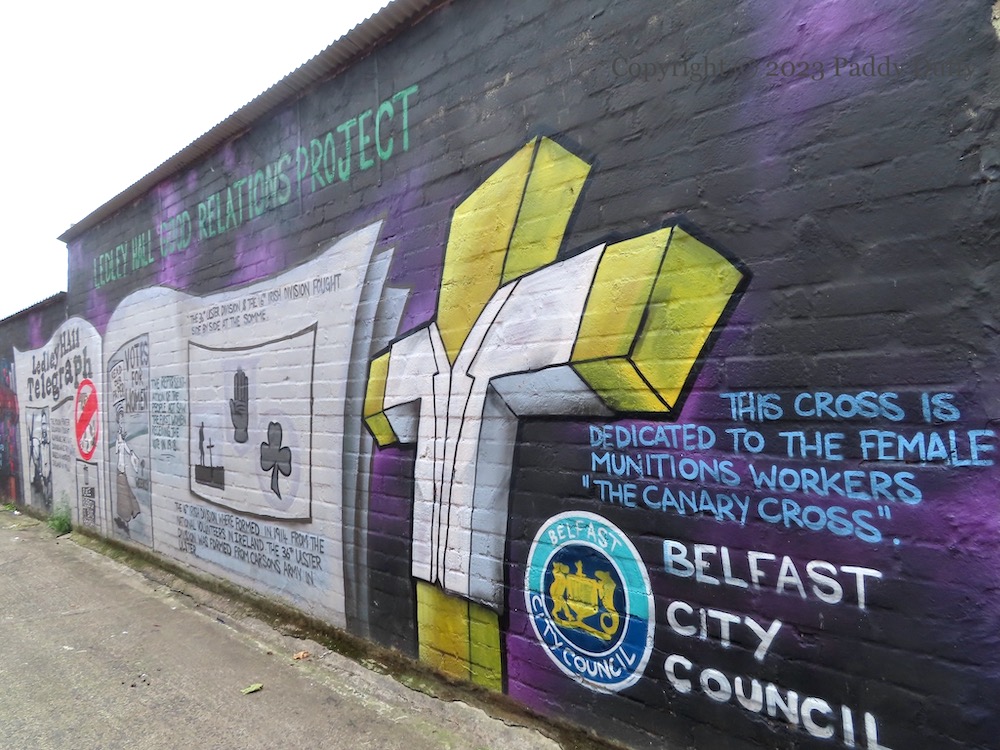
An imaginary newspaper called the “Ledley Hall Telegraph” includes stories on the 303 (Polish) RAF Squadron (which was stationed in Northern Ireland from 1943 to 1944), “Votes for women” (“the Representation Of The People Act saw the first women receiving the vote in 1918”), and the 16th and 36th Divisions (the mural says they “fought side by side at the Somme” – but the 36th was withdrawn on July 2nd after the Battle Of Albert and the 16th arrived in September and fought in the battles of Guillemont and Ginchy; both were withdrawn to Messines and both would take part in the Battle Of Messines in June 1917).
The “newspaper” is bookended by two painted crosses (for Row On Row), one for Guardsman Connor Lilley, a member of the Gertrude Star flute band, who was serving with the 1st battalion Royal Irish Guards when he was killed in an accident in Canada (Fb), and the other for WWI female munitions workers who, because of their work with TNT, risked yellowing skin both from direct exposure and from liver damage (“toxic jaundice”) (WP).
Also included is “The Kindness Hut”: “Be the reason someone smiles today”, “Kindness is free – please share”, “In a world where you can be anything, be kind”, “Take only what you need! If everyone shares there’s enough to go around”.


Click image to enlarge
Copyright © 2023 Paddy Duffy
T03135 T03136 T03137 T03138 T03139 T03140 Ledley Hall Good Relations Project Ledley Hall established 1942
 Paddy Duffy Collection