“Nothing great and durable can be created without the presence of an elite – UDA/UYM/UFF” The quotation seems to be a UDA creation, used here of the Dee Street, East Belfast, UFF.
“Consolidate the peace – release east Belfast’s loyalist prisoners”. As for republicans, the release of political prisoners – specifically UDA prisoners in this case – was for loyalists the most immediate potential benefit of the peace process. “We forget them not – LPA”
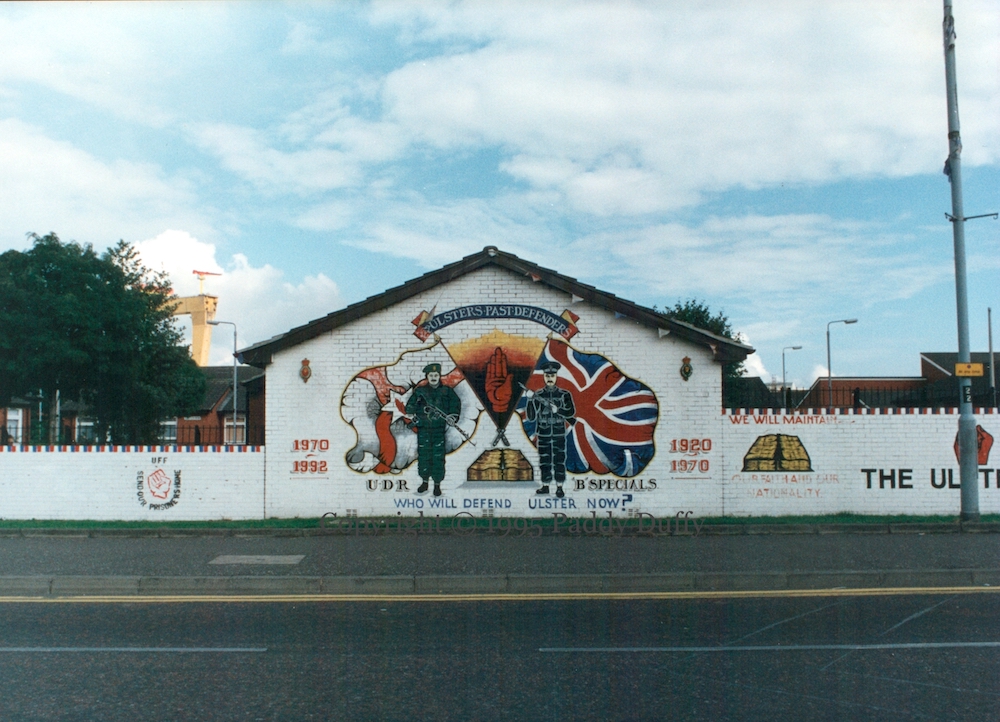
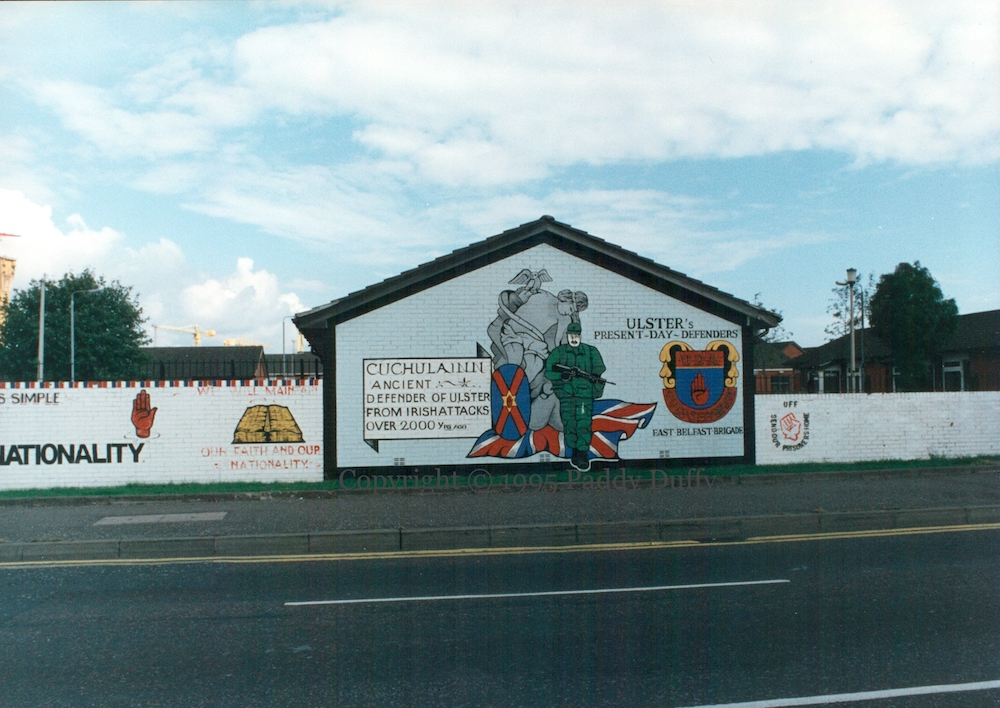
Here is a gallery of the one-storey gables along the Newtownards Road, east Belfast, that is being called “Freedom Corner”, perhaps in imitation of Free Derry Corner (Visual History).
The two low walls between the first-and-second and third-and-fourth gables are blank except for small stencils reading “Send our prisoners home” (for a close-up on shutters on the other side of the street, see the Peter Moloney Collection). The issue of POWs is a shared concern of loyalists and republicans in the (public) discussion surrounding the ceasefire and the peace process and these stencils are from 1994 or 1995. The rest of the pieces date back to 1991 (or 1992).
First is a UFF and LPA/LPOW pair. On the side-wall “Their only crime is loyalty – we forget them not”. The main wall shows a hooded volunteer and rifle, with the “U” of “UFF” wrapped in barbed wire. (The words “East Belfast Brigade” would later be added in the middle.) The quote is modelled on the Declaration of Arbroath: “For as long as one hundred of us remain alive we shall never in any way consent to submit to the rule of the Irish, for it is not for glory we fight but for freedom alone which no man loses but with his life.” (Originally, “for, as long as but a hundred of us remain alive, never will we on any conditions be brought under English rule. It is in truth not for glory, nor riches, nor honours that we are fighting, but for freedom – for that alone, which no honest man gives up but with life itself.”)
The second gable shows two figures from “Ulster’s past defenders”, the B Specials and the Ulster Defence Regiment. The UDR replaced the Specials in 1970 but in 1992 was amalgamated with the Royal Irish Rangers to become the Royal Irish Regiment. Although seven battalions of the new RIR were permanently based in Northern Ireland, the mural asks “Who will defend Ulster now?” (The answer is on the next gable.)
The third gable makes Cú Chulaınn (Visual History) – the “ancient defender of Ulster from Irish attacks over 2000 years ago” – a precursor of the UDA’s East Belfast Brigade, “Ulsters present day defenders”. The volunteer is – unusually – unmasked; it might be Ian Adamson (a civilian, but here given paramilitary gear) the UUP politician and proponent of the hypothesis that north-east Ulster was settled by settlers from Scotland – the Cruthin – who were at war with the Irish Gaels and that the Táın describes part of this conflict, with Cú Chulaınn the hero of Ulster single-handedly holding off the invaders from Connacht (WP).
This is a repainting of a 1992 mural (see M00959) and the main difference is that the shield was previously decorated with an Ulster Banner, whereas it is here decorated with the flag of the independent Northern Ireland proposed in the UDA’s policy document Common Sense, a St Patrick’s cross on a blue background with six-pointed star and red hand.
Fourth: Young Newton was a “tartan” youth gang in the early 1970s whose members joined the nascent “UYM” [Ulster Young Militants] circa 1974. The Young Newton were one of many tartan groups that joined the UYM/UDA, though the nearby Woodstock Tartan joined the Red Hand Commando.
The columns on either side are entwined with ribbons/banners reading “Our civil and religious / liberties we will maintain”, which is a paraphrase of King William III, who proclaimed as he landed in England in 1865, (in French) “the liberties of England and the Protestant religion I will maintain.”
There is a piece of “UVF” graffiti over the flag on the left. Again (as with the third gable), the flag is the flag for the independent Northern Ireland.
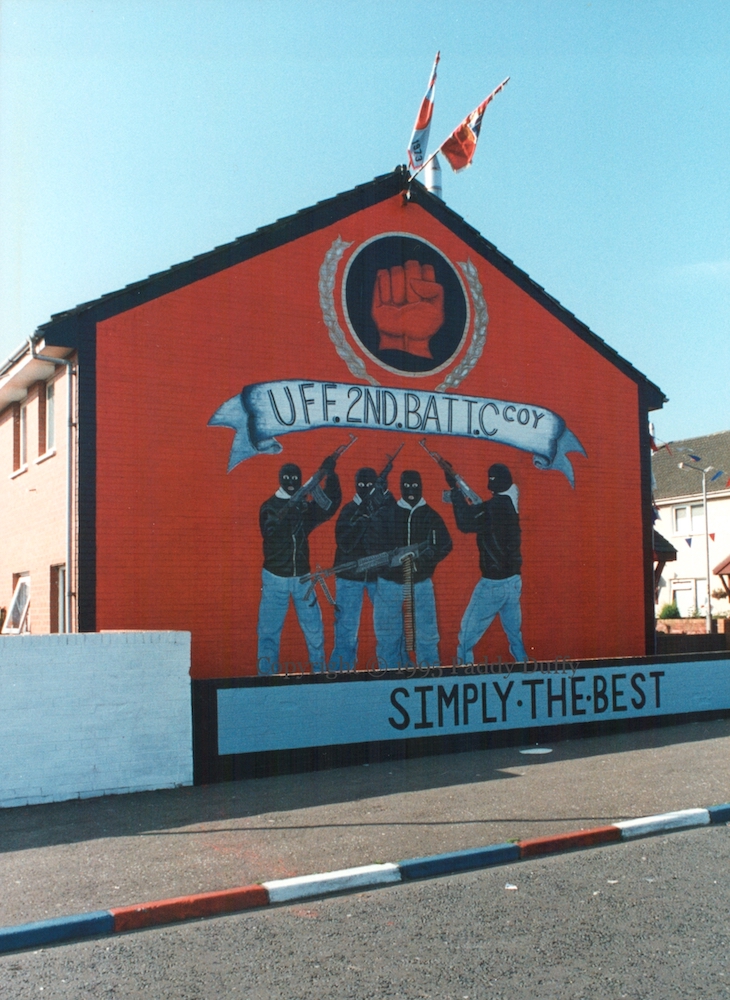
Tina Turner’s cover (youtube) of Bonnie Tyler’s song “The Best” reached #5 in the UK charts in 1989 and the phrase “simply the best” from the chorus would appear in a number of UDA murals over the years, beginning with this 1995 mural depicting hooded gunmen from the UDA/UFF’s second battalion C company.
Dover Place, west Belfast. This mural would be repainted in the Adair era to include a list of mass killings of Catholics.
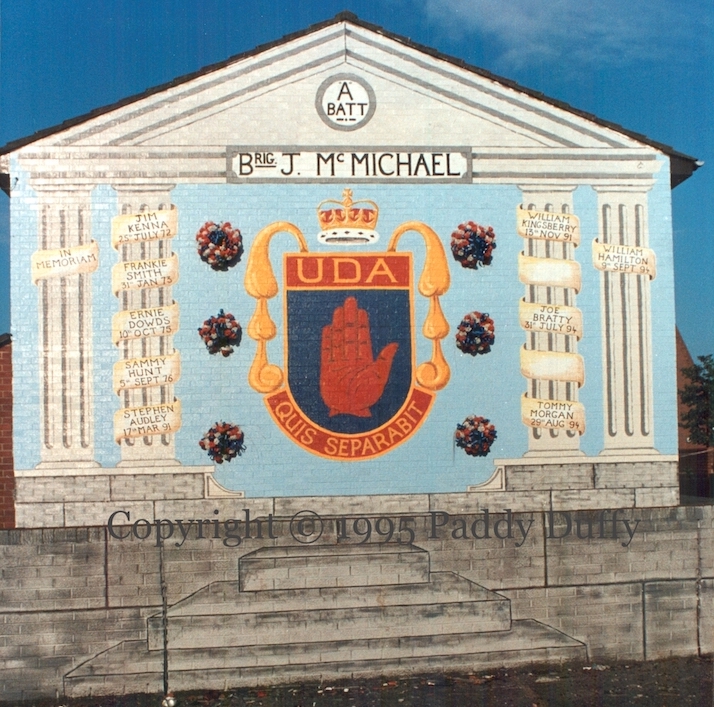
“In memoriam: Brig. J. McMichael, Jim Kenna, Frankie Smyth, Ernie Dowds, Sammy Hunt, Steven Audley, William Kingsberry, Joe Bratty, Tommy Morgan, William Hamilton”
UDA “roll of honour” mural in Rowland Way, Sandy Row, south Belfast
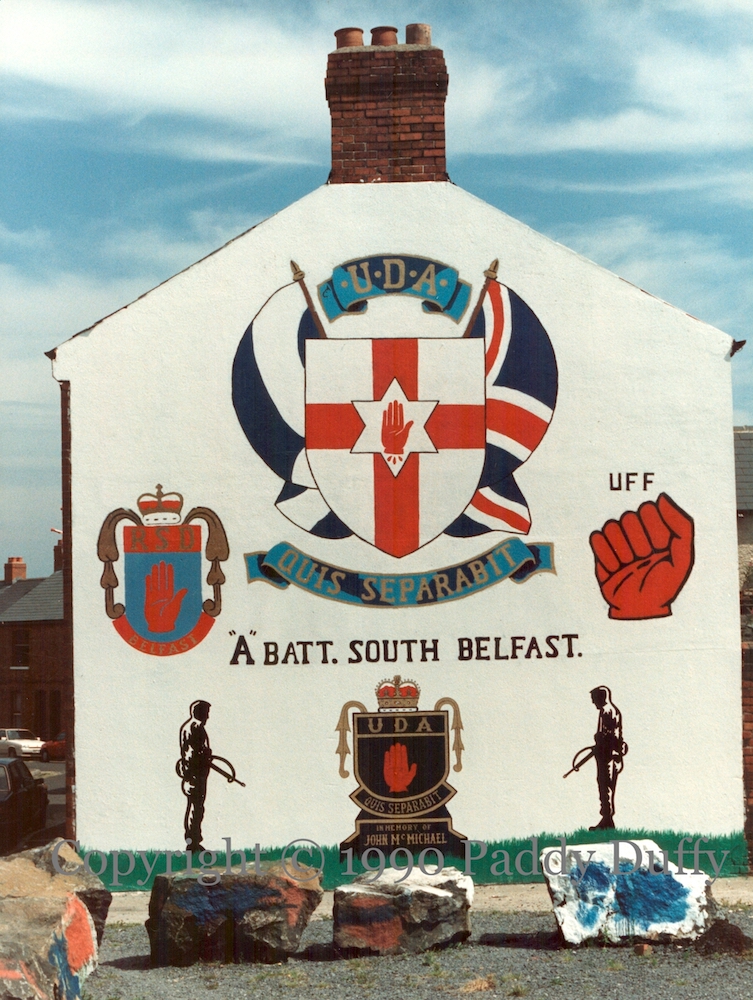
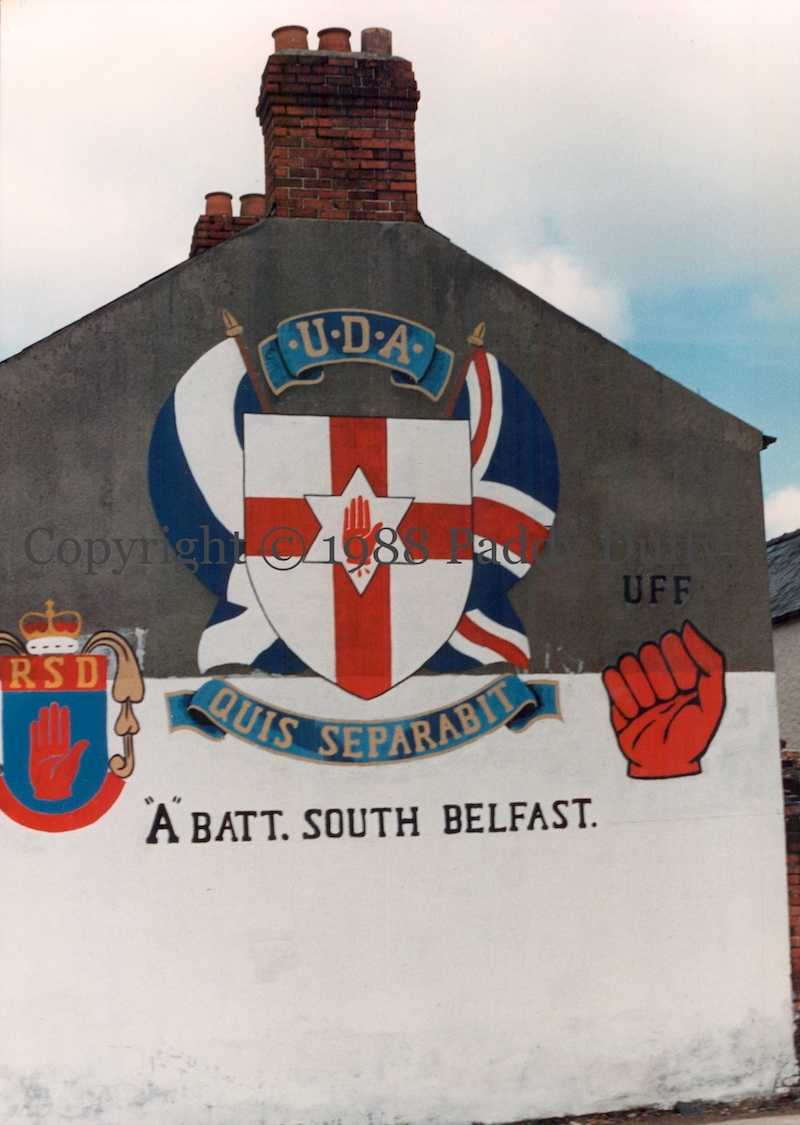
The mural at the corner of Roden Street and Donegall Road was repainted annually in 1989, 1990, and 1991. The first (see the image from 1988) lacked the McMichael memorial seen here and the white background only went half-way up the wall; the second completed the background, added LPA and UDF emblems and “In memory of John McMichael” in text (see C00525). This third iteration places the McMichael memorial and the attendant graveside mourners on a bed of grass.
“West Belfast Brigade UDA C Company”. UDA/UDF/LPA/UFF mural on the Shankill. (For a similar quartet of names and explanation of “UDF”, see Sans Peur.)
The title “First Ulster Defence Assoc.” is an attempt to tie together the defenders of Derry in 1688 (300th anniversary) with the modern Ulster Defence Association. This is an early attempt to give the UDA historical roots, beyond the Shankill and Woodvale Defence Associations. To this end, the group would adopt Cú Chulaınn (beginning in 1992 – see the Visual History page) and (beginning in 2007 – see UDU-UFF-UDA) the 1893 Ulster Defence Union as ancestors.
“UDA “A” batt. South Belfast. RSD [Roden Street Defenders (private Fb)] UFF”
This is the mural that greets travellers moving west along Donegall Road to the Village. The houses in Beit Street have been knocked down and their replacements, which face directly onto Roden Street, no longer reach all the way to Donegall Road, leaving this gable as a prime painting space.
These are murals from completing organisations, the UVF (above) represented by an Uzi above various flags and the emblem of the UVF, and the UDA (below) represented additionally by hooded volunteers on manoeuvres. They were together on the Crumlin Road, on waste-ground at the top of Queensland Street and at the top of Tasmania Street. On the gable next to the UVF flags large YCV and 36th Division emblems would be added – see the Peter Moloney Collection.