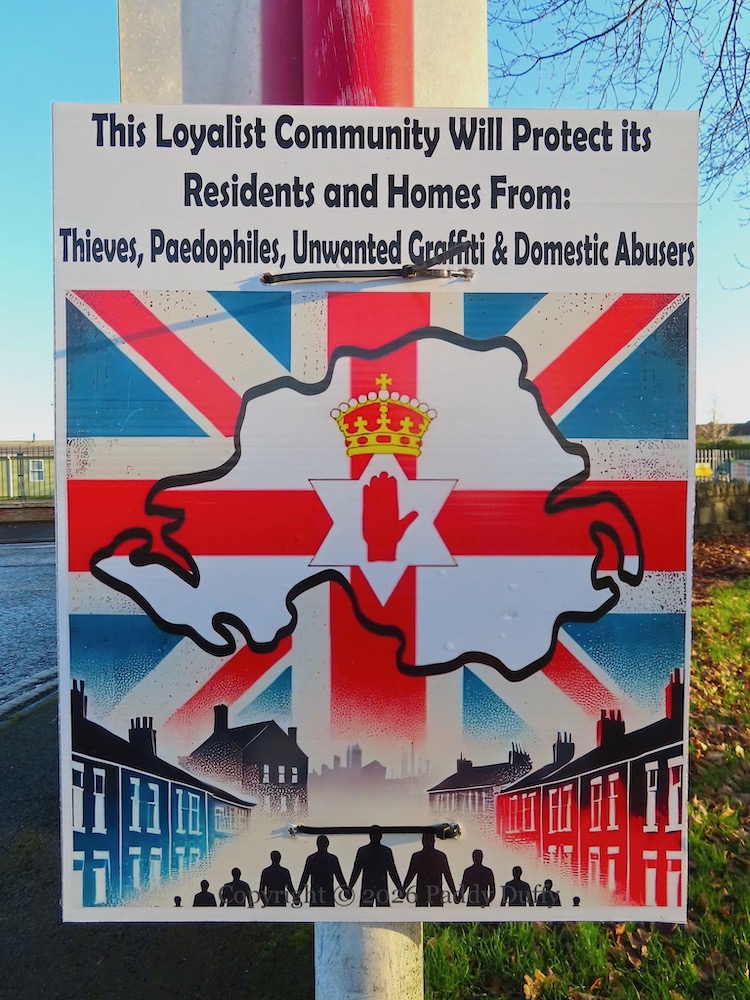
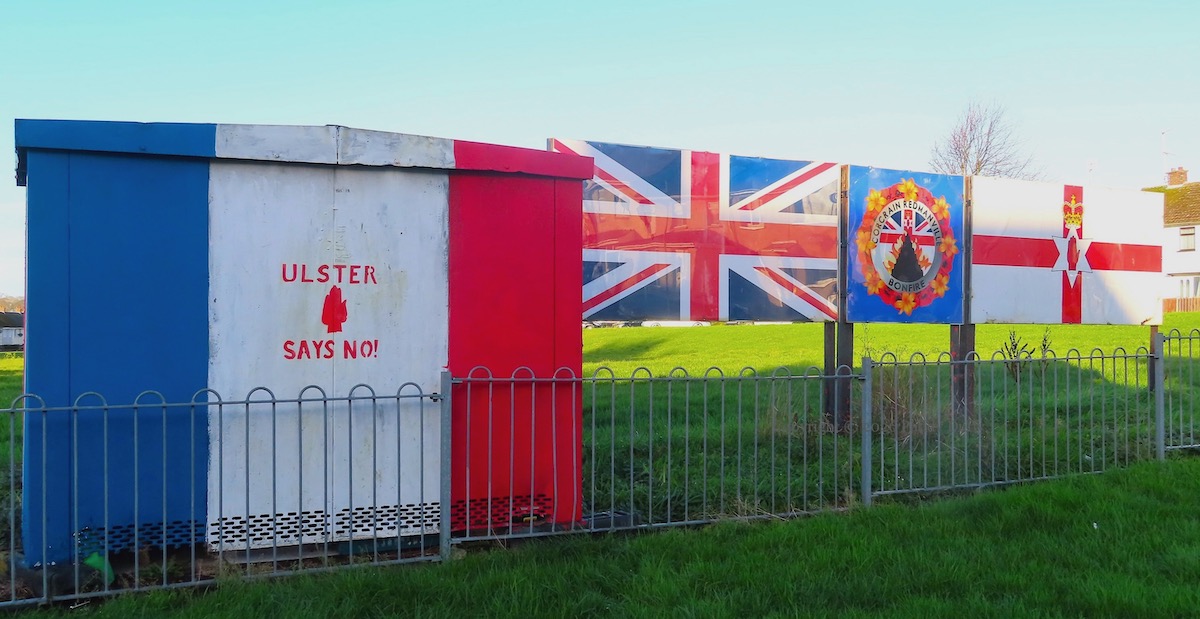
“The loyalist community will protect its residents and homes from: thieves, paedophiles, unwanted graffiti & domestic abusers.” The list of crimes makes no reference to denomination or ethnicity, but “loyalist” and the combined Union Flag (which is incorrectly rendered) and Ulster Banner suggest that the threat comes from those who identify insufficiently with the UK.
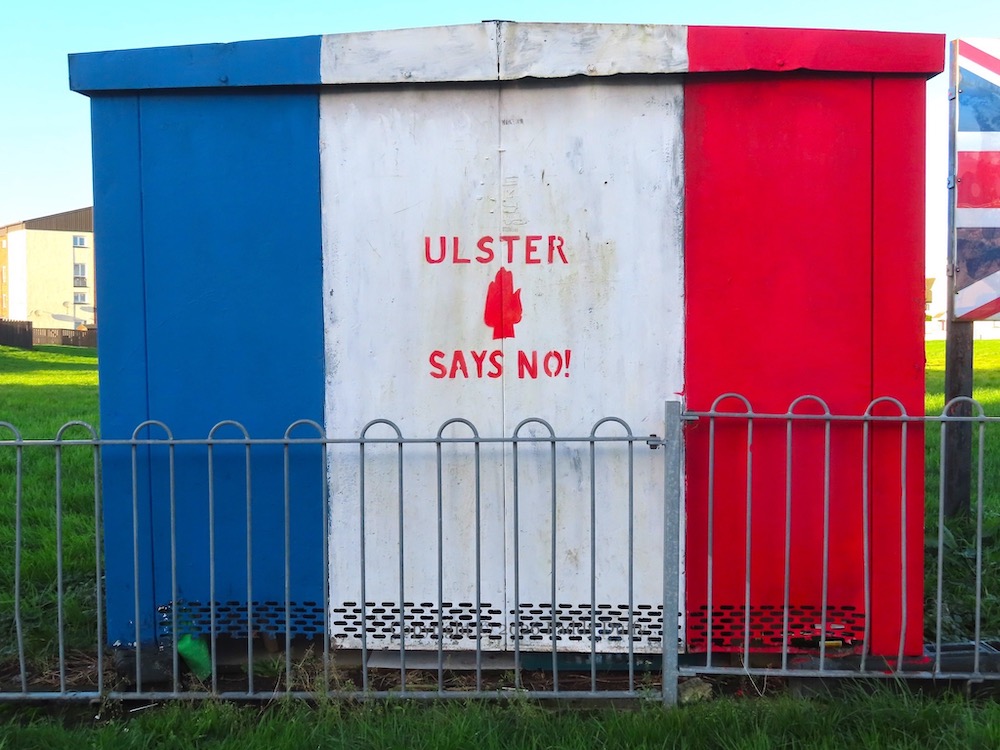
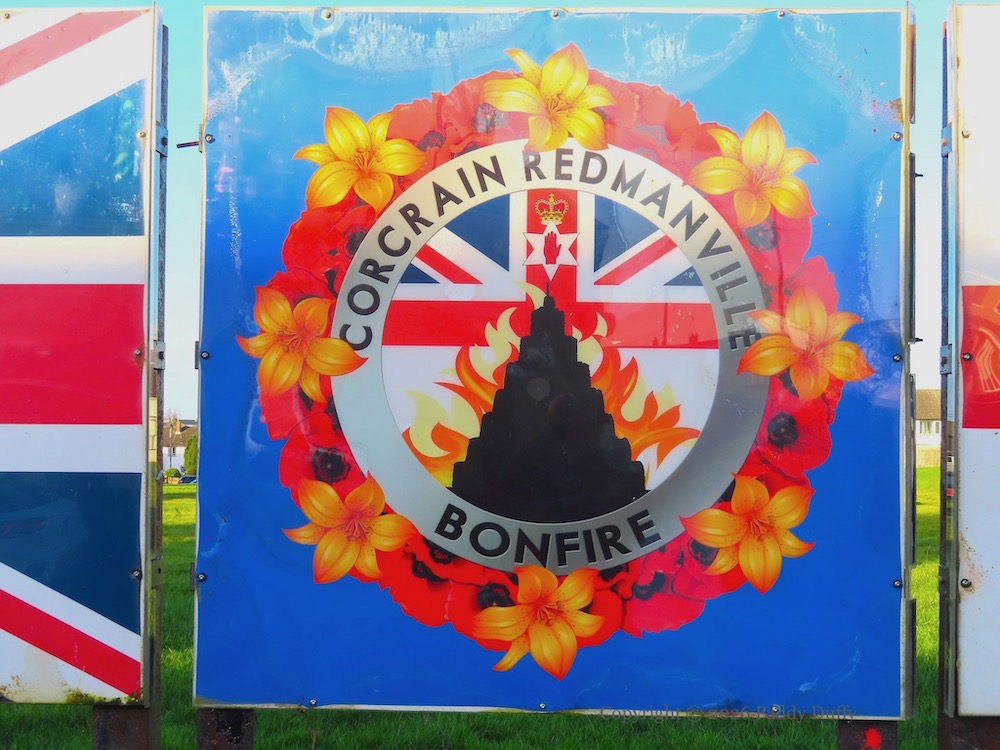
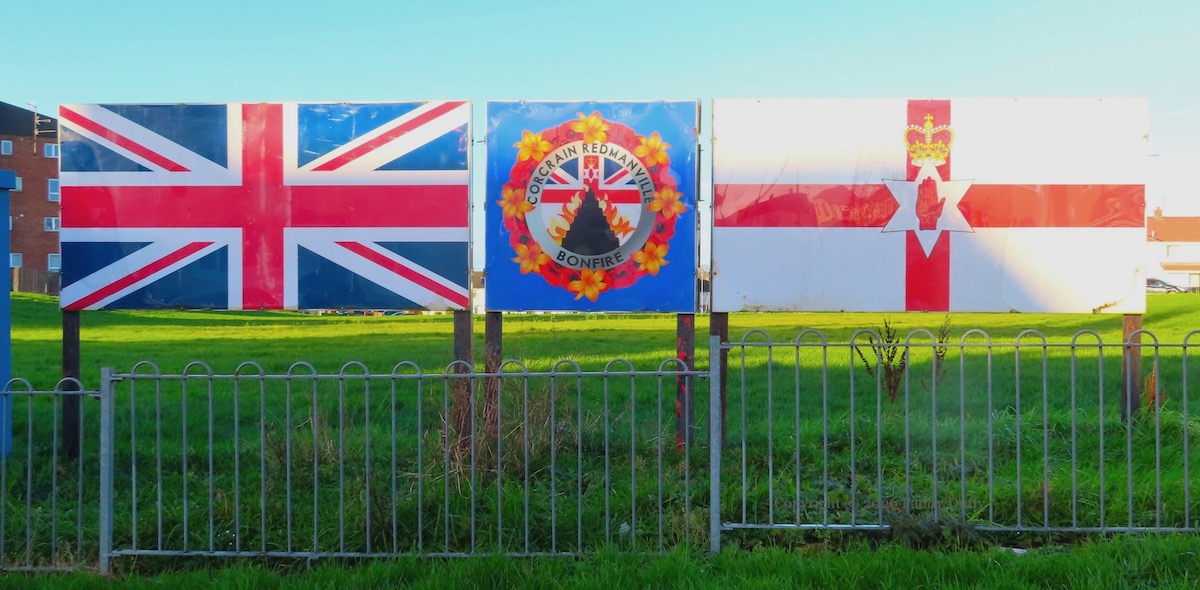
This is the scene at the Corcrain-Redmanville bonfire (Fb) site, along Drumilly Green, where the hut has been moved to the south side of the Green, to join the Union Flag and Ulster Banner.
The 2025 bonfire topped 100 feet in height (News Letter); collecting for the 2026 pyre has yet to begin.
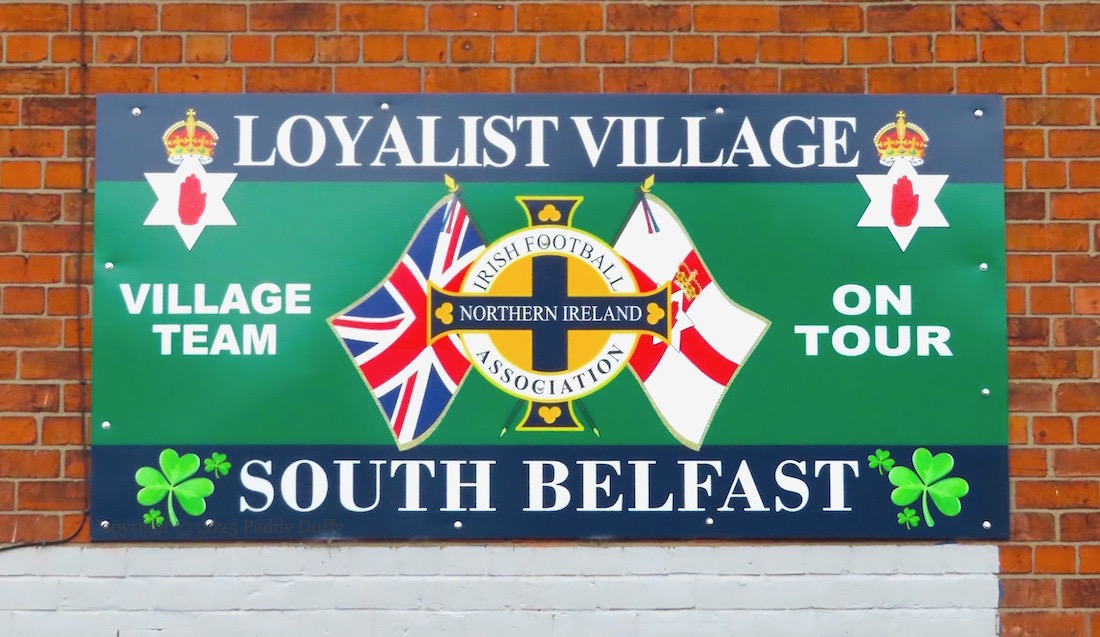
“Loyalist Village, south Belfast – Village team on tour.” This is a new printed board at the eastern edge of the Village in south Belfast. The association with the Northern Ireland soccer team (governed by the Irish Football Association) is perhaps an attempt to rehabilitate the name from the graffiti that appeared in 2015 (Welcome To Hell) and 2016 (Taigs Will Be Dealt With).
There is a “Linfield” version of this board, in red, white, and blue, in Tavanagh Street.
This board in Donegall Pass mashes together not only Linfield and Rangers, but a Union Flag and Ulster Banner, and soccer with WWI soldiers making their way through barbed wire.
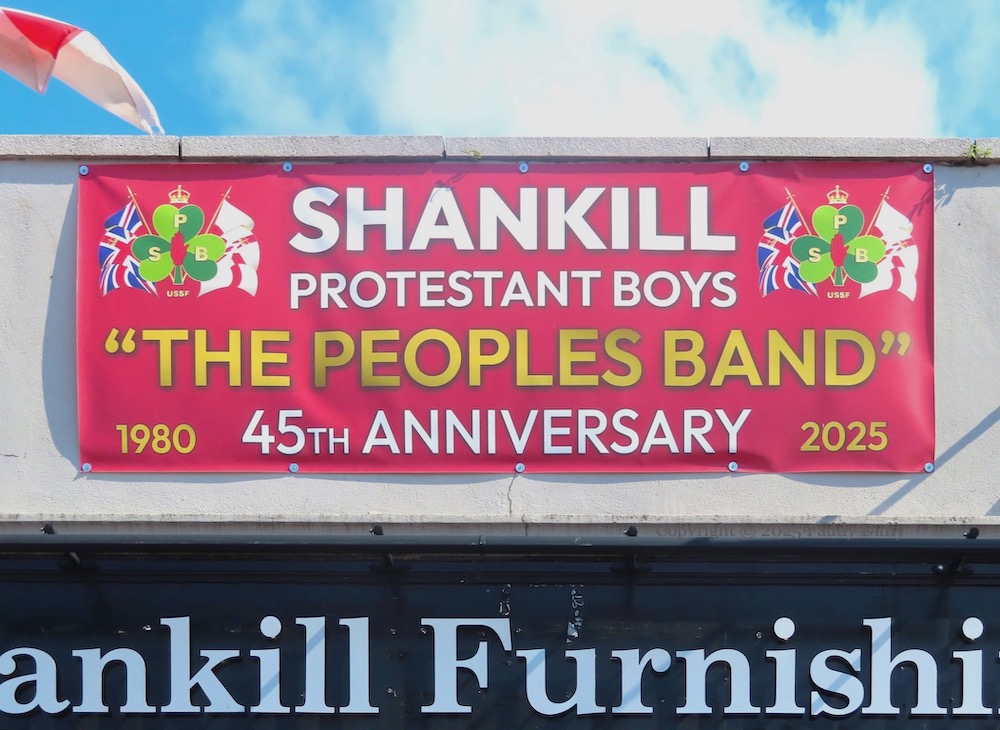
“Shankill Protestant Boys [Fb] “The People’s Band” 45th anniversary, 1980-2025.” The band held a parade on August 1st to commemorate the anniversary, with nearly forty other bands attending (Fb).
Six memorial plaques to members of the UVF’s 1st battalion (West Belfast), D company (Ballysillan) have been re-instated and two new one added alongside the 100 Years Of Conflict boards at Carr’s Glen. The plaques to Bingham, Phillips, McEvoy, the “officers and volunteers”, Stewart, and Taylor were on the old UVF mural on this wall (see the Peter Moloney Collection); the two new ones are to Kenny Howie and to Scottish supporters.
Left: “Lt Col John Dowey Bingham killed by the enemies of Ulster 14th September 1986. Remembered by officers and members of the 1st Batt D Coy Ballysillan. Lest we forget” [(WP)] “In memory of Major Patrick McEvoy. Lest we forget” “In memory of Kenny Howie 21.4.1977 – 8.4.2013. Lest we forget” “In proud memory of the officers and volunteers of D Company 1st Battalion Ulster Volunteer Force. For God and Ulster”.
Right: “In memory of Major Thomas Stewart. Lest we forget” [d. 1996 in a dispute over money (Irish Times | BelTel) “In memory of Martin Chin Taylor. Lest we forget” [d. 2000 killed by the LVF (BBC)] “In proud memory of Volunteer David (Davey) Phillips, taken by cowards Sunday 12th July 1998. Sadly missed by his friends and comrades of ‘D’ Company Ballysillan. Lest we forget” [possibly d. 1998 (BelTel)] “In memory of fallen volunteers 1st Battalion D. Company Ulster Volunteer Force Scotland”
Three plaques at the Ballynafeigh Apprentice Boys social club on Blackwood Street:
“In loving memory of Allison Jane Smith – you’re missed so much by so many who knew you in Ballynafeigh”, “Celebrating the 100th anniversary of the foundation of Northern Ireland – Northern Ireland centennial 3rd May 2021”, “In memory of all our past members”.
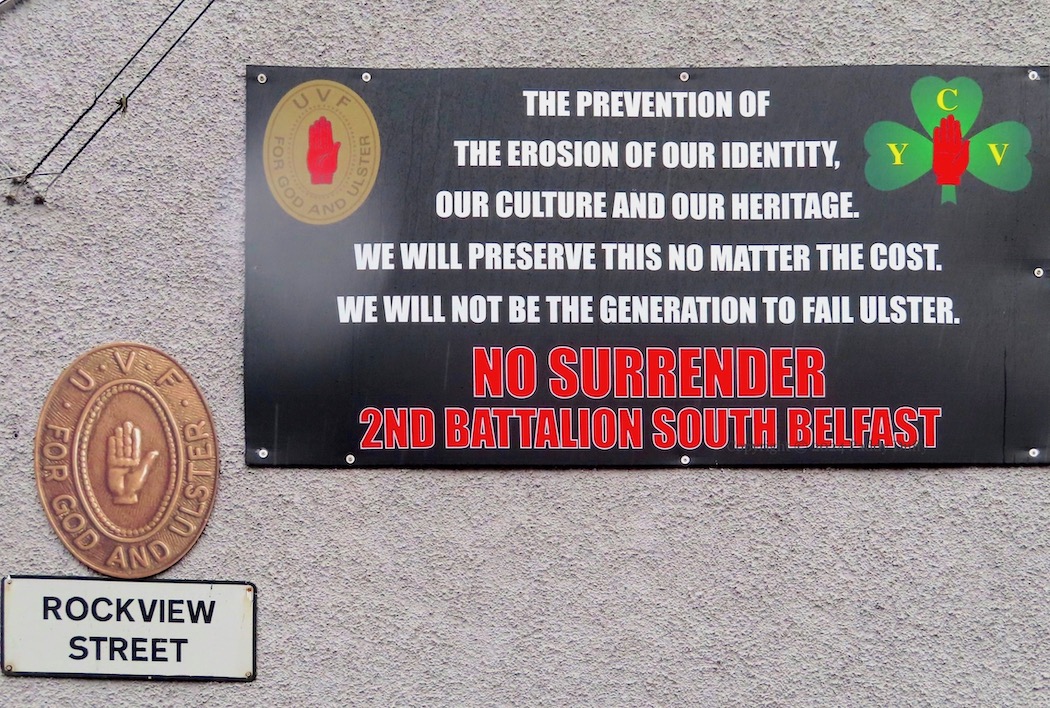
“Loyalist Village, south Belfast.” UVF markings in the Village continue to proliferate with the recently-added board shown above (from the top of Tavanagh Street) alongside a slew of other boards, some of which are included below.
The “Village team” is not Linfield FC but the UVF (the phrase was also used by the Village UDA); “VTOT” (standing for “Village team on tour”) has previously been used as graffiti – see Welcome To Hell!!!
The purple hoarding below gives “1913” as a creation-date for the battalion. The Ulster Unionist Council organised the signing of the Covenant in September, 1912, and in January 1913 voted to bring together the militias that had been formed in various places into an Ulster Volunteer Force. One of these was a South Belfast battalion that had formed in 1912 (History Ireland). Hence, both “1912” and “1913” are given as dates for the creation of the battalion. When the Volunteers were integrated into the Ulster Division for the Great War, the South Belfast Volunteers joined the 10th battalion of the Royal Irish Rifles.
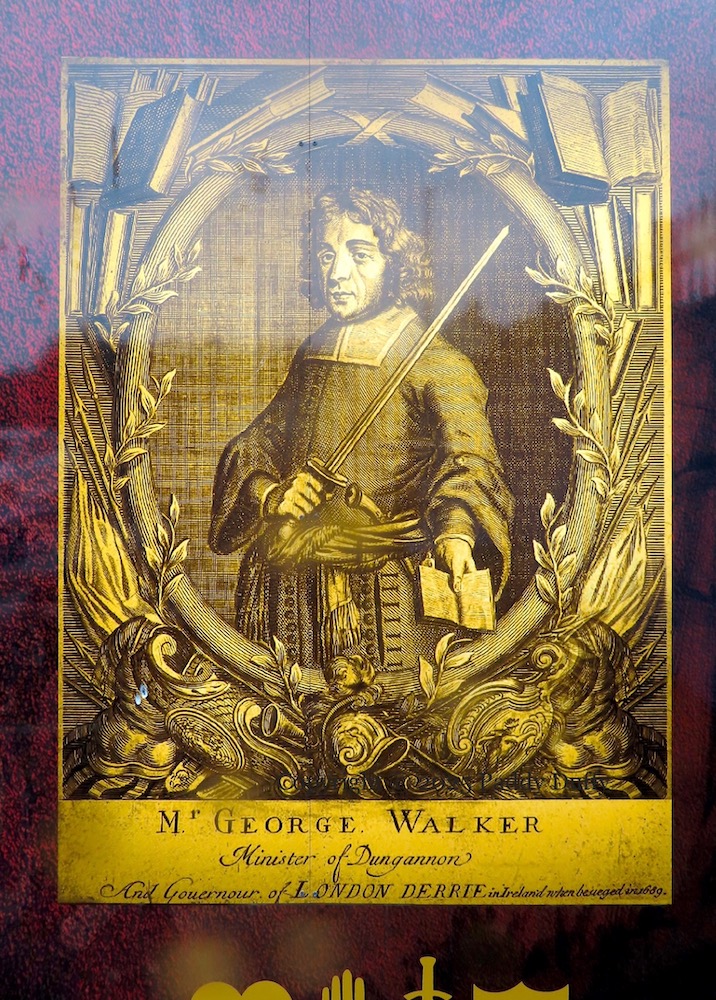
“Mr George Walker, Minister of Dungannon and Gouernour of London Derrie in Ireland when besieged in 1689.” Walker evacuated from Dungannon after Lundy’s troops pulled out and became joint governor of Derry after Lundy’s authority collapsed, first with Henry Baker and later with John Mitchelburne.
Walker put himself at the centre of his own “True Account Of The Siege Of London-Derry” (which can be read at archive.org) and drew criticism for minimising the role of Presbyterians (Walker was Anglican/CoI).
After the siege, Walker went on a victory tour of Scotland and England; while in London, he argued against a Derry trial for Lundy, on the ground that Lundy still had support there. He returned to Ireland in time to greet William III in June 1690 when William travelled from Carrickfergus to Belfast (see June 14th, 1690) and he went south with William to the Boyne, where he was shot and killed. (DIB | DIB | WP)
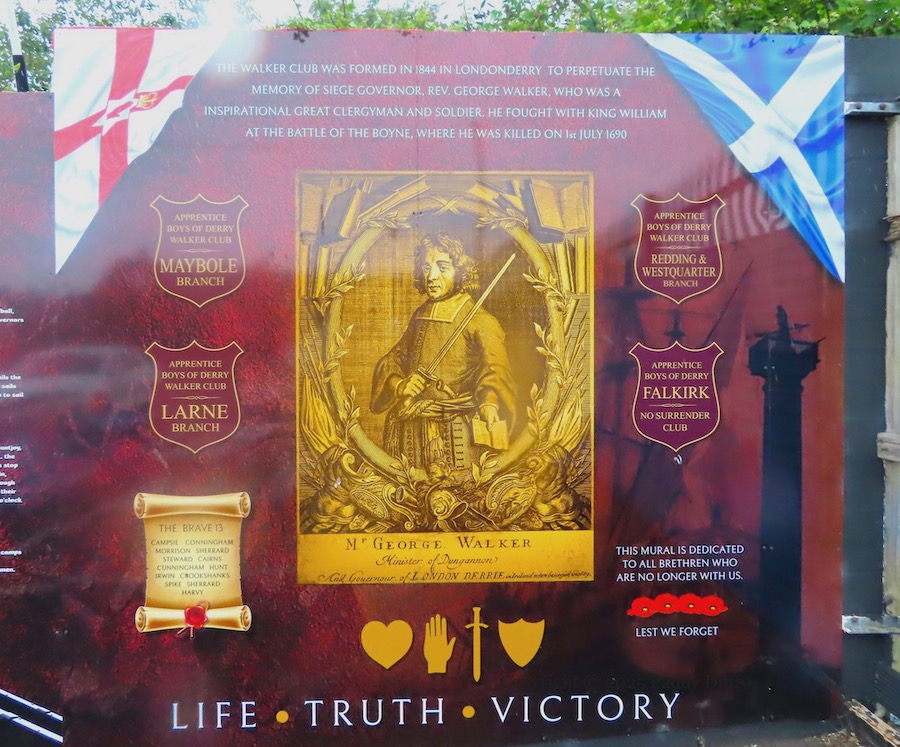
“The Walker Club was formed in 1844 in Londonderry to perpetuate the memory of siege governor, Rev. George Walker, who was a[n] inspirational great clergyman and soldier. He fought with King William at the Battle of the Boyne, where he was killed on 1st July 1690.”
The image of Walker is a line-engraving by John Savage, viewable at Sinclair Genealogy. “Life, truth, victory” is a translation of Londonderry’s Latin motto “Vita, veritas, victoria”.
These new boards are at the Rangers Supporters’ Club (Fb) in Boyne Square/Greenland, Larne.










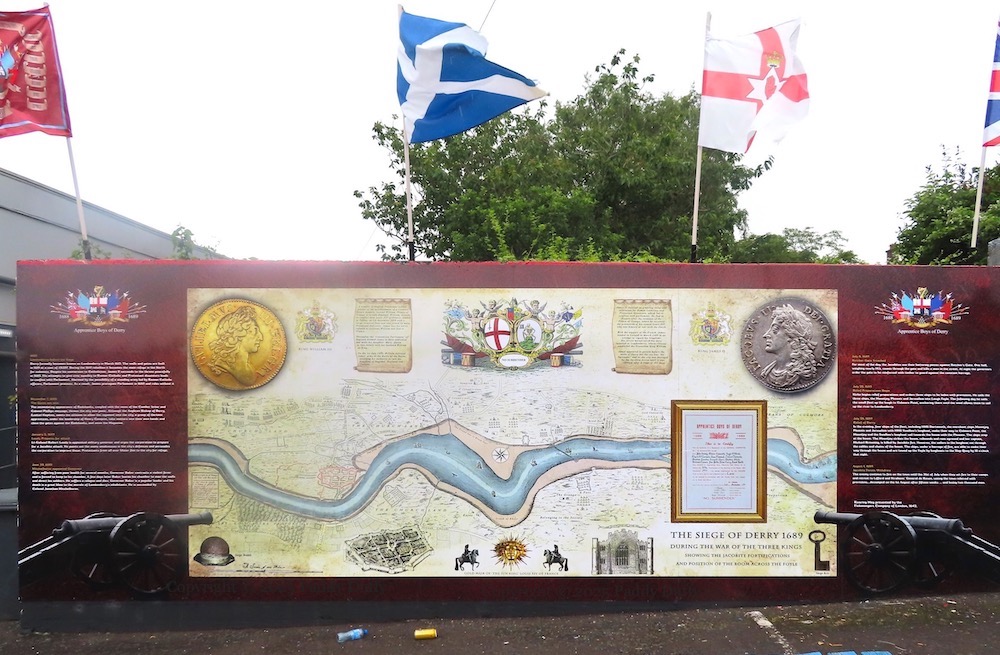

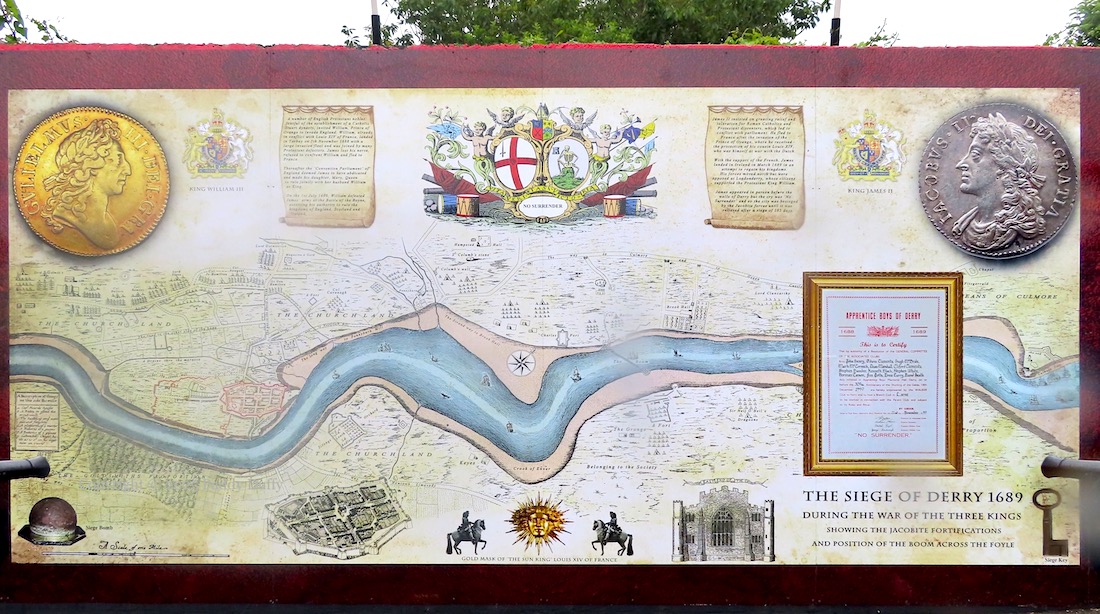

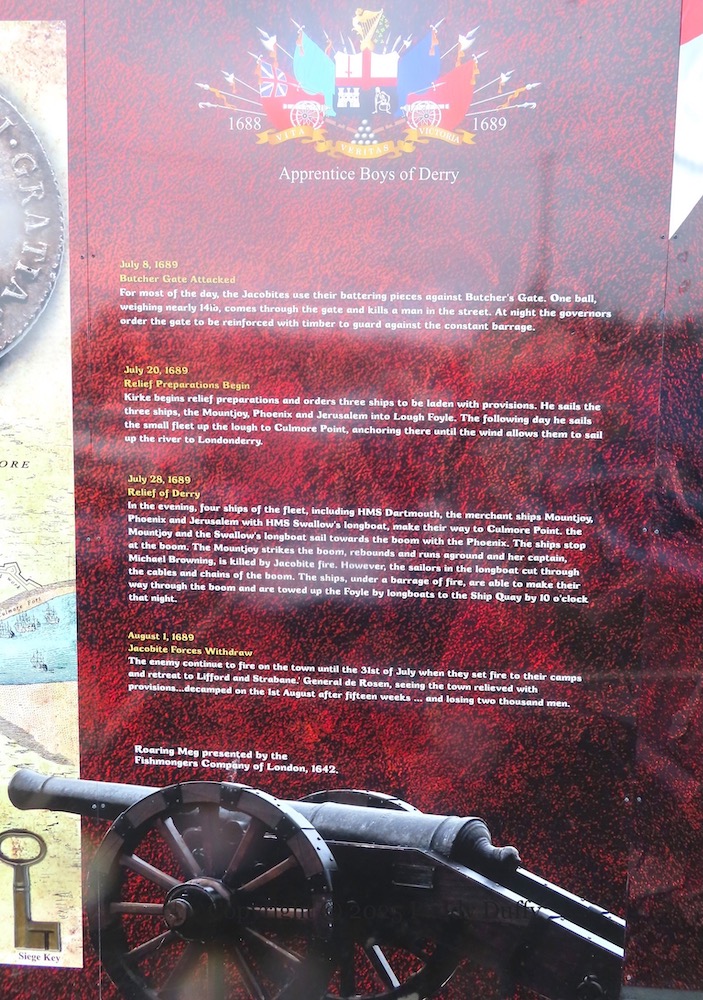

 Paddy Duffy Collection