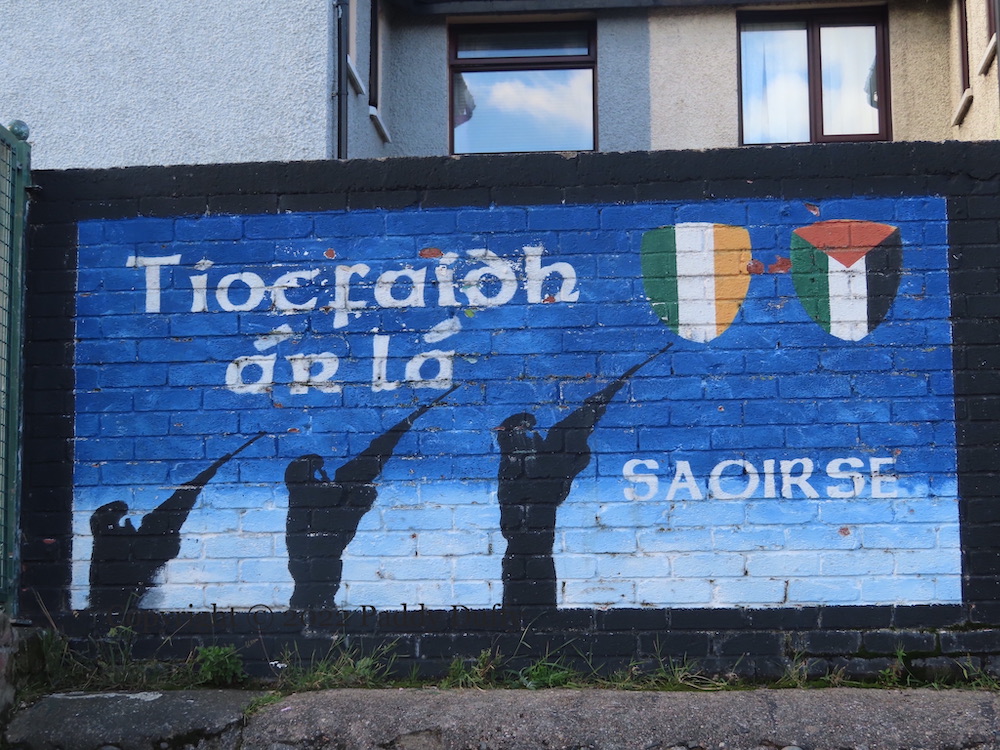
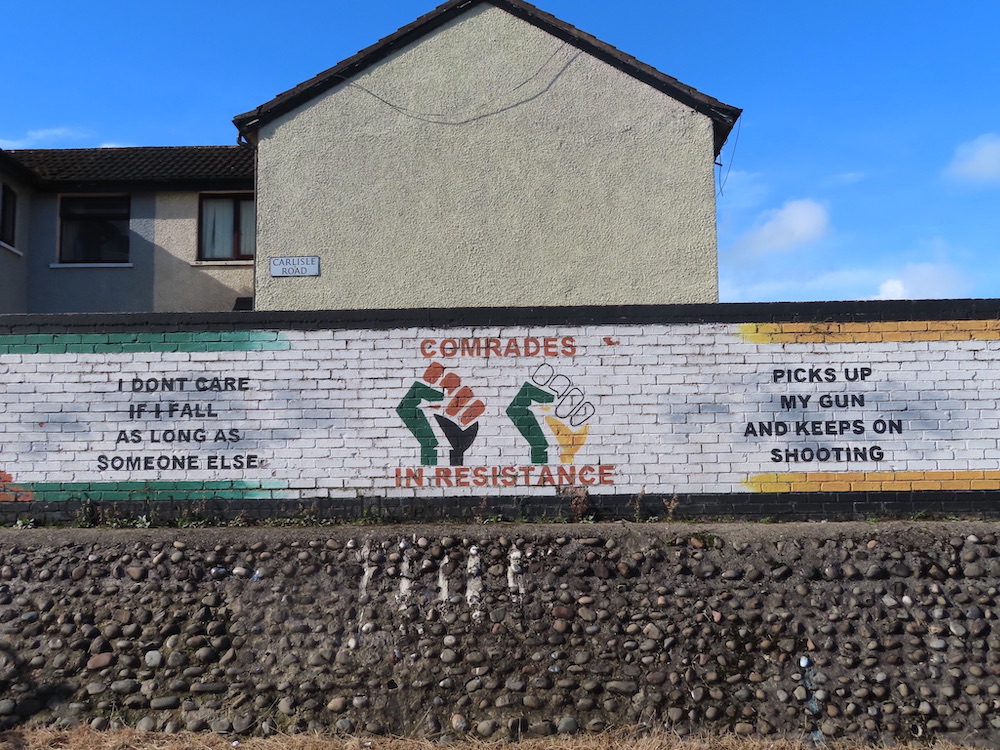
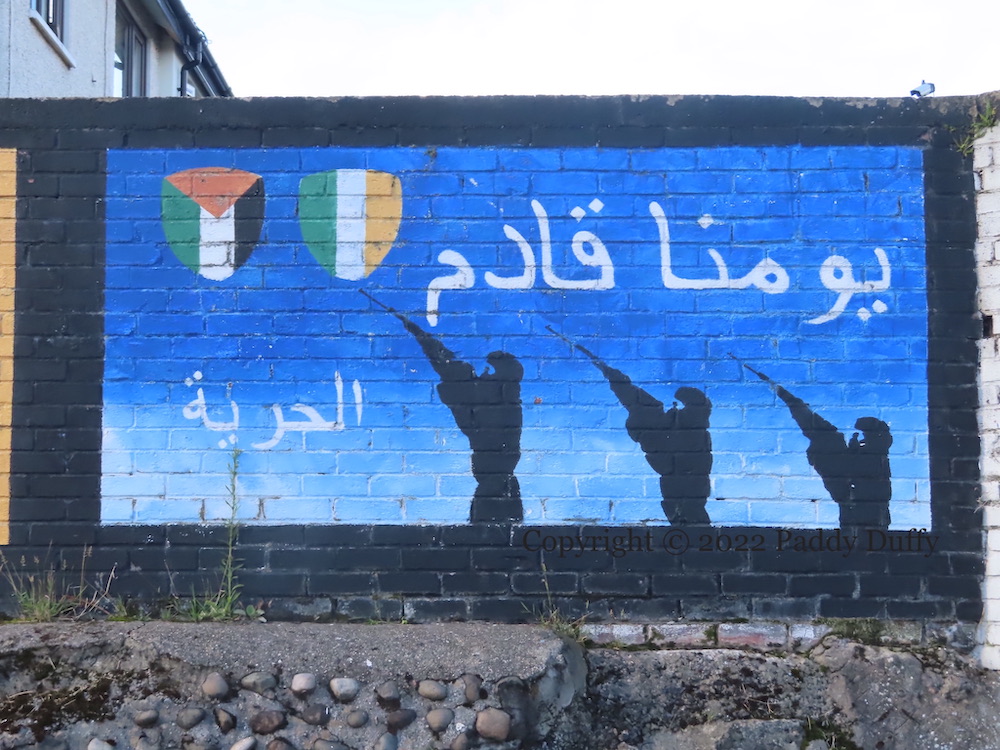
A Che Guevara quote – “I don’t care if I fall as long as someone else picks up my gun and keeps on shooting” – unifies two panels bearing masked men firing funeral volleys, Irish and Palestinian shields, and “Our day will come” in both Irish and Arabic.
Left: “The Annals of the Four Masters record that in 665 AD, the Battle of Farset (Belfast) took place between the County Down Dal Fiatach, self styled Ulaid, and the Pretani or Cruthin where Cathasach, son of Laircine, was slain. This was an attempt by the Dal Fiatach to encroach on the Curtain territory of Trian Congail. The “third of Congal”, which encompassed territory on both sides of the Lagan, corresponding more to less to Uppers and Lower Clandeboye, including modern Belfast. Cathasach was Congal’s grandson. The battle was the first mention of Belfast in Irish history.”
The battle scene shown is Jim Fitzpatrick’s vision of the battle of Moira (in 637), rather than “Bellum Fertsi”. The salience of this description of intra-Ulster fighting is that there is a contention that the Cruthin were Scots (Picts) thus allowing for the idea (employed especially by the UDA – see Ulster’s Defenders and Defender Of Ulster From Irish Attacks) that present-day northern Protestants have a heritage, and a history of fighting for what is roughly Co. Antrim, that pre-dates the plantations. For more information and a similar board, featuring the tower blocks of Rathcoole rather than Cuchulainn and the Battle of Moira, see Kingdom Of The Pretani. For the debate over a connection to the Picts, see WP.
The Annals date back to the 1630s though they mostly comprise a variety of earlier sources.
The image of the gentleman with the sword appears to be a stock fantasy image, used for at least two characters in Game Of Thrones fandom (Rhaegon Targaryen and Lord Cameron Umber).
Middle: 2021 was the centenary of the creation of Northern Ireland and the year in which Scottish football club Glasgow Rangers won their 55th league title. Support for the club is widespread among the PUL community in Northern Ireland; local soccer and the international team is overseen by the IFA.
Right: “Centenary of cultural expression 1921-2021. Sons Of Belfast LOL 743. Castleton Temperance LOL 867. The Memorial LOL 1197. Belfast Harbour LOL 1883. The Coote Memorial LOL 1921. Cave Hill Temperance LOL 1956.”
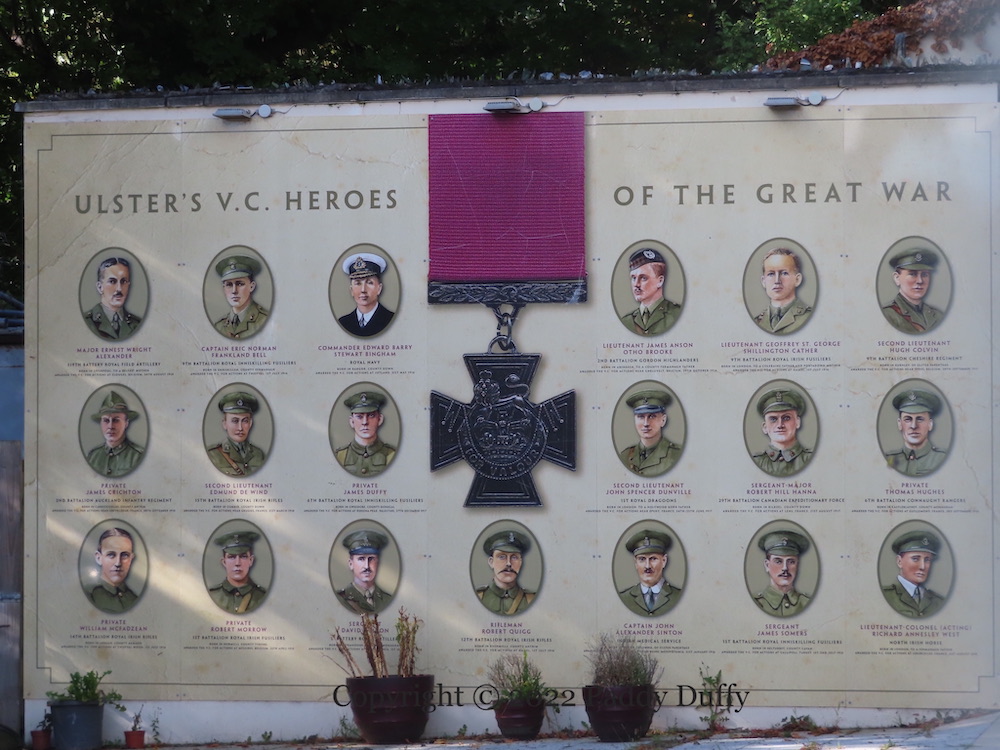
Here are two boards outside the north Belfast Orange hall in Alexandra Park Avenue, north Belfast.
Above: sporting heroes Joey Dunlop, Alan Campbell, Darren Clarke, Alex Higgins, George Best, and Carl Frampton.
Below: nineteen winners of the Victoria Cross: (left) Major Ernest Wright Alexander, Captain Eric Norman Frankland Bell, Commander Edward Barry Stewart Bingham, Private James Crichton, Second Lieutenant Edmund De Wind, Private James Duffy, Private William McFadzean, Private Robert Morrow, Sergeant David Nelson, (centre) Rifleman Robert Quigg, (right) Lieutenant James Anson Ortho Brooke, Lieutenant Geoffrey St. George Shillington Cather, Second Lieutenant Hugh Colvin, Second Lieutenant John Spencer Dunville, Sergeant-Majjor Robert Hill Hanna, Private Thomas Hughes, Captain John Alexander Sinton, Sergeant James Somers, Lieutenant-Colonel (Acting) Richard Annesley West.
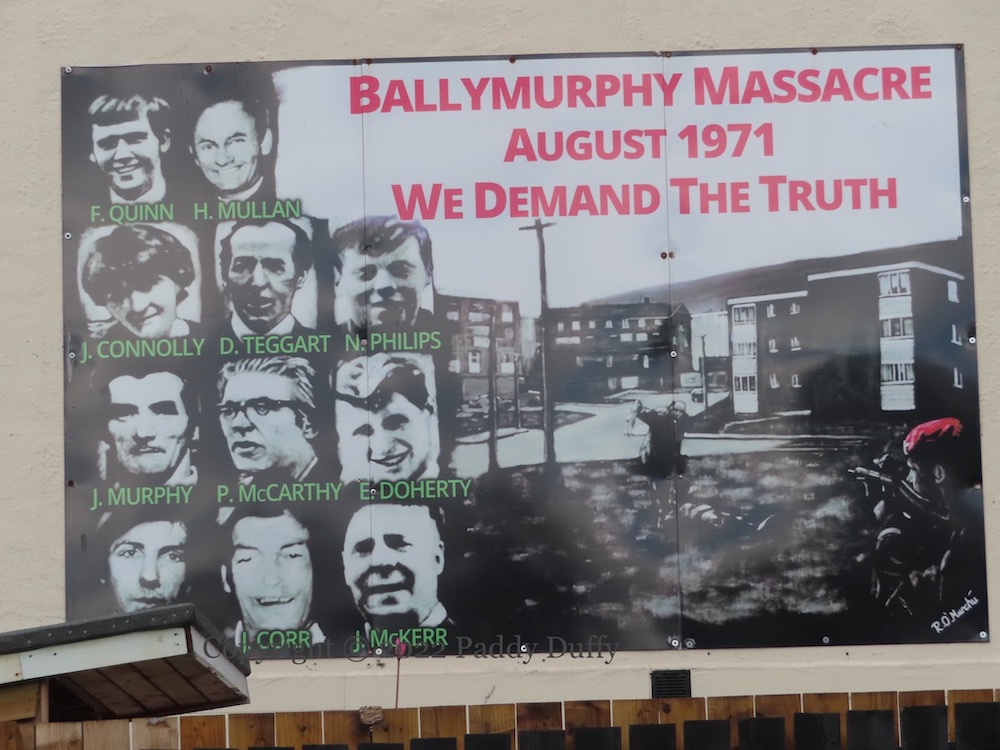
The inquest into the Ballymurphy Massacre – the killings of 11 people from August 9th to 11th, continues, with testimony this past week from former Paratrooper Henry Gow (Irish News | BBC-NI). The image above shows Hugh Mullan being shot from Springmartin while going to the aid of a neigbour, Bobby Clarke; he is waving a white Babygro (BallymurphyMassacre.com). The Paratrooper is distinguished by his red beret.
The mural was originally painted by Rısteard Ó Murchú in 2008 and displayed first on the Whiterock Road then around the corner on the Springfield Road; the location of the repainted board is at the Glenalina Road entrance to the area, in the spot of the former 1916 GPO mural (which had lasted seventeen years before the wall was re-plastered and whitewashed in 2017).
The plaque on the fence reads, “This plaque is dedicated to the 11 innocent civilians murdered by members of the British Parachute regiment in August 1971. Fr Hugh Mullan, Frank Quinn, Noel Phillips, Joan Connolly,
Danny Teggart, Joseph Murphy, Eddie Doherty, John Laverty, Joseph Corr, Paddy McCarthy, John McKerr. Donated by the Frank McCann Cumann, Hamilton [Scotland] (Fb).”
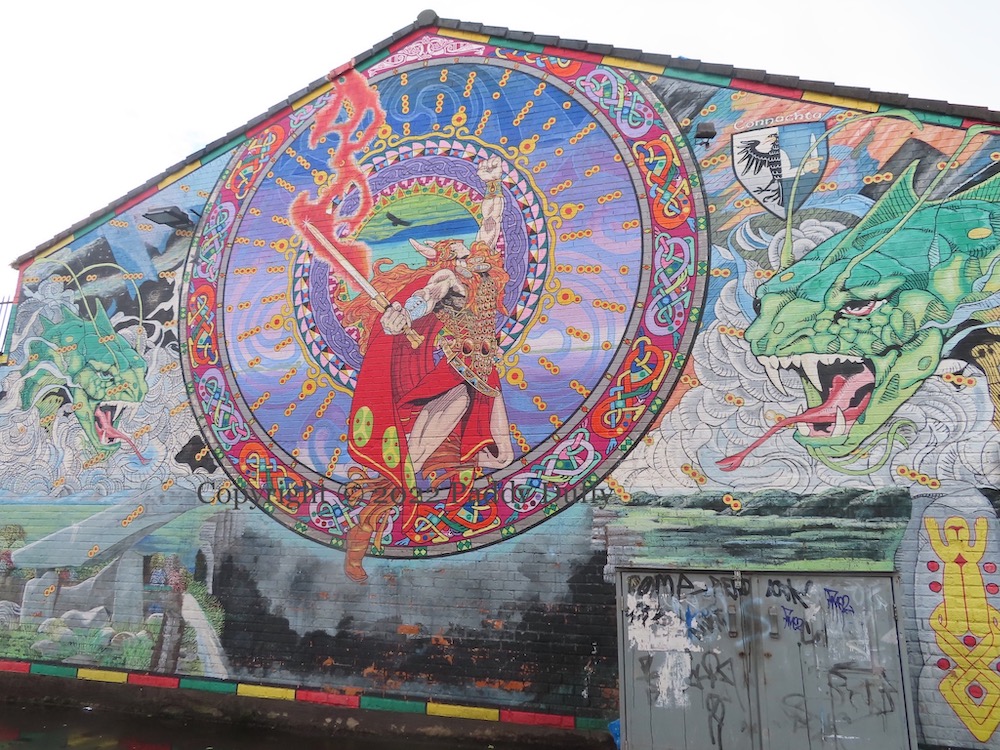
Gerard ‘Mo Chara’ Kelly first painted a mural of King Nuada in 1987, a year after being released from Long Kesh. He reproduced an illustration by Jim Fitzpatrick on a gable wall in Springhill (see images from 1987 | 1988 | 1989). This post-peace version is on the side-wall of the Whiterock Road Spar and was painted as statement of Kelly’s own rebirth after ceasing to work with funding agencies such as the Upper Springfield Development Trust.
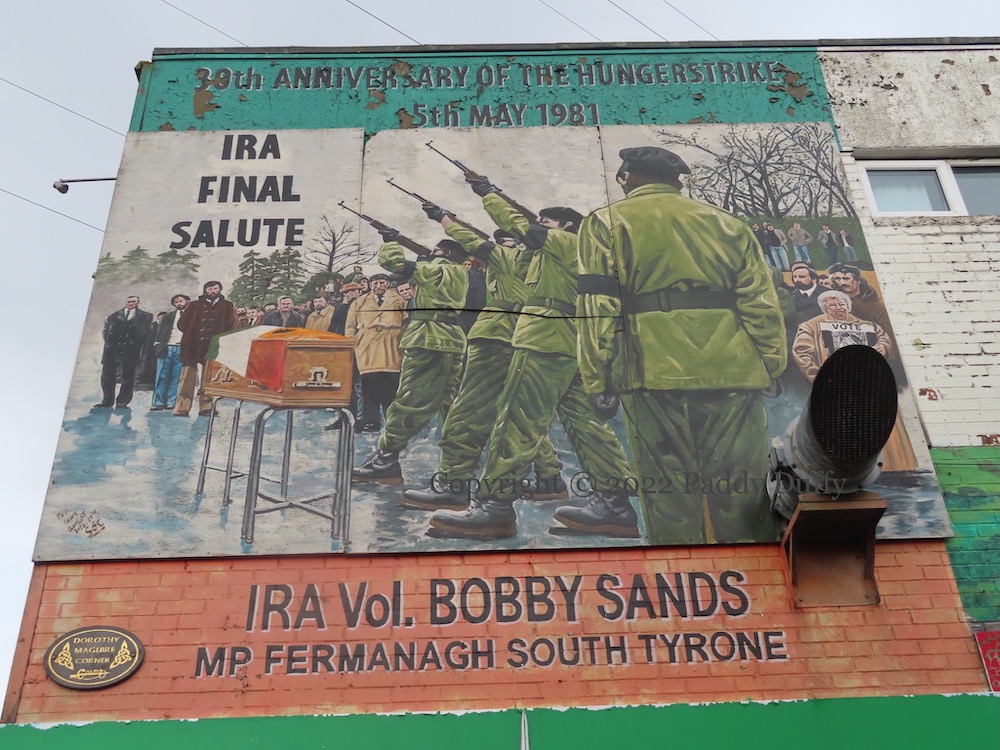
“30th anniversary of the hunger strike. 5th May 1981. IRA final salute. IRA Vol. Bobby Sands, MP Fermanagh South Tyrone.” Gerry Adams watches on as a funeral volley is fired over Sands’s coffin. Whiterock Road, Belfast.
Thomas Ashe was working as an Irish teacher in Dublin when he joined the Irish Volunteers and in 1916 served as a battalion commander in the Easter Rising, for which he was sentenced to penal servitude for life. He went on hunger strike in May 1917 and again in September when he was rearrested by the British authorities for a “seditious” speech. He died on September 25th, one hundred years ago, becoming “an chéad staılceoır ocraıs a maraíodh san 20ú haoıs” (“first hunger striker to die in the 20th century”).
In the five circles around his portrait are Countess Markievicz, Pádraig Pearse, and James Connolly – fellow fighters in the Rising – and (in the bottom left) Máırtín Ó Cadhaın (author of Cré na Cılle and IRA member interned during WWII), and the symbol of Laochra Loch Lao and more generally of An Ceathrú Gaeltachta/Gaeltacht Quarter (see previously The Big Plan and Onwards). In the middle is a march from An Dream Dearg in support of Acht Na Gaeılge (an Irish language Act) past the Bobby Sands mural on Sevastopol Street.
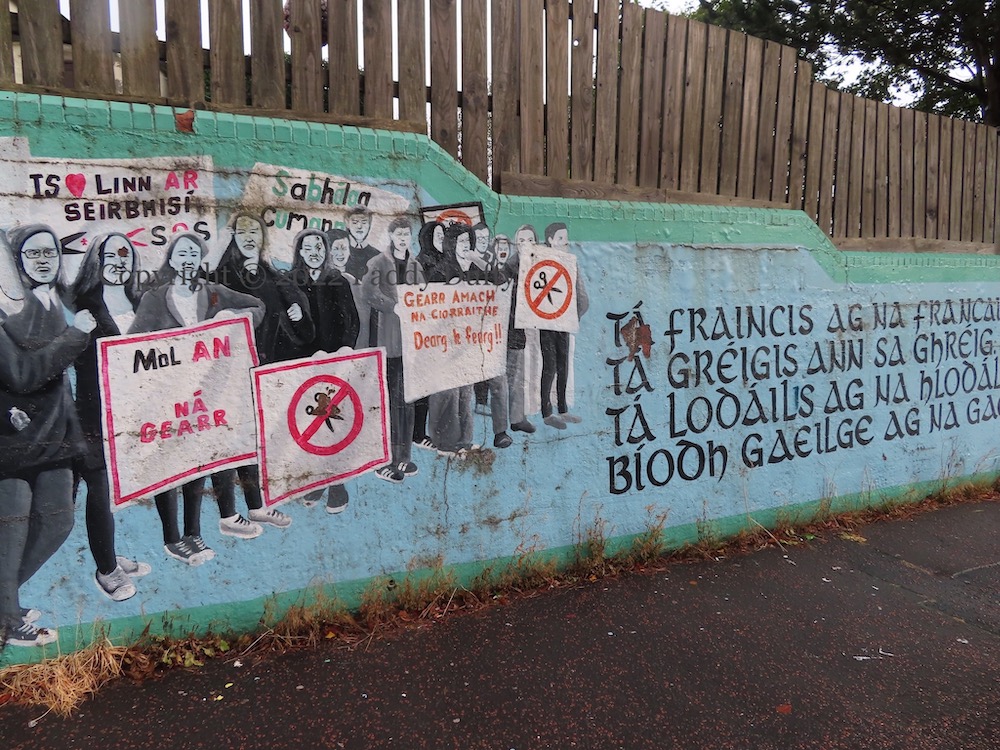
Above is a pro-Gaelic (Irish-language) mural on the Whiterock Road, with signs in Irish being held by young people protesting cuts to social services (on the left) and (on the right) a short poem: “Tá Fraıncıs ag na Francaıgh/Tá Gréıgıs ann sa Ghréıg/Tá Iodáılıs ag na hIodálaıgh/Bíodh Gaeılge ag na Gaeıl.” That is: the French have French, the Greeks Greek, the Italians Italian; let there be Irish for the Irish.
“In memory of our fallen INLA volunteers, upper Springfield area: Hugh Ferguson, Ronnie Bunting, Noel Little, Hugh O’Neill, Micky Kearney, John McColgan, Paddy “Paddybo” Campbell. Comrades: Barry “Baz” McMullan, Sean “Shanto” fleming, Harry O’Hara, Paul Collins, Bernado Brownlee, Emmanuel Kelly, Michael Conlon, Billy Lynch, James “Harpo” Murray, John Kennaway. Saoırse go deo [freedom forever].” Ferguson was the first member of the INLA to die, in 1975 in the feud with the OIRA. Bunting and Little/Lyttle (both Protestants) were shot dead in 1980 in Bunting’s Andersonstown home by masked gunmen from the UDA or SAS with RUC complicity.




 Paddy Duffy Collection