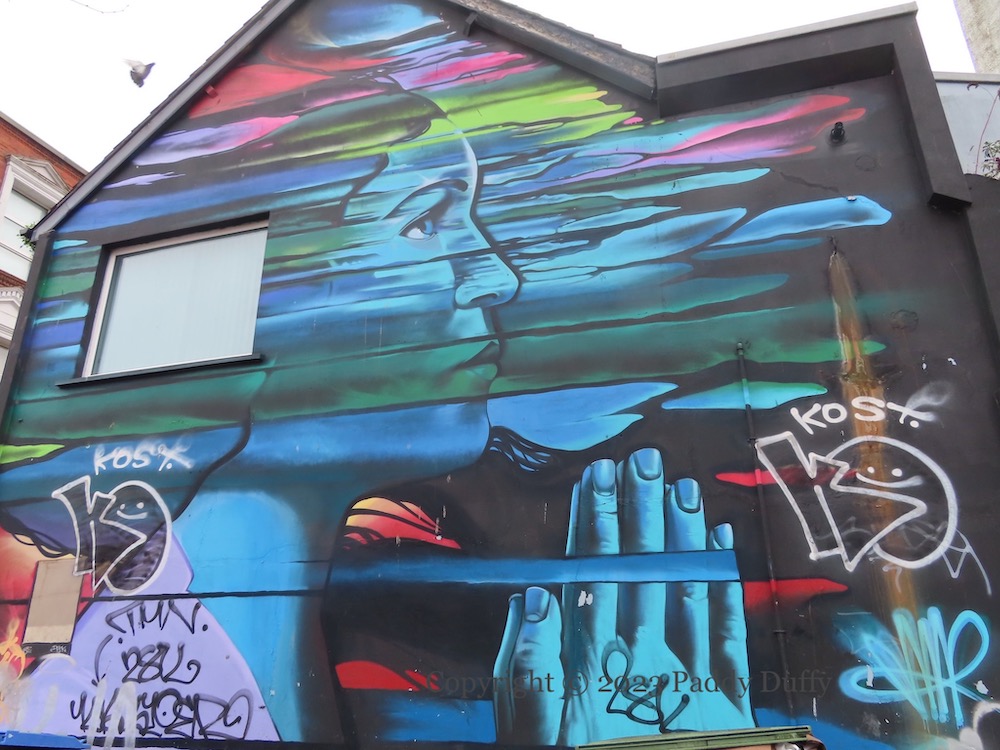
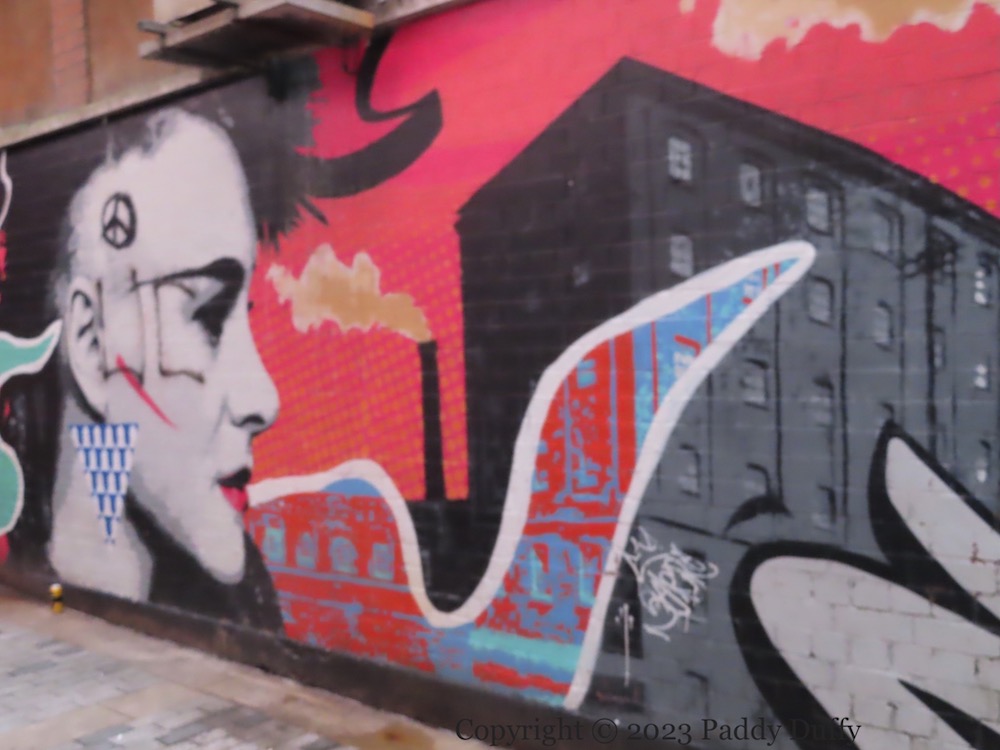
Here is the street art by JMK (Jonny McKerr) in Bank Square with quite a bit of graffiti. For the piece in better condition (in 2016) see the images in the Seosamh Mac Coille collection.
Click image to enlarge
Copyright © 2023 Paddy Duffy
T01732
Here is the street art by JMK (Jonny McKerr) in Bank Square with quite a bit of graffiti. For the piece in better condition (in 2016) see the images in the Seosamh Mac Coille collection.
Click image to enlarge
Copyright © 2023 Paddy Duffy
T01732
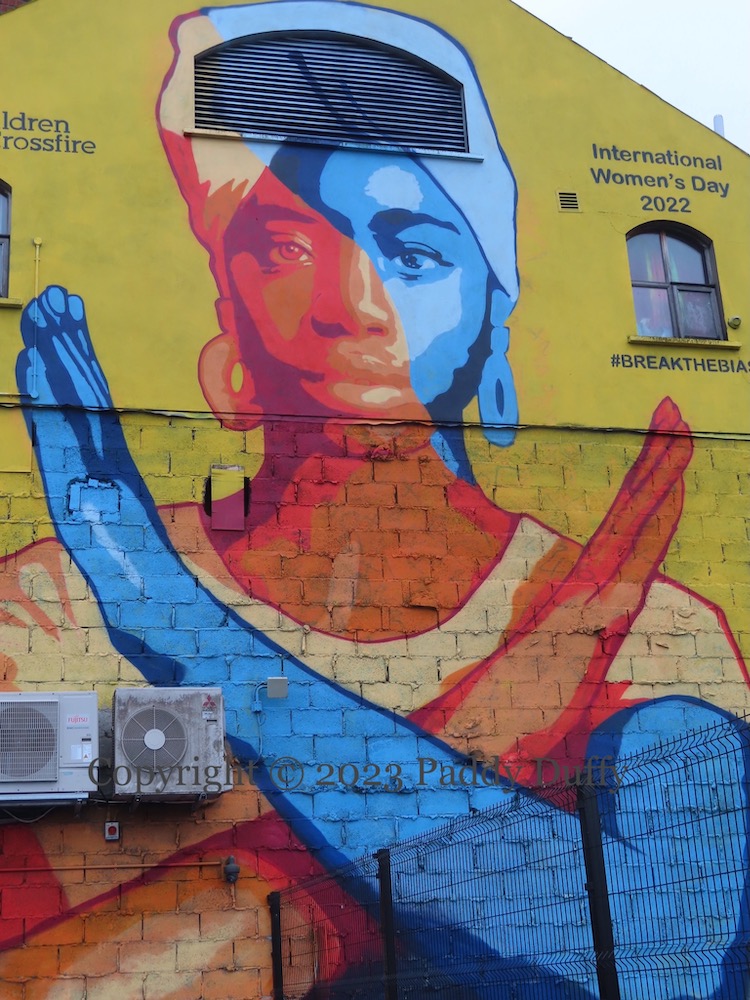
Crossed arms are the symbol of the #BreakTheBias campaign, which is the theme of this year’s International Women’s day (IWD) and people all around the world are striking the pose on social media to show their support (e.g. tw) including this large mural in Belfast, which has been painted off Corporation Street.
By Visual Waste (web | ig), with support from Children In Crossfire (web).
Tomb Street, Belfast
Click image to enlarge
Copyright © 2023 Paddy Duffy
T01748 [T01749]
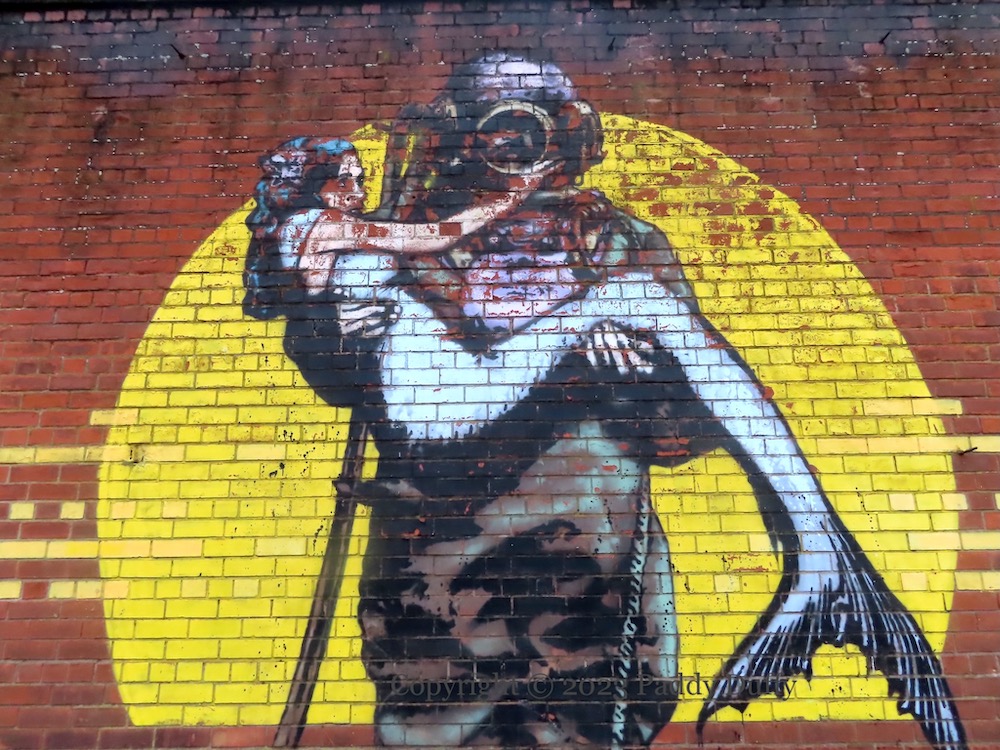
Dublin’s ADW (tw | web | Fb) came north for CNB/HTN17 and painted a mermaid rescued(?) by a deep-sea diver – with a mustache to match her tail. The meme goes back at least to this 1895 Punch cartoon.
Previously: Labelz Are For Jars | The Short Timers (2015 CNB) | Keep Her Lit (2016 CNB)
Click image to enlarge
Copyright © 2023 Paddy Duffy
T01750
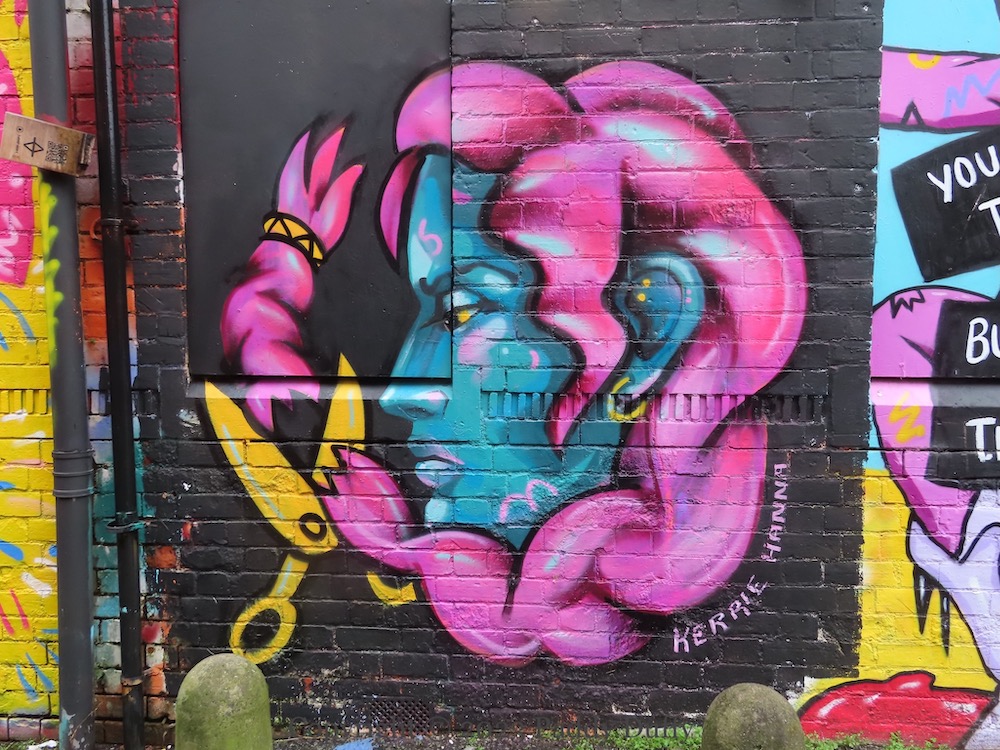
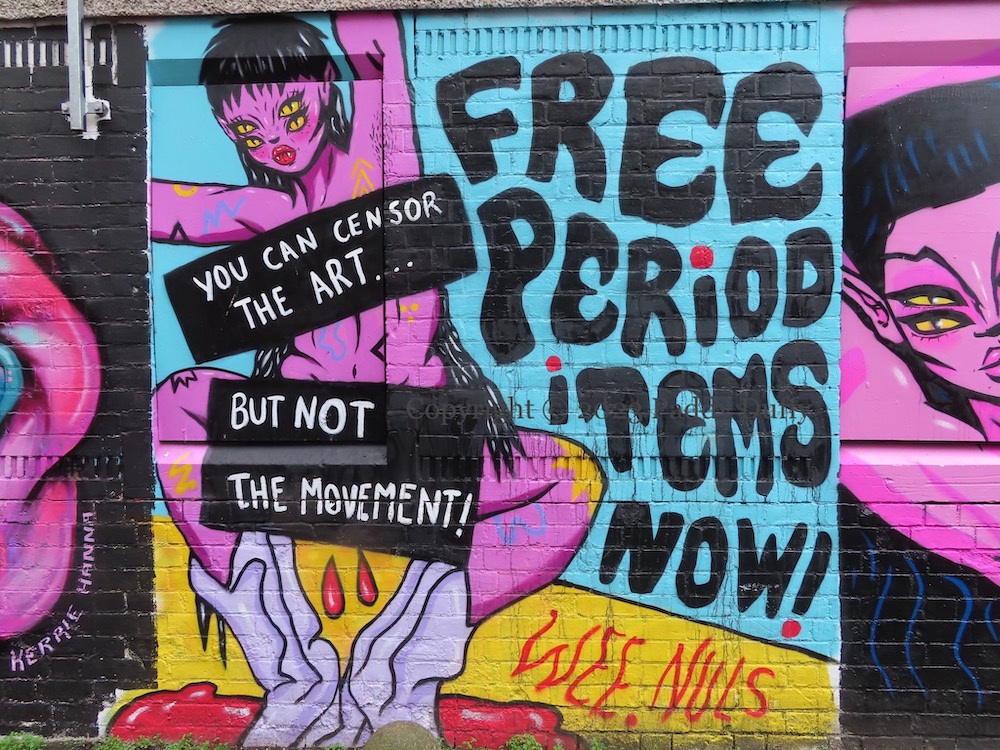
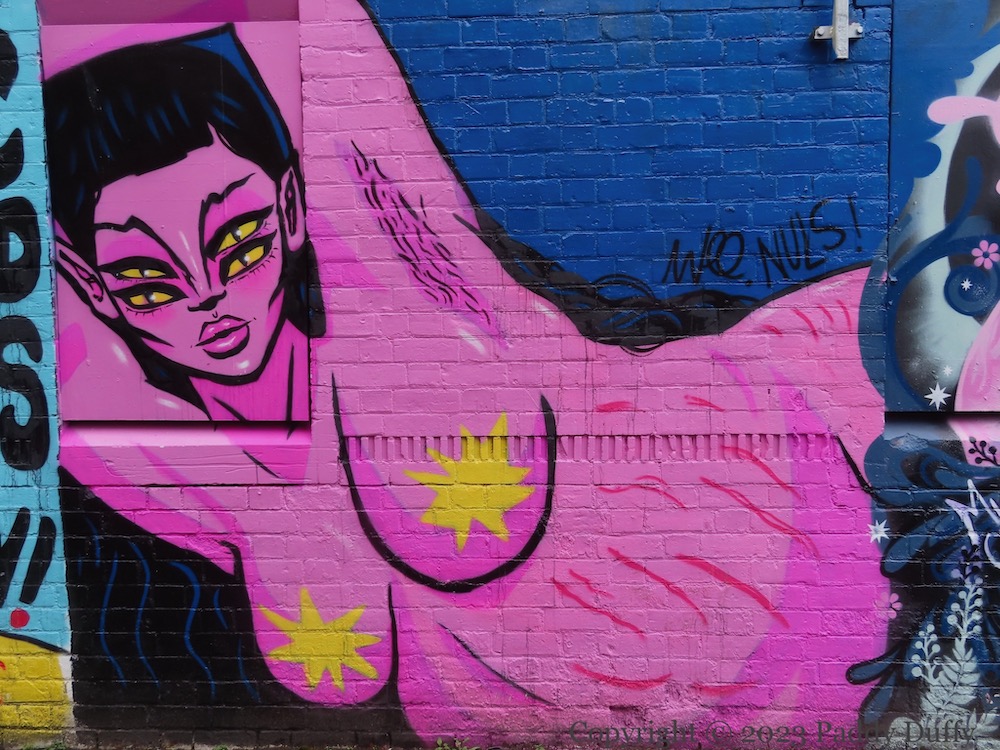
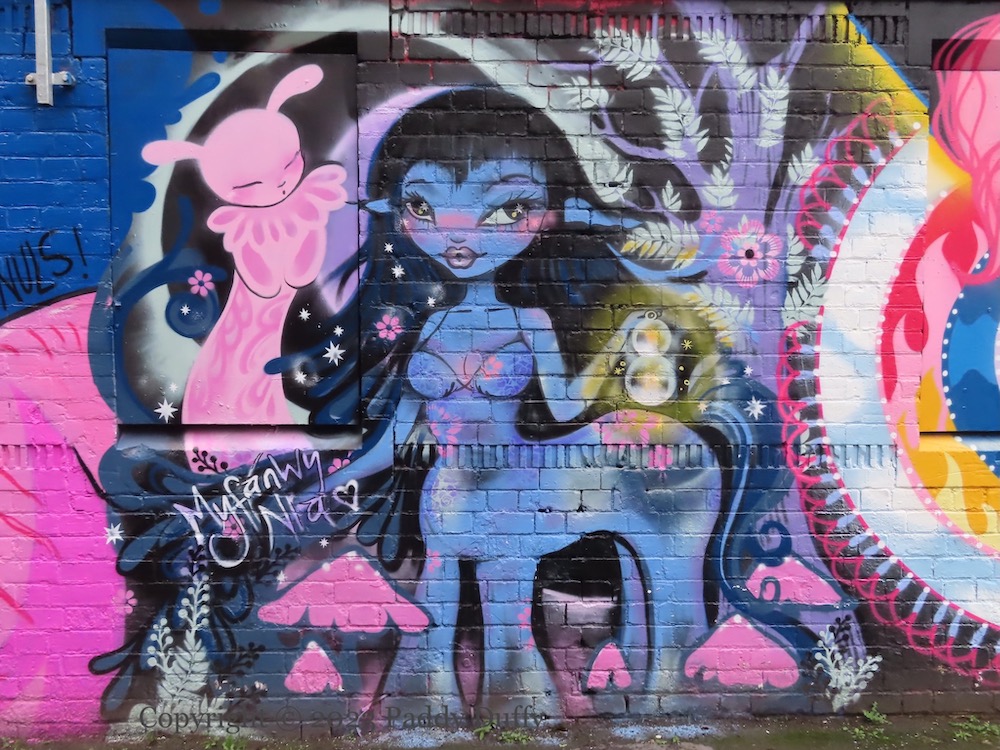
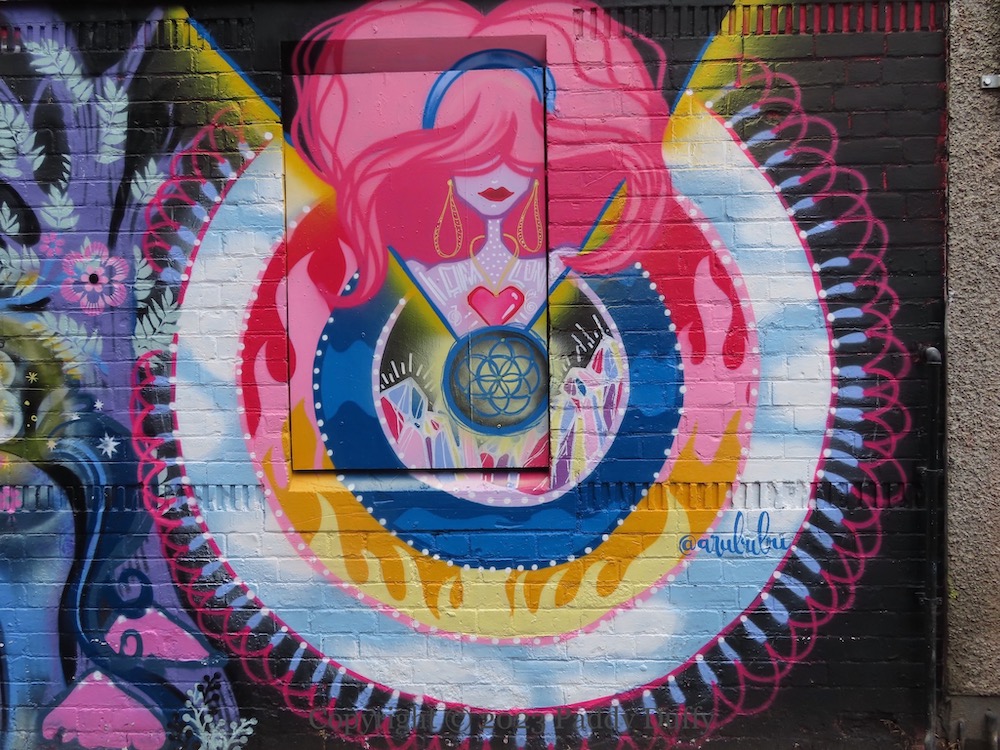
The theme of the all-women jam at ArtCetera (formerly the Red Barn Gallery) (@artceterastudio43) was ‘the veil wears thin’, suggestive of liminal states and places that samhaın brings to mind (HMC). Kerrie Hanna’s (@kerriehanna) interpretation of the theme was to support the women (in Iran and elsewhere) who were cutting their hair as a form of protest at the death of Mahsa Amini while in the custordy of the “Guidance Patrol” or “Morality Police”, allegedly for wearing her hijab improperly (CNN | EuroNews | WP).
Also shown in today’s post are the works by Wee Nuls (web) – Free Period Items and one of her trademark “gremlins” inspired by being 28 weeks pregnant, Harriet Myfanwy (@myfanwynia) – a centaur, Arú Roncada (@arububu) – a representation of the five elements, Ariana Lupascu (@contemplatingthestars) – a pink car, HMC (web) – a ?dragon? on a ?bamboo stalk? and Zippy’s (web) I’ve Got My Eyes On You.
The ‘free period items’ piece – and the controversy surrounding its original location – was described previously in About Bloody Time.
See also: the Women’s Work jam for International Women’s Day 2023, in College Court: Women’s Work | We Built This.
Rosemary Street, Belfast. With support from @Outlines Art Supplies.
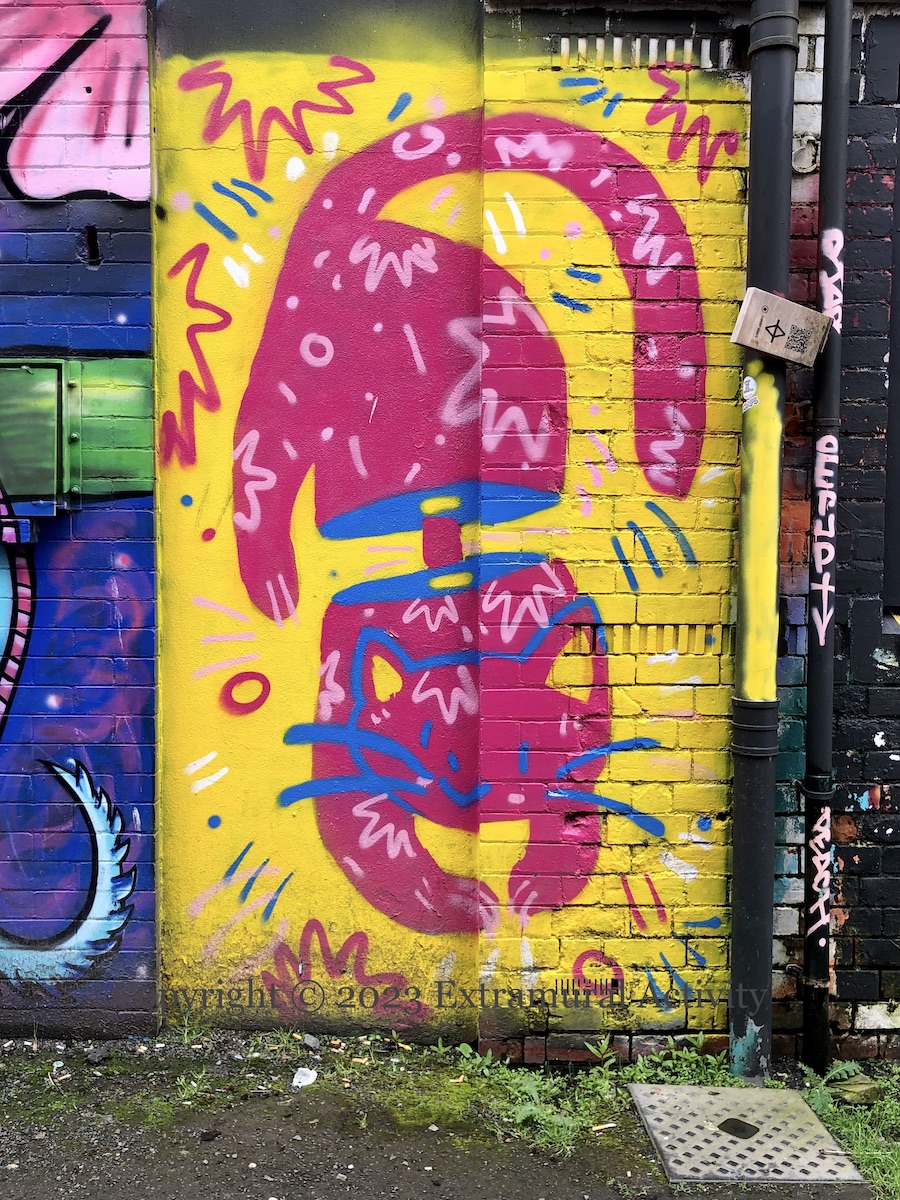
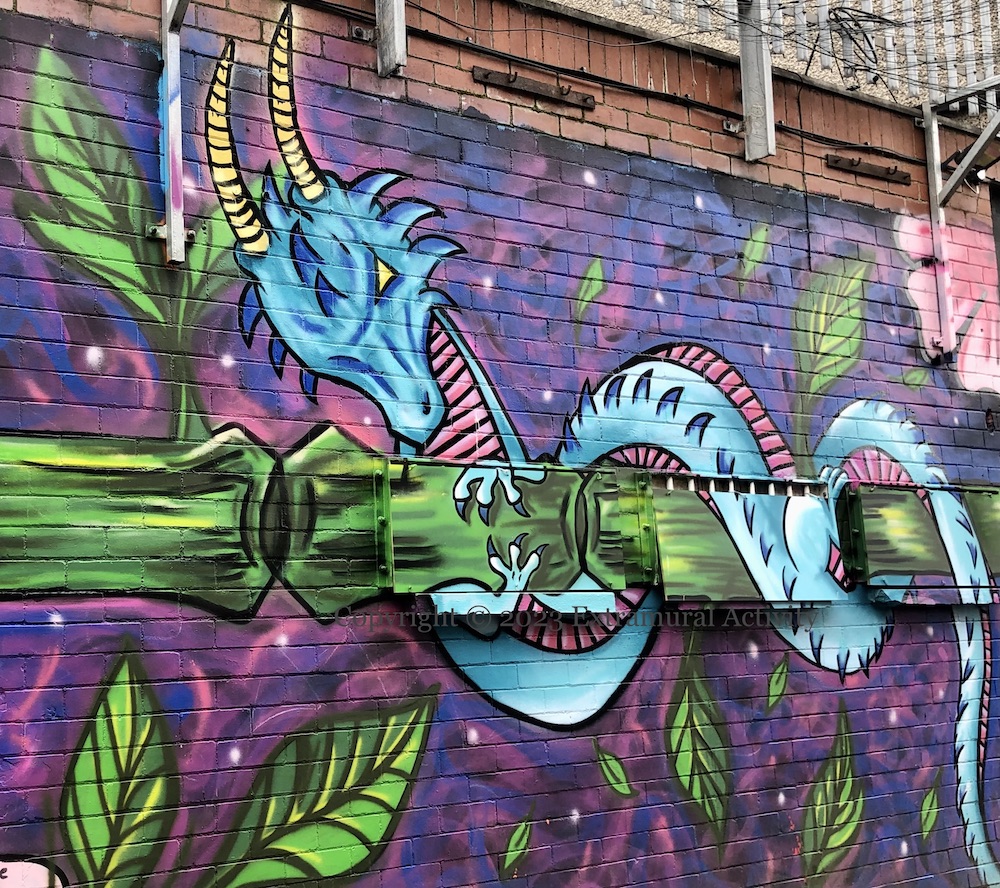
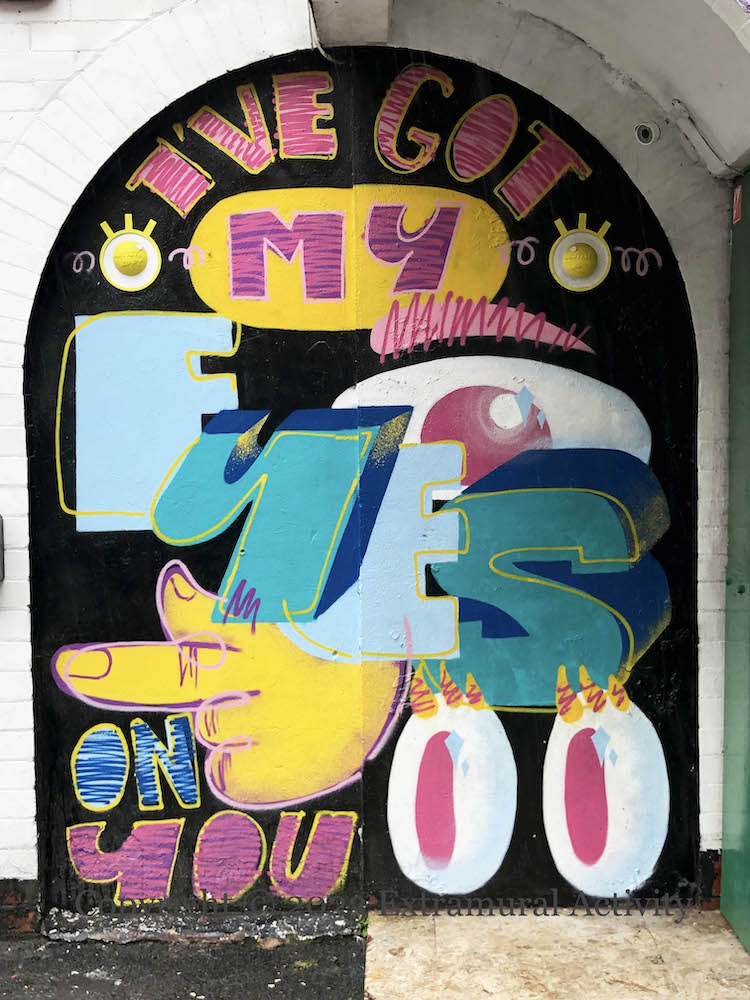
Click image to enlarge
Copyright © 2023 Paddy Duffy
T01723 T01722 [T01721] T01724 T01725 T01726
X12239 X12240 X12978 courtesy of Seosamh Mac Coılle
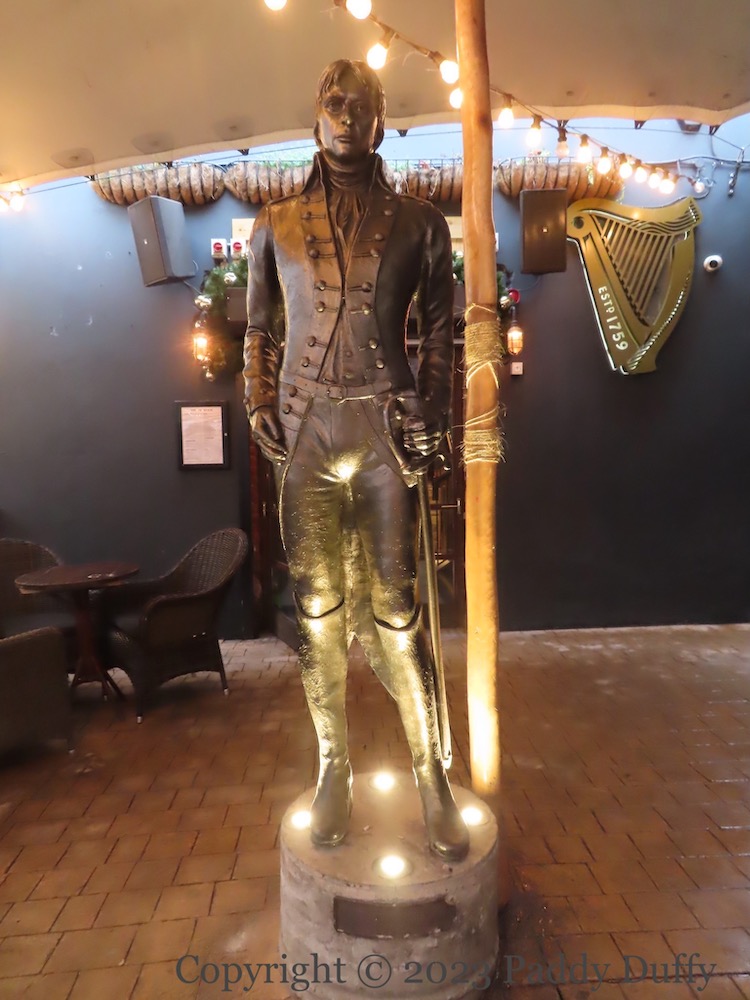
Henry Joy McCracken’s mother was Ann Joy, daughter of Francis Joy, linen manufacturer and founder of the Belfast Newsletter. They both have a “blue plaque” at the northern end of the entry – see the final image, below. Henry led the Antrim uprising of the United Irishmen in 1798 and was hanged for it in Corn Market at age 30. (WP)
The peacock piece – official title ‘Peripheral Palisading’ – is by James Earley (web). It is perhaps inspired by the blue plaque’s note that the News Letter was “first printed ‘at the sign of the peacock’ in Bridge Street”. For a better shot of it, see the Visual History page on the Belfast Entries.
Also in the Entry is a large wall-painting of Olaudah Equiano.
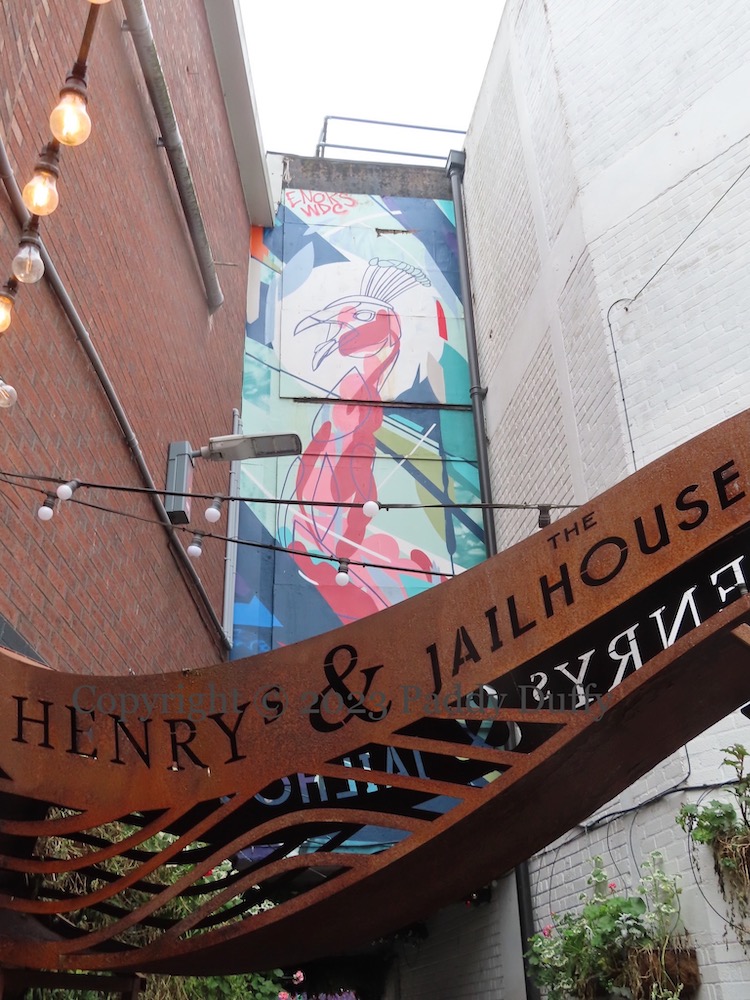
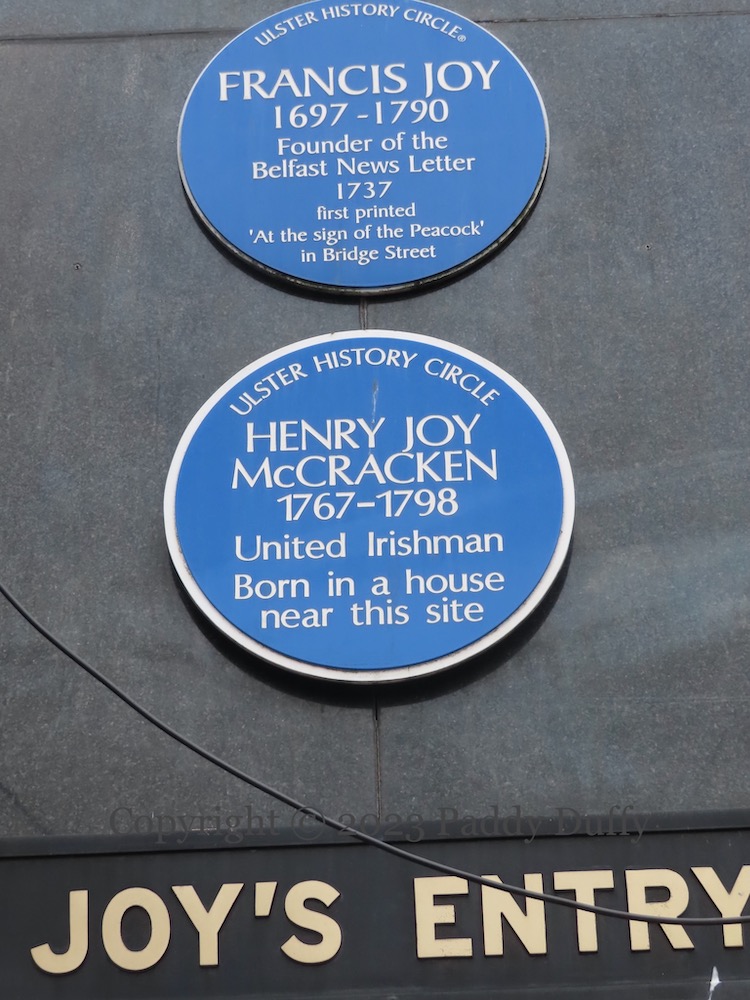
Click image to enlarge
Copyright © 2023 Paddy Duffy
T01707 T01708 T01712 [X09944]
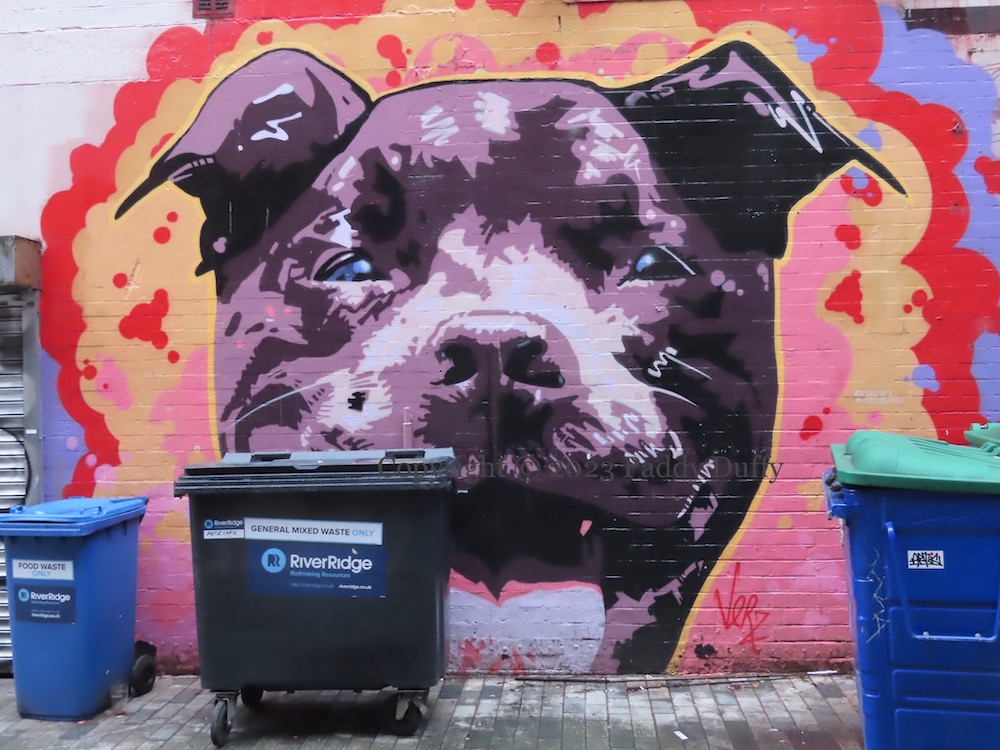
Street art by Verz (Fb) in Pottinger’s entry, Belfast city centre.
Click image to enlarge
Copyright © 2023 Paddy Duffy
T01704
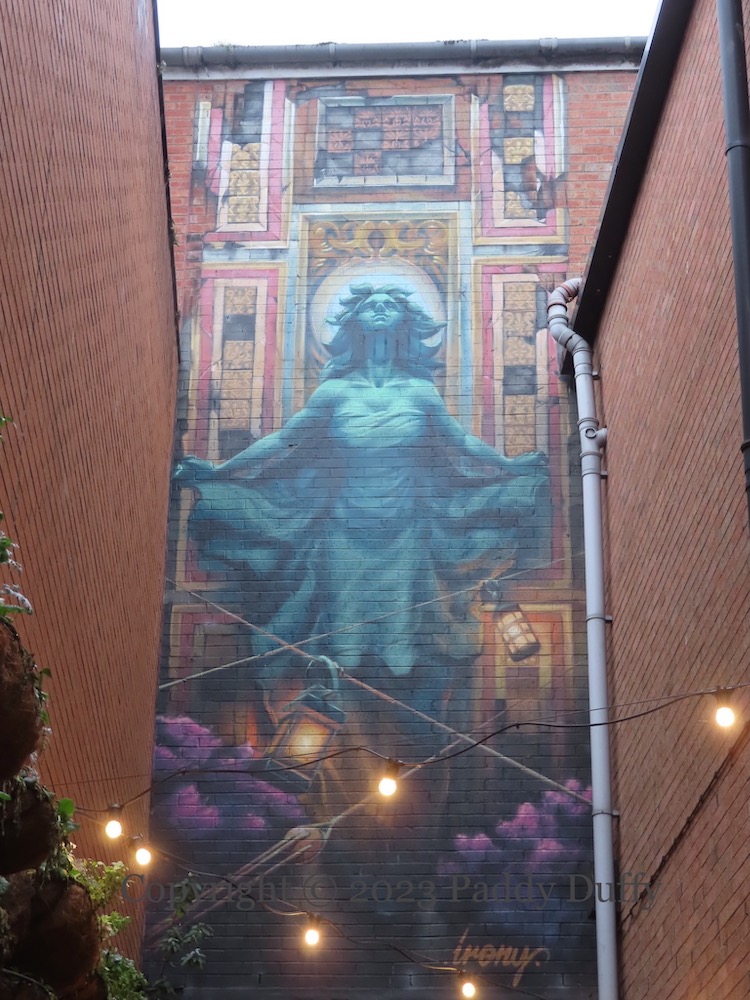
A ship’s figurehead (perhaps) cranes upwards – as the viewer must also do – in front of a background of decaying tile-work. Perhaps the decay is being left behind? In any case, Belfast City Council thought a suitable symbol of Belfast moving onward and upwards when used the art to announced the Belfast Stories project (tw; see The Rising Place).
The piece is by Irony (tw | ig | Fb | tumblr). According to Adam Turkington, Irony was inspired by “the commercial themes in Ciaran Carson’s many visions of Belfast” (Belfast Live). (Belfast Confetti was the inspiration for emic’s piece in Winecellar Entry.)
In Pottinger’s Entry. There is a separate Visual History page on the Belfast entries and the recent (2020 onward) efforts to beautify them.
See also: The Verticality Of The Divine | Tile Refinery.
Click image to enlarge
Copyright © 2023 Paddy Duffy
T01706
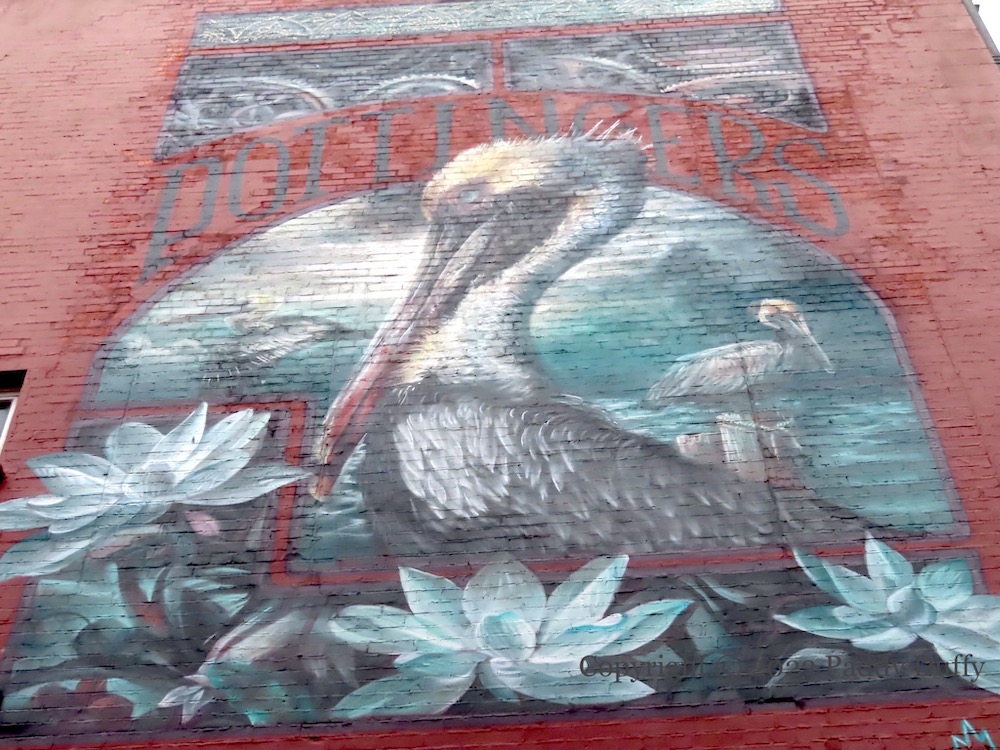
This giant pelican was painted by Nomad Clan (web) from Manchester, England, as part of the first year (2020) of the Belfast Entries Project (Visual History). According to ArtUK, the pelican is a reference to “the Pottinger’s family crest” (Lord Belmont) while the “east Asian flowers” along the bottom and the cogs at the top point “to Belfast’s rich industrial past.
Pottinger’s Entry, Belfast city centre
Click image to enlarge
Copyright © 2023 Paddy Duffy
T01703 [T01702]

In 1789, Olaudah Equiano published a memoir to 311 subscribers describing his early life in west Africa, his kidnapping, transport via Barbados to enslavement in Virginia, then in London, England, and then in Montserrat in the Caribbean. He bought his own freedom in 1766 and went back to England and joined the burgeoning abolitionist movement. His memoir detailing the treatment and conditions he had experienced made him famous. He toured Britain and Ireland in support of his book: “I found the people extremely hospitable, particularly in Belfast [in 1791-1792]” (BBC Sounds 17m 58s). He stayed with Samuel Neilson, a founding member of the United Irishmen (Clifton Belfast | WP | see also yesterday’s post on Belle Martin). Ten years after his death in 1797, the trans-Atlantic slave trade was abolished in both the UK and the States.
The mural in Joy’s Entry, by London artist Dreph, is based on a portrait painted by William Denton and engraved for the book by Daniel Orme (Dreph | National Portrait Gallery).
For an overview of the anti-slavery movement in Belfast, including Thomas Russell, Olaudah Equiano, and Frederick Douglass, see this William Orr speech (at Slugger).
See also the Visual History page on The Belfast Entries.
Click image to enlarge
Copyright © 2023 Paddy Duffy
T01709
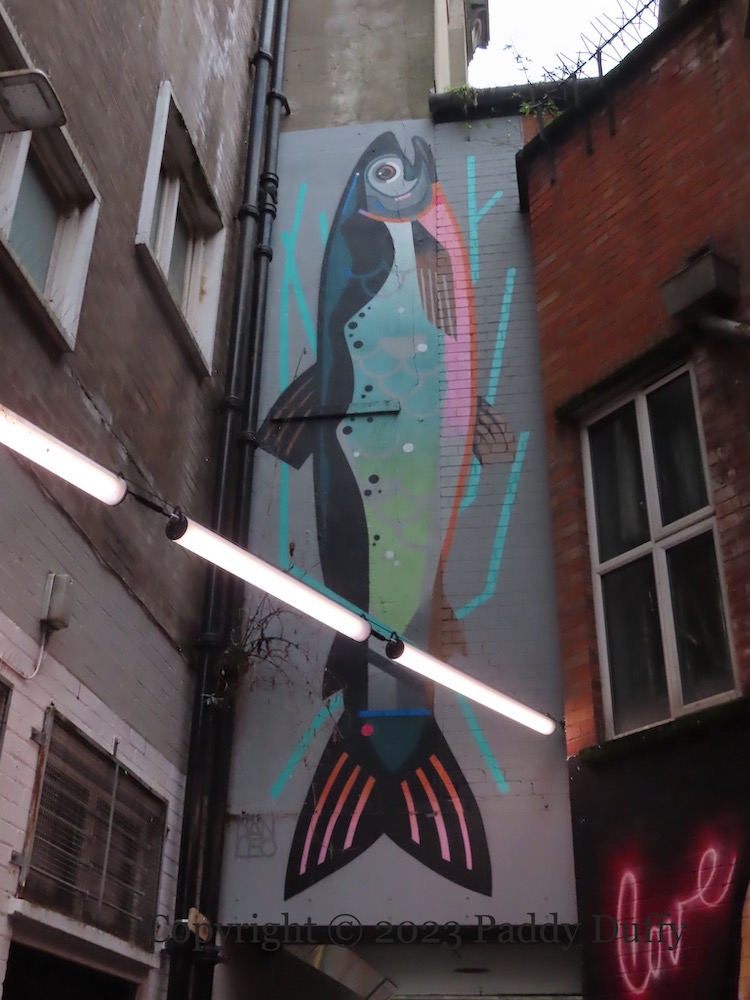
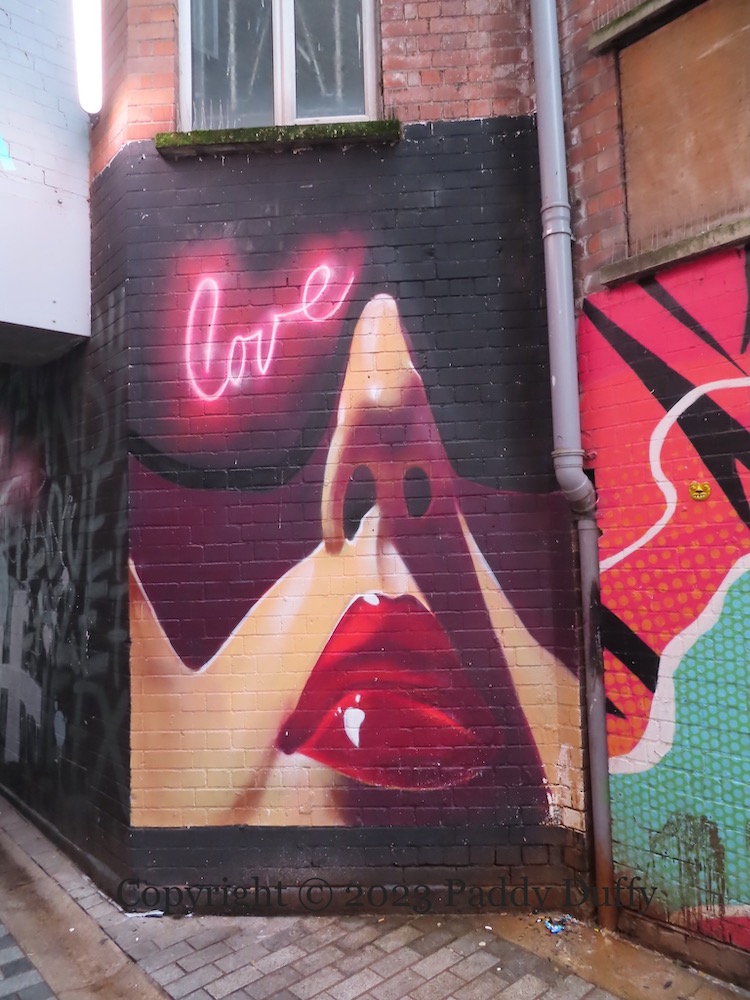
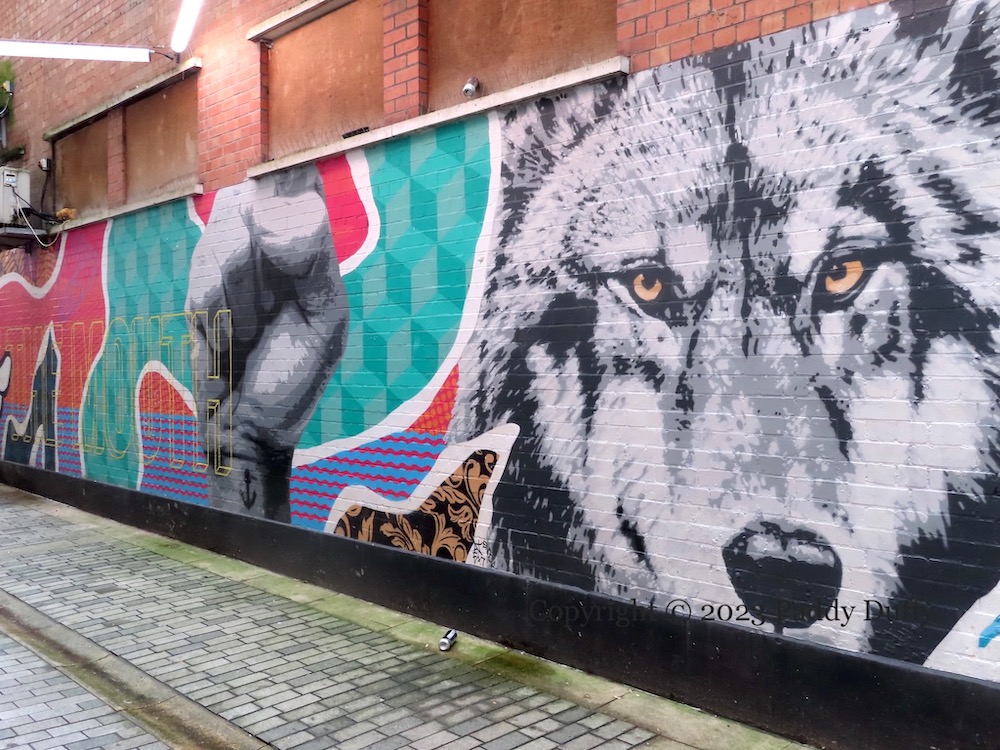
DanLeo’s (web) salmon and ‘At The Mouth’ by ADW (web) (2020) in Crown Entry – one of the Belfast Entries.
Click image to enlarge
Copyright © 2023 Paddy Duffy
T01720 T01719 T01716 T01718
 Paddy Duffy Collection