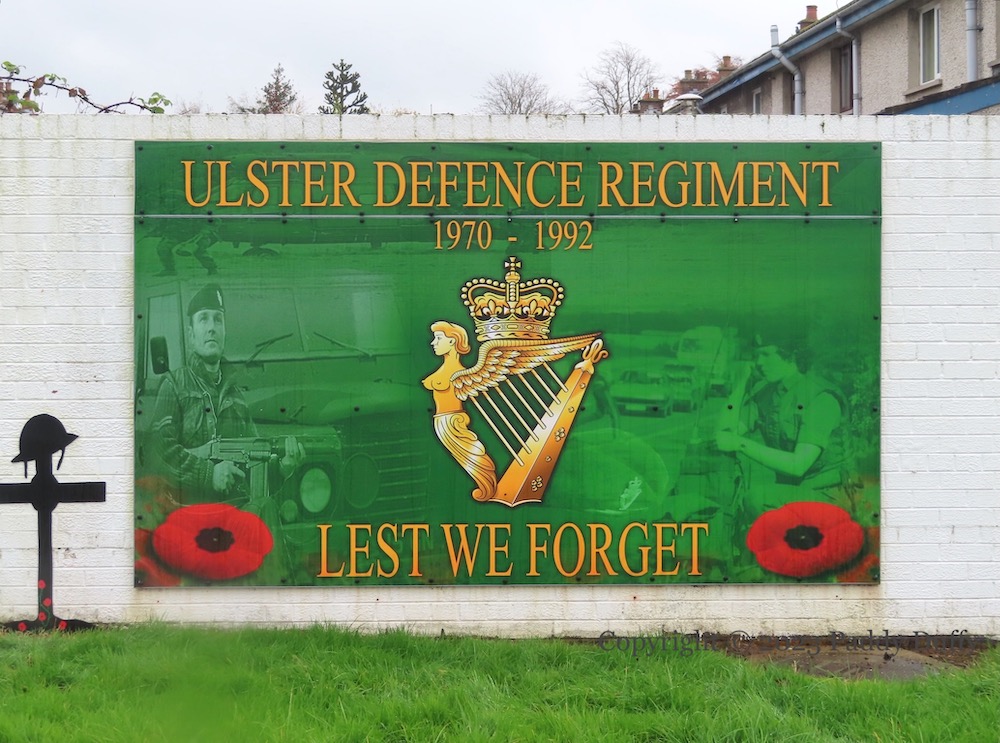
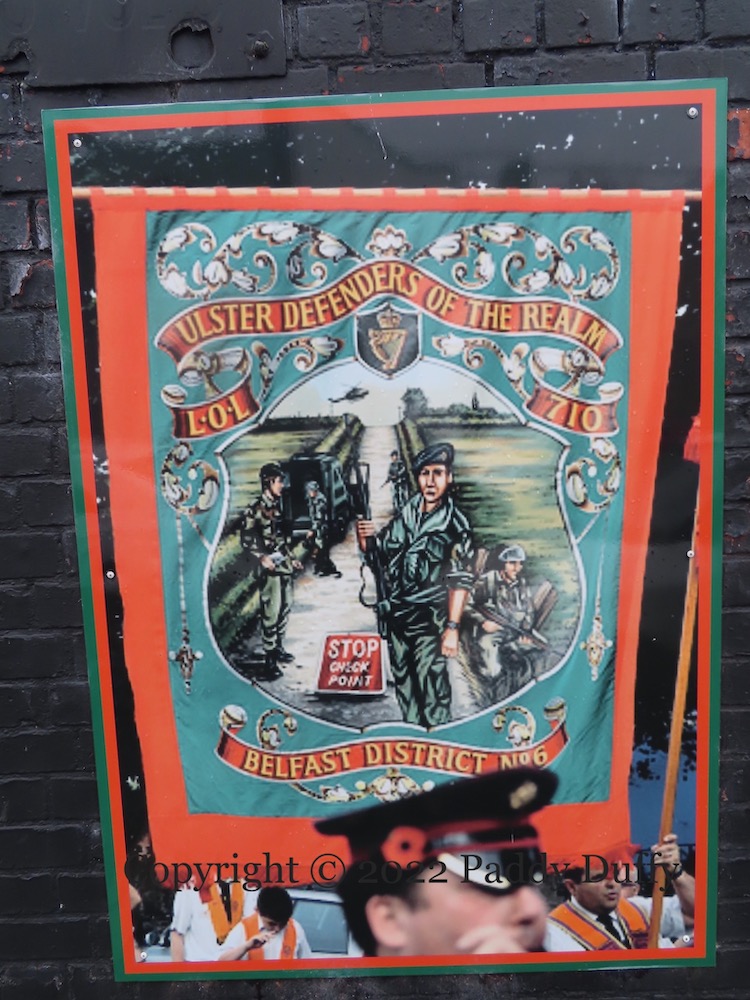
The second mural along Ballee Way, Ballymena (between The Crown and The Lion Wears The Crown), is a tribute to the UDR [Ulster Defence Regiment], established in 1970 to replace the Specials and amalgamated with the Royal Irish Rangers in 1992 to form the Royal Irish Regiment. The mural shows a UDR soldier manning a checkpoint, on top of a free-floating Northern Ireland filled in with a Union Flag.
“‘We bravely charged through no-man’s land/With the red hand flying high/Our cry was ‘No surrender’/Old Ulster’s battle cry.’ 1st July 1916 – Battle Of The Somme. Faugh a ballagh.”
“No surrender” was the cry against the forces of James II as they marched on Derry on December 7th, 1688, a moment celebrated by members of the Orange Order, Royal Black Institution, and Apprentice Boys, and from there, possibly shouted on July 1st as the 36th Division, formed from the Ulster Volunteers, attacked Schwaben Redoubt from Thiepval Wood (Irish Times | History Ireland).
The red hand is the emblem of the 36th (Ulster) Division and the shamrock stands for the 16th (Irish) Division, which was not in action on July 1st (the Battle Of Albert) but at the Battle Of Ginchy and Battle Of Guillemont in early September (Long Long Trail). (See also various Messines 1917 murals: Killed Wounded Missing | Comrades In Arms | We Are The dead | Brothers In Arms | Messines 1917
“Faugh a ballagh” is also included; of the regiments who supplied battalions for the 36th Division, only one – the Royal Irish Fusiliers – used that motto, the 9th battalion of the RIF was raised from the Armagh, Monaghan, and Cavan Volunteers. The motto of the Royal Irish Rifles (who supplied 8 of the 12 battalions of the 36th), and later of the UDR, was “Quis separabit”. “Faugh a ballagh” was the motto of the Royal Irish Rangers and is the motto of the current Royal Irish Regiment.
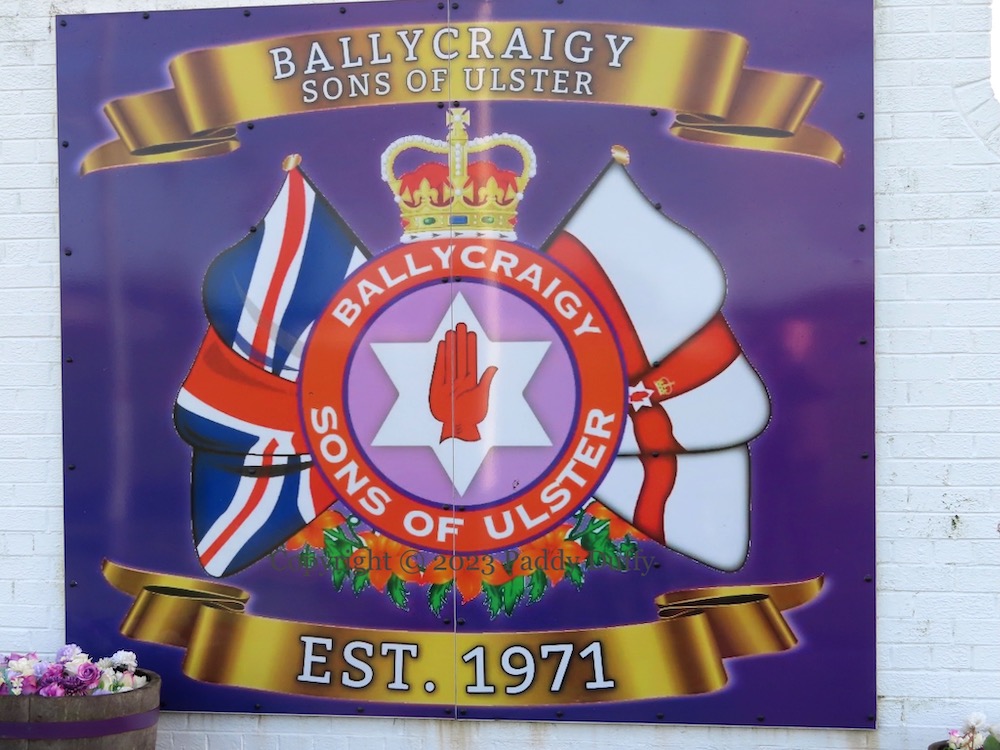
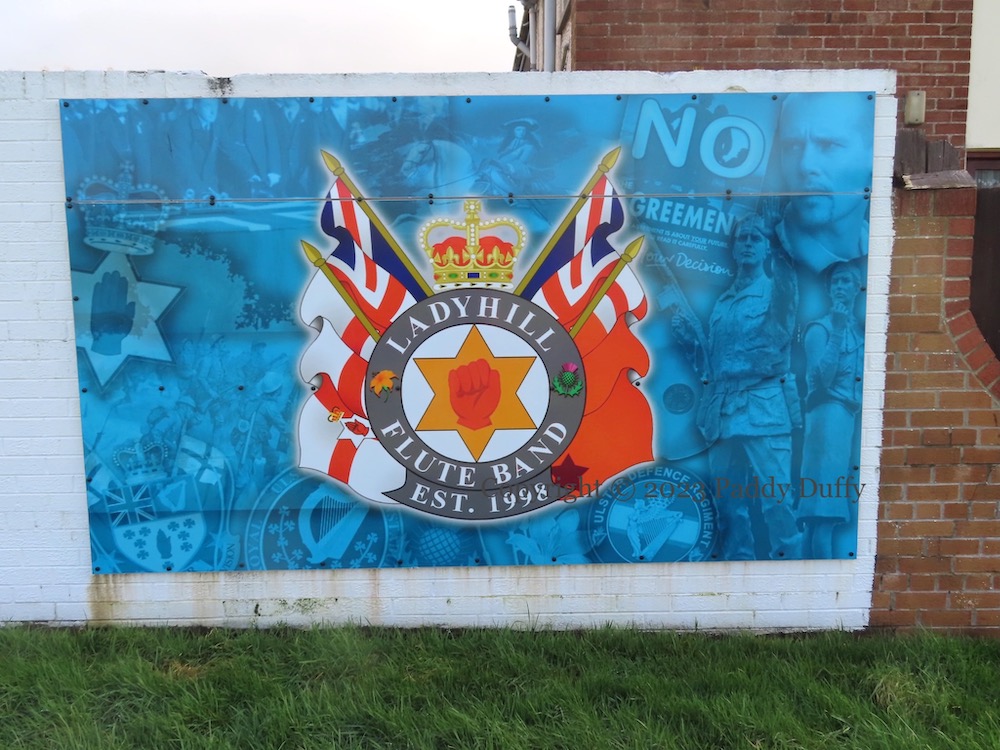
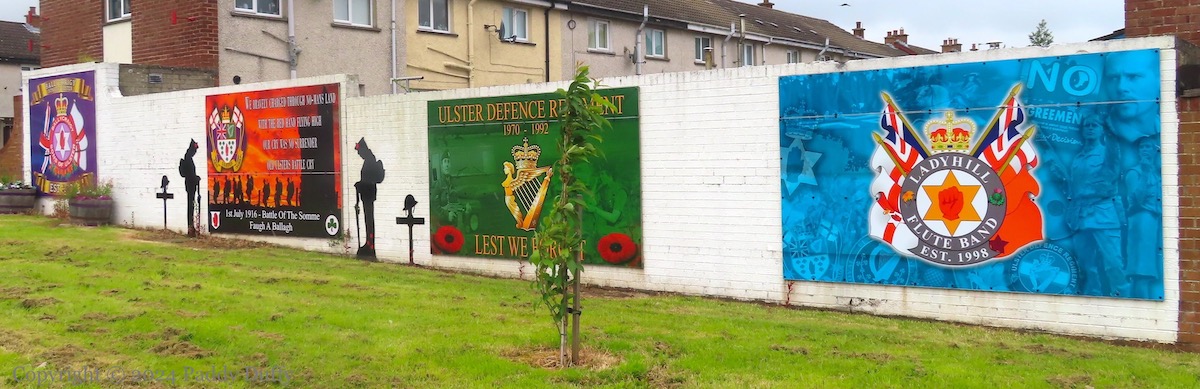
The military boards are flanked by boards for two local flute bands: “Ballycraigy Sons Of Ulster est. 1971” (tw) and “Ladyhill flute band est. 1998” (Fb).
Update 2024-06: Silhouetted graveside mourners have been added to either side of the Somme board – see the final two images.
2023-11: with silhouetted graveside mourners and helmet on cross
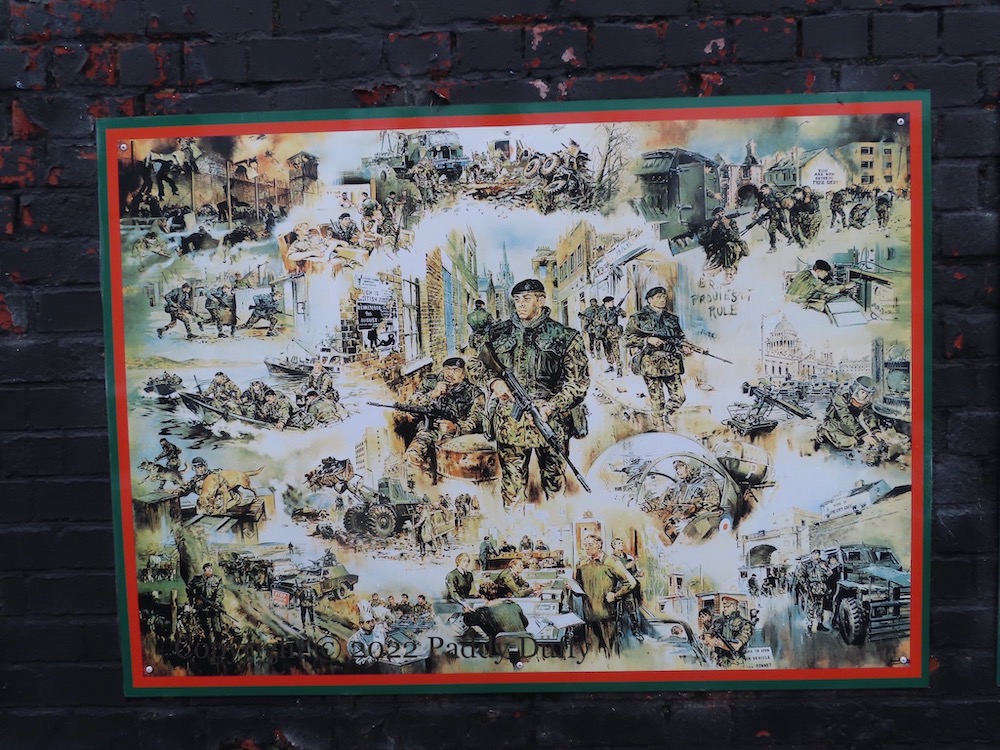
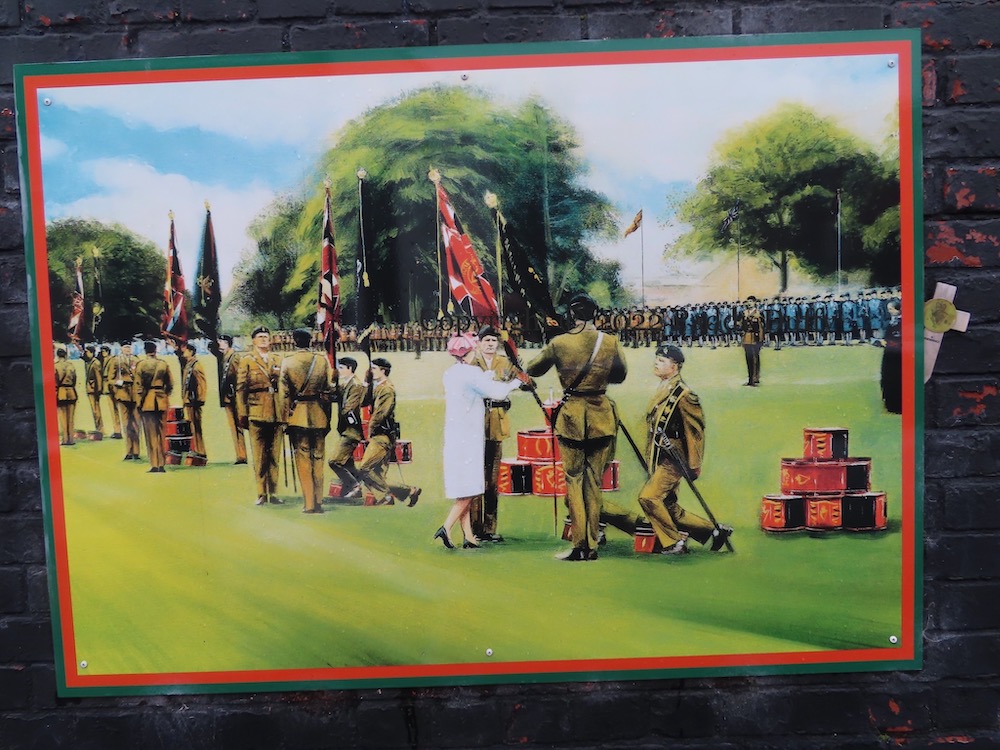
These five boards together form a memorial to the UDR and in particular to Privates Fred Starrett and James Cummings, who died in an IRA bombing on Belfast’s Royal Avenue on February 24th, 1988. Both Orangemen, their deaths are commemorated every year by a parade from east Belfast to the city centre.
“May Ulster flourish” as the newly created Northern Ireland under “Sir James Craig, 1st Viscount Craigavon, Prime Minister of Northern Ireland”. The Northern Ireland parliament was opened in 1921 and the coat of arms adopted in 1924 (WP); the Special Constabulary (including the B-Specials) had been formed prior to and in preparation for partition – the quote from Carson (also seen in an east Belfast mural) is from July 12th, 1920.
The text on the board is the same as at WP: “The Ulster Special Constabulary (USC; commonly called the “B-Specials” or “B Men”) was a quasi-military reserve special constable police force in what would later become Northern Ireland. It was set up in October 1920, shortly before the partition of Ireland. It was an armed corps, organised partially on military lines and called out in times of emergency, such as war or insurgency. It performed this role most notably in the early 1920s during the Irish War of Independence and the 1956-1962 IRA Border Campaign. During its existence, 95 USC members were killed in the line of duty. Most of these (72) were killed in conflict with the IRA in 1921 and 1922. Another 8 died during the Second World War, in air raids or IRA attacks. Of the remainder, most died in accidents but two former officers were killed during the Troubles in the 1980s. The Special Constabulary was disbanded in May 1970, after the Hunt Report, which advised re-shaping Northern Ireland’s security forces and demilitarizing the police. Its functions and membership were largely taken over by the Ulster Defence Regiment and the Royal Ulster Constabulary.”
This Belfast Live article (which has images from the launch) leads with the headline that this new board replaces a UVF mural, but there hasn’t been anything on this wall since a large “UDA” lettering in 1999. The adjacent wall, which has now been painted over, previously (in 2010) had a UVF flag which had been vandalised with “Jesus Christ Is Lord Of All’ graffiti by 2017.









 Paddy Duffy Collection