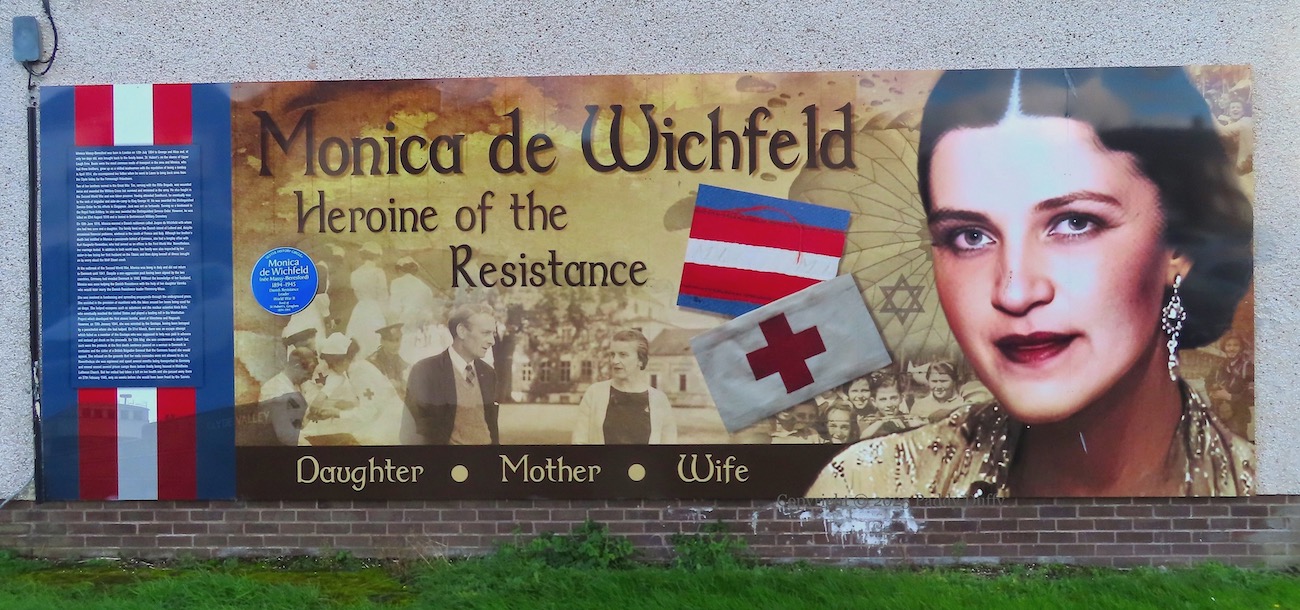
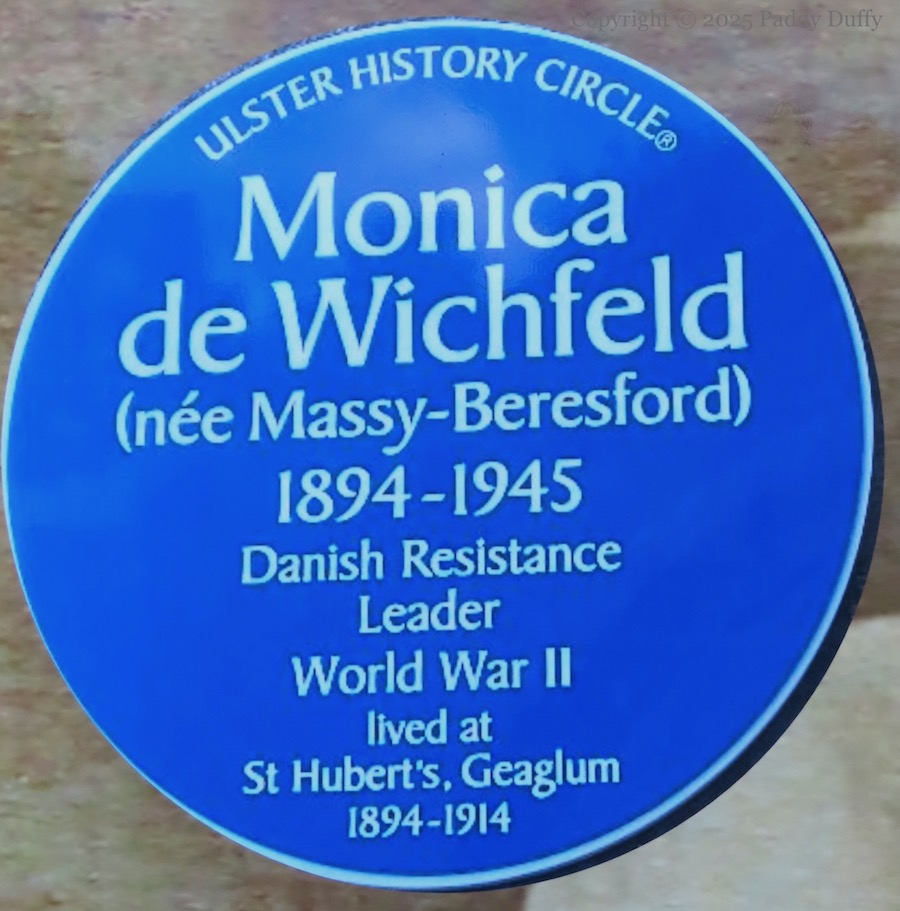
“Monica de Wichfeld, heroine of the resistance, daughter, mother, wife”. The blue plaque to Monica Massy-Beresford is at the Kinawley Holy Trinity church in Derrylin, Fermanagh, (Street View), near where she grew up. She moved to Denmark upon her marriage and had a long and varied career in the Danish resistance to the German occupation in WWII, raising money for the Communists, using her estate to shelter fleeing families and receive arms and train volunteers, and eventually heading the regional group on Lolland (WP).
Castlemara Drive, Carrickfergus
h/t Alain Miossec
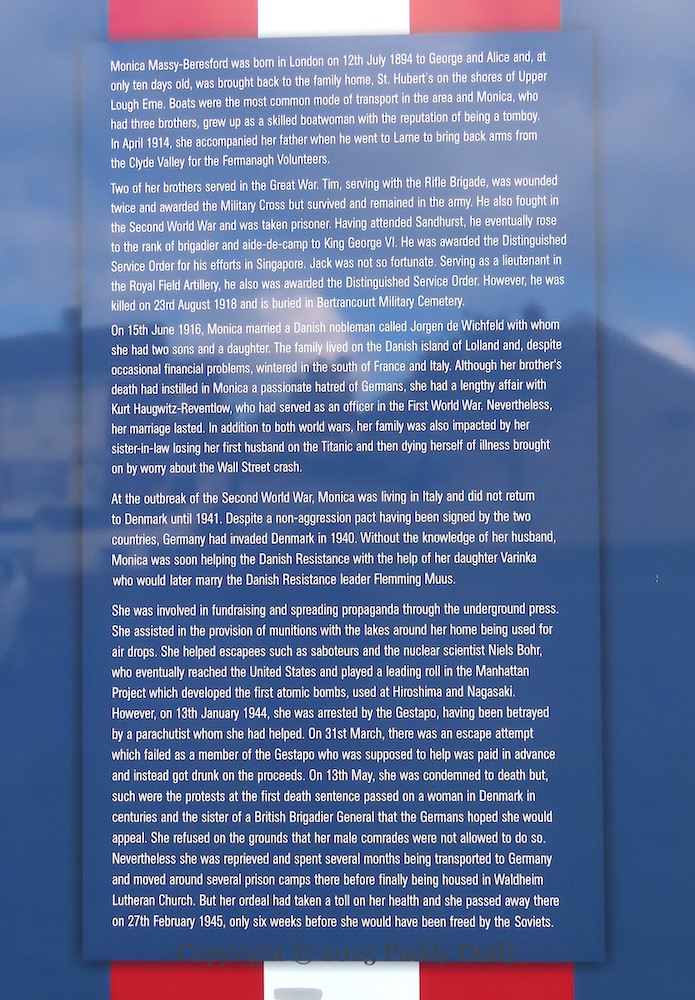
“Monica Massy-Beresford was born in London on 12th July 1894 to George and Alice and, at only ten years old, was brought back to the family home, St Hubert’s on the shores of Upper Lough Erne. Boats were the most common mode of transport in the area and Monica, who had three brothers, grew up as a skilled boatwoman with the reputation of being a tomboy. In April 1914, she accompanied her father when he went to Larne to bring back arms from the Clyde Valley for the Fermanagh Volunteers. … On 15th June 1916, Monica married a Danish nobleman called Jorgen de Wichfeld with whom she had two sons and a daughter. The family lived on the Danish island of Lolland and, despite occasional financial problems, wintered in the south of France and Italy. Although her brother’s death had instilled in Monica a passionate hatred of Germans, she had a lengthy affair with Kurt Huagwitz-Reventlow, who had served as an officer in the First World War. Nevertheless, her marriage lasted. … At the outbreak of the Second World War, Monica was living in Italy and did not return to Denmark until 1941. Despite a non-aggression pact having been signed by the two countries, Germany had invaded Denmark in 1940. Without the knowledge of her husband, Monica was soon helping the Danish Resistance with the help of her daughter Varinka who would later marry the Danish Resistance leader Flemming Muus.
She was involved in fundraising and spreading propaganda through the underground press. She assisted in the provision of munitions with the lakes around her home being used for air drops. She helped escapees such as saboteurs and the nuclear physicist Niels Bohr, who eventually reached the United States and played a leading roll [role] in the Manhattan Project which developed the first atomic bombs, used at Hiroshima and Nagasaki. However, on 13th January 1944, she was arrested by the Gestapo, having been betrayed by a parachutist whom she had helped. On 31st March, these was an escape attempt which failed as a member of the Gestapo who was supposed to help was paid in advance and instead got drunk on the proceeds. On 13th May, she was condemned to death but, such were the protests at the first death sentence passed on a woman in Denmark in centuries and the sister of a British Brigadier General that the Germans hoped she would appeal. She refused on the grounds that her male comrades were not allowed to do so. Nevertheless she was reprieved and spent several months being transported to Germany and moved around several prison camps there before finally being housed in Waldheim Lutheran Church. But her ordeal had taken a toll on her health and she passed away there on 27th February 1945, only six weeks before she would have been freed by the Soviets.

Click image to enlarge
Copyright © 2025 Paddy Duffy
T07907 T07906 T07909 T07908
 Paddy Duffy Collection