Thanks And Remembrance

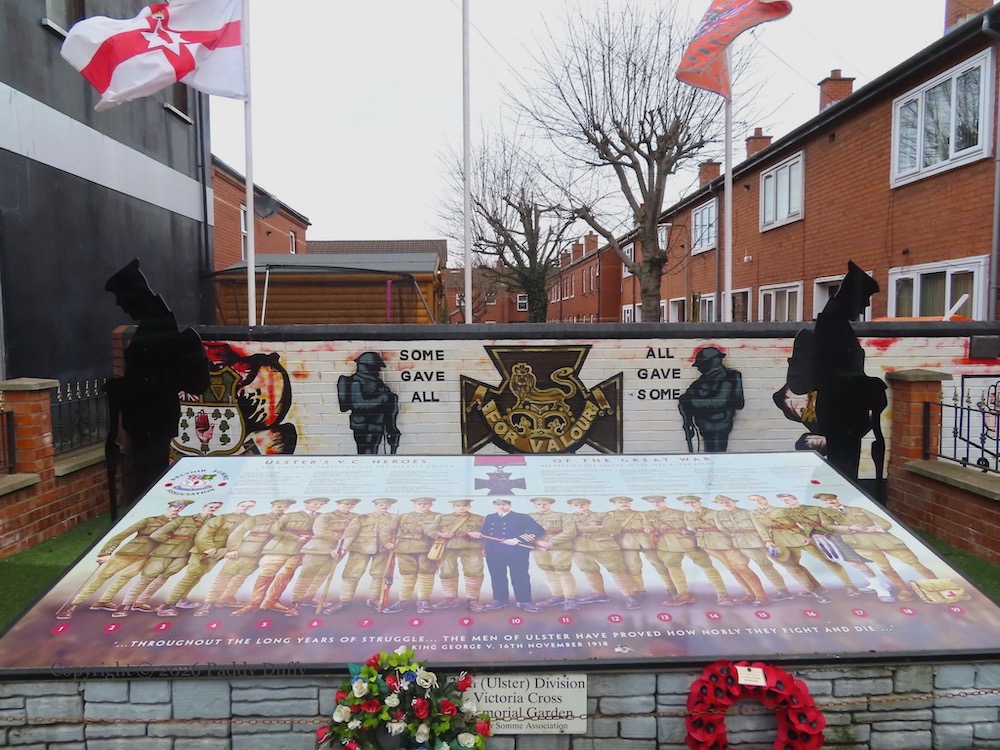
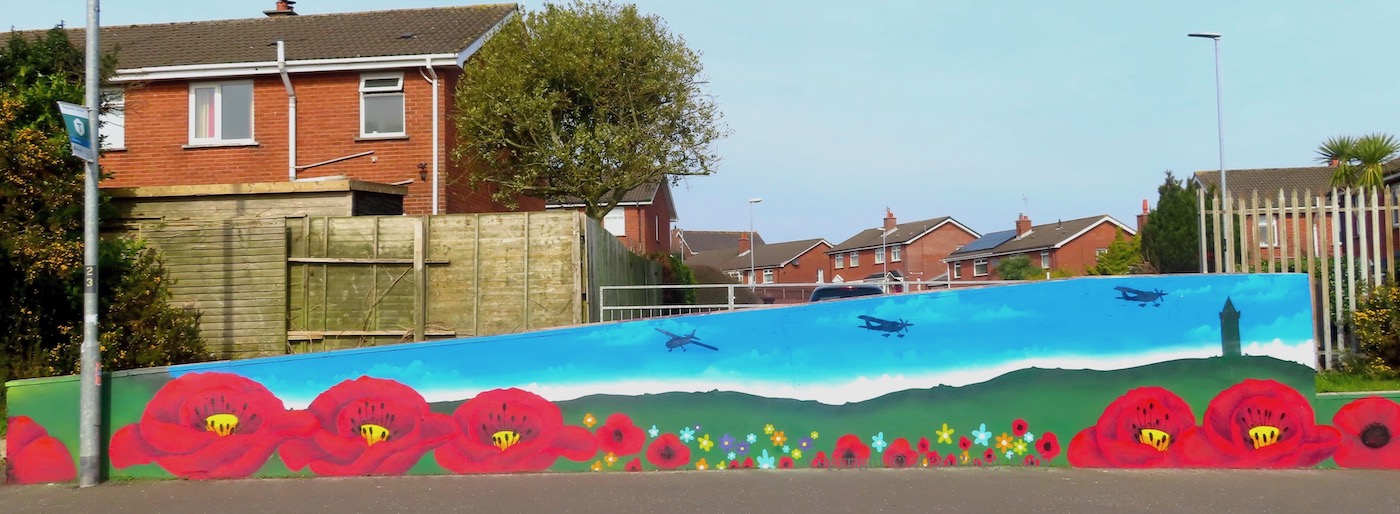
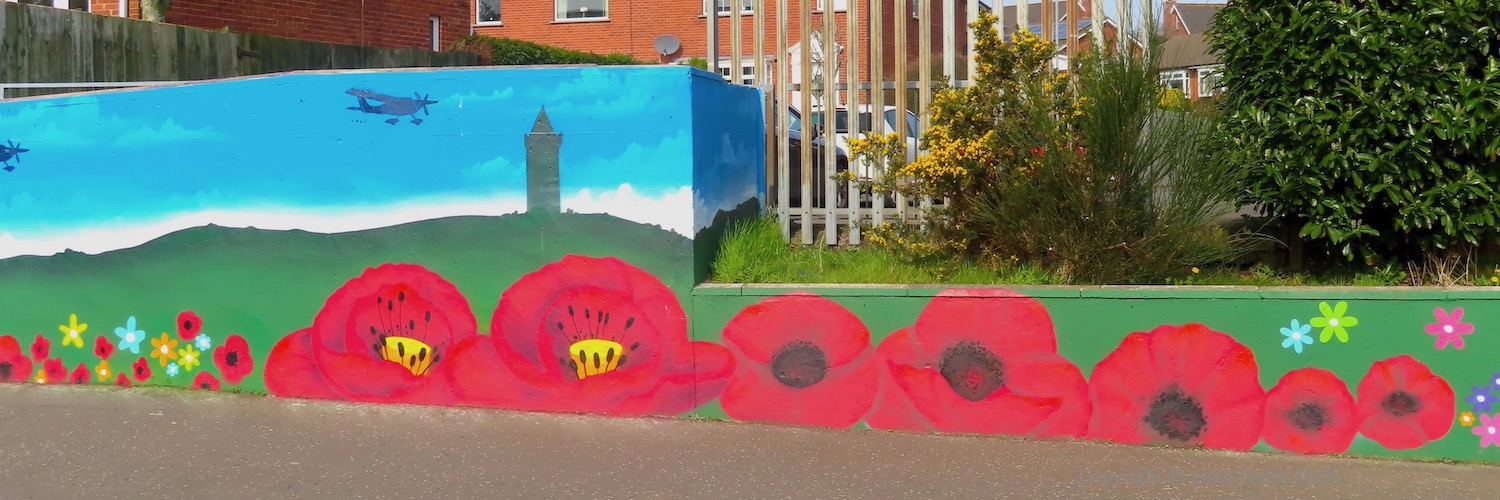
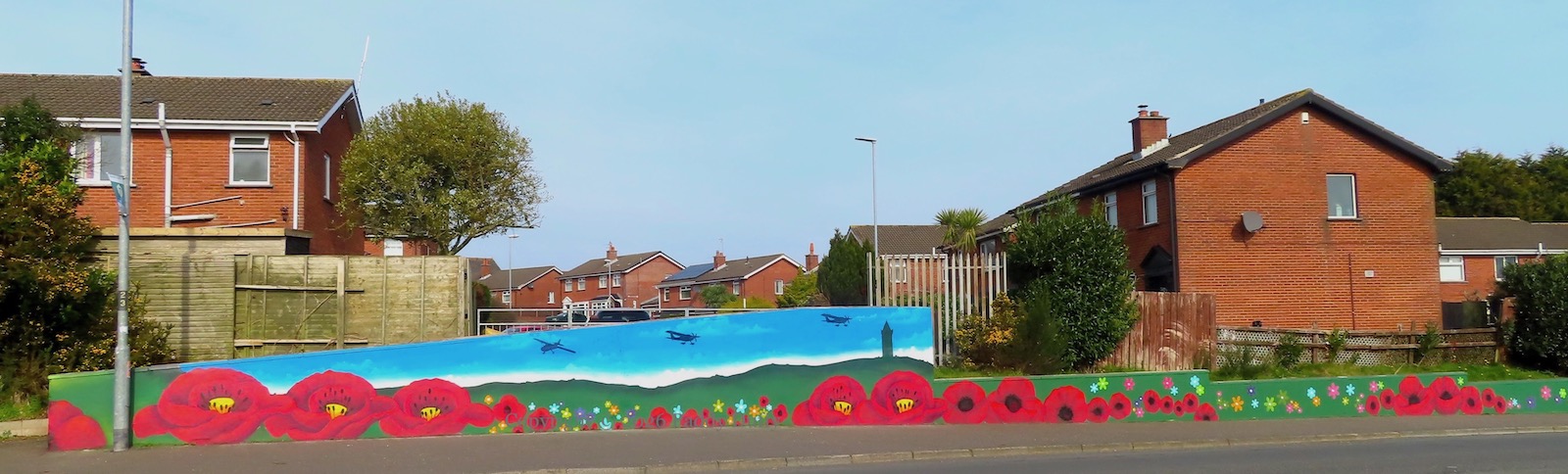
“This cross of thanks and remembrance was erected by the residents and children of the local area, Sunday 3rd November, 2024.” The small black plaques mounted on the cross commemorate a variety of units and individuals from the World Wars, Operation Banner, and the Iraq War, including the British Armed Forces, Royal Inniskillings, Royal Hussars, Women’s Auxiliary Air Force, Royal Irish Rifles, UDR, B Specials, Parachute Regiment, Royal Irish Regiment. In front are three plaques on stones, one marking QEII’s platinum jubilee, the middle one marking Northern Ireland’s centenary, and one on the right marking KCIII’s coronation.

The cross was officially launched on November 7th (Fb).

Ransevyn Drive, Whitehead

Click image to enlarge
Copyright © 2025 Paddy Duffy
T07916 T07917 [T07918] T07919 T07920

William & Catherine

“William & Catherine, prince and princess of Wales, baron and baroness of [sic] Carrickfergus.” Prince William was granted the title of “Baron Carrickfergus” upon his marriage to Catherine Middleton in 2011; he was also made Earl Of Strathearn and Duke Of Cambridge (royal.uk). The couple visited Carrickfergus in 2022 (NI World), shortly after Charles acceded to the throne and William gained the title of Prince Of Wales.

Larne Road, Eden

h/t Alain Miossec

Click image to enlarge
Copyright © 2025 Paddy Duffy
T07911 T07922 T07921

Monica De Wichfeld

“Monica de Wichfeld, heroine of the resistance, daughter, mother, wife”. The blue plaque to Monica Massy-Beresford is at the Kinawley Holy Trinity church in Derrylin, Fermanagh, (Street View), near where she grew up. She moved to Denmark upon her marriage and had a long and varied career in the Danish resistance to the German occupation in WWII, raising money for the Communists, using her estate to shelter fleeing families and receive arms and train volunteers, and eventually heading the regional group on Lolland (WP).

Castlemara Drive, Carrickfergus

h/t Alain Miossec

“Monica Massy-Beresford was born in London on 12th July 1894 to George and Alice and, at only ten years old, was brought back to the family home, St Hubert’s on the shores of Upper Lough Erne. Boats were the most common mode of transport in the area and Monica, who had three brothers, grew up as a skilled boatwoman with the reputation of being a tomboy. In April 1914, she accompanied her father when he went to Larne to bring back arms from the Clyde Valley for the Fermanagh Volunteers. … On 15th June 1916, Monica married a Danish nobleman called Jorgen de Wichfeld with whom she had two sons and a daughter. The family lived on the Danish island of Lolland and, despite occasional financial problems, wintered in the south of France and Italy. Although her brother’s death had instilled in Monica a passionate hatred of Germans, she had a lengthy affair with Kurt Huagwitz-Reventlow, who had served as an officer in the First World War. Nevertheless, her marriage lasted. … At the outbreak of the Second World War, Monica was living in Italy and did not return to Denmark until 1941. Despite a non-aggression pact having been signed by the two countries, Germany had invaded Denmark in 1940. Without the knowledge of her husband, Monica was soon helping the Danish Resistance with the help of her daughter Varinka who would later marry the Danish Resistance leader Flemming Muus.
She was involved in fundraising and spreading propaganda through the underground press. She assisted in the provision of munitions with the lakes around her home being used for air drops. She helped escapees such as saboteurs and the nuclear physicist Niels Bohr, who eventually reached the United States and played a leading roll [role] in the Manhattan Project which developed the first atomic bombs, used at Hiroshima and Nagasaki. However, on 13th January 1944, she was arrested by the Gestapo, having been betrayed by a parachutist whom she had helped. On 31st March, these was an escape attempt which failed as a member of the Gestapo who was supposed to help was paid in advance and instead got drunk on the proceeds. On 13th May, she was condemned to death but, such were the protests at the first death sentence passed on a woman in Denmark in centuries and the sister of a British Brigadier General that the Germans hoped she would appeal. She refused on the grounds that her male comrades were not allowed to do so. Nevertheless she was reprieved and spent several months being transported to Germany and moved around several prison camps there before finally being housed in Waldheim Lutheran Church. But her ordeal had taken a toll on her health and she passed away there on 27th February 1945, only six weeks before she would have been freed by the Soviets.

Click image to enlarge
Copyright © 2025 Paddy Duffy
T07907 T07906 T07909 T07908

We Are Here Today

This is a new version of the board seen in 2022, in which the central emblem was of the 8th battalion of the Royal Irish Rifles, whereas it is now of the “East Belfast & North Down Veterans’ Association”.

Below, a small plaque reading “We were there yesterday, We are here today, We will be here tomorrow” has been added

Albertbridge Road, east Belfast

Click image to enlarge
Copyright © 2025 Paddy Duffy
T07927

Generation To Generation

Here are two new small boards on the fence where Hawthorn Avenue and Sandes Court meet between Woodburn and Sunnylands. Above, “Remembering our fallen everyday [sic]” with images of soldiers from the World Wars and UVF emblems in the corners. Below, an Ulster Grenadiers flute band (Fb) board, similar to the large board mounted last year (2024) in St Bride’s Street – see Never Forget, Always Remember.

The main board, on the gable beyond – “Loyalist Woodburn celebrates 100th anniversary Northern Ireland” – and Captain Sir Tom Moore remain as in 2022’s entry – see Maintain The Union.

Click image to enlarge
Copyright © 2025 Paddy Duffy
T07924 T07925 T07926

Where The Troubles Began

A new visitor exhibition will open on Thursday November 6th at Ionad Eileen Howell with images, video, and audio recordings covering the period from the start of the Troubles in 1969 to the Falls Curfew in 1970 (Belfast Media). The new exhibition is hosted by the Falls Community Council (Fb); tickets via Visit Belfast.

The Troubles are generally said to have started in August, 1969, rather than (e.g.) October, 1968, because the Battle Of The Bogside in Derry (beginning on August 12th) and the rioting in Belfast (beginning on the 13th) led to the deployment of British troops (on August 14th and 15th).

The Falls Curfew, in July 1970, was a pivotal event in the souring of relations between the CNR population and the British Army. About 3,000 homes were cordoned off, the area was saturated with CS gas, and thousands of bullets were fired by the Officials and Army soldiers, the latter killing Charles O’Neill, William Burns, Zbigniew Uglik, and Patrick Elliman; there is a plaque commemorating the four a little further up the road – see The Falls Curfew.

St Comgall’s, Divis Street, west Belfast

Click image to enlarge
Copyright © 2025 Paddy Duffy
T07889 T07890 [T07891] [T07892]

On The Shoulders Of Giants

Matt Talbot Youth Centre (Fb) provides activities and services for young people from New Barnsley and Moyard, including an afternoon club, trips during the summer months, and Halloween and Christmas parties.

The two murals are face-to-face in New Barnsley Gardens. Also included are some painted utility boxes in the area, including a hurler/camogie-player from Michael Davitt’s GAC (web).

Click image to enlarge
Copyright © 2025 Paddy Duffy
T07886 T07885 T07883 T07884
T07882 T07881 T07887 T07888
T08169 [T08168]

Saoırse Go Deo

The gallery of socialist heroes at the top of the Rock, first painted in 2006, has been repainted in blue (rather than yellow). The faces remain the same as before: (l-r) Seamus Costello (INLA/IRSP founder), Gino Gallagher (INLA chief of staff), Che (in the Guerillero Heroico pose), Patsy O’HaraMiriam Daly, James Connolly.

Click image to enlarge
Copyright © 2025 Paddy Duffy
T07880 T07879 T07878 T07877