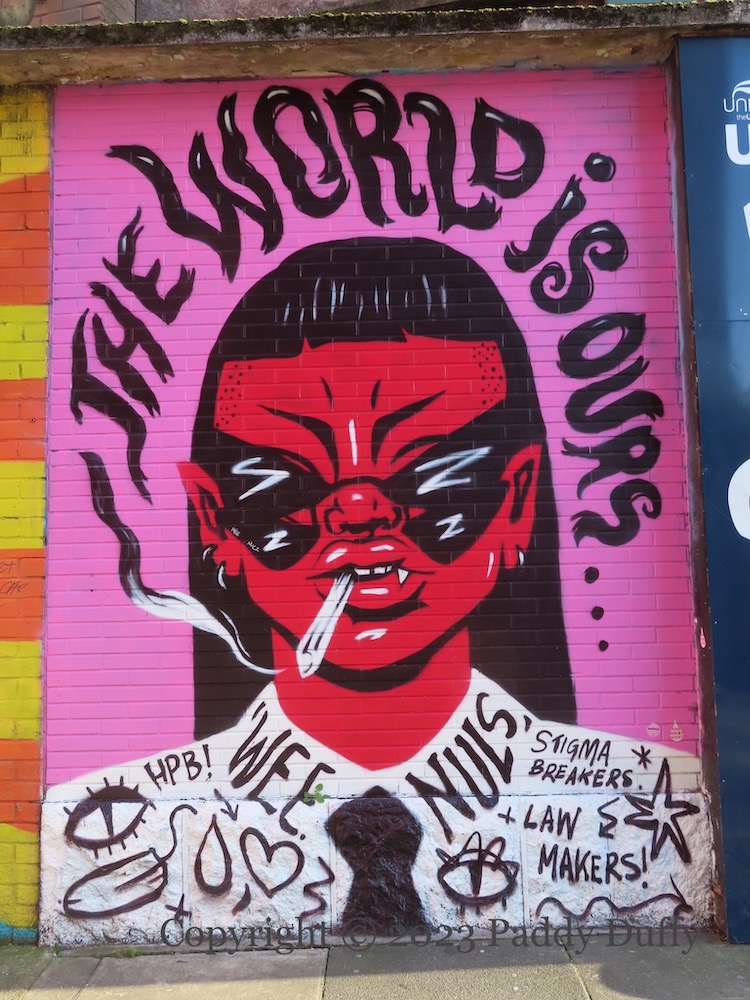
This is Wee Nuls’s (web | ig) street art celebrating the success of the ‘menstruation matters’ (ig) campaign for free period products and the passage of the Period Products Bill.
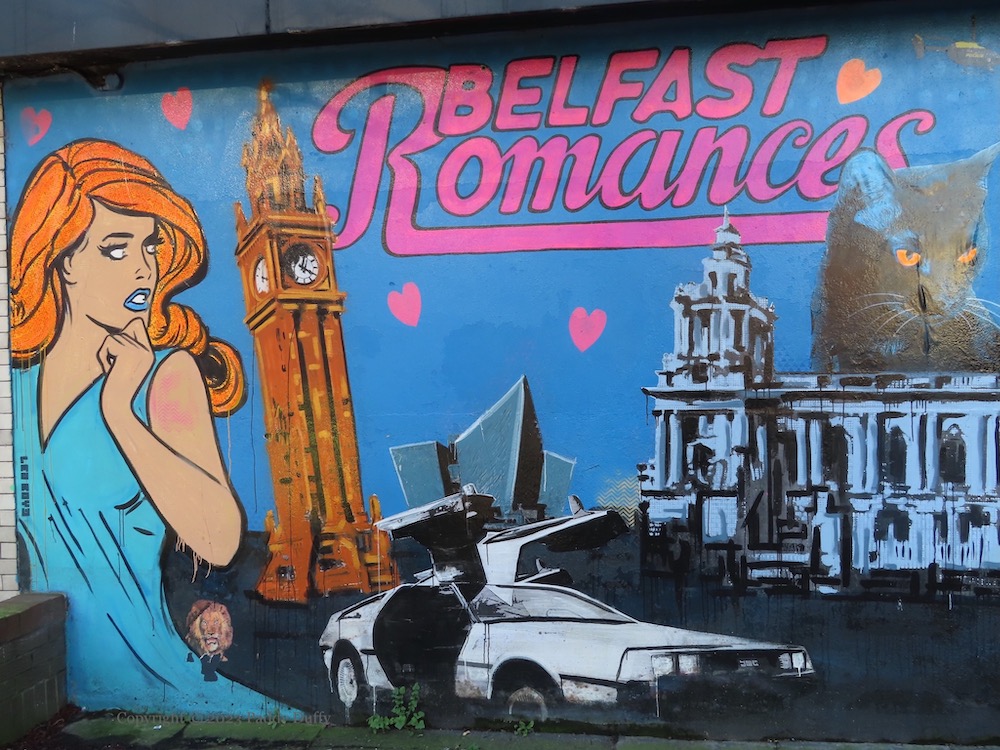
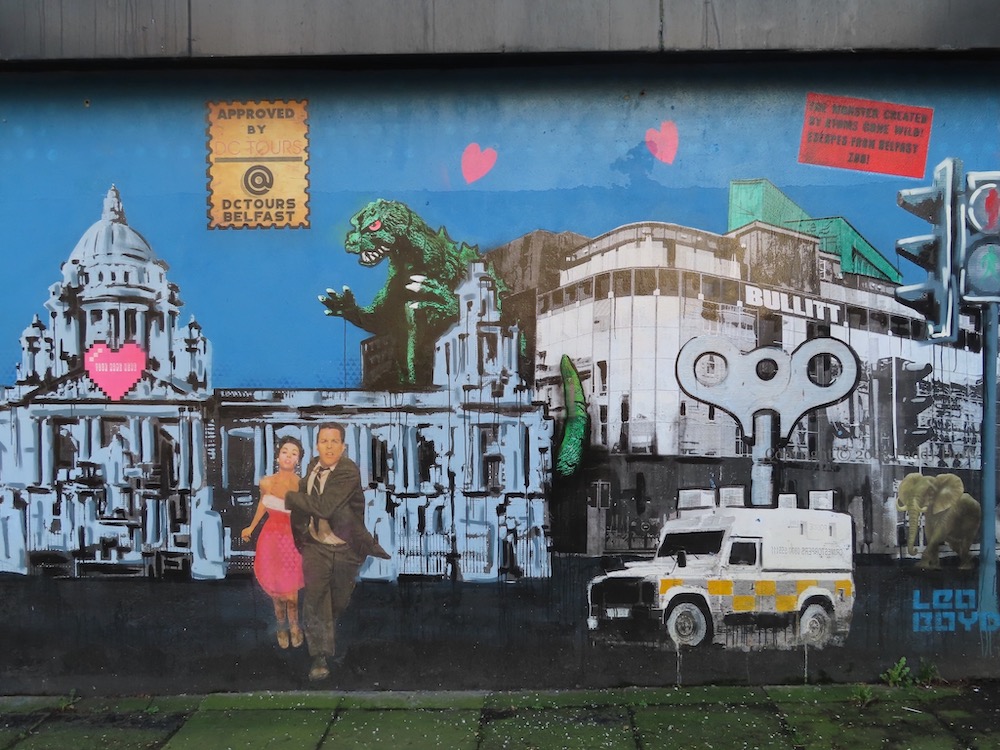
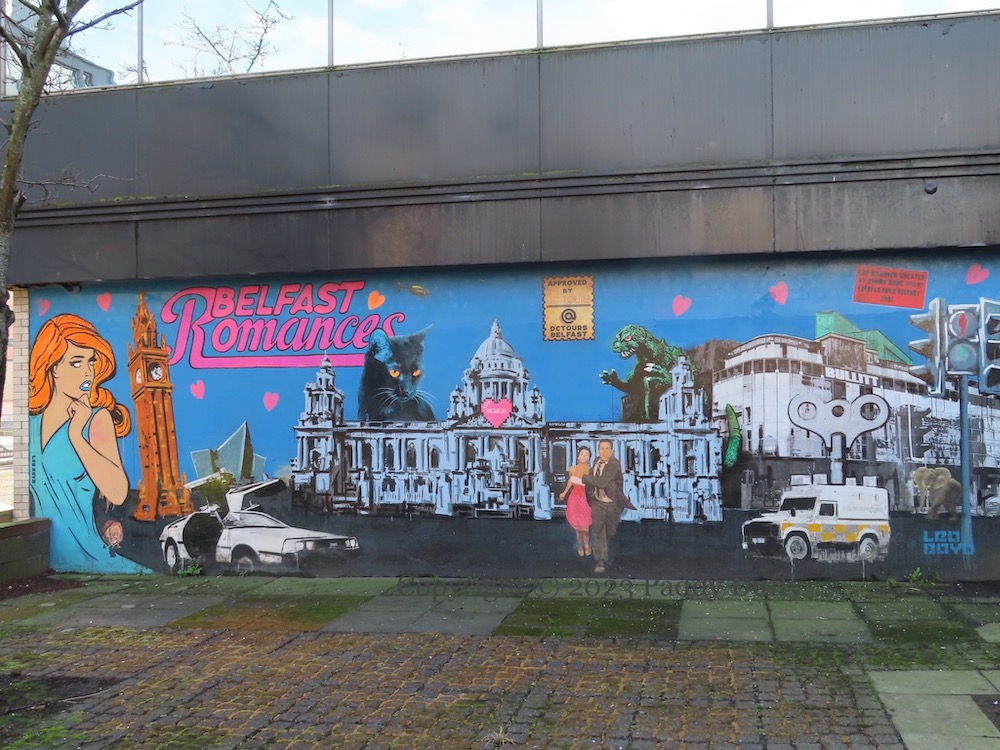
This Leo Boyd (web) piece in Great Victoria Street brings together many of the ideas seen in his posters over the years, including When Urban Love Goes Wrong, Belfast Kitty Hall, DeLorean cars, Godzilla – “The monster created by atoms gone wild! Escaped from Belfast zoo”, and the wind-up police land-rover.
In Irish mythology, Étaín (Éadaoın, Aideen) of the Ulaıd and her lover Mıdır of the Tuatha Dé Danann turn into swans after Mıdır wins an embrace from her in a board game with her husband Eochaıd, the High King of Ireland (Tochmarc Étaíne/The Wooing Of Étaín).
Street art by JMK (ig) in the Bullit alleyway off Church Lane.
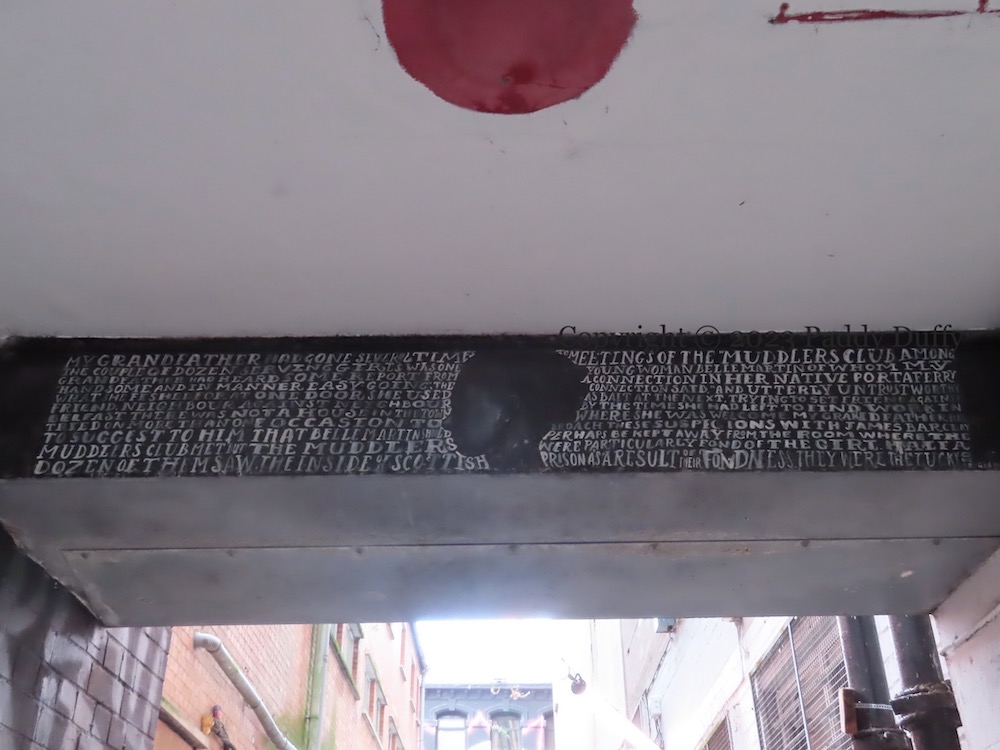
After Britain’s declaration of war against France in 1793, the United Irishmen – who hoped for French support for a rebellion in Ireland – could no longer meet openly. In Belfast, meetings were held at Dr [Benjamin] Franklin’s tavern, also called “Peggy Barclay’s” after its owner, under the guise of a social group called the Muddlers’ Club.
The true nature of the group was betrayed to the authorities in 1796 by Isabella “Belle” Martin, a serving girl in the tavern (Romanticsm Anthology | Belfast Entries | Belfast Media | Joe Baker). As the text in the Peter Strain mural above concludes, “Half a dozen of them saw the inside of a Scottish prison as a result” and the club dissolved. (The text surrounding Martin’s profile is from Glenn Patterson’s book, A Mill For Grinding Old People Young – this was the name of Peggy Barclay’s inn when she left the city centre for the Buttermilk Loney (now Skegoniell Avenue) on the Shore Road in north Belfast.
The tavern, in Sugarhouse Entry, later become a hotel before eventually being destroyed in the WWII blitz. Sugarhouse Entry still exists but has been impassable since 1972 when it was closed off as part of the “ring of steel” securing Belfast city centre (DC Tours).
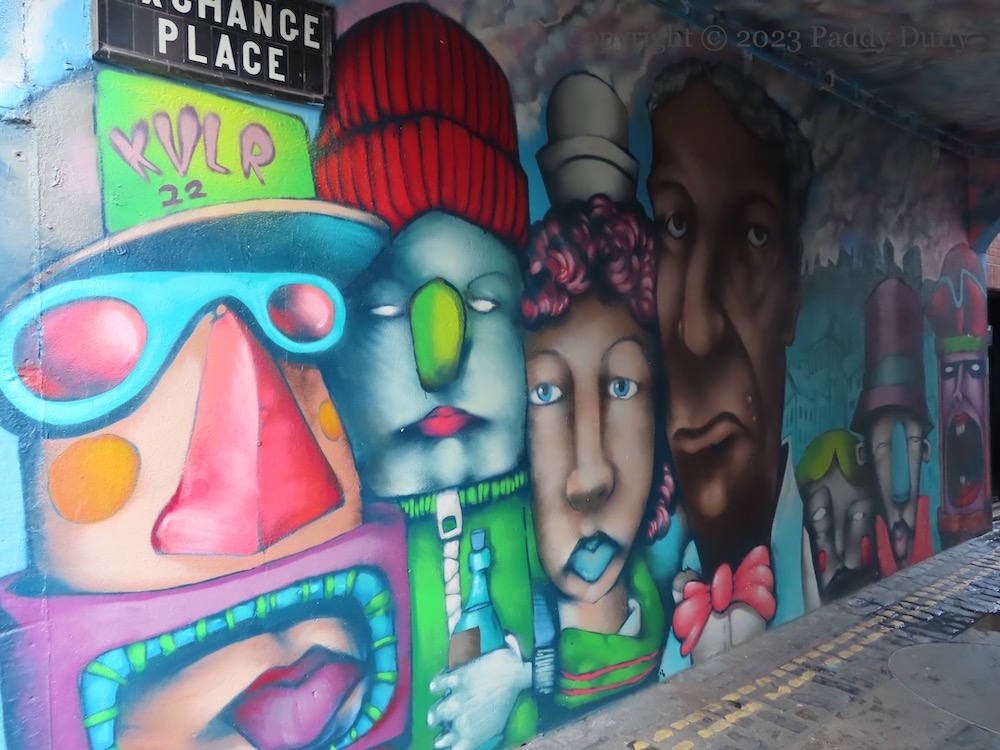
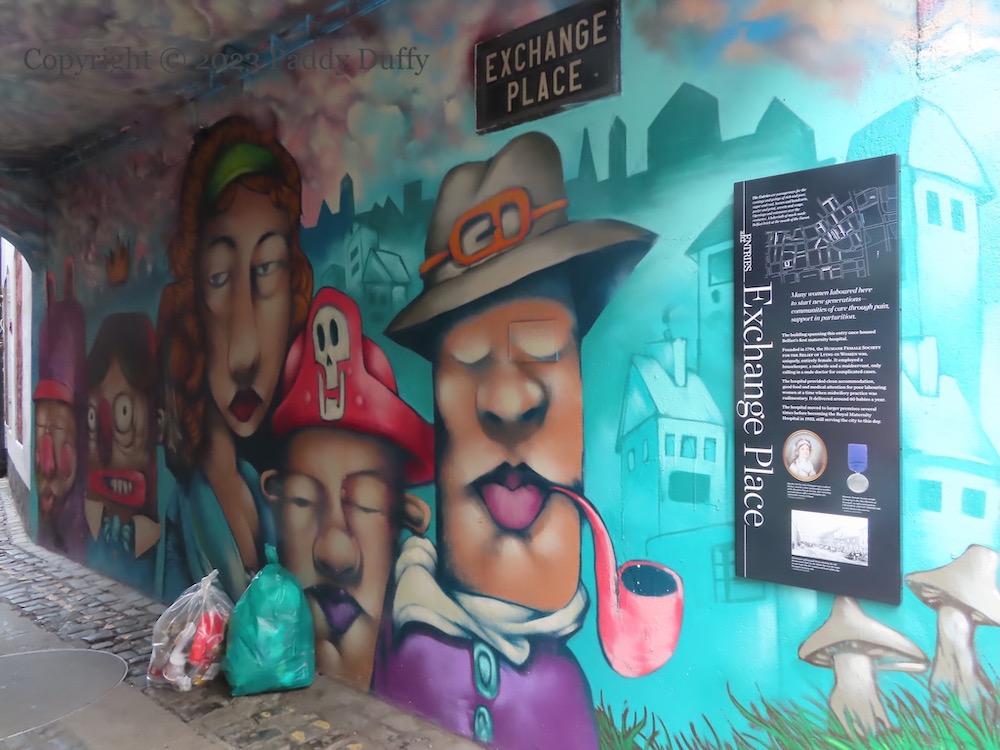
A gallery of faces from KVLR (ig) in Exchange Place, perhaps on their way to Belfast’s first maternity hospital, the Humane Female Society For The Relief Of Lying-In Women (Clifton House) which was in the building above these artworks.
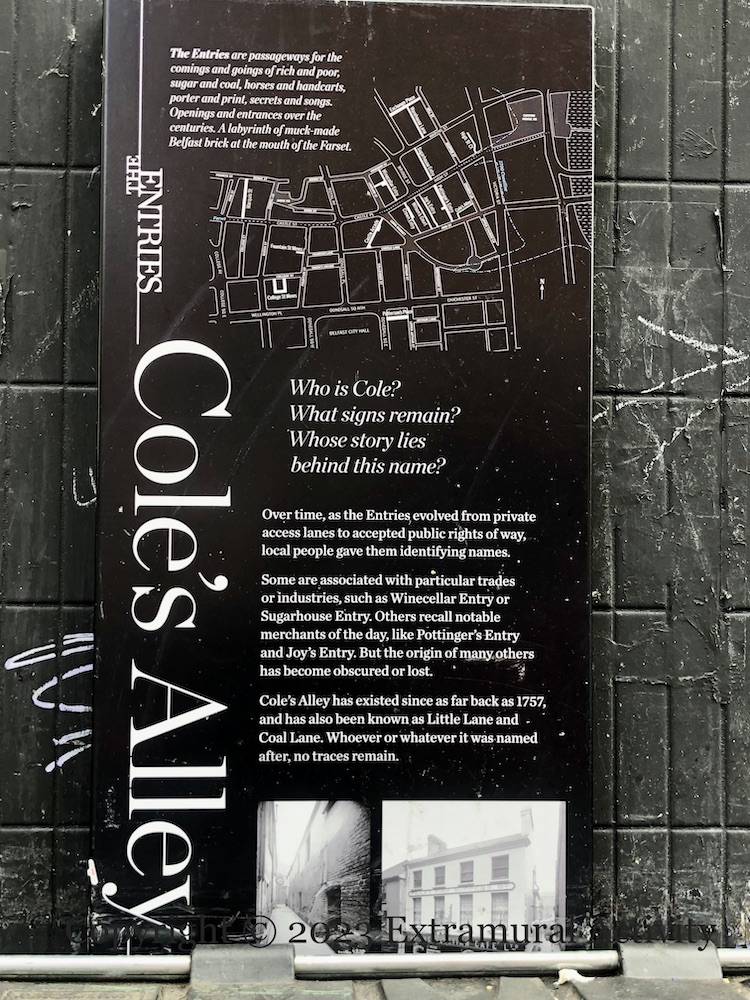
“The Entries are passageways for the comings and goings of rich and poor, sugar and coal, horses and handcarts, porter and print, secrets and songs. Openings and entrances over the centuries. A labyrinth of muck-made Belfast brick at the mouth of the Farset.”
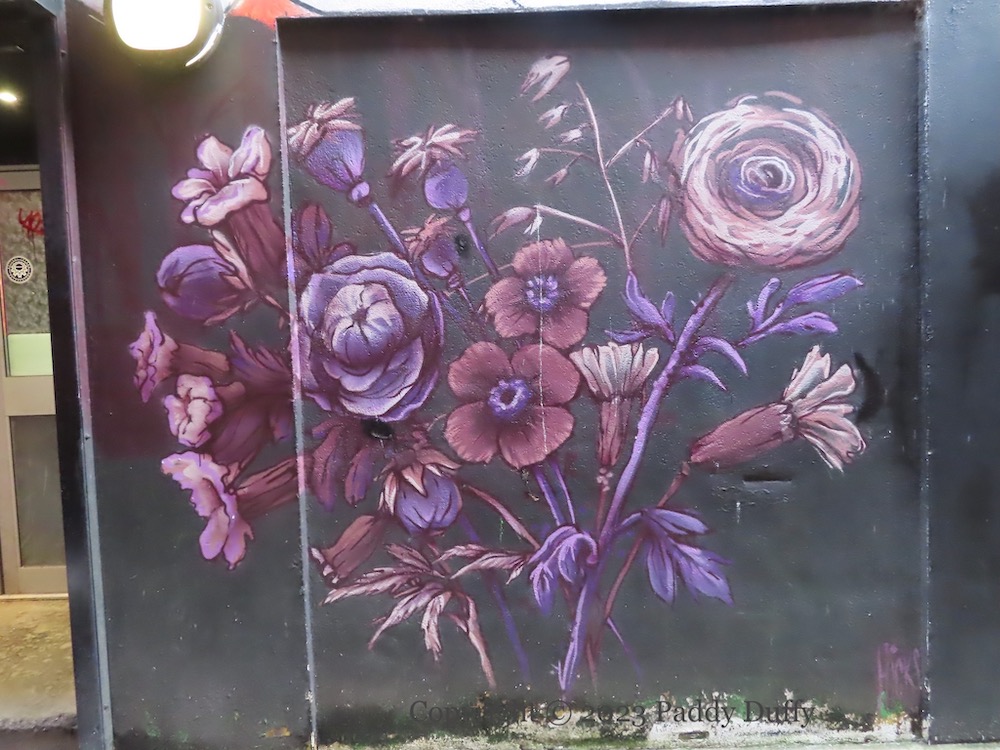
The artist of these purple flowers in Exchange Place is unknown, but they look quite like the (former) wood painted by Hicks on the other side of the doorway.
The most famous redshanks in Ireland are the Scottish soldiers of James II who marched on Derry, only to be rebuffed with cries of “No surrender” (December 7th, 1688). The soldier is perhaps (though there is no certainty) named after wading bird; the bird is known for its long red legs (Birdwatch Ireland), while the soldier went into battle bare-legged (Scotsman). The second image shows a shrimp and other items among the redshanks’ prey.
By Birmingham artist Annatomix (tw | web | Fb) in Cole’s Alley for the Belfast Entries Project (Visual History page).
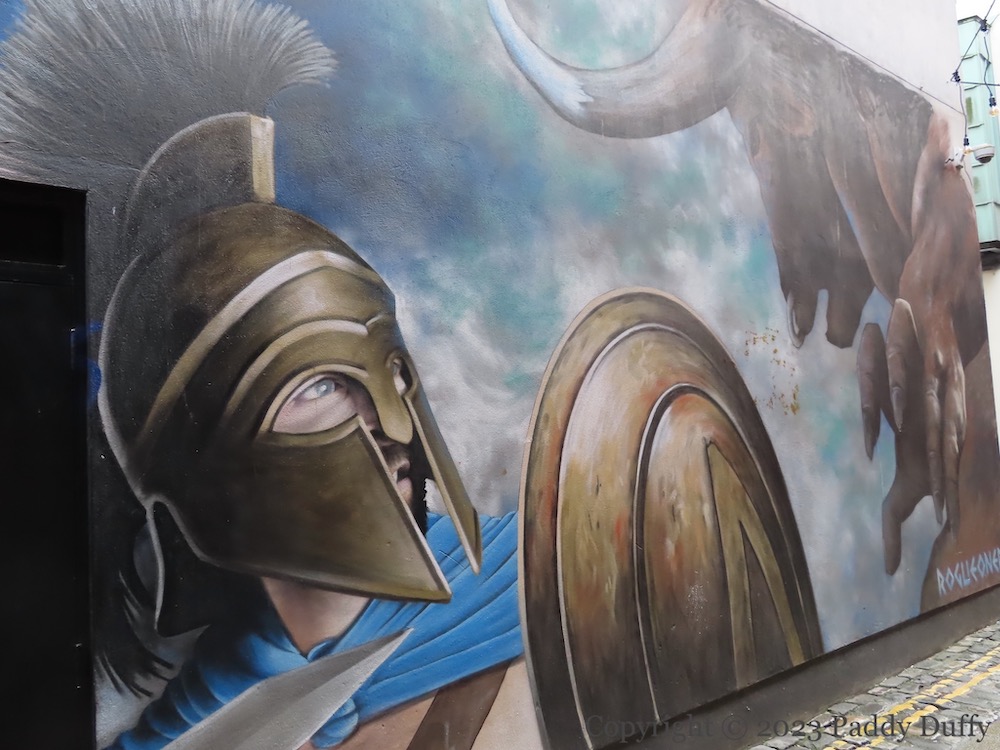
In ancient Greek mythology, the Athenian Theseus (though here carrying a Spartan shield) killed the bull (minotaur) of Cretan king Minos, thus ending the practice of sacrificing of Athenian youths as retribution for the earlier death of Minos’s son Androgeos. Glasgow artist Rogue One (Fb | ig) recreated the myth for CNBX/HTN18.
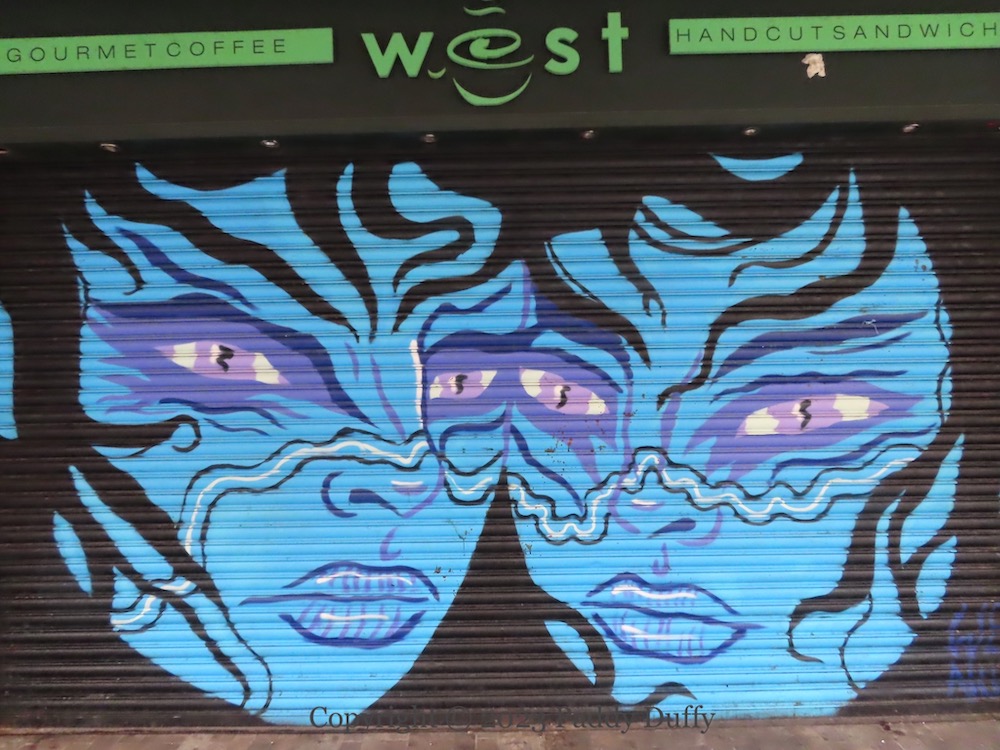
“The Spirits Of The Two Fountains” from Wee Nuls (web | ig), on one of the shutters below the Norwich Union building in the Fountain area of Belfast, based on the idea that there were two fountains in the street (Belfast Entries says there were three).
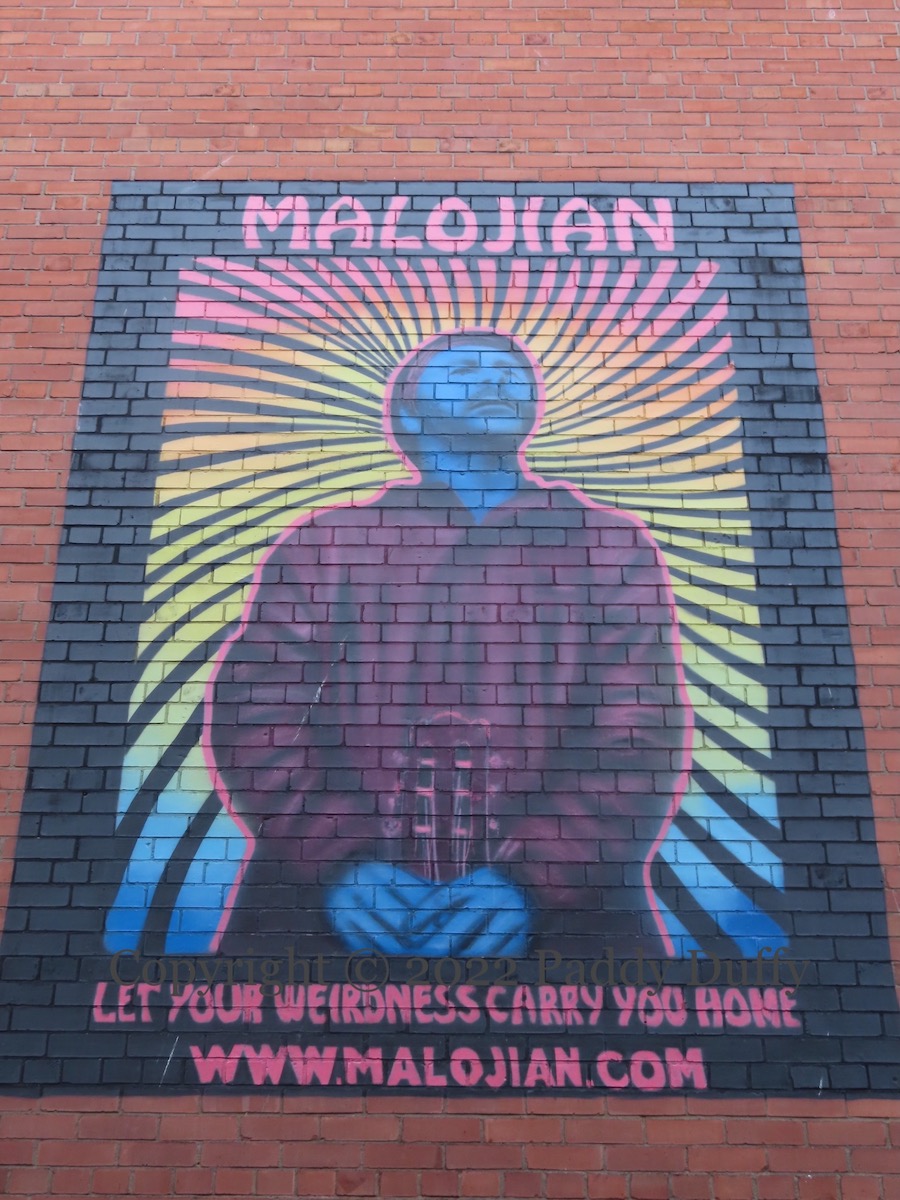
The Malojian (Fb) mural (shown below) on the Oh Yeah Centre was the idea of Lyndon Stephens, founder of Quiet Arch records, and when he died in January 2020 after a long illness (Hotpress), Stevie Scullion returned the favour by organising the painting of a mural by Jonny McKerr (JMK) & Dermot McConaghy (DMC) the following November (Dig With It).





 Paddy Duffy Collection